
Evaluation Assessment Mechanical Forces Muscle Injuries Objectives Identify
Evaluation & Assessment Mechanical Forces & Muscle Injuries
Objectives § Identify types of FORCES and their effect on the body. § Relate the demands of exercise to injury.
Introduction § To correctly evaluate an injury is to understand how the injury occurred § AKA: Mechanism of Injury § An injury sustained in a car crash would involve significantly more force than one sustained while descending the stairs. § The extent of an injury to a muscle depends on the amount of force applied.
Question § Think of a muscle injury that you have had in the past. § What was the cause of the injury? § How severe was the injury?

Mechanical Force § Can we define “FORCE” § What do we mean by “Mechanical Force? ” • There are 3 types of Mechanical Forces that cause injury
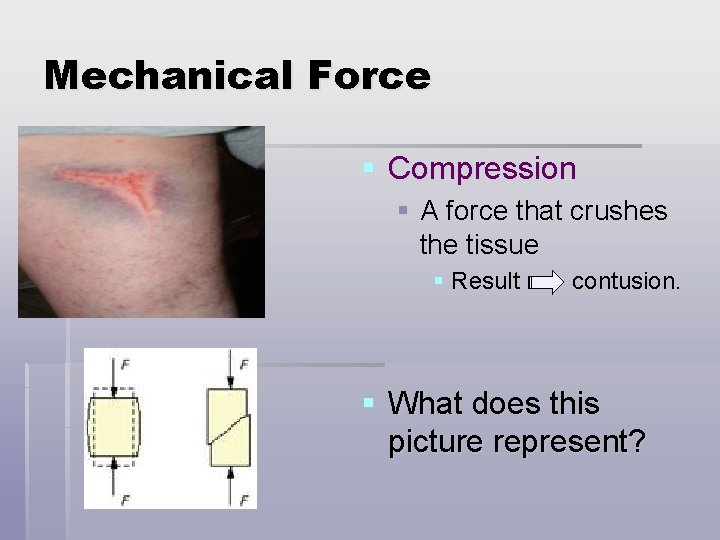
Mechanical Force § Compression § A force that crushes the tissue § Result contusion. § What does this picture represent?
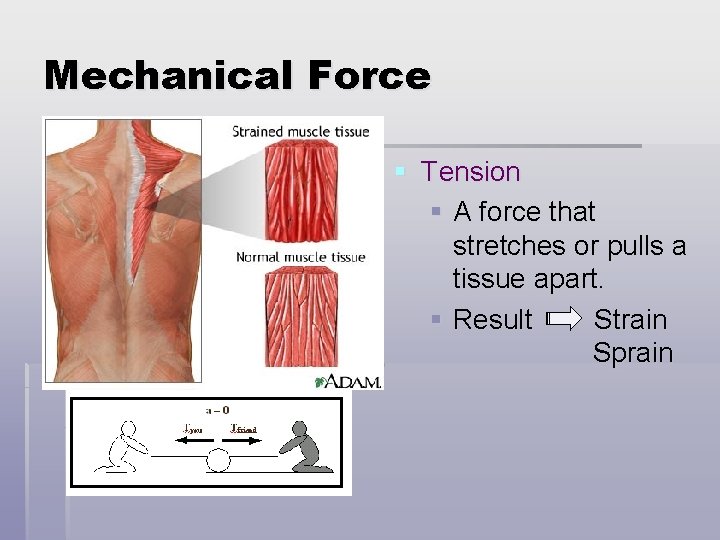
Mechanical Force § Tension § A force that stretches or pulls a tissue apart. § Result Strain Sprain
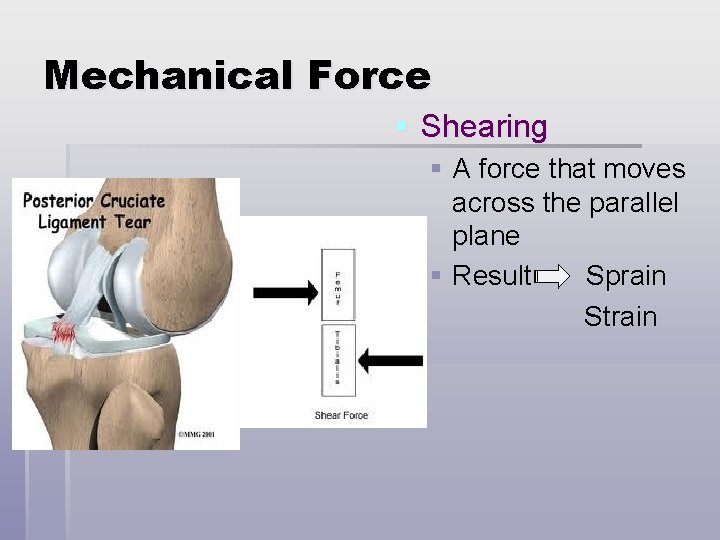
Mechanical Force § Shearing § A force that moves across the parallel plane § Result Sprain Strain
Identify the force § On the following slides, read the injury mechanism described & identify the type of force that would produce an injury. § § § Compression Tension Shearing
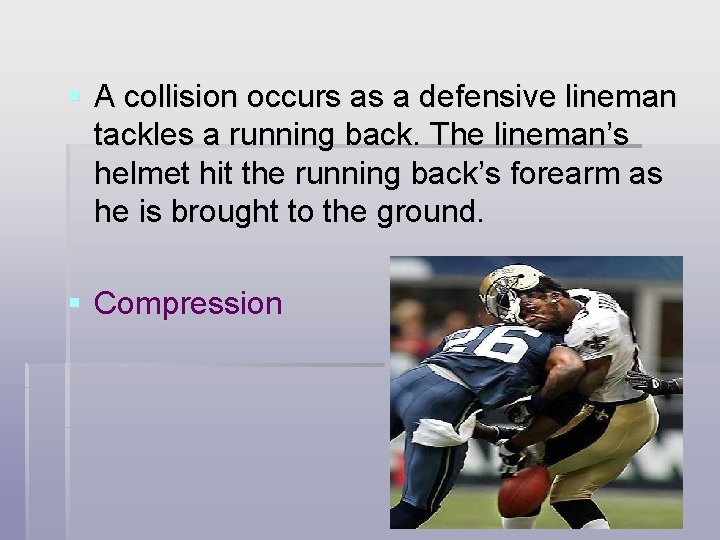
§ A collision occurs as a defensive lineman tackles a running back. The lineman’s helmet hit the running back’s forearm as he is brought to the ground. § Compression
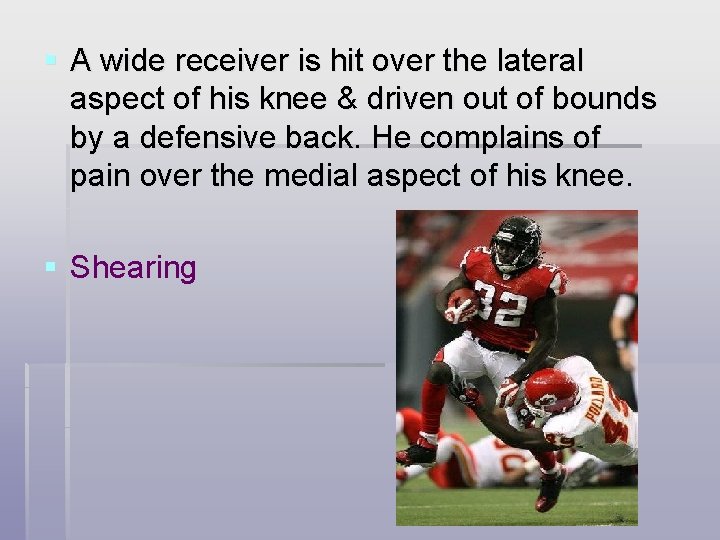
§ A wide receiver is hit over the lateral aspect of his knee & driven out of bounds by a defensive back. He complains of pain over the medial aspect of his knee. § Shearing
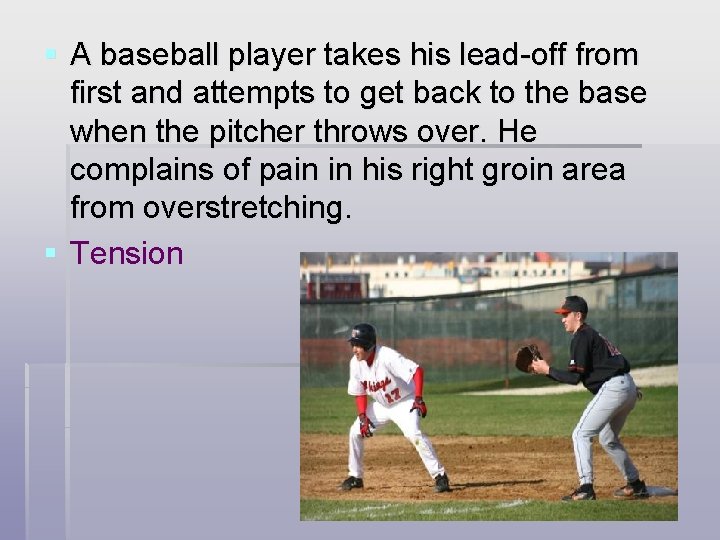
§ A baseball player takes his lead-off from first and attempts to get back to the base when the pitcher throws over. He complains of pain in his right groin area from overstretching. § Tension
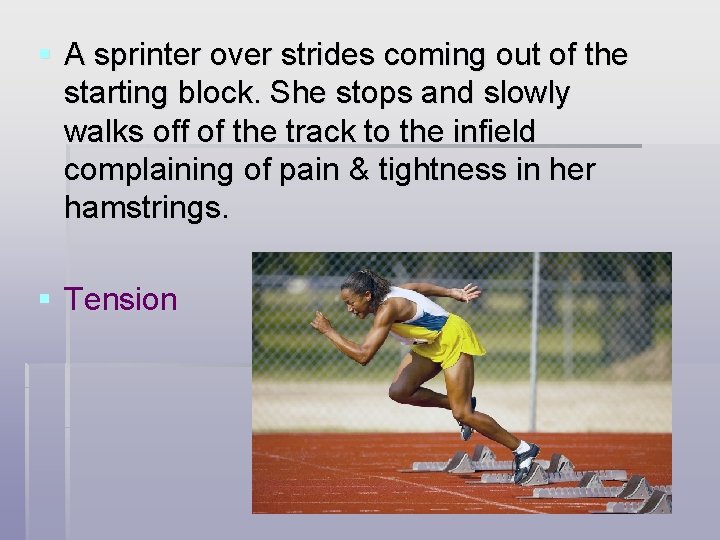
§ A sprinter over strides coming out of the starting block. She stops and slowly walks off of the track to the infield complaining of pain & tightness in her hamstrings. § Tension
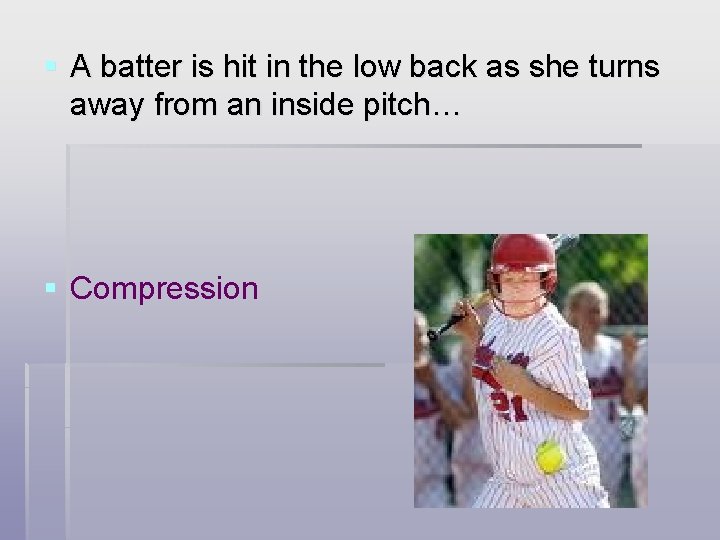
§ A batter is hit in the low back as she turns away from an inside pitch… § Compression
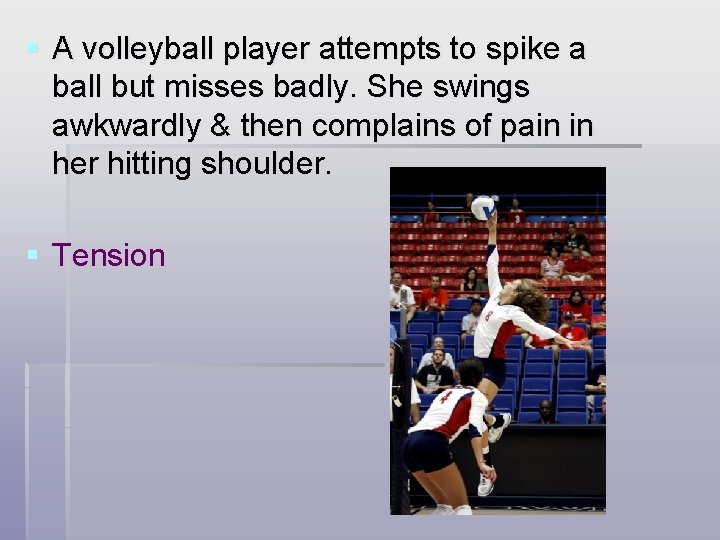
§ A volleyball player attempts to spike a ball but misses badly. She swings awkwardly & then complains of pain in her hitting shoulder. § Tension
Muscle Injuries § What type of injuries can happen to the muscle?
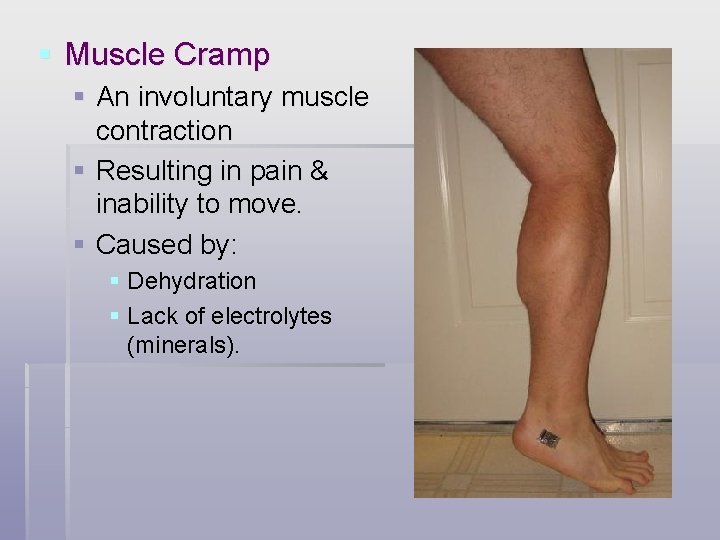
§ Muscle Cramp § An involuntary muscle contraction § Resulting in pain & inability to move. § Caused by: § Dehydration § Lack of electrolytes (minerals).
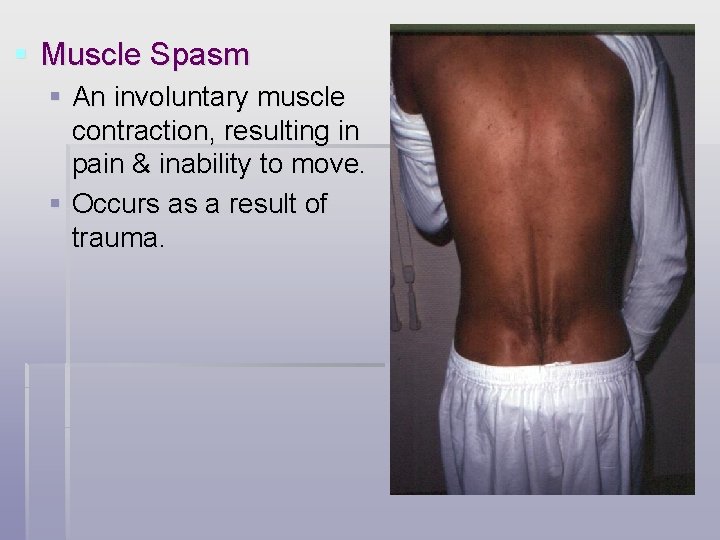
§ Muscle Spasm § An involuntary muscle contraction, resulting in pain & inability to move. § Occurs as a result of trauma.

§ Acute Onset Muscle Soreness § Muscle soreness during or shortly after physical activity. § Caused by a build up of lactic acid. § Resolves quickly.

§ Delayed Onset Muscle Soreness § Muscle soreness which occurs 2 to 3 days after exertion. § Caused by small tears in muscle fibers as a result of weightlifting or eccentric exercise. § Resolves in 5 – 7 days.
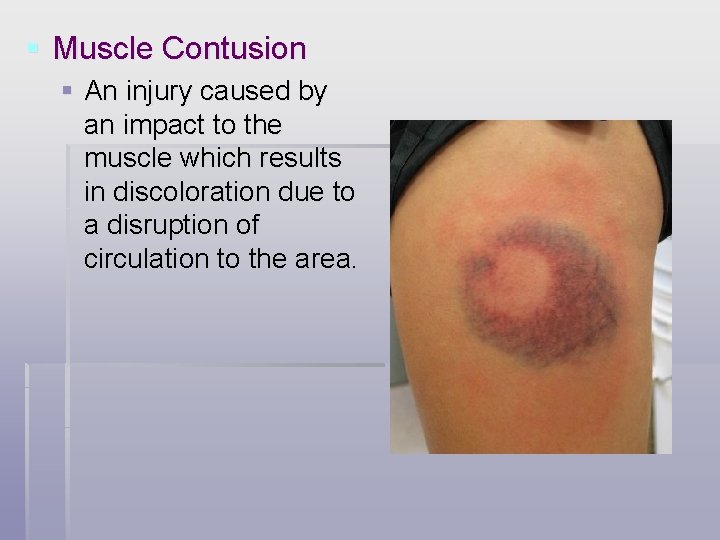
§ Muscle Contusion § An injury caused by an impact to the muscle which results in discoloration due to a disruption of circulation to the area.
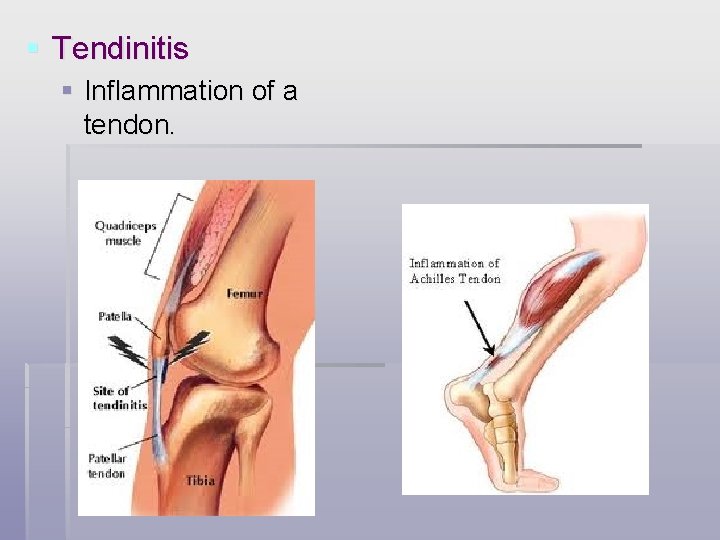
§ Tendinitis § Inflammation of a tendon.
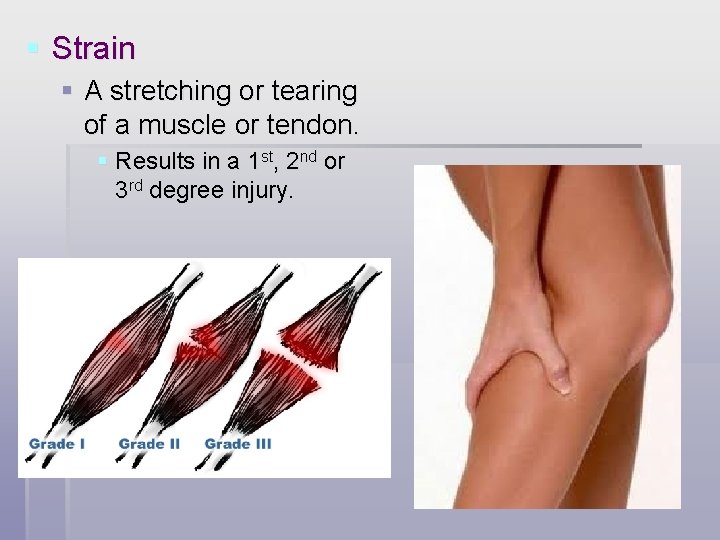
§ Strain § A stretching or tearing of a muscle or tendon. § Results in a 1 st, 2 nd or 3 rd degree injury.
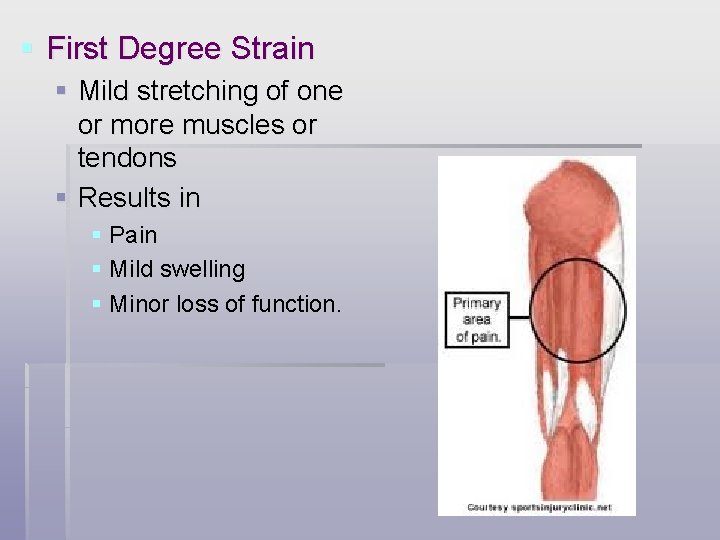
§ First Degree Strain § Mild stretching of one or more muscles or tendons § Results in § Pain § Mild swelling § Minor loss of function.
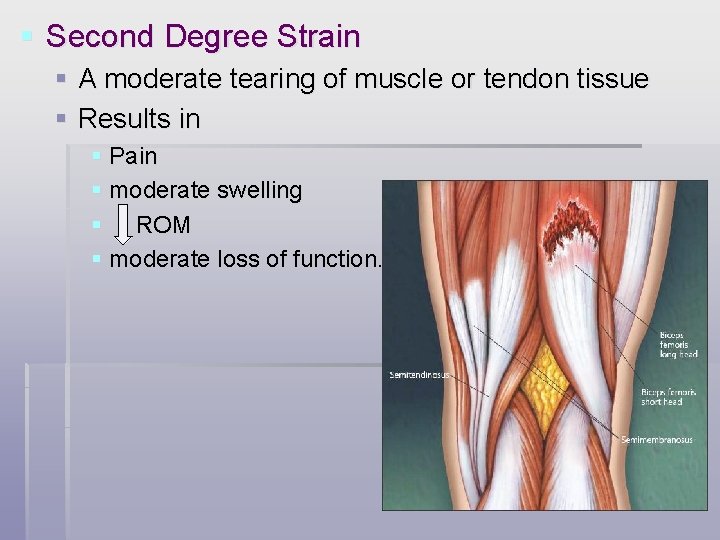
§ Second Degree Strain § A moderate tearing of muscle or tendon tissue § Results in § Pain § moderate swelling § ROM § moderate loss of function.
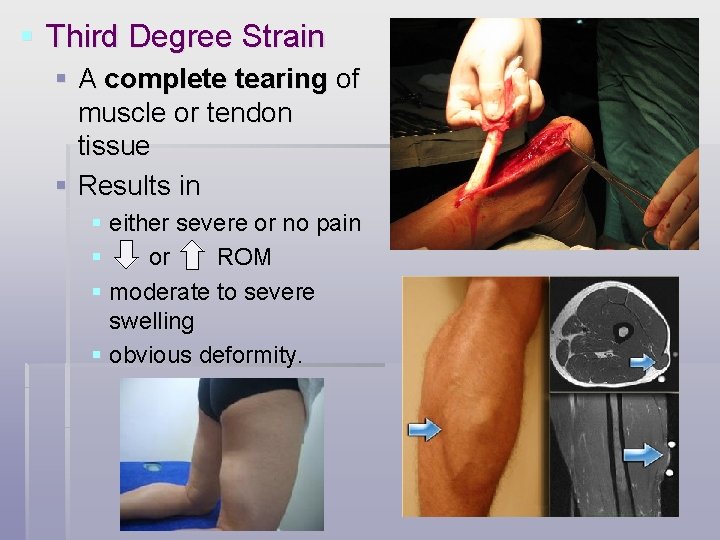
§ Third Degree Strain § A complete tearing of muscle or tendon tissue § Results in § either severe or no pain § or ROM § moderate to severe swelling § obvious deformity.
Closure § Get out a sheet of paper… § Give examples of § A shearing injury § A tension injury § A compression injury § Explain in your own words: § 1 st degree § 2 nd degree § 3 rd degree injuries § Put your name on it and turn in.
- Slides: 27