
Evaluating Utah Energy Balance Snowmelt Model in Operational

Evaluating Utah Energy Balance Snowmelt Model in Operational Forecasting John A Koudelka David Tarboton Utah State University 3/26/2015

Bio • MS in Remote Sensing & GIS - University of Wisconsin, 2006 • Research Scientist at the Idaho National Laboratory - GIS applications and Spatial Databases • Ph. D student with Dr David Tarboton at Utah State University
Overview • • Purpose Utah Energy Balance (UEB) Snowmelt Model Preliminary Study Next Steps
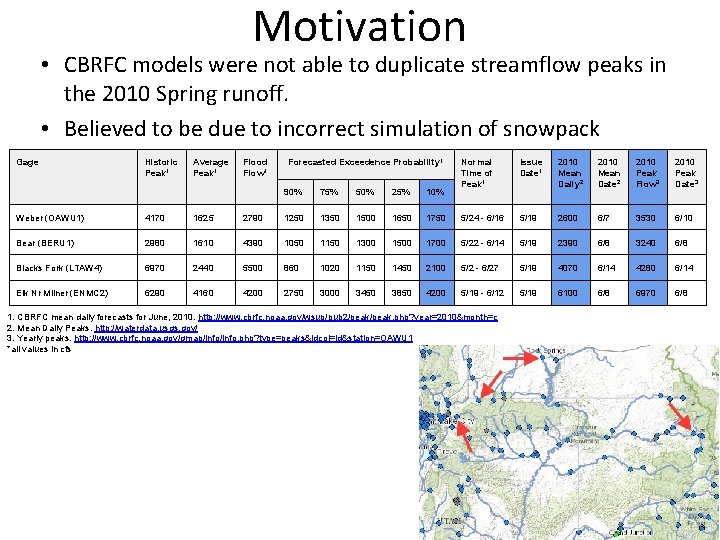
Motivation • CBRFC models were not able to duplicate streamflow peaks in the 2010 Spring runoff. • Believed to be due to incorrect simulation of snowpack Gage Historic Peak 1 Average Peak 1 Flood Flow 1 Forecasted Exceedence Probability 1 90% 75% 50% 25% 10% Normal Time of Peak 1 Issue Date 1 2010 Mean Daily 2 2010 Mean Date 2 2010 Peak Flow 3 2010 Peak Date 3 Weber (OAWU 1) 4170 1625 2790 1250 1350 1500 1650 1750 5/24 - 6/16 5/19 2600 6/7 3530 6/10 Bear (BERU 1) 2980 1610 4390 1050 1150 1300 1500 1700 5/22 - 6/14 5/19 2390 6/8 3240 6/8 Blacks Fork (LTAW 4) 6970 2440 5500 860 1020 1150 1450 2100 5/2 - 6/27 5/19 4070 6/14 4280 6/14 Elk Nr Milner (ENMC 2) 6290 4160 4200 2750 3000 3450 3850 4200 5/19 - 6/12 5/19 6100 6/8 6970 6/8 1. CBRFC mean daily forecasts for June, 2010. http: //www. cbrfc. noaa. gov/wsup/pub 2/peak. php? year=2010&month=c 2. Mean Daily Peaks. http: //waterdata. usgs. gov/ 3. Yearly peaks. http: //www. cbrfc. noaa. gov/gmap/info. php? type=peaks&idcol=id&station=OAWU 1 *all values in cfs
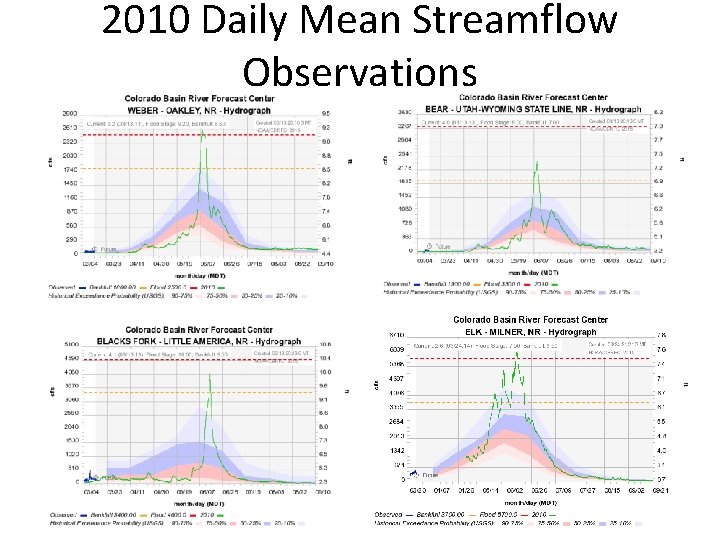
2010 Daily Mean Streamflow Observations
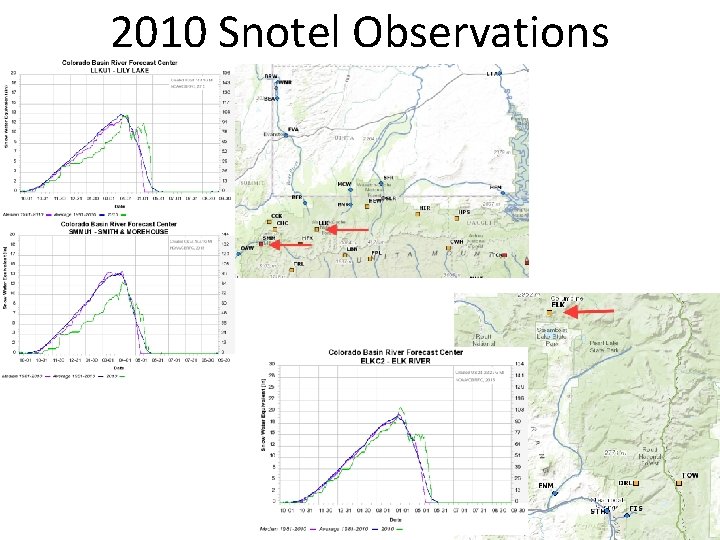
2010 Snotel Observations
Questions • Can operational streamflow forecasts be improved by using a distributed, physicallybased snowmelt model instead of a temperature index model? a. Is a UEB capable of improving CBRFC streamflow predictions using NWS forecast data? i. SNOW 17 uses temperature melt factors ii. UEB uses a physical energy balance driven by radiation, temperature, wind, and humidity b. Can UEB run in the FEWS/CHPS application?
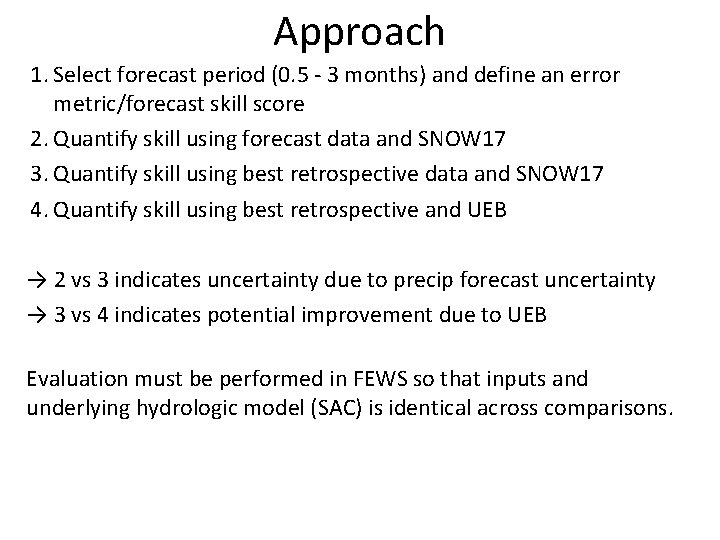
Approach 1. Select forecast period (0. 5 - 3 months) and define an error metric/forecast skill score 2. Quantify skill using forecast data and SNOW 17 3. Quantify skill using best retrospective data and SNOW 17 4. Quantify skill using best retrospective and UEB → 2 vs 3 indicates uncertainty due to precip forecast uncertainty → 3 vs 4 indicates potential improvement due to UEB Evaluation must be performed in FEWS so that inputs and underlying hydrologic model (SAC) is identical across comparisons.
Utah Energy Balance Model Overview • Physically based calculation of snow energy balance. – Predictive capability in changed settings – Strives to get sensitivities to changes right • Simplicity. Small number of state variables and adjustable parameters. – Avoid assumptions and parameterizations that make no difference • Transportable. Applicable with little calibration at different locations. • Match diurnal cycle of melt outflow rates • Match overall accumulation and ablation for water balance. • Distributed by application over a spatial grid. • Effects of vegetation on interception, radiation, wind fields
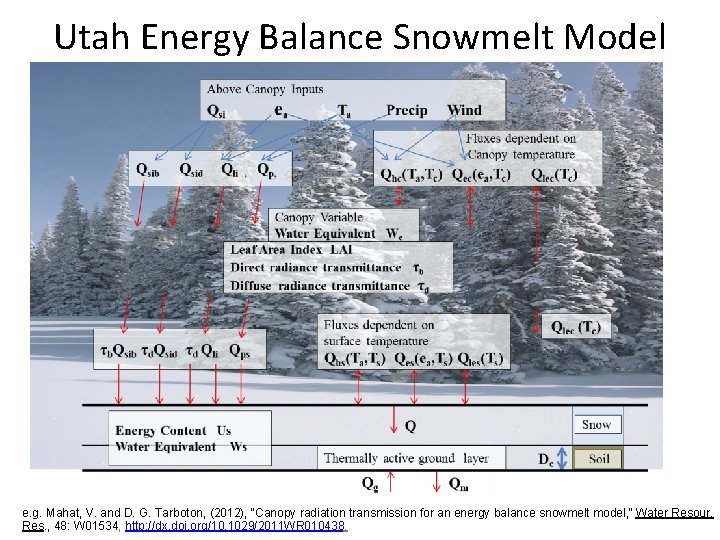
Utah Energy Balance Snowmelt Model e. g. Mahat, V. and D. G. Tarboton, (2012), "Canopy radiation transmission for an energy balance snowmelt model, " Water Resour. Res. , 48: W 01534, http: //dx. doi. org/10. 1029/2011 WR 010438.

UEB Model Structure State Variables • Surface snow water equivalent, Ws • Internal energy of the surface snowpack, Us • Canopy snow water equivalent, Wc State Equations Surface mass and energy balance (beneath the canopy) Canopy mass and energy balance
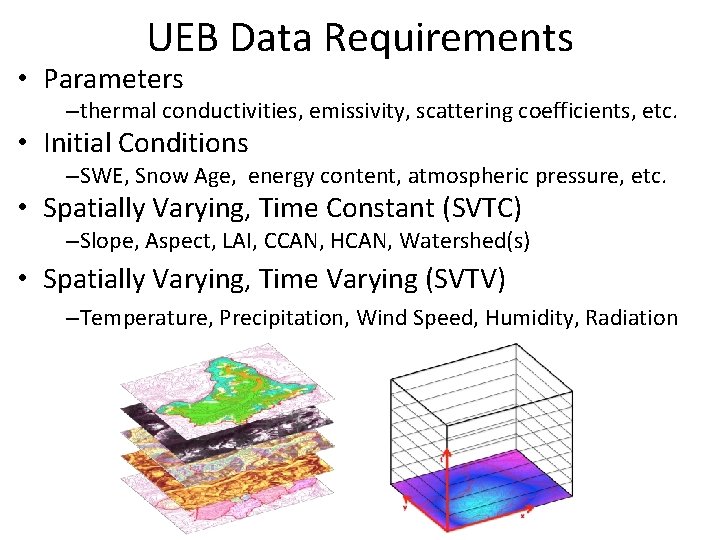
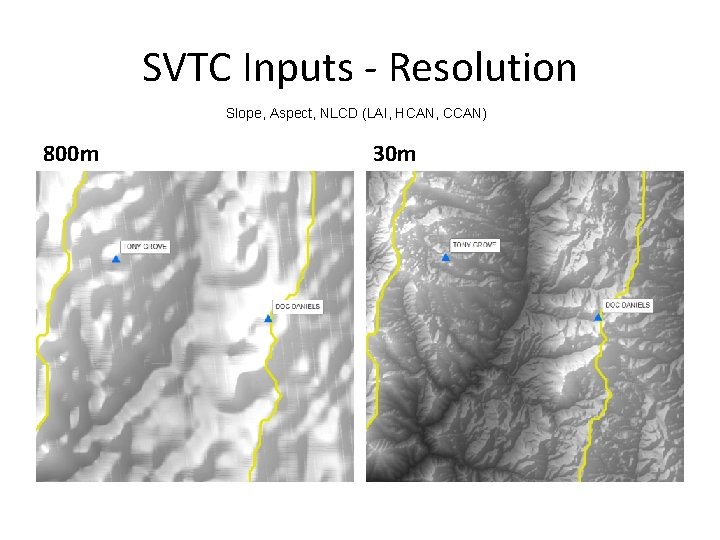
UEB Data Requirements • Parameters –thermal conductivities, emissivity, scattering coefficients, etc. • Initial Conditions –SWE, Snow Age, energy content, atmospheric pressure, etc. • Spatially Varying, Time Constant (SVTC) –Slope, Aspect, LAI, CCAN, HCAN, Watershed(s) • Spatially Varying, Time Varying (SVTV) –Temperature, Precipitation, Wind Speed, Humidity, Radiation
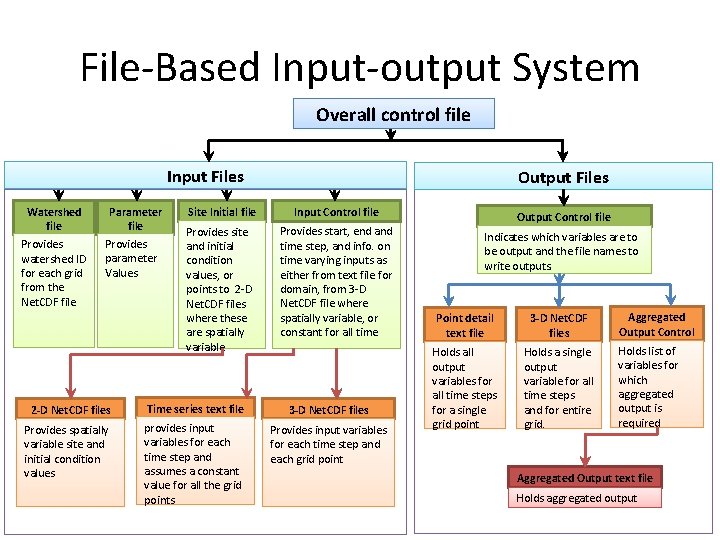
File-Based Input-output System Overall control file Input Files Watershed file Provides watershed ID for each grid from the Net. CDF file Parameter file Provides parameter Values Output Files Site Initial file Input Control file Provides site and initial condition values, or points to 2 -D Net. CDF files where these are spatially variable Provides start, end and time step, and info. on time varying inputs as either from text file for domain, from 3 -D Net. CDF file where spatially variable, or constant for all time 2 -D Net. CDF files Time series text file 3 -D Net. CDF files Provides spatially variable site and initial condition values provides input variables for each time step and assumes a constant value for all the grid points Provides input variables for each time step and each grid point Output Control file Indicates which variables are to be output and the file names to write outputs. Point detail text file 3 -D Net. CDF files Holds all output variables for all time steps for a single grid point Holds a single output variable for all time steps and for entire grid. Aggregated Output Control Holds list of variables for which aggregated output is required Aggregated Output text file Holds aggregated output
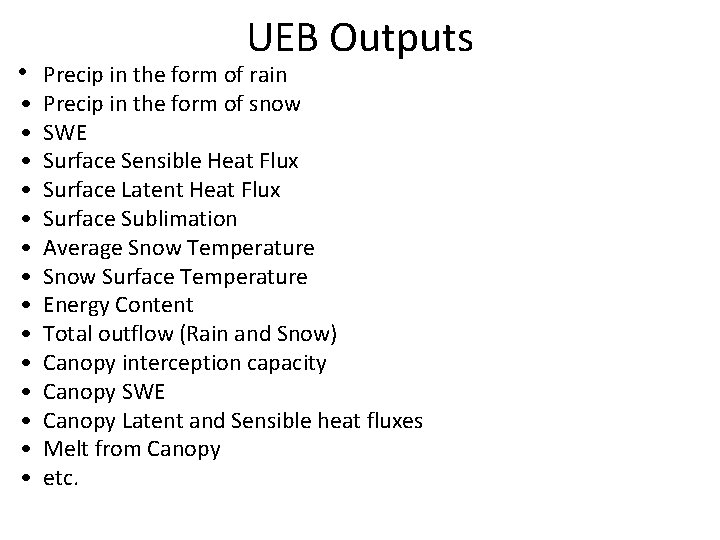
• • • • UEB Outputs Precip in the form of rain Precip in the form of snow SWE Surface Sensible Heat Flux Surface Latent Heat Flux Surface Sublimation Average Snow Temperature Snow Surface Temperature Energy Content Total outflow (Rain and Snow) Canopy interception capacity Canopy SWE Canopy Latent and Sensible heat fluxes Melt from Canopy etc.
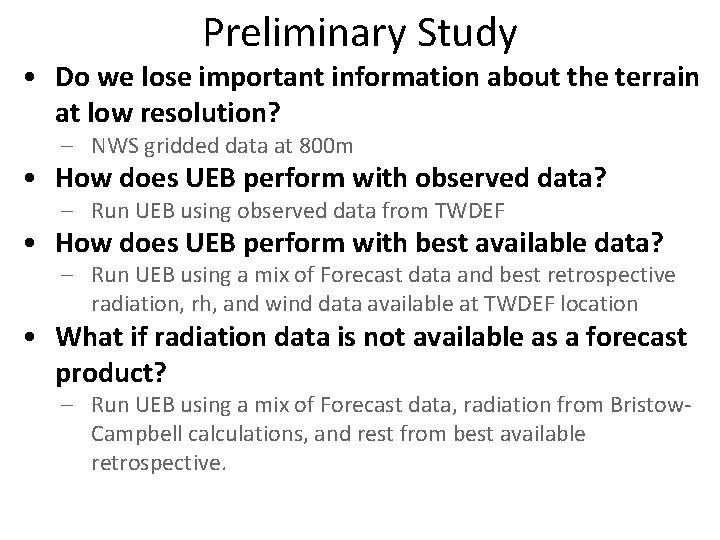
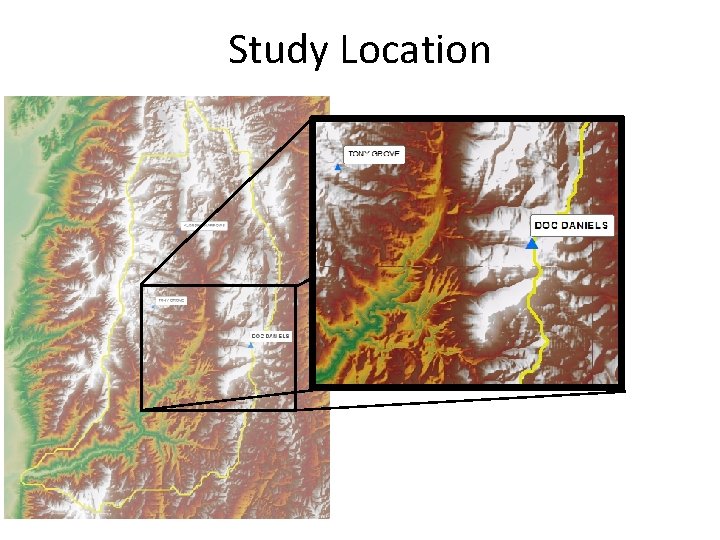
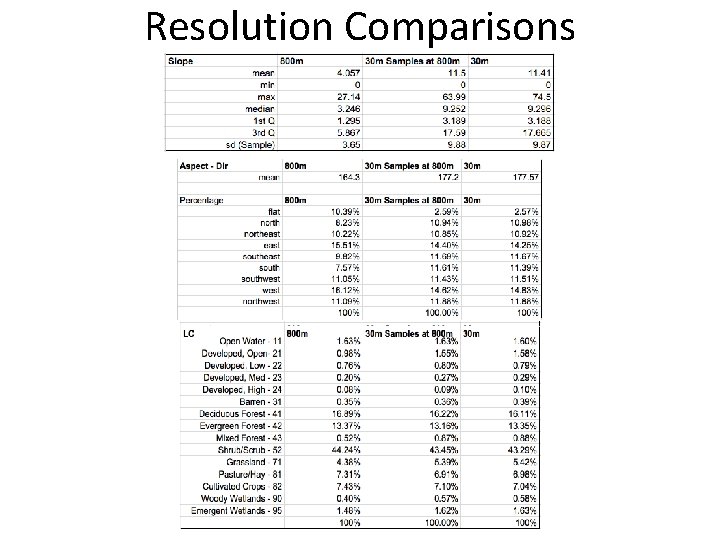
Preliminary Study • Do we lose important information about the terrain at low resolution? – NWS gridded data at 800 m • How does UEB perform with observed data? – Run UEB using observed data from TWDEF • How does UEB perform with best available data? – Run UEB using a mix of Forecast data and best retrospective radiation, rh, and wind data available at TWDEF location • What if radiation data is not available as a forecast product? – Run UEB using a mix of Forecast data, radiation from Bristow. Campbell calculations, and rest from best available retrospective.
Study Location
SVTC Inputs - Resolution Slope, Aspect, NLCD (LAI, HCAN, CCAN) 800 m 30 m
Resolution Comparisons
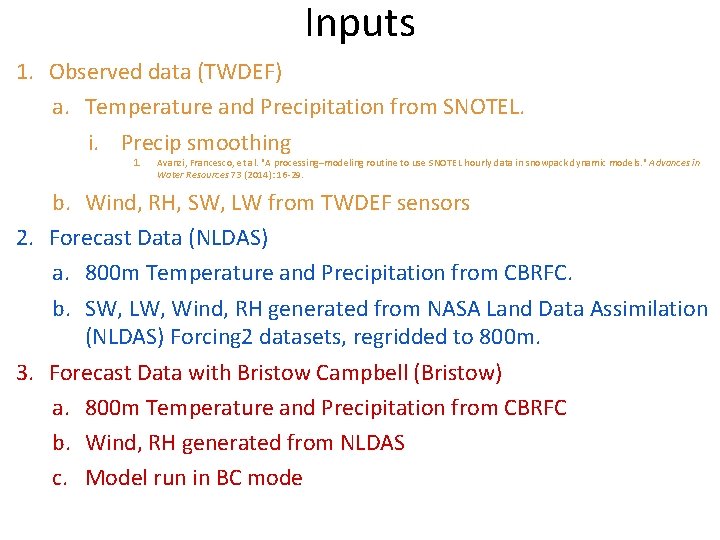
Inputs 1. Observed data (TWDEF) a. Temperature and Precipitation from SNOTEL. i. Precip smoothing 1. Avanzi, Francesco, et al. "A processing–modeling routine to use SNOTEL hourly data in snowpack dynamic models. " Advances in Water Resources 73 (2014): 16 -29. b. Wind, RH, SW, LW from TWDEF sensors 2. Forecast Data (NLDAS) a. 800 m Temperature and Precipitation from CBRFC. b. SW, LW, Wind, RH generated from NASA Land Data Assimilation (NLDAS) Forcing 2 datasets, regridded to 800 m. 3. Forecast Data with Bristow Campbell (Bristow) a. 800 m Temperature and Precipitation from CBRFC b. Wind, RH generated from NLDAS c. Model run in BC mode
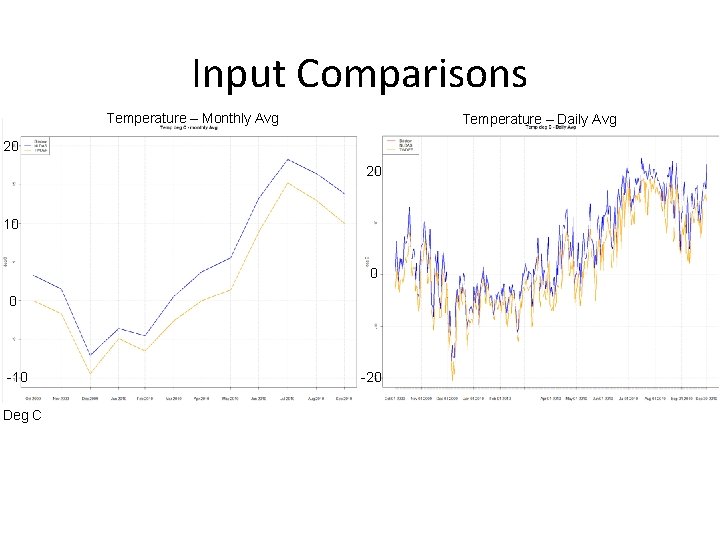
Input Comparisons Temperature – Monthly Avg Temperature – Daily Avg 20 20 10 0 0 -10 Deg C -20
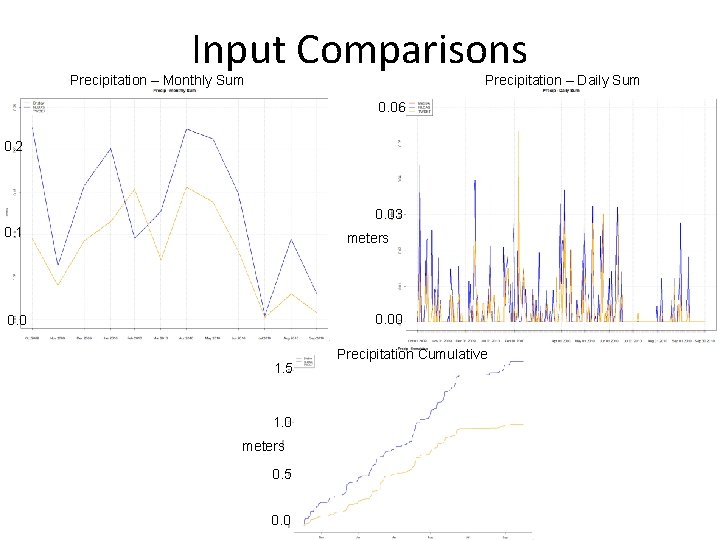
Input Comparisons Precipitation – Monthly Sum Precipitation – Daily Sum 0. 06 0. 2 0. 03 0. 1 meters 0. 00 0. 0 1. 5 1. 0 meters 0. 5 0. 0 Precipitation Cumulative
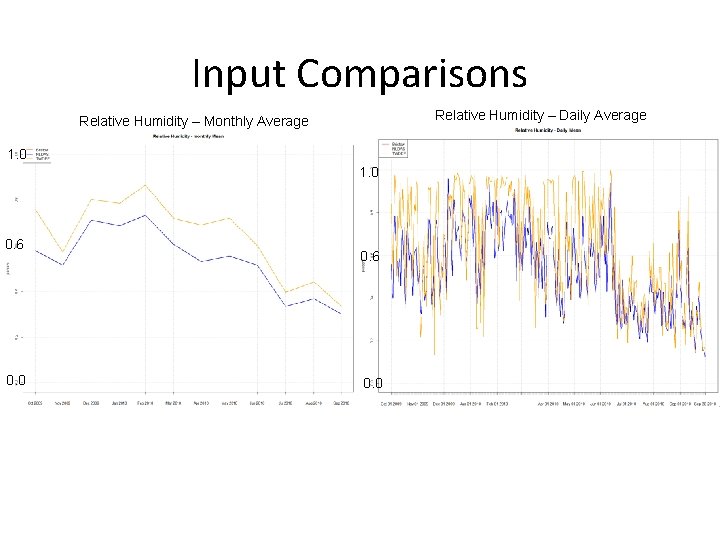
Input Comparisons Relative Humidity – Daily Average Relative Humidity – Monthly Average 1. 0 0. 6 0. 0
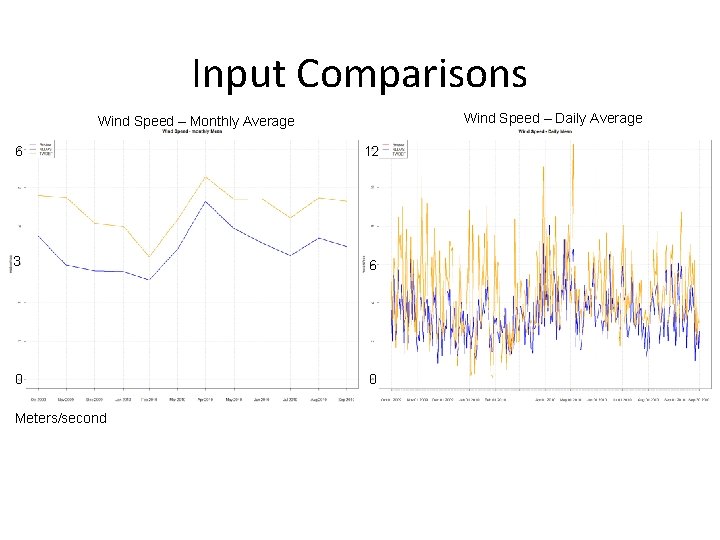
Input Comparisons Wind Speed – Daily Average Wind Speed – Monthly Average 6 12 3 6 0 0 Meters/second
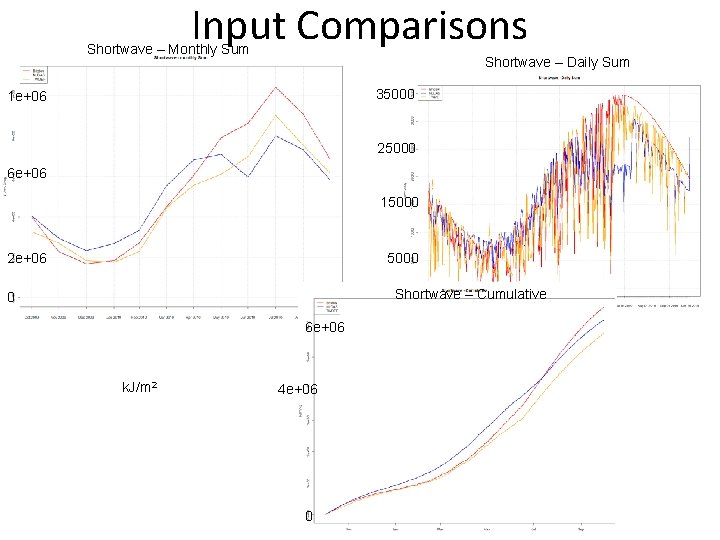
Input Comparisons Shortwave – Monthly Sum Shortwave – Daily Sum 35000 1 e+06 25000 6 e+06 15000 2 e+06 5000 Shortwave – Cumulative 0 6 e+06 k. J/m 2 4 e+06 0
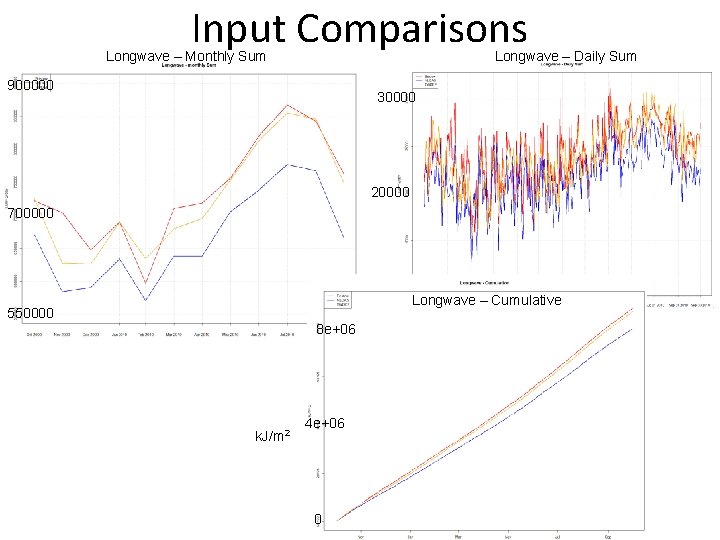
Input Comparisons Longwave – Monthly Sum Longwave – Daily Sum 900000 30000 20000 700000 Longwave – Cumulative 550000 8 e+06 k. J/m 2 4 e+06 0
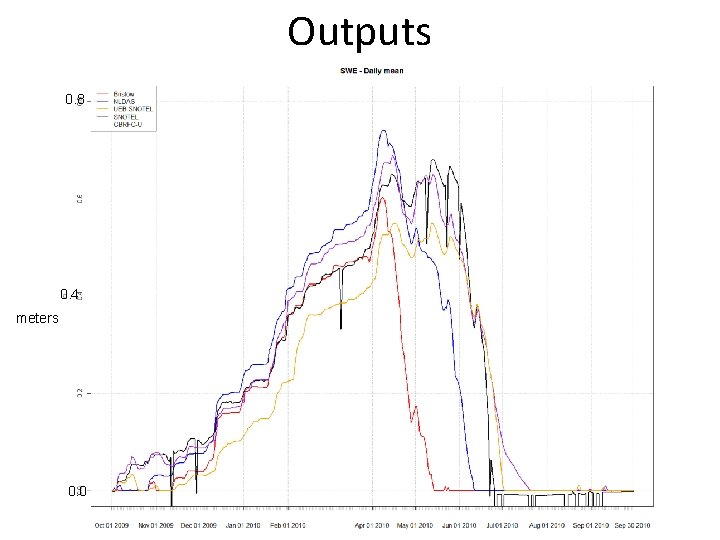
Outputs 0. 8 0. 4 meters 0. 0
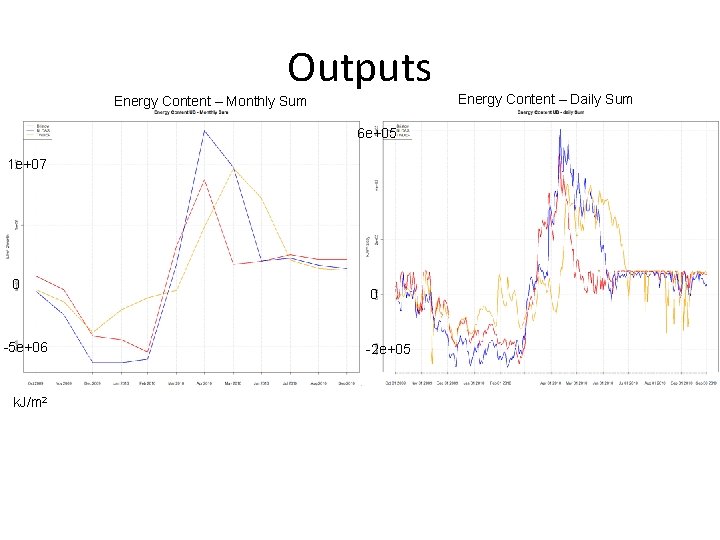
Outputs Energy Content – Monthly Sum 6 e+05 1 e+07 0 -5 e+06 k. J/m 2 0 -2 e+05 Energy Content – Daily Sum
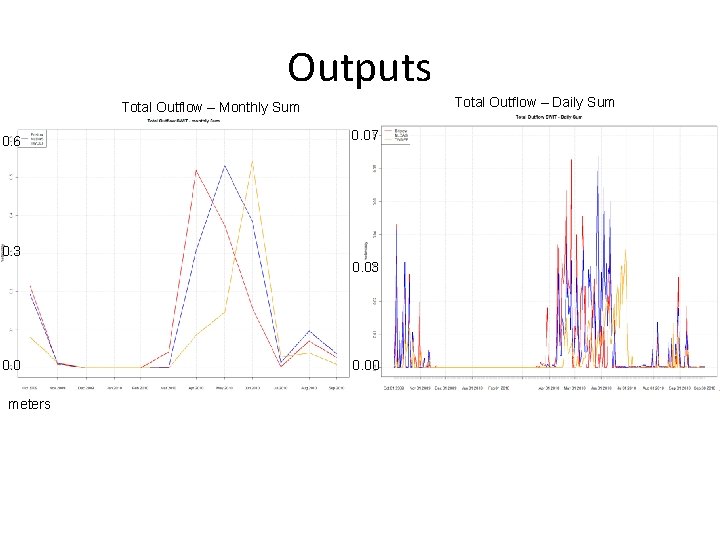
Outputs Total Outflow – Daily Sum Total Outflow – Monthly Sum 0. 6 0. 07 0. 3 0. 0 meters 0. 00
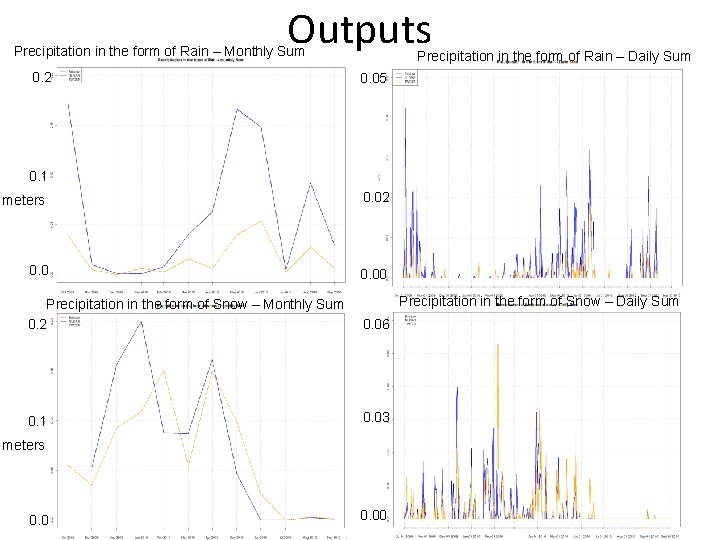
Outputs Precipitation in the form of Rain – Monthly Sum 0. 2 Precipitation in the form of Rain – Daily Sum 0. 05 0. 1 meters 0. 02 0. 00 Precipitation in the form of Snow – Daily Sum Precipitation in the form of Snow – Monthly Sum 0. 2 0. 06 0. 1 0. 03 meters 0. 00
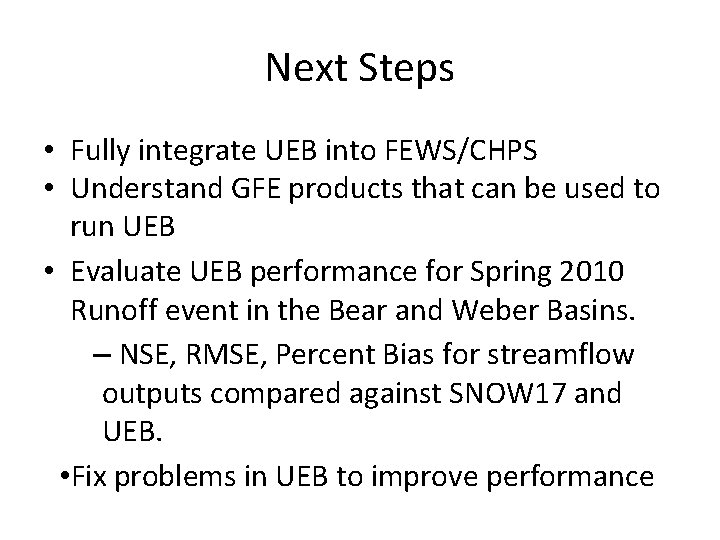
Next Steps • Fully integrate UEB into FEWS/CHPS • Understand GFE products that can be used to run UEB • Evaluate UEB performance for Spring 2010 Runoff event in the Bear and Weber Basins. – NSE, RMSE, Percent Bias for streamflow outputs compared against SNOW 17 and UEB. • Fix problems in UEB to improve performance
The End QUESTIONS? john. koudelka@gmail. com dtarb@usu. edu
- Slides: 31