
Evaluating the UK Breast Screening Programme Study design

Evaluating the UK Breast Screening Programme Study design and practicalities Louise Johns, Sue Moss, Tony Swerdlow Department of Health Cancer Screening Evaluation Unit Section of Epidemiology
Background • UK breast screening programme started in 1987 • Decrease in breast cancer mortality rates since 1990 • Debate over relative contribution of screening and treatment changes • Requirement to evaluate effectiveness

Difficulties of evaluating population screening programmes • Lack of control group in most programmes • Dilution • Self-selection bias • Confounding • Small size of effect
UK evaluation study aims • Primary Estimate effectiveness of the NHS breast screening programme in reducing breast cancer mortality • Secondary Estimate effect of programme on death from all causes and all cancers Estimate effect of screening policy changes on effectiveness of the programme

Study design • Cohort study Retrospective and prospective • Exposure Screening data from national call/recall system • Outcome Death registrations from UK Office for National Statistics Predicted breast cancer mortality
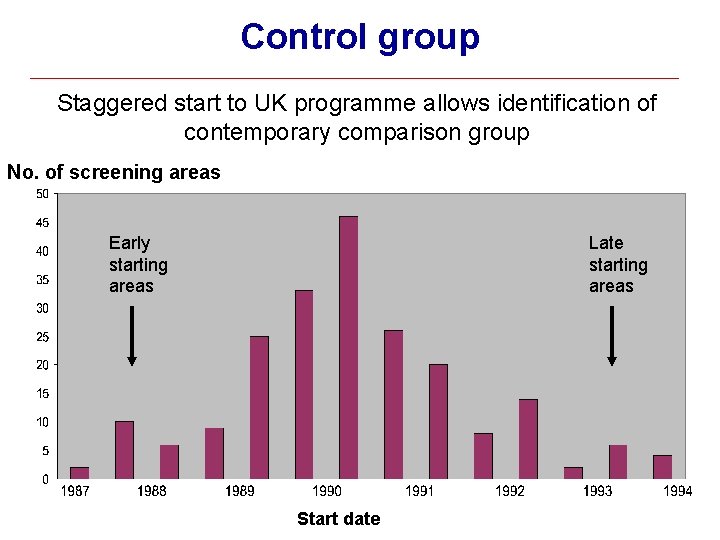
Control group Staggered start to UK programme allows identification of contemporary comparison group No. of screening areas Early starting areas Late starting areas Start date
Dilution, bias, confounding & size of effect • Dilution Individual-level data • Self-selection bias Analyse by intention to treat • Confounding Socio-economic status Treatment data • Size of effect Powered for 15% mortality difference after 7 years
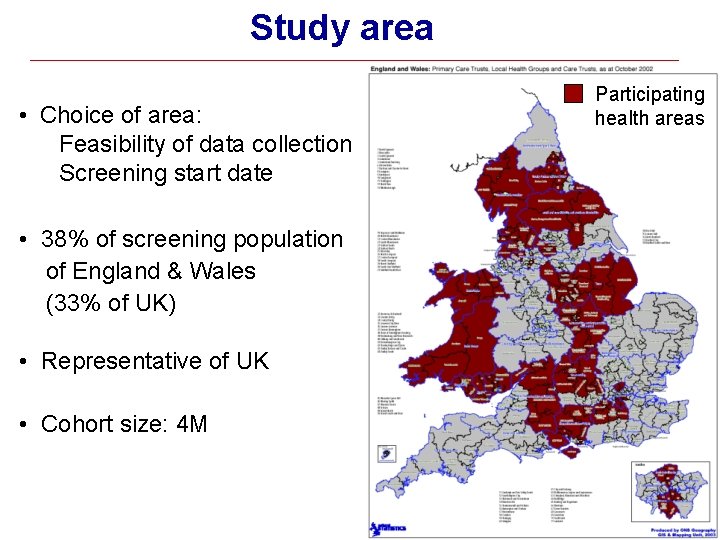
Study area • Choice of area: Feasibility of data collection Screening start date • 38% of screening population of England & Wales (33% of UK) • Representative of UK • Cohort size: 4 M Participating health areas
Health area re-organisation and data protection • 2002: major re-organisation of health areas in England Wales • Climate of increased data protection 18 months to obtain permission to collect data

Obtaining individual mortality data • Standard methods are impractical Cost Time • Exploration of alternative data sources and linkage methods
Progress • Collection of cohort 2. 7 M women of eligible screening age up to 1995 • Collection of exposure data for these women 7. 3 M screening episodes up to end 2004 • Method for collection of mortality data developed and piloted
Next stages • Collection of mortality data • Data validation • Preliminary analyses Effect of screening programme 1995 -2001
Concluding remarks • Evaluation of population screening is technically and practically challenging • Major hurdles can be overcome
- Slides: 13