
Evaluating the Relationship Between Seismicity and Crustal Uplift
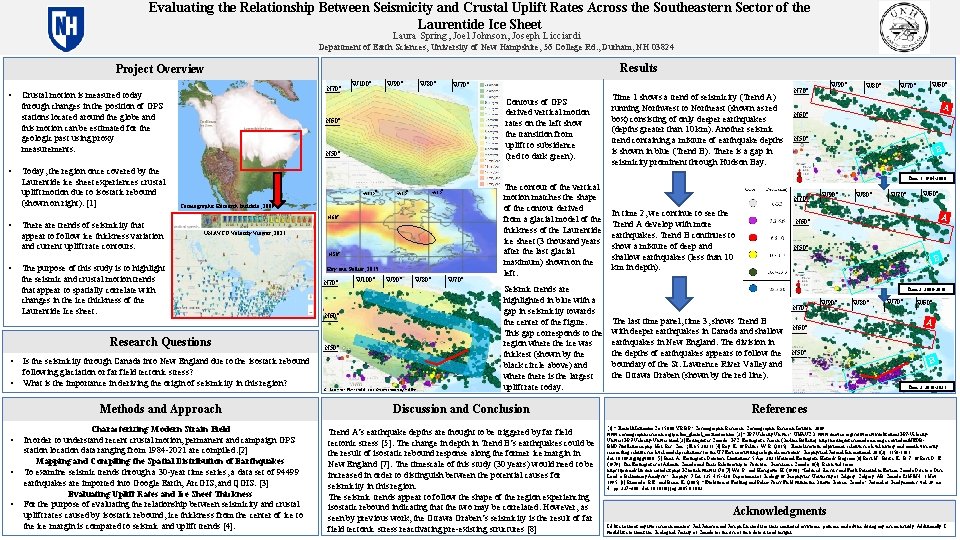
Evaluating the Relationship Between Seismicity and Crustal Uplift Rates Across the Southeastern Sector of the Laurentide Ice Sheet W 85° Laura Spring, Joel Johnson, Joseph Licciardi Department of Earth Sciences, University of New Hampshire, 56 College Rd. , Durham, NH 03824 Results Project Overview • • N 70° Crustal motion is measured today through changes in the position of GPS stations located around the globe and this motion can be estimated for the geologic past using proxy measurements. Today, the region once covered by the Laurentide ice sheet experiences crustal uplift motion due to isostatic rebound (shown on right). [1] There are trends of seismicity that appear to follow ice thickness variation and current uplift rate contours. • • W 90° W 80° W 70° Contours of GPS derived vertical motion rates on the left show the transition from uplift to subsidence (red to dark green). N 60° N 50° Time 1 shows a trend of seismicity (Trend A) running Northwest to Northeast (shown as red box) consisting of only deeper earthquakes (depths greater than 10 km). Another seismic trend containing a mixture of earthquake depths is shown in blue (Trend B). There is a gap in seismicity prominent through Hudson Bay. W 90° N 70° W 80° W 70° W 60° A N 60° N 50° B Time 1: 1984 -2000 W 110° W 70° W 90° Cosmographic Research Institute, 2009 N 60° UNAVCO Velocity Viewer, 2021 The purpose of this study is to highlight the seismic and crustal motion trends that appear to spatially correlate with changes in the ice thickness of the Laurentide Ice sheet. Research Questions • W 100° Is the seismicity through Canada into New England due to the isostatic rebound following glaciation or far field tectonic stress? What is the importance in deriving the origin of seismicity in this region? N 50° Roy and Peltier, 2015 N 70° W 100° W 90° W 80° N 60° N 50° St. Lawrence River and Ottawa Graben shown by red line W 70° The contour of the vertical motion matches the shape of the contour derived from a glacial model of the thickness of the Laurentide ice sheet (3 thousand years after the last glacial maximum) shown on the left. Seismic trends are highlighted in blue with a gap in seismicity towards the center of the figure. This gap corresponds to the region where the ice was thickest (shown by the black circle above) and where there is the largest uplift rate today. Methods and Approach Discussion and Conclusion Characterizing Modern Strain Field In order to understand recent crustal motion, permanent and campaign GPS station location data ranging from 1984 -2021 are compiled. [2] Mapping and Compiling the Spatial Distribution of Earthquakes To examine seismic trends through a 30 -year time series, a data set of 94499 earthquakes are imported into Google Earth, Arc. GIS, and QGIS. [3] Evaluating Uplift Rates and Ice Sheet Thickness For the purpose of evaluating the relationship between seismicity and crustal uplift rates caused by isostatic rebound, ice thickness from the center of ice to the ice margin is compared to seismic and uplift trends [4]. Trend A’s earthquake depths are thought to be triggered by far field tectonic stress [5]. The change in depth in Trend B’s earthquakes could be the result of isostatic rebound response along the former ice margin in New England [7]. The timescale of this study (30 years) would need to be increased in order to distinguish between the potential causes for seismicity in this region. The seismic trends appear to follow the shape of the region experiencing isostatic rebound indicating that the two may be correlated. However, as seen by previous work, the Ottawa Graben’s seismicity is the result of far field tectonic stress reactivating pre-existing structures [8] N 70° In time 2, we continue to see the Trend A develop with more earthquakes. Trend B continues to show a mixture of deep and shallow earthquakes (less than 10 km in depth). W 90° W 80° W 70° W 60° A N 60° N 50° B Time 2: 2000 -2010 N 70° The last time panel, time 3, shows Trend B with deeper earthquakes in Canada and shallow earthquakes in New England. The division in the depths of earthquakes appears to follow the boundary of the St. Lawrence River Valley and the Ottawa Graben (shown by the red line). W 90° N 60° N 50° W 80° W 70° W 60° A B Time 3: 2010 -2021 References [1] “Glacial Maximum Ca 15, 000 YR BP. ” Cosmographic Research, Cosmographic Research Institute, 2009, www. cosmographicresearch. org/prelim_glacial_maximum. htm. [2] “GPS Velocity Viewer. ” UNAVCO, www. unavco. org/software/visualization/GPS-Velocity. Viewer/GPS-Velocity-Viewer. html [3] Earthquakes Canada, GSC, Earthquake Search (On-line Bulletin), http: //earthquakescanada. nrcan. gc. ca/stndon/NEDBBNDS/bulletin-en. php, Nat. Res. Can. , {Feb. 5, 2021} [4] Roy, K. , & Peltier, W. R. (2015). Glacial isostatic adjustment, relative sea level history and mantle viscosity: reconciling relative sea level model predictions for the US East coast with geological constraints. Geophysical Journal International, 201(2), 1156 -1181, doi: 10. 1093/gji/ggv 066. [5] Bent, A. , Earthquake Database Limitations, 5 Apr. 2021. National Earthquake Hazards Program [6] Rast, N. , Burke, K. B. S. , & Rast, D. E. (1979). The Earthquakes of Atlantic Canada and Their Relationship to Structure. Geoscience Canada, 6(4). Retrieved from https: //journals. lib. unb. ca/index. php/GC/article/view/3178 [7] Wu, P. , and Hasegawa, H. (1996). “Induced Stresses and Fault Potential in Eastern Canada Due to a Disc Load: a Preliminary Analysis. ” Geophys. J. Int. 125, 415 -430, Department of Geology & Geophysics, University of Calgary, AB, Canada T 2 N-l. N 4 , 1 Nov. 1995. [8] Rimando, R. E. , and Benn, K. (2005). “Evolution of Faulting and Paleo-Stress Field within the Ottawa Graben, Canada. ” Journal of Geodynamics, vol. 39, no. 4, , pp. 337– 360. , doi: 10. 1016/j. jog. 2005. 01. 003. Acknowledgments I’d like to thank my two research mentors, Joel Johnson and Joseph Licciardi for their continued assistance, patience and advice during my research study. Additionally, I would like to thank the Geological Society of Canada for the use of their data set and insight.
- Slides: 1