
Evaluating the potential of Qualitative Reasoning to capture
- Slides: 25
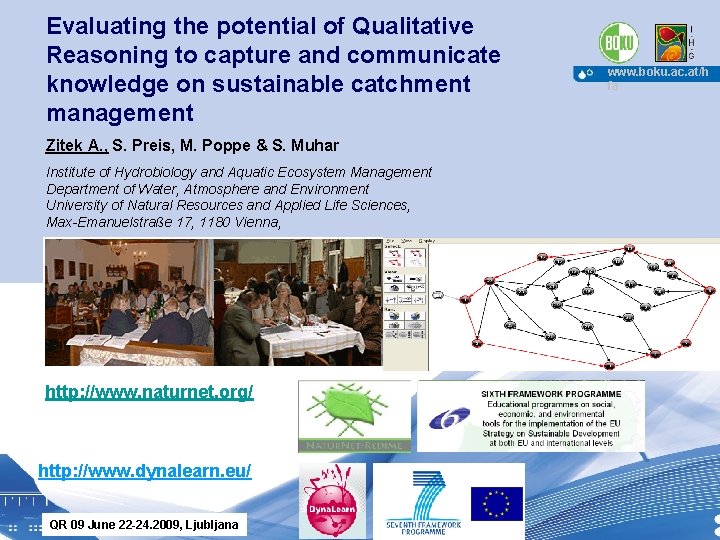
Evaluating the potential of Qualitative Reasoning to capture and communicate knowledge on sustainable catchment management Zitek A. , S. Preis, M. Poppe & S. Muhar Institute of Hydrobiology and Aquatic Ecosystem Management Department of Water, Atmosphere and Environment University of Natural Resources and Applied Life Sciences, Max-Emanuelstraße 17, 1180 Vienna, http: //www. naturnet. org/ http: //www. dynalearn. eu/ QR 09 June 22 -24. 2009, Ljubljana www. boku. ac. at/h fa
Content • • The problem The question The target The need for qualitative modelling The (potential) way A (potential) solution The river Kamp case study (Austria) – Two models built and evaluated • Evaluation – Process – Results • Summary & conclusions www. boku. ac. at/h fa
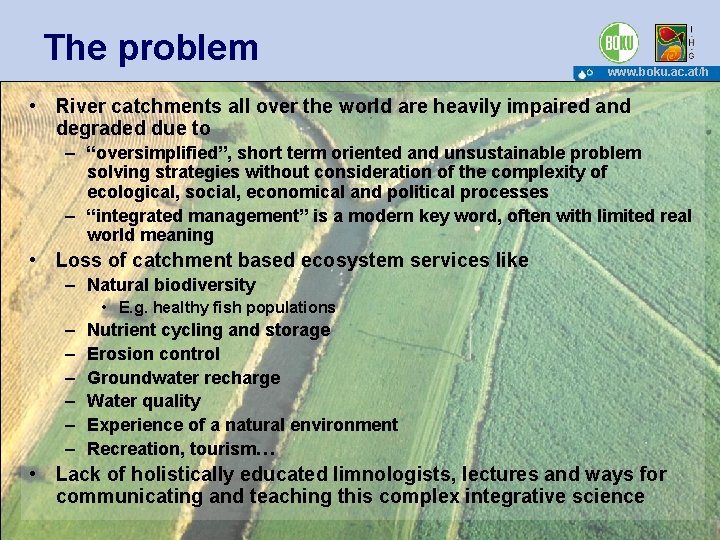
The problem www. boku. ac. at/h fa • River catchments all over the world are heavily impaired and degraded due to – “oversimplified”, short term oriented and unsustainable problem solving strategies without consideration of the complexity of ecological, social, economical and political processes – “integrated management” is a modern key word, often with limited real world meaning • Loss of catchment based ecosystem services like – Natural biodiversity • E. g. healthy fish populations – – – Nutrient cycling and storage Erosion control Groundwater recharge Water quality Experience of a natural environment Recreation, tourism… • Lack of holistically educated limnologists, lectures and ways for communicating and teaching this complex integrative science
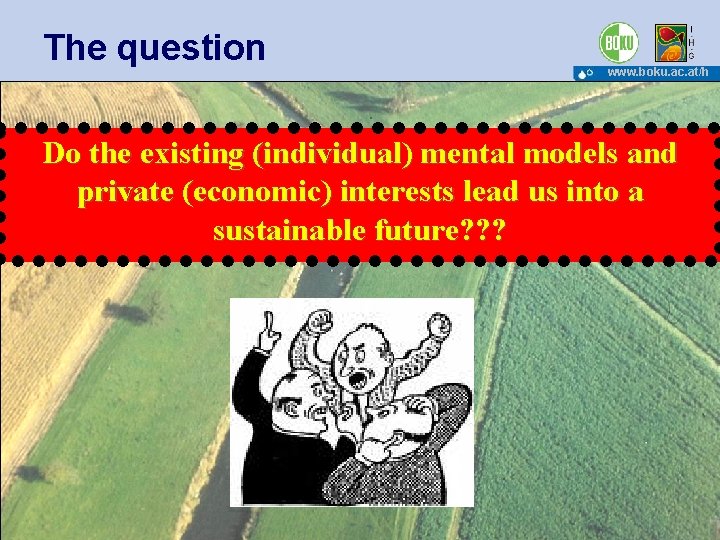
The question www. boku. ac. at/h fa Do the existing (individual) mental models and private (economic) interests lead us into a sustainable future? ? ?
The target www. boku. ac. at/h fa • Creation of ways – to capture, communicate and teach complex integrative science. – to integrate (and probably change) personal mental models with scientific knowledge for developing a common know how and vision. • Education of a new generation of students, managers, planners, scientists and politicians being capable of dealing with the complex issue of integrated catchment management. – Resource oriented EU regulations and directives strongly require an approach integrating ecological, social, political and economic aspects with a focus on stakeholder integration.
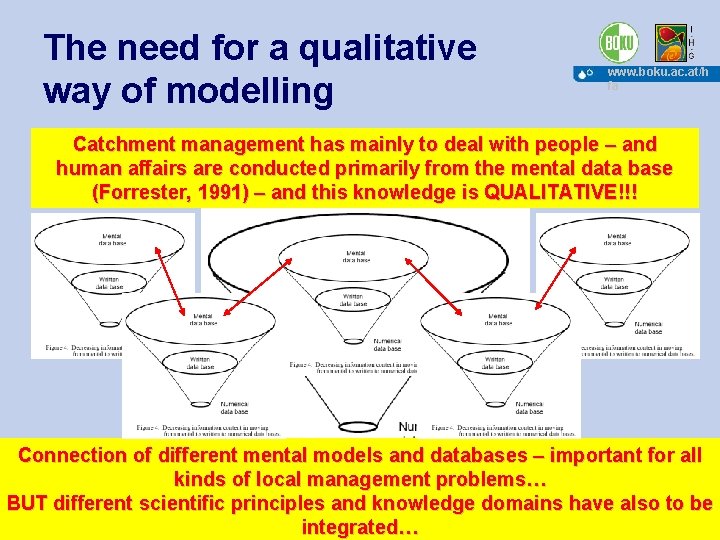
The need for a qualitative way of modelling www. boku. ac. at/h fa Catchment management has mainly to deal with people – and human affairs are conducted primarily from the mental data base (Forrester, 1991) – and this knowledge is QUALITATIVE!!! Connection of different mental models and databases – important for all kinds of local management problems… BUT different scientific principles and knowledge domains have also to be integrated…
The (potential) way www. boku. ac. at/h fa • After Sterman (1994) effective methods for learning in and about complex dynamic systems must include: (1) Tools to elicit participant knowledge, articulate and reframe perceptions. (2) Simulation tools to assess the dynamics of those perceptions and test new possibilities. (3) Methods to improve scientific reasoning skills, strengthen group processes and overcome defensive routines of individuals and teams.
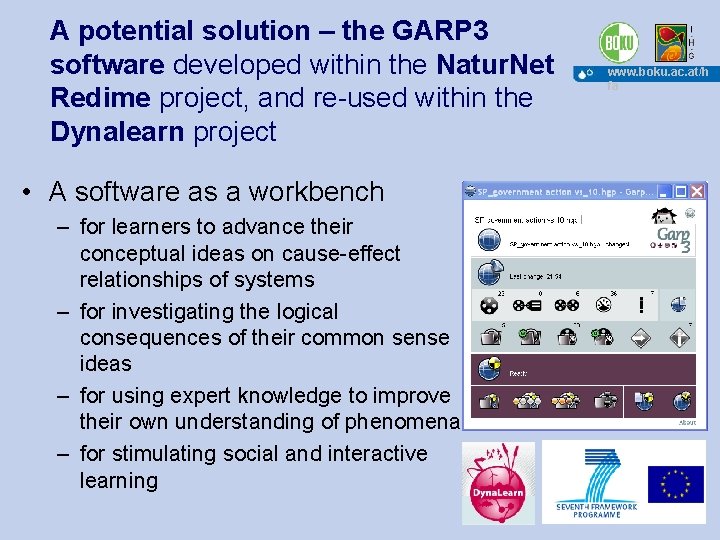
A potential solution – the GARP 3 software developed within the Natur. Net Redime project, and re-used within the Dynalearn project • A software as a workbench – for learners to advance their conceptual ideas on cause-effect relationships of systems – for investigating the logical consequences of their common sense ideas – for using expert knowledge to improve their own understanding of phenomena – for stimulating social and interactive learning www. boku. ac. at/h fa
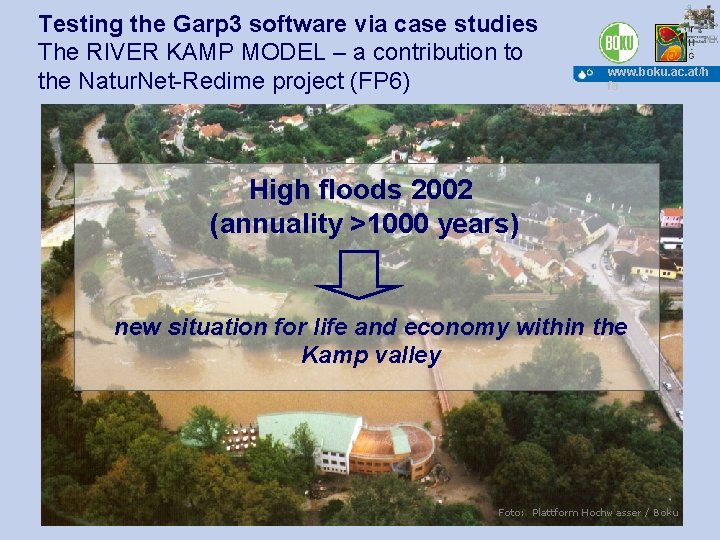
Testing the Garp 3 software via case studies The RIVER KAMP MODEL – a contribution to the Natur. Net-Redime project (FP 6) www. boku. ac. at/h fa High floods 2002 (annuality >1000 years) new situation for life and economy within the Kamp valley Foto: Plattform Hochwasser / Boku
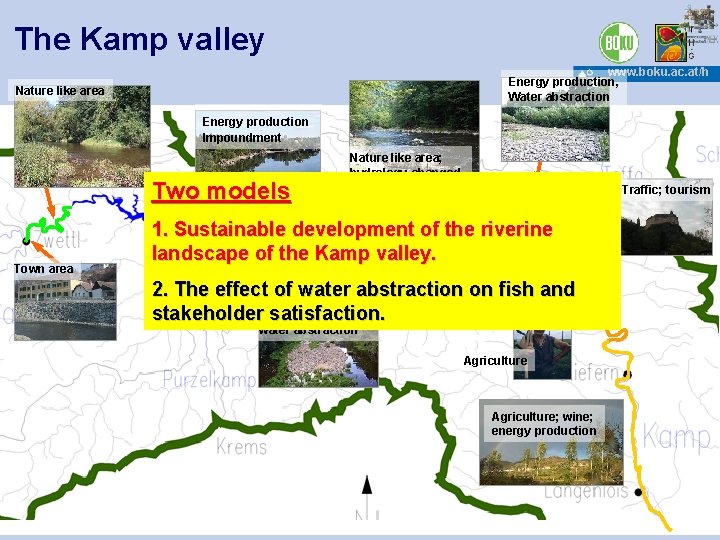
The Kamp valley www. boku. ac. at/h Energy production, fa Water abstraction Nature like area Energy production Impoundment Two models Town area Nature like area; hydrology changed Traffic; tourism 1. Sustainable development of the riverine landscape of the Kamp valley. 2. The effect. Energy of water abstraction on fish and production & stakeholder. Hydropeaking satisfaction. water abstraction Agriculture; wine; energy production
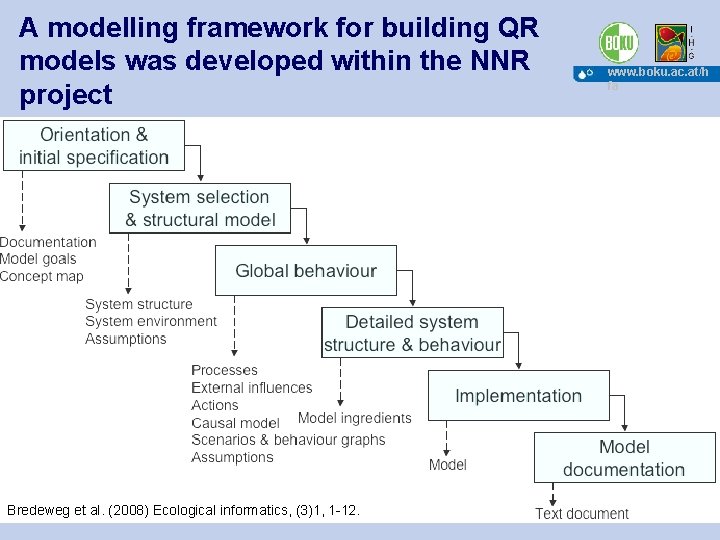
A modelling framework for building QR models was developed within the NNR project www. boku. ac. at/h fa How to put my experience, knowledge and ideas about real world phenomena into QR models? Bredeweg et al. (2008) Ecological informatics, (3)1, 1 -12.
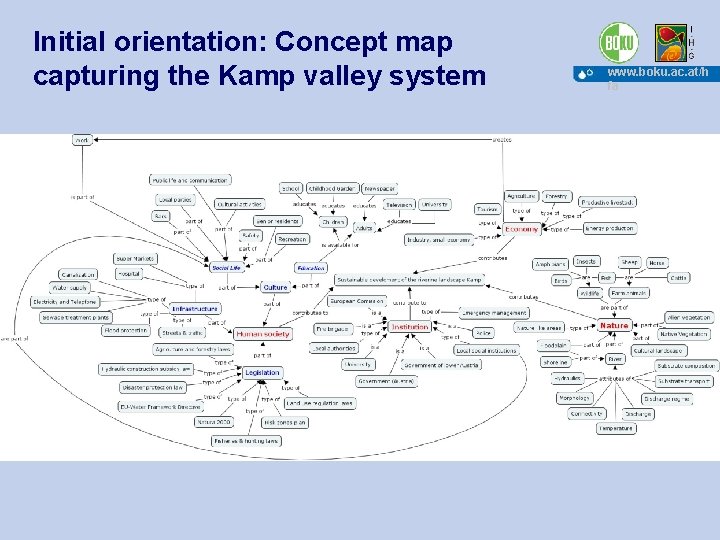
Initial orientation: Concept map capturing the Kamp valley system www. boku. ac. at/h fa
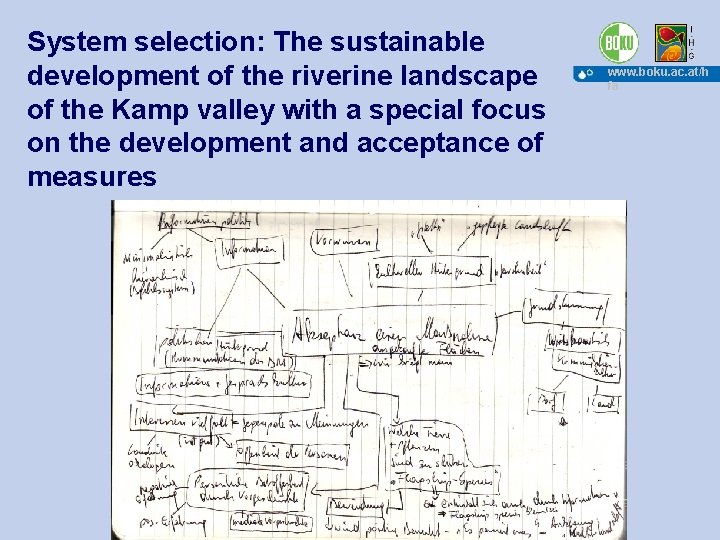
System selection: The sustainable development of the riverine landscape of the Kamp valley with a special focus on the development and acceptance of measures www. boku. ac. at/h fa
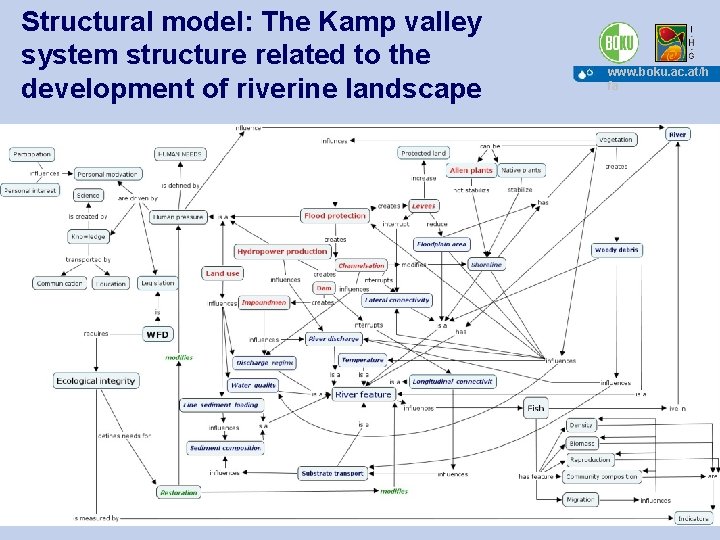
Structural model: The Kamp valley system structure related to the development of riverine landscape www. boku. ac. at/h fa
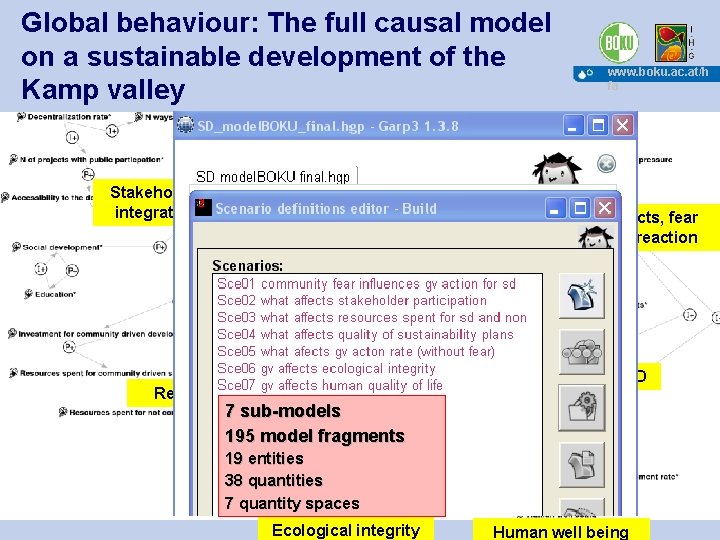
Global behaviour: The full causal model on a sustainable development of the Kamp valley www. boku. ac. at/h fa Private interests Stakeholder integration Planners preparedness, scientific involvement Catastrophic effects, fear and government reaction Quality of plans Resistance against measures Gv action for SD 7 sub-models 195 model fragments 19 entities 38 quantities 7 quantity spaces Ecological integrity Human well being
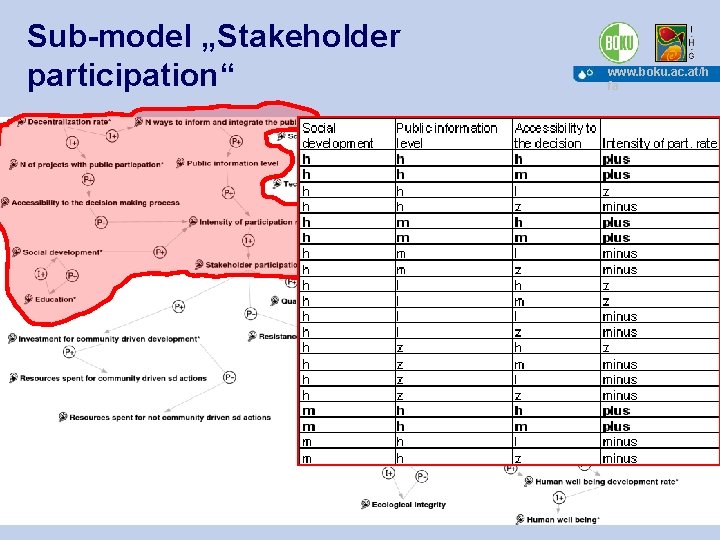
Sub-model „Stakeholder participation“ www. boku. ac. at/h fa
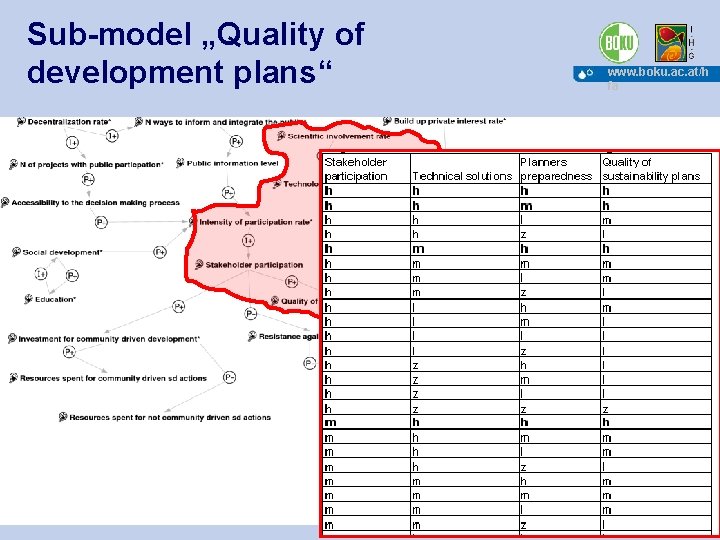
Sub-model „Quality of development plans“ www. boku. ac. at/h fa
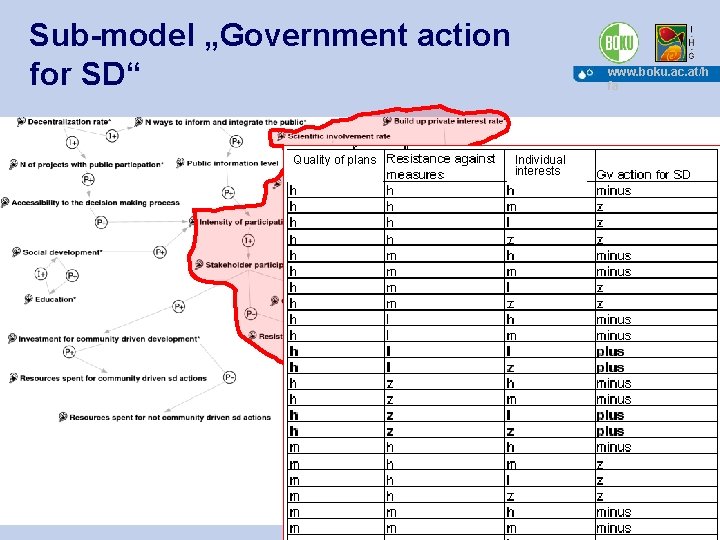
Sub-model „Government action for SD“ Quality of plans www. boku. ac. at/h fa Individual interests
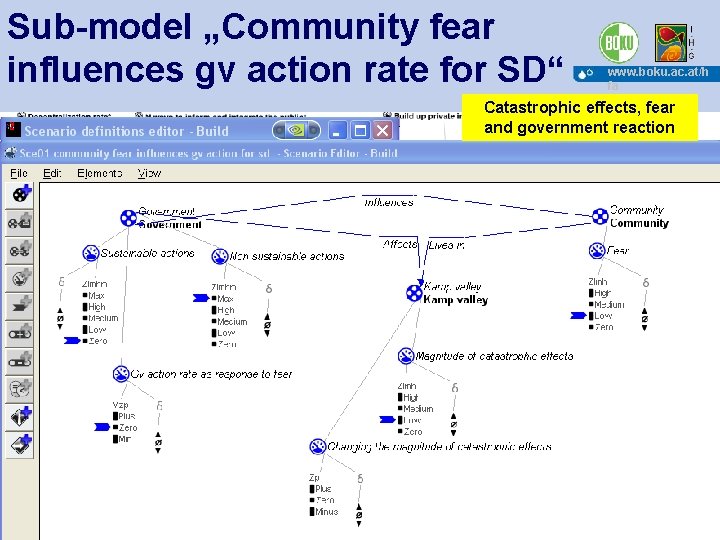
Sub-model „Community fear influences gv action rate for SD“ www. boku. ac. at/h fa Catastrophic effects, fear and government reaction
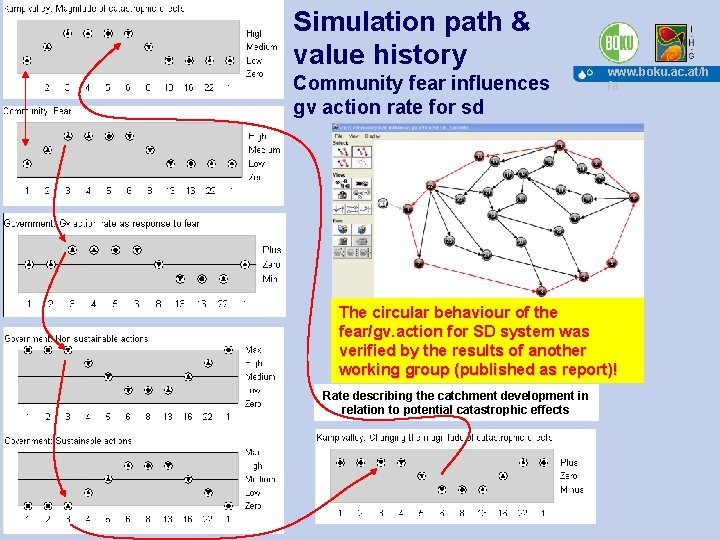
Simulation path & value history Community fear influences gv action rate for sd www. boku. ac. at/h fa The circular behaviour of the fear/gv. action for SD system was verified by the results of another working group (published as report)! Rate describing the catchment development in relation to potential catastrophic effects
Model evaluation • General evaluation www. boku. ac. at/h fa “acceptance of the chosen approach and models” – based on a power point presentation and a collective exploration of parts of the model using GARP 3 on personal Lap tops – 11 persons, divided into students and experts of different aquatic resource domains • Expert evaluations of both models – Discussions with experts based on the printed causal maps and a conjoint exploration of important model fragments and simulations using GARP 3 on a Laptop. • does the model provide a scientifically acceptable explanation for the cause-effect relationships encoded in the model? • does the model outputs and simulated behaviour meet the performance standards required for the model purpose? • Finally, after about 2 hours the participants were asked to fill in pre-prepared questionnaires.
Summary: the model building and simulation process www. boku. ac. at/h fa • Model building proved to be a circular process of creating a model structure, testing behaviour of the model, comparing that behaviour with knowledge about the real world being represented, and reconsidering structure (Forrester, 1975). • Simulations offered new insights in potential system states and system development routes stimulating discussion, thinking and understanding. • QR domain specific restrictions of expressing things (e. g. the quantity spaces as points and intervals) sometimes conflicted with the intuitive way of building a qualitative model. – Support of QR specialists was needed. • Modelling more than one influence on an entity turned out to be complicated (but was possible).
Summary: general evaluation results www. boku. ac. at/h fa • High potential of the presented QR models and simulations for education, collective and interactive social learning, decision making and research. • Knowledge on dependencies and causal relationships was identified as pre-requisite for system understanding and crucial basis for learning and decision making. • GARP 3 can be used very intuitively to build and explore models. • Some behaviours of simulations might not be true in real world systems (e. g. that they stay within an interval for a certain time steps before they change) – this has to be carefully considered to not irritate end users.
Conclusions www. boku. ac. at/h fa • QR offers a promising way of capturing and simulating existing (qualitative) knowledge from different sources (mental, written, numerical) across various disciplines. • The presented framework is able to support social learning (“mediated modelling”) and can be used to communicate knowledge on different levels of detail. – In accordance with other modelling evaluations (for example STELLA, VENSIM …) the modelling process itself is considered to be a central value – all models are wrong but some are useful! • For a broader use of Garp 3 by non-QR experts QR specific ingredients should be more hidden behind intuitive model building features. • With regard to chatchment management activities: a model library of (arche)typical management problems might be very helpful as a learning and communication basis. – Only certified models should be re-used – A detailed glossary and model documentation are needed • Informed people, a shared vision and common understanding form the well known basis for any sustainable development.
THANK YOU! www. boku. ac. at/h fa