
Evaluating the Performance of Four Snooping Cache Coherency


- Slides: 24
Evaluating the Performance of Four Snooping Cache Coherency Protocols Susan J. Eggers, Randy H. Katz
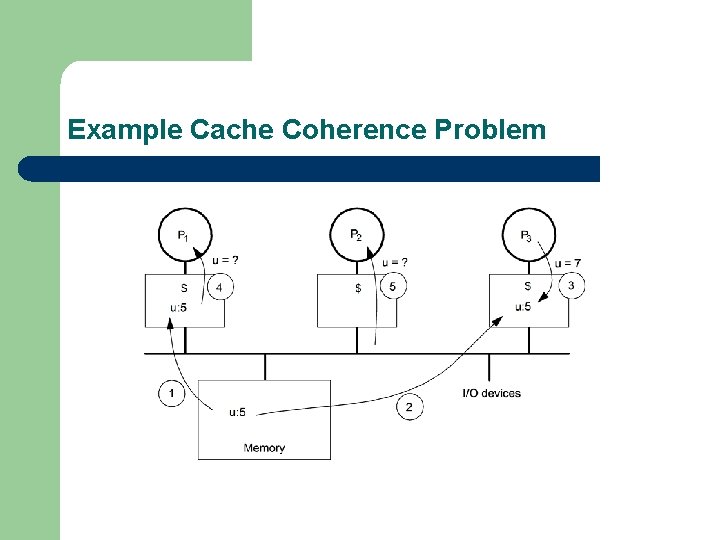
Example Cache Coherence Problem
Solutions - Protocols l Snooping protocols – – l suitable for bus-based architectures requires broadcast Directory-based protocols - sharing information stored separately (in directories) non-bus based architectures
Snooping Protocols l Suitable for bus-based architectures l Types – * write – invalidate - processor invalidates all other cached copies of shared data - it can then update its own with no further bus operations * write – broadcast - processor broadcasts updates to shared data to other caches - therefore, all copies are the same
Case Studies l Architecture - shared-memory architecture - 5 – 12 processors connected on a single bus - one-cycle per instruction execution - direct-mapped cache, one-cycle reads, two-cycle write l Applications - traces gathered from 4 parallel CAD programs, developed for single-bus, shared memory multiprocessors. - granularity of parallelism is a process - single-program-multiple-data
Write-Invalidate Protocols l Writing processor invalidates all other shared (cached) copies of data. l Any subsequent writes by the same processor do not require bus utilization l Caches of other processors “snoop” on the bus l Example – Berkeley Ownership (Invalid, Valid, Shared Dirty, Dirty) l Sources of overhead • Invalidation signal, Invalidation misses
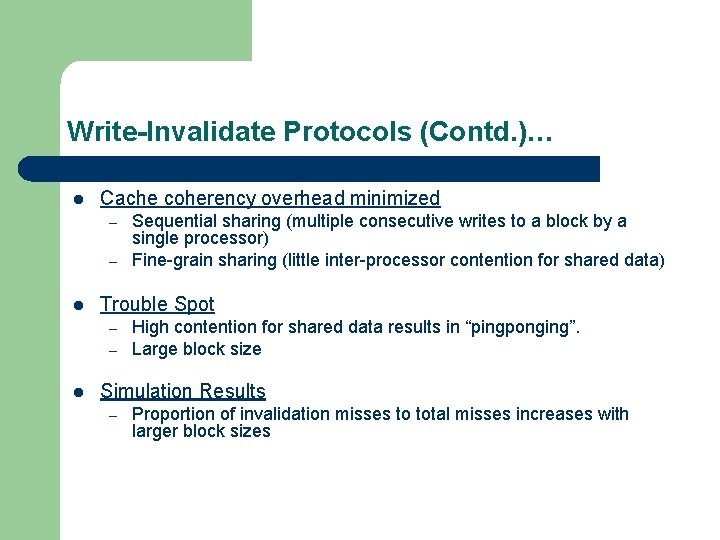
Write-Invalidate Protocols (Contd. )… l Cache coherency overhead minimized – – l Trouble Spot – – l Sequential sharing (multiple consecutive writes to a block by a single processor) Fine-grain sharing (little inter-processor contention for shared data) High contention for shared data results in “pingponging”. Large block size Simulation Results – Proportion of invalidation misses to total misses increases with larger block sizes
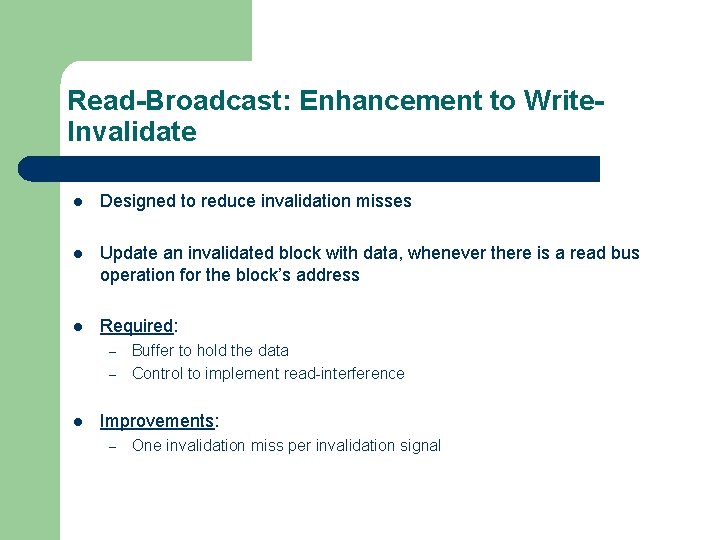
Read-Broadcast: Enhancement to Write. Invalidate l Designed to reduce invalidation misses l Update an invalidated block with data, whenever there is a read bus operation for the block’s address l Required: – – l Buffer to hold the data Control to implement read-interference Improvements: – One invalidation miss per invalidation signal
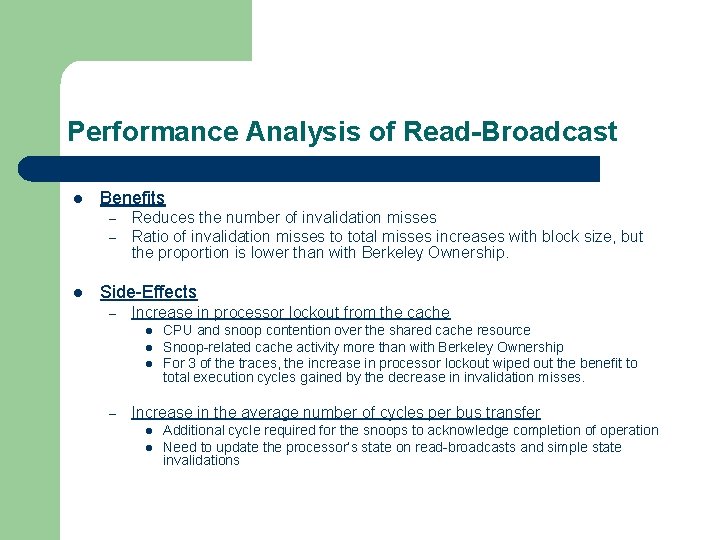
Performance Analysis of Read-Broadcast l Benefits – – l Reduces the number of invalidation misses Ratio of invalidation misses to total misses increases with block size, but the proportion is lower than with Berkeley Ownership. Side-Effects – Increase in processor lockout from the cache l l l – CPU and snoop contention over the shared cache resource Snoop-related cache activity more than with Berkeley Ownership For 3 of the traces, the increase in processor lockout wiped out the benefit to total execution cycles gained by the decrease in invalidation misses. Increase in the average number of cycles per bus transfer l l Additional cycle required for the snoops to acknowledge completion of operation Need to update the processor’s state on read-broadcasts and simple state invalidations
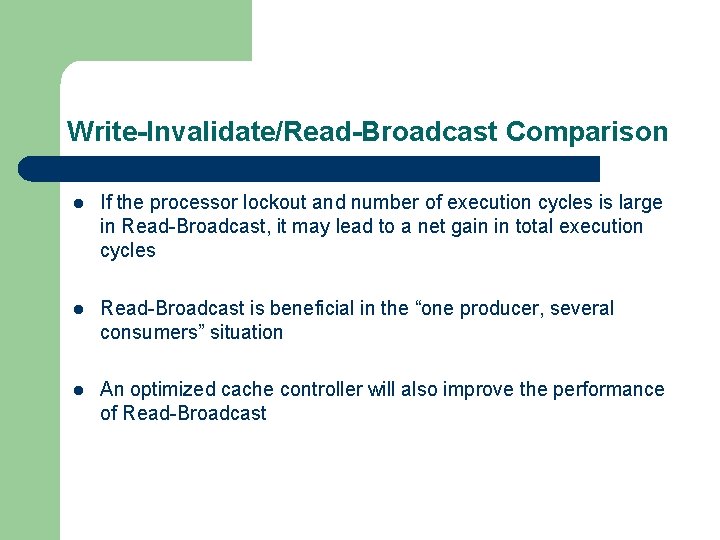
Write-Invalidate/Read-Broadcast Comparison l If the processor lockout and number of execution cycles is large in Read-Broadcast, it may lead to a net gain in total execution cycles l Read-Broadcast is beneficial in the “one producer, several consumers” situation l An optimized cache controller will also improve the performance of Read-Broadcast
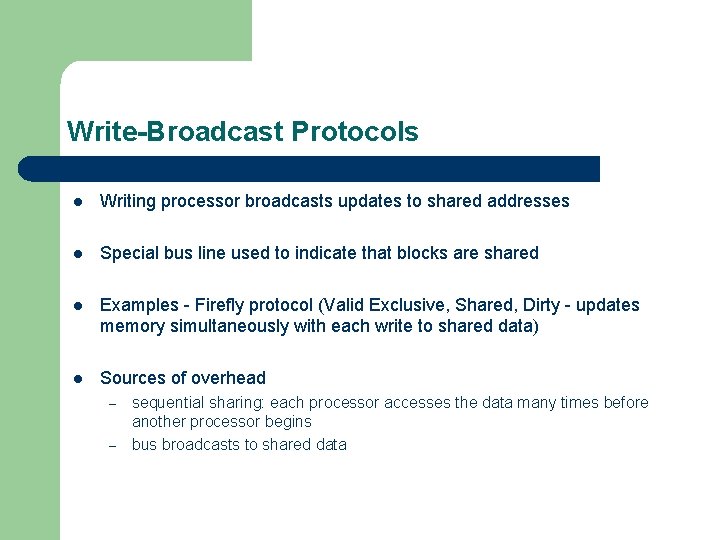
Write-Broadcast Protocols l Writing processor broadcasts updates to shared addresses l Special bus line used to indicate that blocks are shared l Examples - Firefly protocol (Valid Exclusive, Shared, Dirty - updates memory simultaneously with each write to shared data) l Sources of overhead – – sequential sharing: each processor accesses the data many times before another processor begins bus broadcasts to shared data
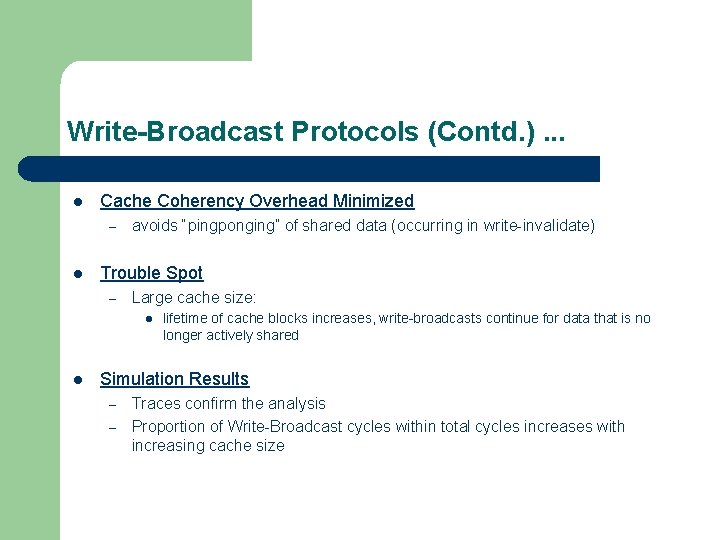
Write-Broadcast Protocols (Contd. ). . . l Cache Coherency Overhead Minimized – l avoids “pingponging” of shared data (occurring in write-invalidate) Trouble Spot – Large cache size: l l lifetime of cache blocks increases, write-broadcasts continue for data that is no longer actively shared Simulation Results – – Traces confirm the analysis Proportion of Write-Broadcast cycles within total cycles increases with increasing cache size
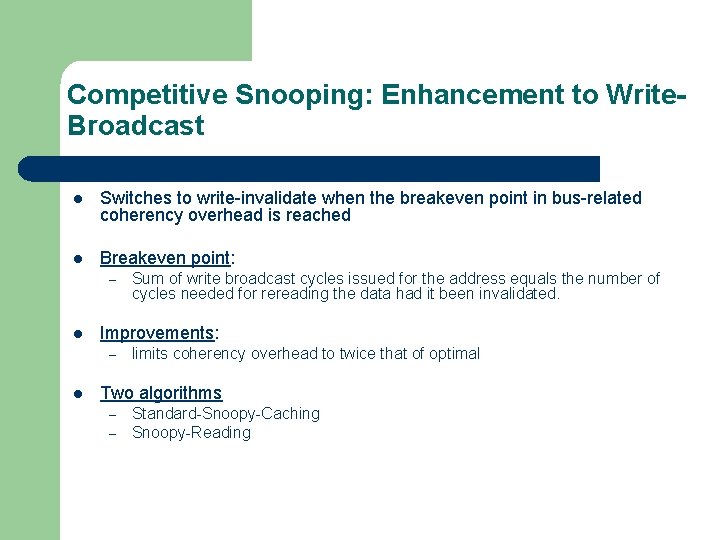
Competitive Snooping: Enhancement to Write. Broadcast l Switches to write-invalidate when the breakeven point in bus-related coherency overhead is reached l Breakeven point: – l Improvements: – l Sum of write broadcast cycles issued for the address equals the number of cycles needed for rereading the data had it been invalidated. limits coherency overhead to twice that of optimal Two algorithms – – Standard-Snoopy-Caching Snoopy-Reading
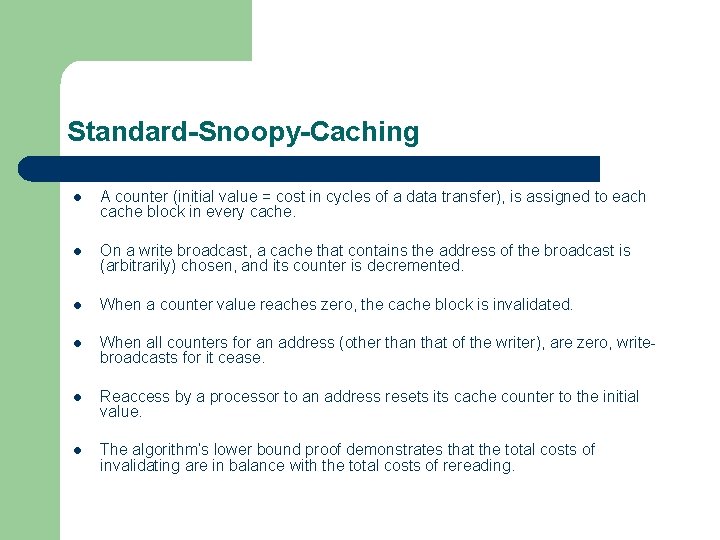
Standard-Snoopy-Caching l A counter (initial value = cost in cycles of a data transfer), is assigned to each cache block in every cache. l On a write broadcast, a cache that contains the address of the broadcast is (arbitrarily) chosen, and its counter is decremented. l When a counter value reaches zero, the cache block is invalidated. l When all counters for an address (other than that of the writer), are zero, writebroadcasts for it cease. l Reaccess by a processor to an address resets its cache counter to the initial value. l The algorithm’s lower bound proof demonstrates that the total costs of invalidating are in balance with the total costs of rereading.
Snoopy-Reading l The adversary is allowed to read-broadcast on rereads. l All other caches with invalidated copies take the data, and reset their counters. l When a cache’s counter reaches zero, it invalidates the block containing the address; and write broadcasts are discontinued, when all caches but that of the writer have been invalidated. l Other changes – – – On a write-broadcast, all caches containing the address decrement their counters Decrementing is done on consecutive write broadcasts by a particular processor
Snoopy-Reading Vs Standard-Snoopy. Caching l Advantages of Snoopy-Reading Well suited for a workload with few rereads – Does not require hardware to “arbitrarily” choose a cache Snoopy-Reading invalidates more quickly than Standard-Snoopy-Caching –
Performance Analysis of Competitive Snooping l Simulation results – – Decreases number of write broadcasts Benefit is greater when there is sequential sharing
Write-Broadcast/Competitive Snooping Comparison l Competitive snooping is beneficial in case of sequential sharing. – l Decreases bus utilization and total execution time As inter-processor contention increases, competitive snooping results in an increase in bus utilization and total execution time
Conclusion Write-Invalidate/Read-Broadcast l Read-broadcast is not suitable for sequential sharing l It may prove beneficial in the single-producer, multipleconsumer situation Write-Broadcast/Competitive Snooping l Competitive Snooping is advantageous if there is sequential sharing
References l S. J. Eggers, R. H. Katz, “Evaluating the Performance of Four Snooping Cache Coherency Protocols”
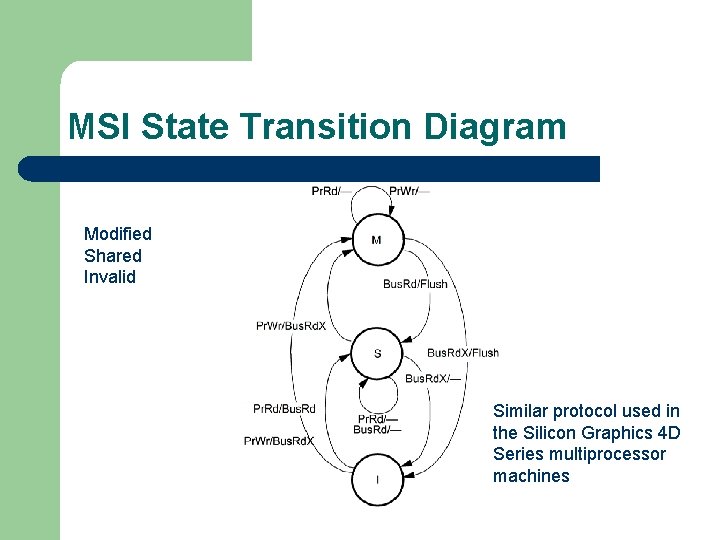
MSI State Transition Diagram Modified Shared Invalid Similar protocol used in the Silicon Graphics 4 D Series multiprocessor machines
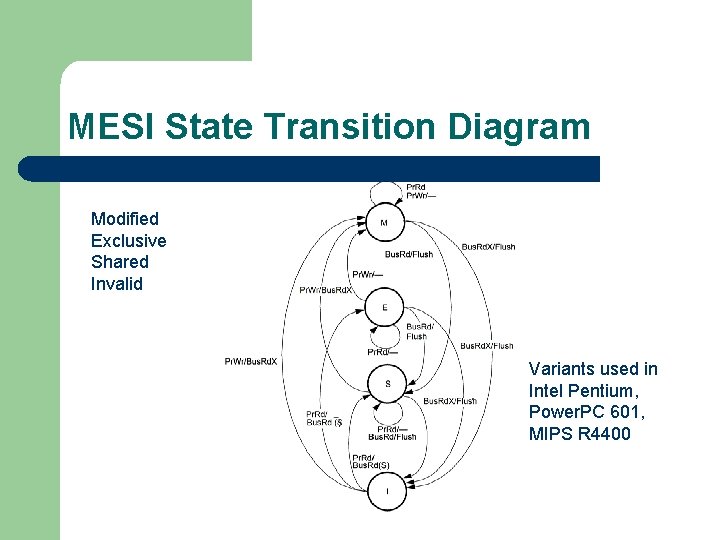
MESI State Transition Diagram Modified Exclusive Shared Invalid Variants used in Intel Pentium, Power. PC 601, MIPS R 4400
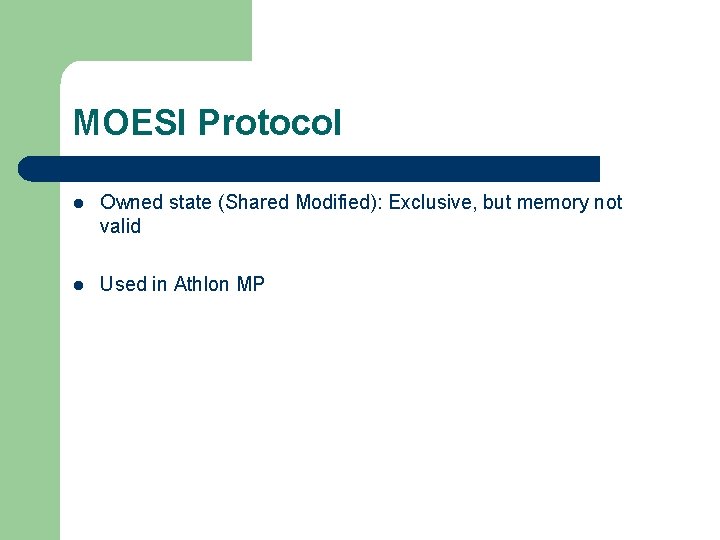
MOESI Protocol l Owned state (Shared Modified): Exclusive, but memory not valid l Used in Athlon MP
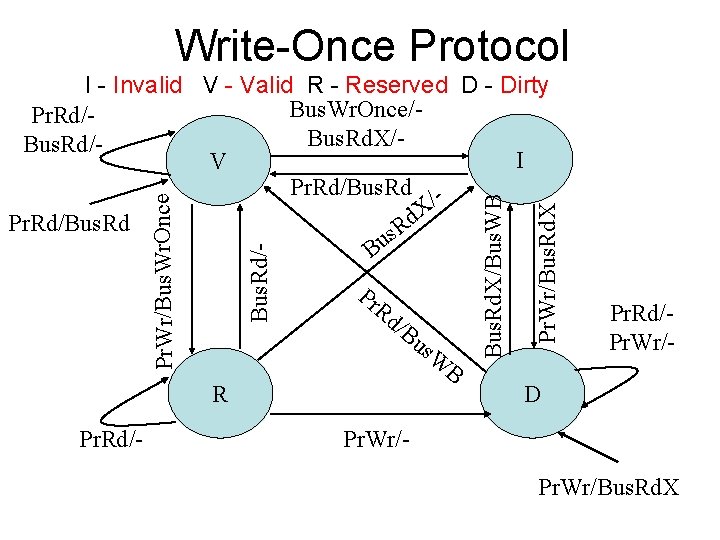
Write-Once Protocol Rd /B R Pr. Rd/- us W B Pr. Wr/Bus. Rd. X Pr Bus. Rd. X/Bus. WB Bus. Rd/- Pr. Wr/Bus. Wr. Once I - Invalid V - Valid R - Reserved D - Dirty Bus. Wr. Once/Pr. Rd/Bus. Rd. X/Bus. Rd/I V Pr. Rd/Bus. Rd / X d Pr. Rd/Bus. Rd R s u B Pr. Rd/Pr. Wr/- D Pr. Wr/Bus. Rd. X