
Evaluating the Performance Limitations of MPMD Communication ChiChao

- Slides: 20
Evaluating the Performance Limitations of MPMD Communication Chi-Chao Chang Dept. of Computer Science Cornell University Grzegorz Czajkowski (Cornell) Thorsten von Eicken (Cornell) Carl Kesselman (ISI/USC)
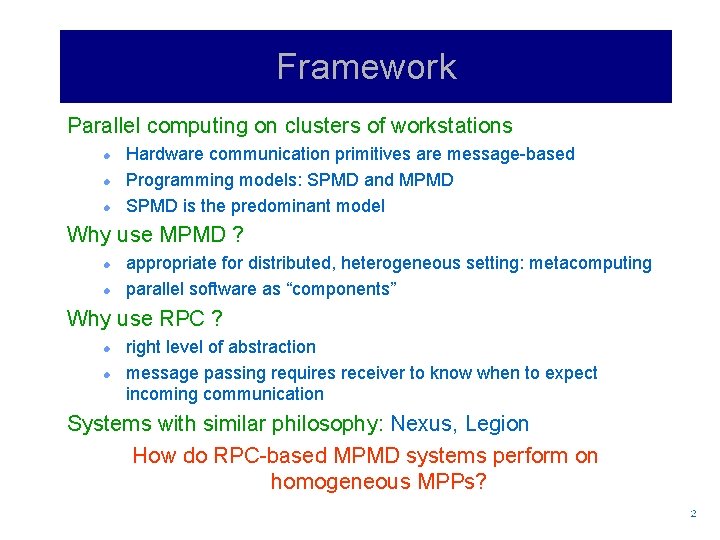
Framework Parallel computing on clusters of workstations l l l Hardware communication primitives are message-based Programming models: SPMD and MPMD SPMD is the predominant model Why use MPMD ? l l appropriate for distributed, heterogeneous setting: metacomputing parallel software as “components” Why use RPC ? l l right level of abstraction message passing requires receiver to know when to expect incoming communication Systems with similar philosophy: Nexus, Legion How do RPC-based MPMD systems perform on homogeneous MPPs? 22
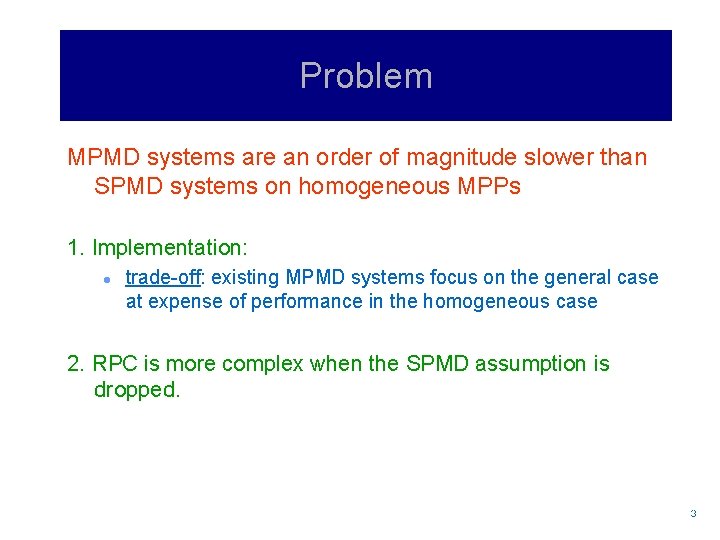
Problem MPMD systems are an order of magnitude slower than SPMD systems on homogeneous MPPs 1. Implementation: l trade-off: existing MPMD systems focus on the general case at expense of performance in the homogeneous case 2. RPC is more complex when the SPMD assumption is dropped. 33
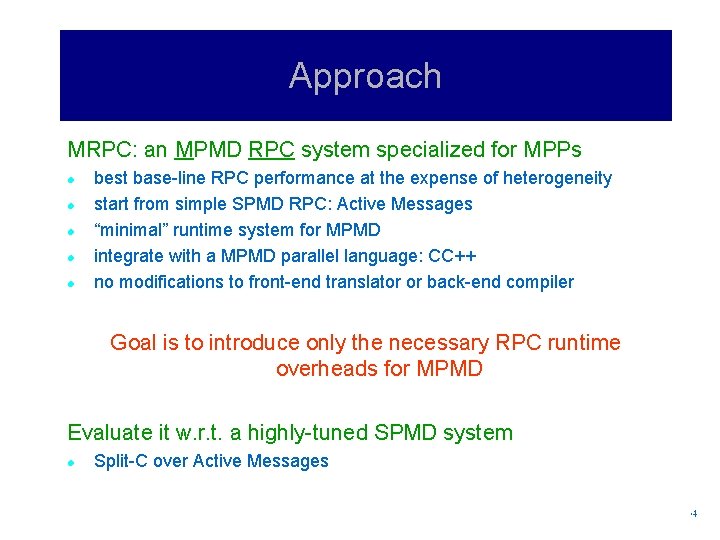
Approach MRPC: an MPMD RPC system specialized for MPPs l l l best base-line RPC performance at the expense of heterogeneity start from simple SPMD RPC: Active Messages “minimal” runtime system for MPMD integrate with a MPMD parallel language: CC++ no modifications to front-end translator or back-end compiler Goal is to introduce only the necessary RPC runtime overheads for MPMD Evaluate it w. r. t. a highly-tuned SPMD system l Split-C over Active Messages 44
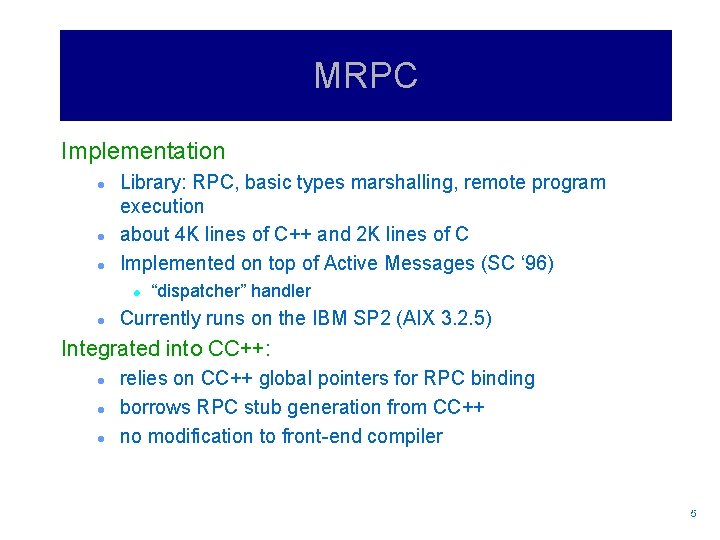
MRPC Implementation l l l Library: RPC, basic types marshalling, remote program execution about 4 K lines of C++ and 2 K lines of C Implemented on top of Active Messages (SC ‘ 96) l l “dispatcher” handler Currently runs on the IBM SP 2 (AIX 3. 2. 5) Integrated into CC++: l l l relies on CC++ global pointers for RPC binding borrows RPC stub generation from CC++ no modification to front-end compiler 55
Outline l l l Design issues in MRPC and CC++ Performance results 66
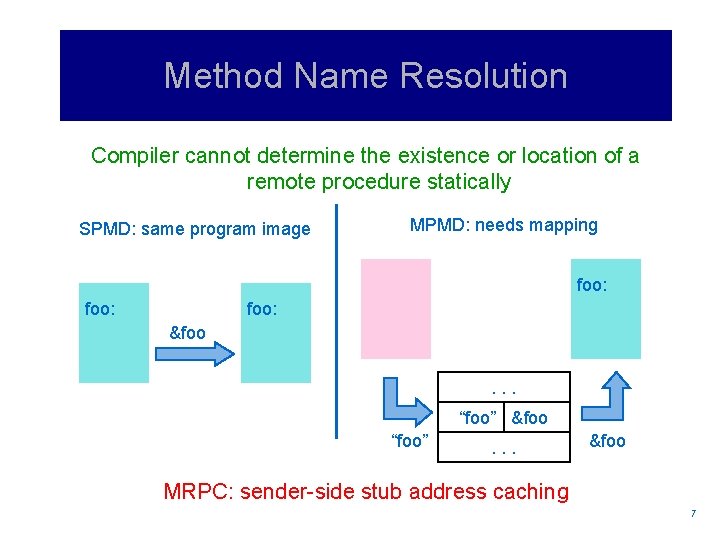
Method Name Resolution Compiler cannot determine the existence or location of a remote procedure statically SPMD: same program image MPMD: needs mapping foo: &foo. . . “foo” &foo “foo” . . . MRPC: sender-side stub address caching &foo 77
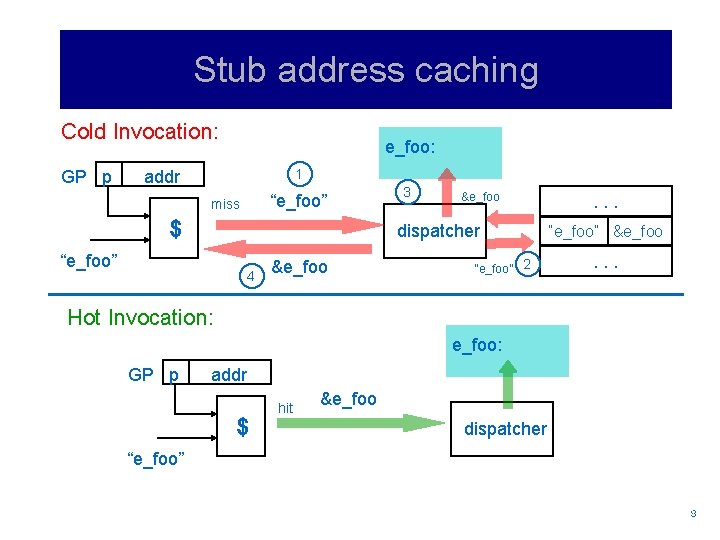
Stub address caching Cold Invocation: GP p e_foo: 1 addr “e_foo” miss $ 3 &e_foo dispatcher “e_foo” 4 &e_foo “e_foo” 2 . . . “e_foo” &e_foo . . . Hot Invocation: e_foo: GP p addr $ hit &e_foo dispatcher “e_foo” 88
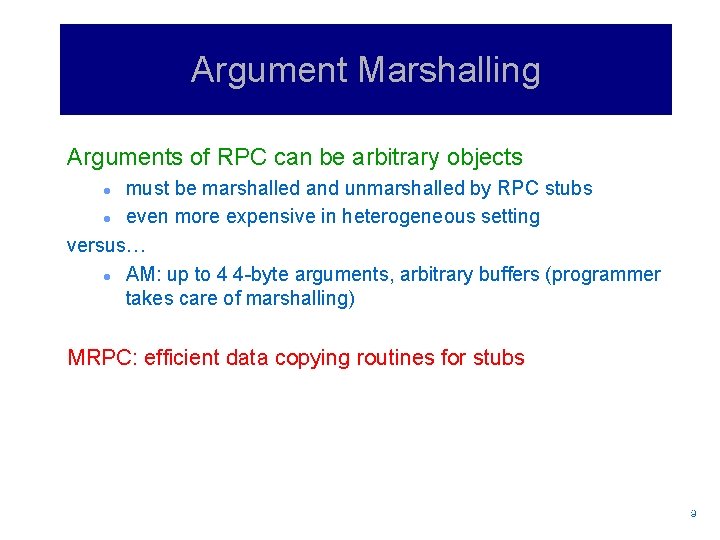
Argument Marshalling Arguments of RPC can be arbitrary objects must be marshalled and unmarshalled by RPC stubs l even more expensive in heterogeneous setting versus… l AM: up to 4 4 -byte arguments, arbitrary buffers (programmer takes care of marshalling) l MRPC: efficient data copying routines for stubs 99
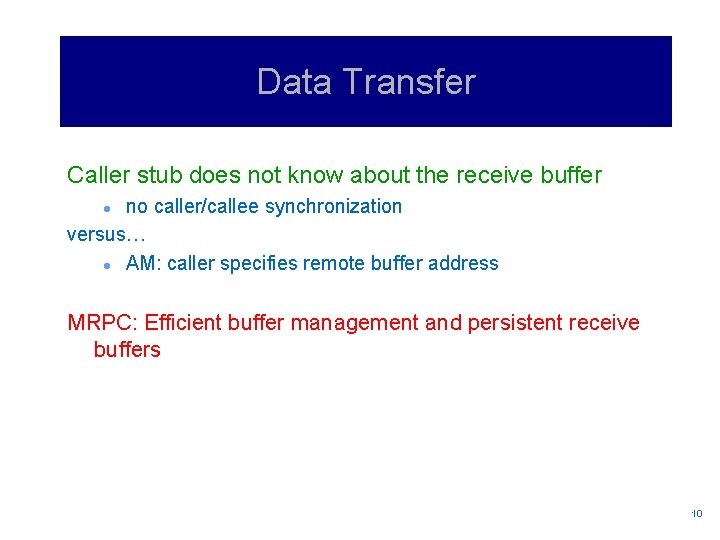
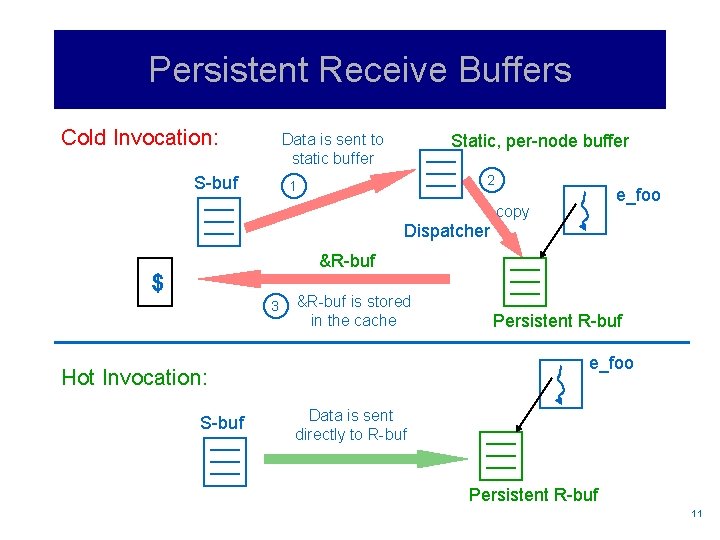
Data Transfer Caller stub does not know about the receive buffer no caller/callee synchronization versus… l AM: caller specifies remote buffer address l MRPC: Efficient buffer management and persistent receive buffers 1010
Persistent Receive Buffers Cold Invocation: Data is sent to static buffer S-buf Static, per-node buffer 2 1 e_foo copy Dispatcher &R-buf $ 3 &R-buf is stored in the cache e_foo Hot Invocation: S-buf Persistent R-buf Data is sent directly to R-buf Persistent R-buf 1111
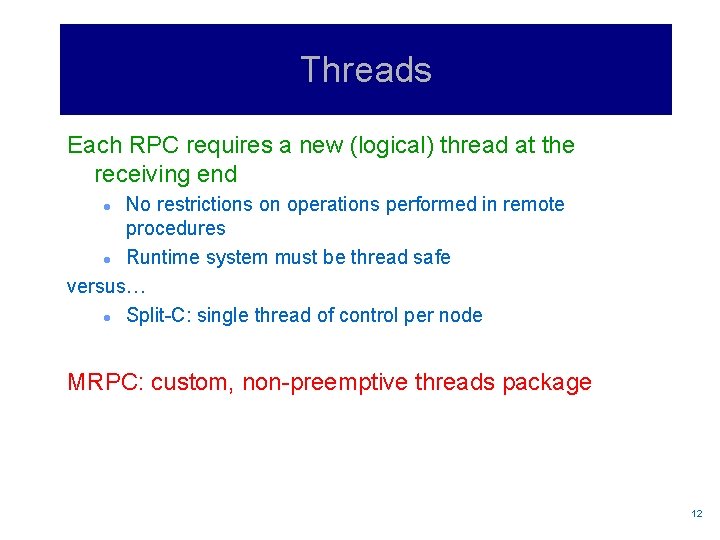
Threads Each RPC requires a new (logical) thread at the receiving end No restrictions on operations performed in remote procedures l Runtime system must be thread safe versus… l Split-C: single thread of control per node l MRPC: custom, non-preemptive threads package 1212
Message Reception Message reception is not receiver-initiated Software interrupts: very expensive versus… l MPI: several different ways to receive a message (poll, post, etc) l SPMD: user typically identifies comm phases into which cheap polling can be introduced easily l MRPC: Polling thread 1313
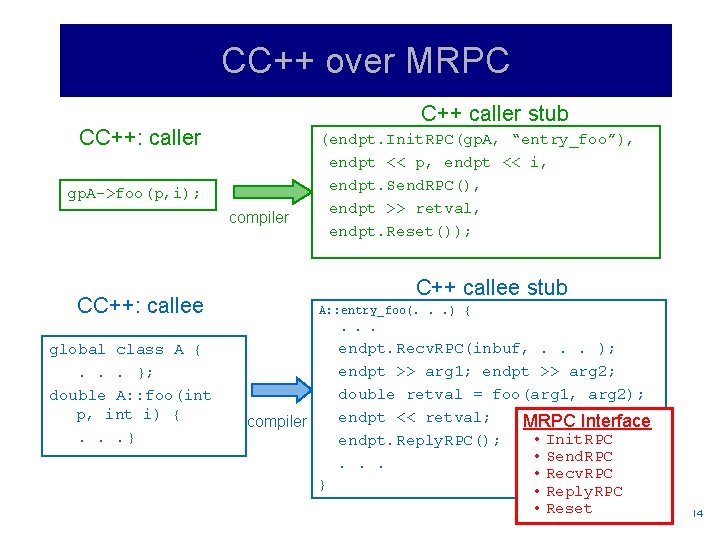
CC++ over MRPC C++ caller stub CC++: caller gp. A->foo(p, i); compiler CC++: callee global class A {. . . }; double A: : foo(int p, int i) {. . . } (endpt. Init. RPC(gp. A, “entry_foo”), endpt << p, endpt << i, endpt. Send. RPC(), endpt >> retval, endpt. Reset()); C++ callee stub A: : entry_foo(. . . ) {. . . endpt. Recv. RPC(inbuf, . . . ); endpt >> arg 1; endpt >> arg 2; double retval = foo(arg 1, arg 2); endpt << retval; compiler MRPC Interface • Init. RPC endpt. Reply. RPC(); • Send. RPC. . . • Recv. RPC } • Reply. RPC • Reset 1414
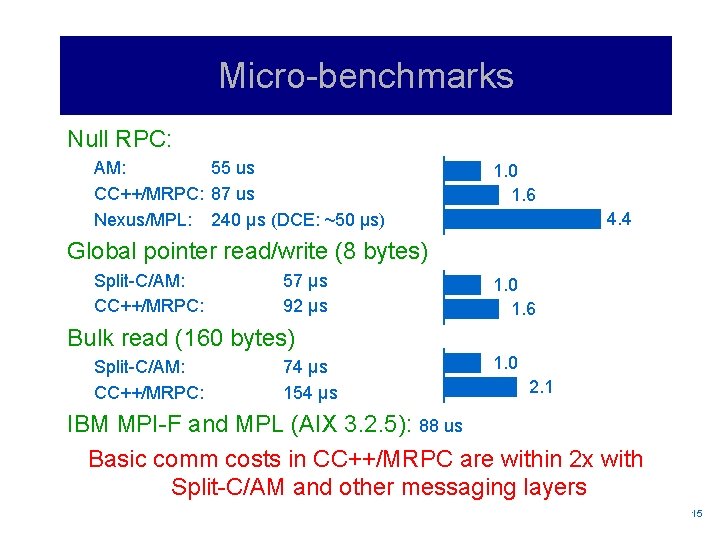
Micro-benchmarks Null RPC: AM: 55 us CC++/MRPC: 87 us Nexus/MPL: 240 μs (DCE: ~50 μs) 1. 0 1. 6 4. 4 Global pointer read/write (8 bytes) Split-C/AM: CC++/MRPC: 57 μs 92 μs 1. 0 1. 6 Bulk read (160 bytes) Split-C/AM: CC++/MRPC: 74 μs 154 μs 1. 0 2. 1 IBM MPI-F and MPL (AIX 3. 2. 5): 88 us Basic comm costs in CC++/MRPC are within 2 x with Split-C/AM and other messaging layers 1515
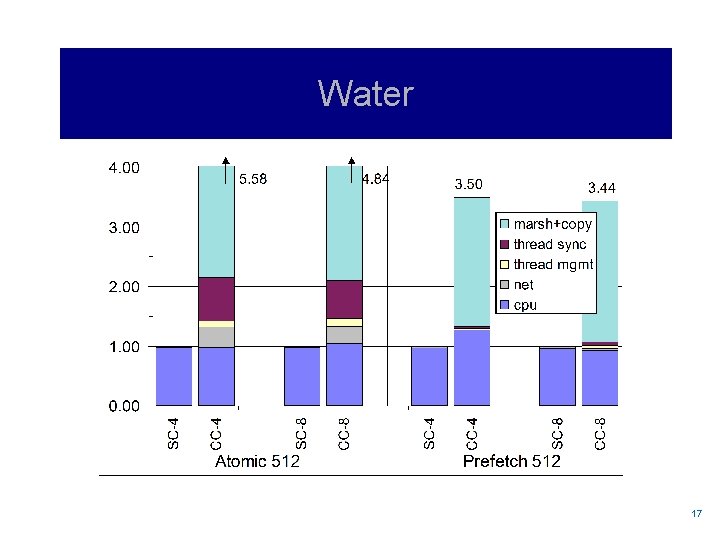
Applications l l l 3 versions of EM 3 D, 2 versions of Water, LU and FFT CC++ versions based on original Split-C code Runs taken for 4 and 8 processors on IBM SP-2 1616
Water 1717
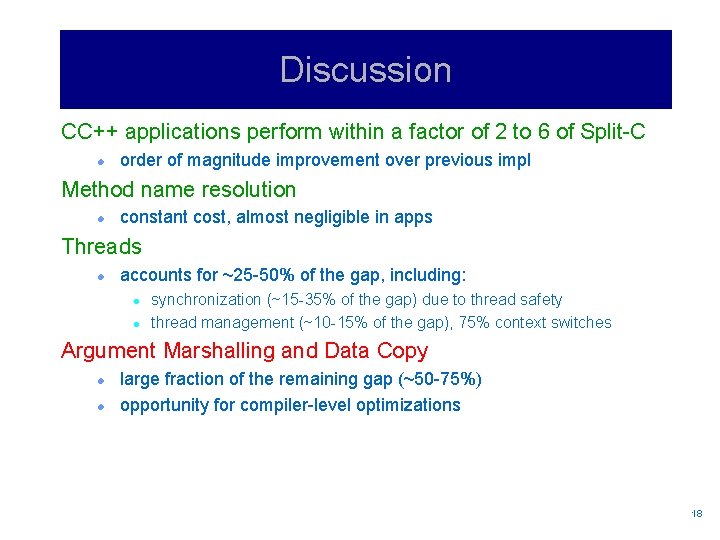
Discussion CC++ applications perform within a factor of 2 to 6 of Split-C l order of magnitude improvement over previous impl Method name resolution l constant cost, almost negligible in apps Threads l accounts for ~25 -50% of the gap, including: l l synchronization (~15 -35% of the gap) due to thread safety thread management (~10 -15% of the gap), 75% context switches Argument Marshalling and Data Copy l l large fraction of the remaining gap (~50 -75%) opportunity for compiler-level optimizations 1818
Related Work Lightweight RPC l LRPC: RPC specialization for local case High-Performance RPC in MPPs l Concert, p. C++, ABCL Integrating threads with communication l l Optimistic Active Messages Nexus Compiling techniques l Specialized frame mgmt and calling conventions, lazy threads, etc. (Taura’s PLDI ‘ 97) 1919
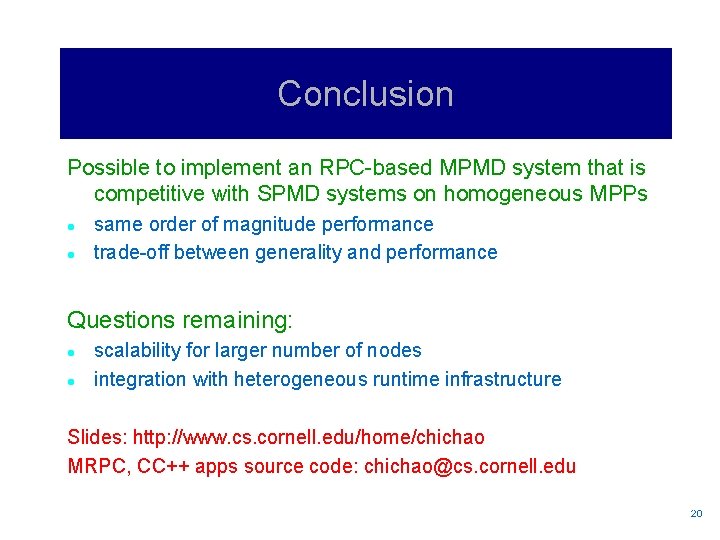
Conclusion Possible to implement an RPC-based MPMD system that is competitive with SPMD systems on homogeneous MPPs l l same order of magnitude performance trade-off between generality and performance Questions remaining: l l scalability for larger number of nodes integration with heterogeneous runtime infrastructure Slides: http: //www. cs. cornell. edu/home/chichao MRPC, CC++ apps source code: chichao@cs. cornell. edu 2020