
Evaluating the Minnesota Multiphasic Personality Inventory2 Restructured Form
- Slides: 1
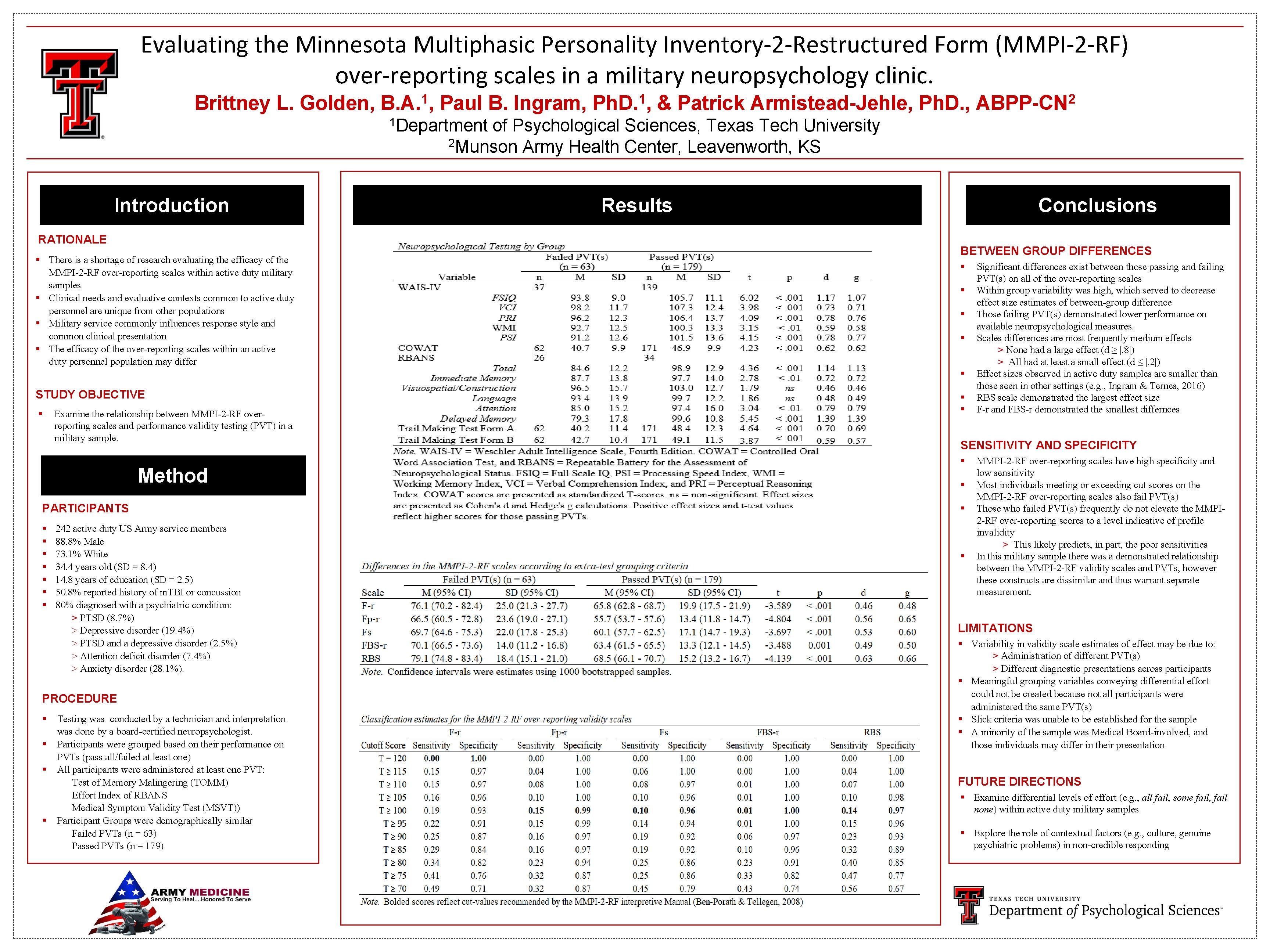
Evaluating the Minnesota Multiphasic Personality Inventory-2 -Restructured Form (MMPI-2 -RF) over-reporting scales in a military neuropsychology clinic. Brittney L. Golden, 1 B. A. , Paul B. Ingram, 1 Ph. D. , & Patrick Armistead-Jehle, Ph. D. , 2 ABPP-CN 1 Department of Psychological Sciences, Texas Tech University 2 Munson Army Health Center, Leavenworth, KS Introduction RATIONALE § There is a shortage of research evaluating the efficacy of the MMPI-2 -RF over-reporting scales within active duty military samples. § Clinical needs and evaluative contexts common to active duty personnel are unique from other populations § Military service commonly influences response style and common clinical presentation § The efficacy of the over-reporting scales within an active duty personnel population may differ Results Conclusions BETWEEN GROUP DIFFERENCES § § § STUDY OBJECTIVE § Examine the relationship between MMPI-2 -RF overreporting scales and performance validity testing (PVT) in a military sample. Method PARTICIPANTS § § § § 242 active duty US Army service members 88. 8% Male 73. 1% White 34. 4 years old (SD = 8. 4) 14. 8 years of education (SD = 2. 5) 50. 8% reported history of m. TBI or concussion 80% diagnosed with a psychiatric condition: > PTSD (8. 7%) > Depressive disorder (19. 4%) > PTSD and a depressive disorder (2. 5%) > Attention deficit disorder (7. 4%) > Anxiety disorder (28. 1%). PROCEDURE § § Testing was conducted by a technician and interpretation was done by a board-certified neuropsychologist. Participants were grouped based on their performance on PVTs (pass all/failed at least one) All participants were administered at least one PVT: Test of Memory Malingering (TOMM) Effort Index of RBANS Medical Symptom Validity Test (MSVT)) Participant Groups were demographically similar Failed PVTs (n = 63) Passed PVTs (n = 179) § § Significant differences exist between those passing and failing PVT(s) on all of the over-reporting scales Within group variability was high, which served to decrease effect size estimates of between-group difference Those failing PVT(s) demonstrated lower performance on available neuropsychological measures. Scales differences are most frequently medium effects > None had a large effect (d ≥ |. 8|) > All had at least a small effect (d ≤ |. 2|) Effect sizes observed in active duty samples are smaller than those seen in other settings (e. g. , Ingram & Ternes, 2016) RBS scale demonstrated the largest effect size F-r and FBS-r demonstrated the smallest differnces SENSITIVITY AND SPECIFICITY § § MMPI-2 -RF over-reporting scales have high specificity and low sensitivity Most individuals meeting or exceeding cut scores on the MMPI-2 -RF over-reporting scales also fail PVT(s) Those who failed PVT(s) frequently do not elevate the MMPI 2 -RF over-reporting scores to a level indicative of profile invalidity > This likely predicts, in part, the poor sensitivities In this military sample there was a demonstrated relationship between the MMPI-2 -RF validity scales and PVTs, however these constructs are dissimilar and thus warrant separate measurement. LIMITATIONS § Variability in validity scale estimates of effect may be due to: > Administration of different PVT(s) > Different diagnostic presentations across participants § Meaningful grouping variables conveying differential effort could not be created because not all participants were administered the same PVT(s) § Slick criteria was unable to be established for the sample § A minority of the sample was Medical Board-involved, and those individuals may differ in their presentation FUTURE DIRECTIONS § Examine differential levels of effort (e. g. , all fail, some fail, fail none) within active duty military samples § Explore the role of contextual factors (e. g. , culture, genuine psychiatric problems) in non-credible responding