
EVALUATING THE BUSINESS VALUE OF INFORMATION TECHNOLOGY 13
EVALUATING THE BUSINESS VALUE OF INFORMATION TECHNOLOGY 13. 05. 2005, Janne Laine Fujitsu Services Oy ETTEI TIETOTEKNIIKKA KÄVISI TYÖSTÄ
Background and problem § Evaluating IT is considered problematic in businesses in general – The value of IT is largely intangible (calculation ROI difficult) – The value-creating process in IT is not clear (cause-effect relationships unclear) – Traditional metrics do not capture the business value of IT § Many IT projects do not obtain their objectives – IT is not managed and steered by business (technology project perspective or business development project perspective) – The actual business value of IT is not measured – The necessary change to realise the benefits is not managed There is a strong need for adequate methodology and process to analyze and manage the potential business benefits of information technology projects Fujitsu Services Oy ETTEI TIETOTEKNIIKKA KÄVISI TYÖSTÄ
Objectives The study had two principal objectives: 1. To understand describe the value-creating process in IT (how IT produces measurable business value) § linkage between IT and business (strategic alignment) § critical phases of the process, and their inputs and outputs § effective IT management and control according to corporate strategy and business requirements 2. To develop methodology to analyze the benefits of a single IT investment § business benefit identification and evaluation § clear responsibilities § foundation for change management Fujitsu Services Oy ETTEI TIETOTEKNIIKKA KÄVISI TYÖSTÄ
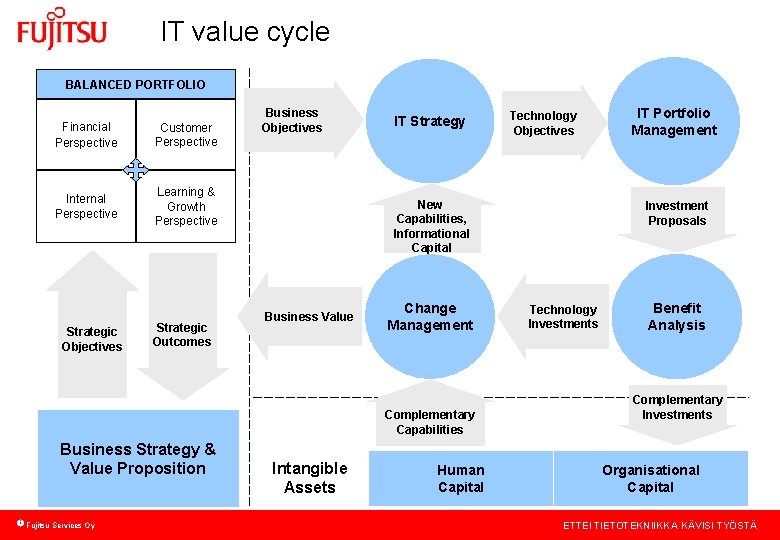
IT value cycle BALANCED PORTFOLIO Financial Perspective Customer Perspective Internal Perspective Learning & Growth Perspective Strategic Objectives Strategic Outcomes Business Objectives IT Strategy New Capabilities, Informational Capital Business Value Change Management Complementary Capabilities Business Strategy & Value Proposition Fujitsu Services Oy Technology Objectives Intangible Assets Human Capital IT Portfolio Management Investment Proposals Technology Investments Benefit Analysis Complementary Investments Organisational Capital ETTEI TIETOTEKNIIKKA KÄVISI TYÖSTÄ
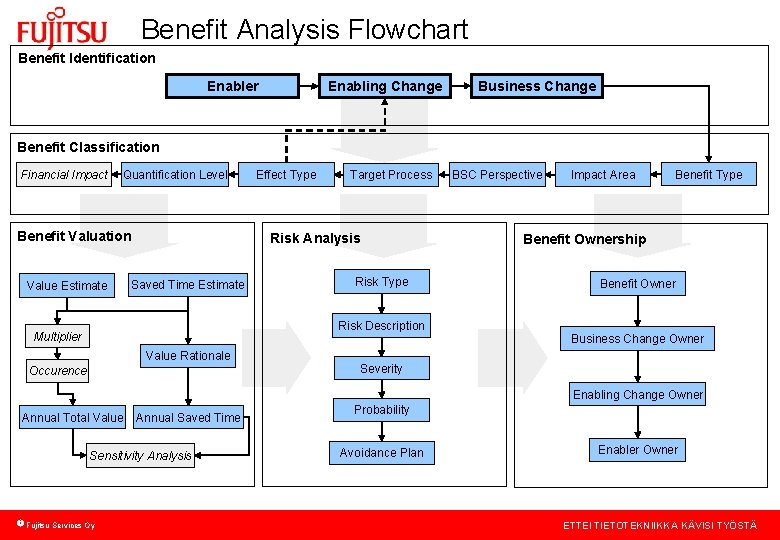
Benefit Analysis Flowchart Benefit Identification Enabler Enabling Change Business Change Benefit Classification Financial Impact Quantification Level Benefit Valuation Value Estimate Effect Type Target Process Risk Analysis Saved Time Estimate Risk Type Risk Description Multiplier Value Rationale Occurence BSC Perspective Impact Area Benefit Type Benefit Ownership Benefit Owner Business Change Owner Severity Enabling Change Owner Annual Total Value Annual Saved Time Sensitivity Analysis Fujitsu Services Oy Probability Avoidance Plan Enabler Owner ETTEI TIETOTEKNIIKKA KÄVISI TYÖSTÄ
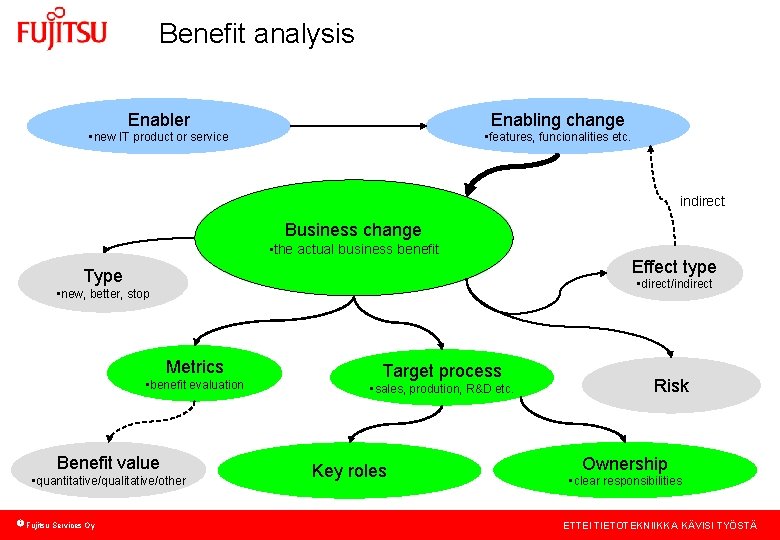
Benefit analysis Enabler Enabling change • new IT product or service • features, funcionalities etc. indirect Business change • the actual business benefit Type • direct/indirect • new, better, stop Metrics • benefit evaluation Benefit value • quantitative/qualitative/other Fujitsu Services Oy Effect type Target process • sales, prodution, R&D etc. Key roles Risk Ownership • clear responsibilities ETTEI TIETOTEKNIIKKA KÄVISI TYÖSTÄ

Conclusions § IT value cycle provides linkage between business objectives and IT management and identifies critical phases and elements in the value -creating process enabled by information technology – Business strategy and IT strategy become aligned and integrated § Benefit analysis is required to identify the business changes that ultimately deliver the benefits the IT enables – the responsibilities for both IT and business must be made clear (ownership) § Understanding the value-creating process and the role of IT helps managing the necessary business changes to realise the business benefits – IT is only an enabler for the potential benefits IT can only be responsible for the enabler part of the process, the business change requires also actions on other assets Fujitsu Services Oy ETTEI TIETOTEKNIIKKA KÄVISI TYÖSTÄ
- Slides: 7