
Evaluating Success and Complications of Cecostomy Tube Insertion

Evaluating Success and Complications of Cecostomy Tube Insertion for Patients with Bowel Dysfunction: A Retrospective Review David W. Chapman, Steven Tong, Peter Metcalfe, Nathan Hoy, Darcie Kiddoo Division of Urology, Department of Surgery, University of Alberta

Disclosures None
Background Bowel Dysfunction is a common problem in the Pediatric Urology Patient Standard treatment for refractory constipation and fecal incontinence is an antegrade enema Cecostomy Tubes versus Malone Antegrade Continence Enema
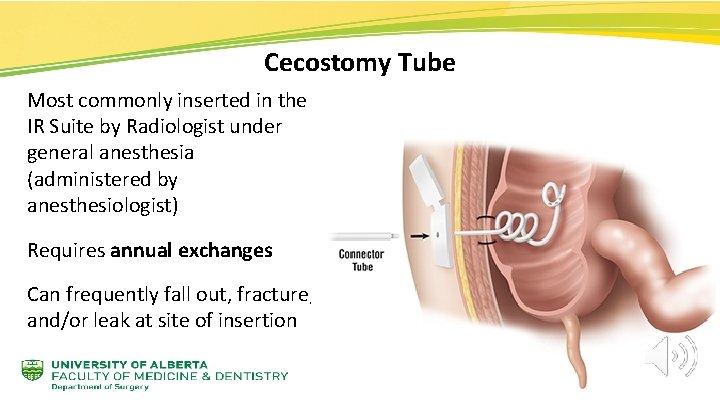
Cecostomy Tube Most commonly inserted in the IR Suite by Radiologist under general anesthesia (administered by anesthesiologist) Requires annual exchanges Can frequently fall out, fracture, and/or leak at site of insertion
Objectives Evaluate the success and complication rate for insertion of cecostomy tubes Evaluate the frequency of unplanned cecostomy tube exchanges
Methods Retrospective Review of 45 charts of patients that underwent cecostomy tube insertion between 2002 and 2018. Primary Outcome: Defined as continence at 1 year follow-up Secondary Outcomes: 30 day complication rate (Clavien Dindo ≥ 3) Unplanned exchanges (an event that resulted in early exchange) Number of general anesthetics required and age at last GA Length of Hospital Stay (days) Follow Up: Continence at most recent follow up Statistics: Descriptive statistics and linear regression used to evaluate risk factors for success rate and frequency of unplanned exchanges
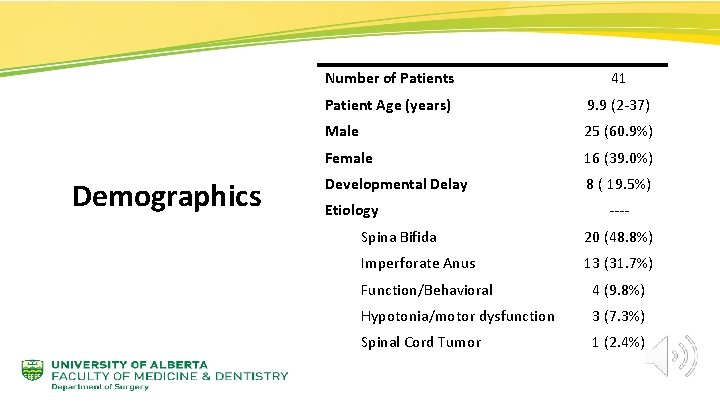
Demographics Number of Patients 41 Patient Age (years) 9. 9 (2 -37) Male 25 (60. 9%) Female 16 (39. 0%) Developmental Delay 8 ( 19. 5%) Etiology ---- Spina Bifida 20 (48. 8%) Imperforate Anus 13 (31. 7%) Function/Behavioral 4 (9. 8%) Hypotonia/motor dysfunction 3 (7. 3%) Spinal Cord Tumor 1 (2. 4%)
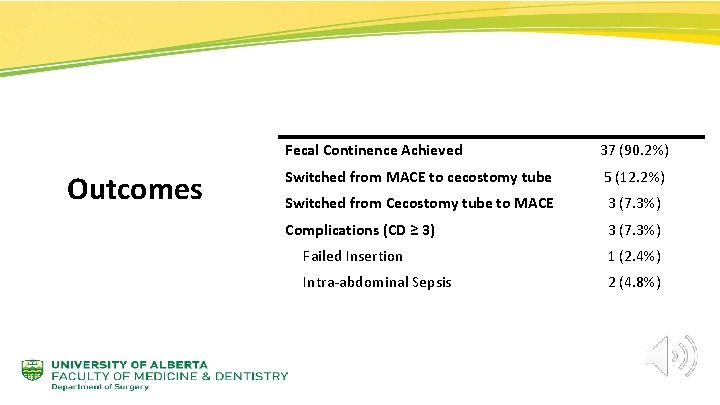
Outcomes Fecal Continence Achieved 37 (90. 2%) Switched from MACE to cecostomy tube 5 (12. 2%) Switched from Cecostomy tube to MACE 3 (7. 3%) Complications (CD ≥ 3) 3 (7. 3%) Failed Insertion 1 (2. 4%) Intra-abdominal Sepsis 2 (4. 8%)
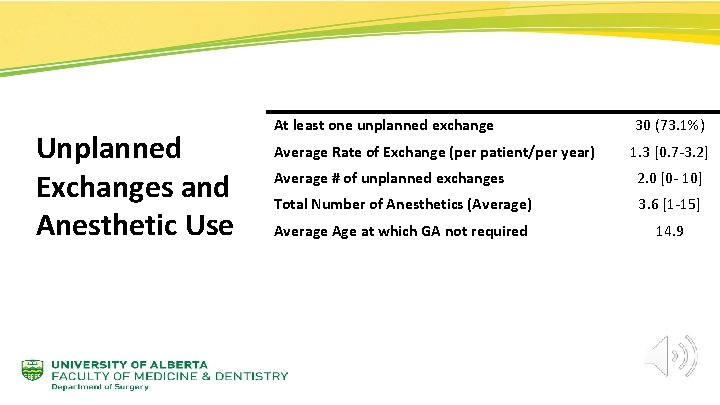
Unplanned Exchanges and Anesthetic Use At least one unplanned exchange Average Rate of Exchange (per patient/per year) 30 (73. 1%) 1. 3 [0. 7 -3. 2] Average # of unplanned exchanges 2. 0 [0 - 10] Total Number of Anesthetics (Average) 3. 6 [1 -15] Average Age at which GA not required 14. 9
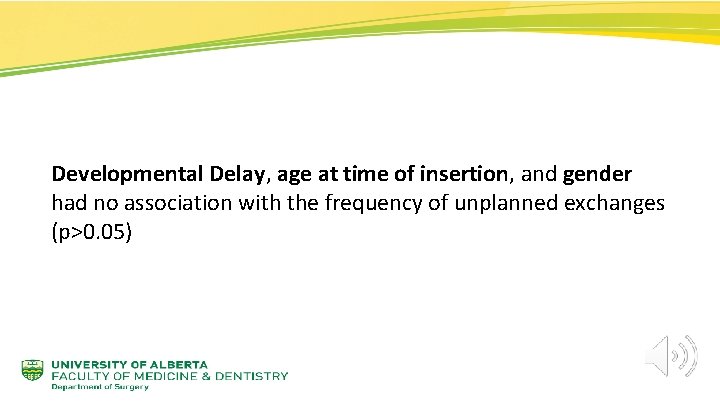
Developmental Delay, age at time of insertion, and gender had no association with the frequency of unplanned exchanges (p>0. 05)
Conclusions Cecostomy tube use is a safe and effective method for the treatment of refractory constipation and fecal incontinence Unplanned exchanges due to malfunction, mechanical breakage, or becoming dislodged are frequent. Appropriate Counselling is required about the long-term commitment that may be required for high rate of continence
- Slides: 11