
Evaluating Solution Alternatives Rob Prinzo The Prinzo Group
Evaluating Solution Alternatives Rob Prinzo, The Prinzo Group April 23 -24, 2019
Agenda § Introductions § The Needs Assessment § Defining Requirements § Validating Requirements § Evaluating Alternatives § Summary 2
Introduction Representative Clients Commission for a New Georgia Commonwealth of Massachusetts Georgia Department of Administrative Services Georgia Department of Labor Georgia Department of Public Health Georgia Department of Veterans Services § The Prinzo Group is a management consulting firm that helps organizations implement change through projects. § Founded in 2004, The Prinzo Group blends proven methodologies with subject matter expertise and unparalleled project management skills to provide a framework for project success. Georgia General Assembly Georgia Technology Authority MA State College and University System MA Department of Transportation State Accounting Office (GA) State of Maine State of Vermont University System of Georgia

The Needs Assessment § Conducted early in the project lifecycle before the RFP is written. § Defines the business and technical requirements of the project. § Identifies best practices by researching market trends and how other organizations are addressing similar issues. § Analyzes the options for meeting the project’s objectives. § Outlines the high-level implementation plan for the project. 4

Why Projects Fail Strategic Reasons Projects Fail Strategy Tactical Acquisition Planning Design Testing Training Lack of Project Sponsor Engagement X X X Unrealistic Expectations X X X Poor Requirements Definition X X Choosing the Wrong Vendor X Gaps between the requirements and the solution. X Inadequate Resources X X X Underestimating Time and Costs X X X Underestimating Impact of Change Lack of Training / Education X X X The Top 10 Project Failure Points Often X Precede Implementation X Poor Project Management / Lack of Methodology Roll-out X X X X X 5
Requirements: The Foundation of Success Evaluating Solution Alternatives 6
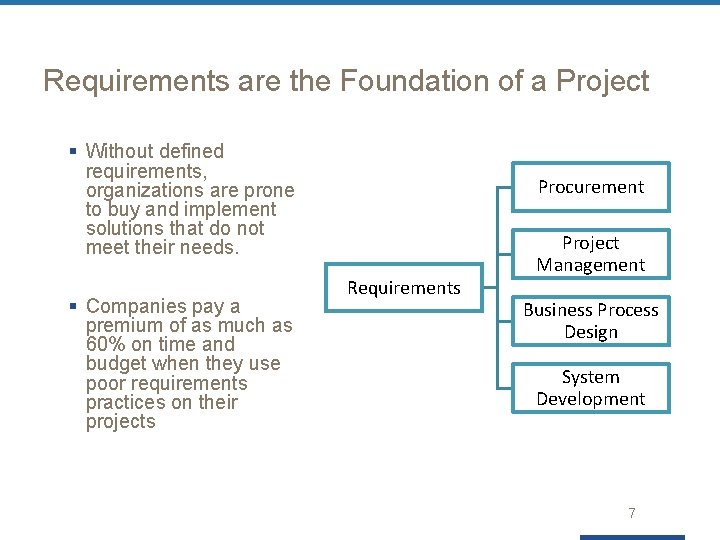
Requirements are the Foundation of a Project § Without defined requirements, organizations are prone to buy and implement solutions that do not meet their needs. § Companies pay a premium of as much as 60% on time and budget when they use poor requirements practices on their projects Procurement Requirements Project Management Business Process Design System Development 7

Why it is Difficult to Define Requirements. § No process for requirements definition - just do not know where to start. § People often struggle with being able to articulate what they want or know what is available. § Overcomplicate the process for requirements definition or start with defining their detailed requirements first. § This results in frustration and finger pointing between internal teams on the same project. 8

Tips for Defining Requirements Conduct internet research to identify common system requirements to use as a starting point or supplement existing requirements. Identify Subject Matter Experts to assist with the detailed requirements (business areas, technology, finance, legal, etc. ). Define requirements in several sessions as there may be additional requirements over time. Include others in the process and validate the requirements with other system users and project stakeholders. 9

Requirements Definition Process Summary Requirements (Project / Procurement Objectives) Detailed Requirements Business or Functional Requirements Technical Requirements Professional Services / Support Requirements
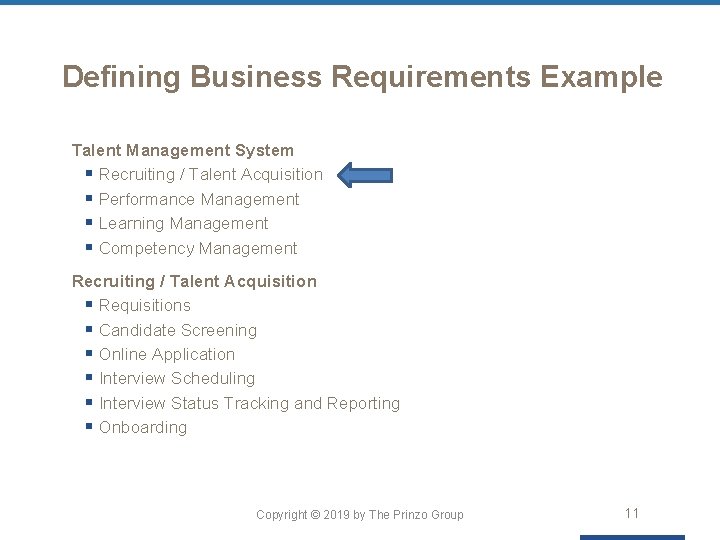
Defining Business Requirements Example Talent Management System § Recruiting / Talent Acquisition § Performance Management § Learning Management § Competency Management Recruiting / Talent Acquisition § Requisitions § Candidate Screening § Online Application § Interview Scheduling § Interview Status Tracking and Reporting § Onboarding Copyright © 2019 by The Prinzo Group 11

Business Requirements Example # S 001 S 002 S 003 S 004 S 006 S 007 Recruiting -> Candidate Screening Priority The system should provide the ability to ask applicants prescreening questions to prevent users who do not meet entry qualifications for a Mandatory position from applying. The prescreening questions (related to preferred qualification) are Mandatory configurable based on appropriate role security. All prescreening (Entry and Preferred) questions are maintained in a bank, grouped or searchable based on job and agency, for re-use. The responses to all screening questions are recorded for report tracking. System enables use of screening questions related to preferred qualifications tracking scored, ranked response. System controls users attempting to reapply to the same requisition by changing answers to pre-screening and screening questions. Copyright © 2019 by The Prinzo Group Medium Mandatory High Mandatory 12

Technology Requirements § Technology Platform § Hosting § System Security and Access Controls § Data Privacy § Data Conversion / Archiving § Integration with other Systems Copyright © 2019 by The Prinzo Group 13
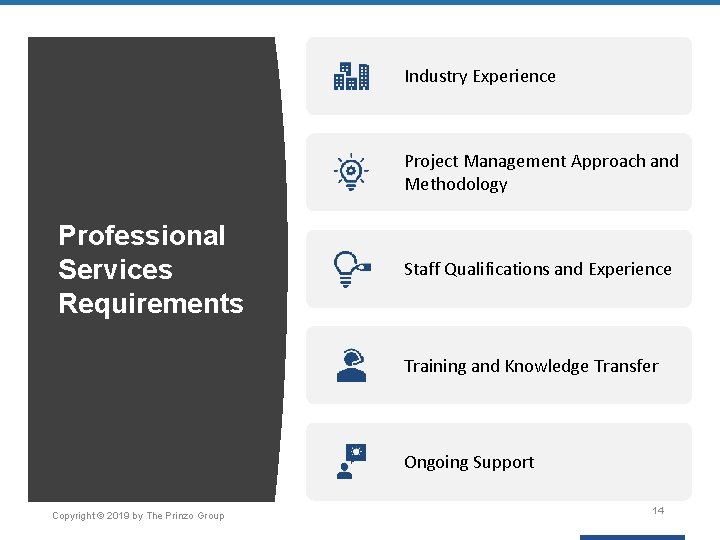
Industry Experience Project Management Approach and Methodology Professional Services Requirements Staff Qualifications and Experience Training and Knowledge Transfer Ongoing Support Copyright © 2019 by The Prinzo Group 14

Turning Requirements into RFP Questions Mandatory Questions • Sets the Minimum Criteria for Respondents “Must Haves” • Yes / No Responses Narrative Questions • “Describe your ability to meet the business requirements outlines in section XX of the RFP” • Best for Business, Technical and Services Requirements Functionality Grid • Vendors complete a grid indicating which requirements are met as delivered or require additional configuration • Best for Software Features and Functionality Response Template or Questionnaires • Respondents follow a template or complete a standard questionnaire • Best for Technical Requirements and Statement of Work Copyright © 2019 by The Prinzo Group 15
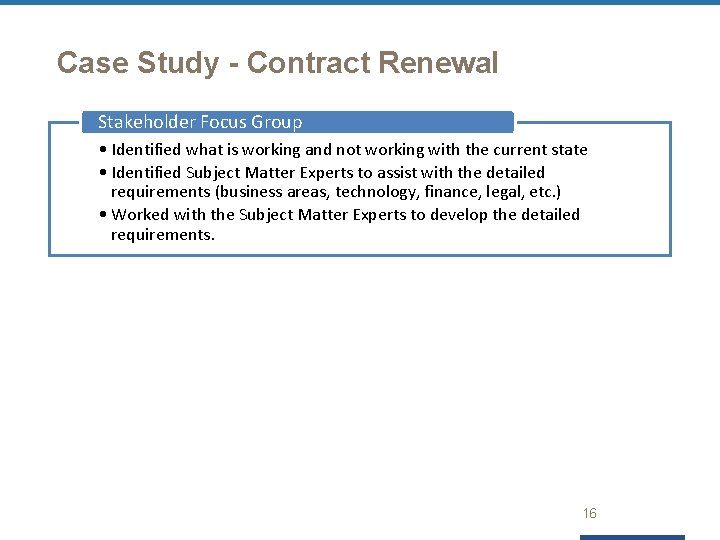
Case Study - Contract Renewal Stakeholder Focus Group • Identified what is working and not working with the current state • Identified Subject Matter Experts to assist with the detailed requirements (business areas, technology, finance, legal, etc. ) • Worked with the Subject Matter Experts to develop the detailed requirements. Market Research • Develop a list of key questions • Scheduled call with the representative project teams • Asked for Lessons Learned Requirements Validated • Reviewed and prioritized the requirements developed by SME’s • Reviewed the findings from the other States. • Updated and finalized the requirements 16
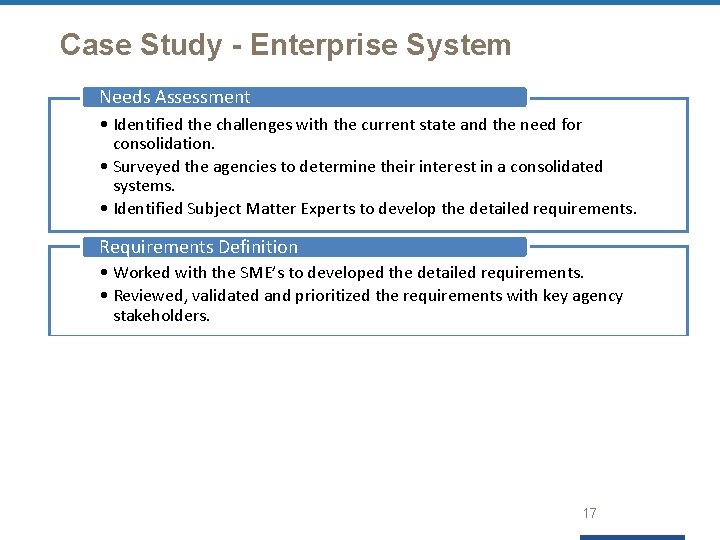
Case Study - Enterprise System Needs Assessment • Identified the challenges with the current state and the need for consolidation. • Surveyed the agencies to determine their interest in a consolidated systems. • Identified Subject Matter Experts to develop the detailed requirements. Requirements Definition • Worked with the SME’s to developed the detailed requirements. • Reviewed, validated and prioritized the requirements with key agency stakeholders. Market Validation • Surveyed other State’s using an online questionnaire through an industry group • Identified the top vendors using industry research • Scheduled vendor demonstrations and obtained budgetary cost estimates 17
Requirements Validation Evaluating Solution Alternatives
Validating Requirements Identify peer organizations that have recently conducted similar procurements. § Who has implemented the same project or something similar? Can you leverage an industry group for a referral? § Identify a contact person willing to schedule a conference call or respond to an email questionnaire. § Develop a list of questions an provide it prior to the conference call. 19
Validating Requirements Identify three to five articles or studies from research firms or industry thought leaders on topics related to your project. § Look for executive summaries or best practice articles. Target industry research to identify the top vendors. § Schedule sales presentations or product demonstrations. § Obtain budgetary cost estimates. 20
Validating Requirements Consolidate your findings to apply to your project. § Summarize the findings that are applicable to your project. § Not everything will apply. Look for key points or applicable portions of reports or case studies to piece together what you need. § Adjust your requirements, RFP and budget accordingly. 21
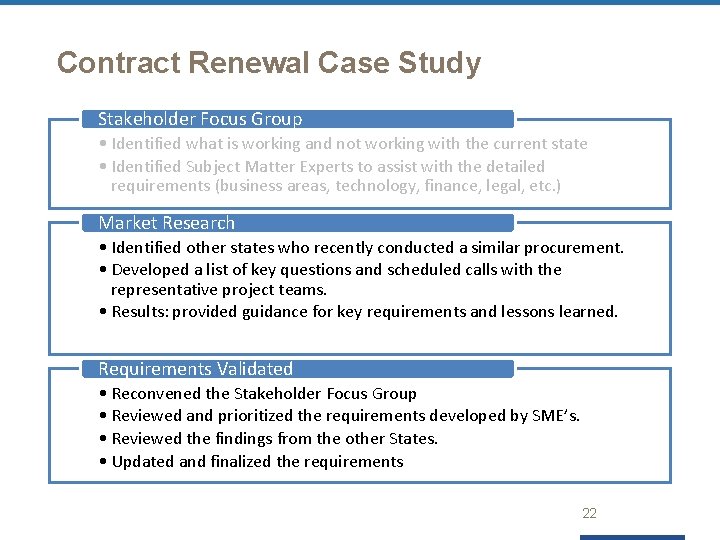
Contract Renewal Case Study Stakeholder Focus Group • Identified what is working and not working with the current state • Identified Subject Matter Experts to assist with the detailed requirements (business areas, technology, finance, legal, etc. ) Market Research • Identified other states who recently conducted a similar procurement. • Developed a list of key questions and scheduled calls with the representative project teams. • Results: provided guidance for key requirements and lessons learned. Requirements Validated • Reconvened the Stakeholder Focus Group • Reviewed and prioritized the requirements developed by SME’s. • Reviewed the findings from the other States. • Updated and finalized the requirements 22
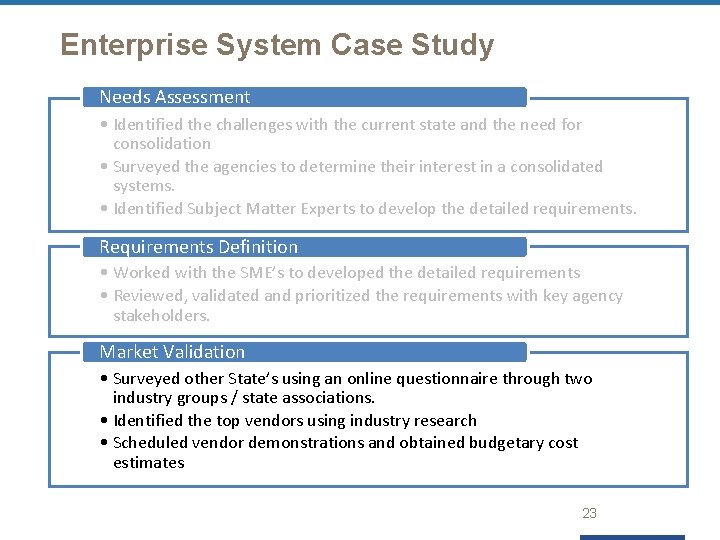
Enterprise System Case Study Needs Assessment • Identified the challenges with the current state and the need for consolidation • Surveyed the agencies to determine their interest in a consolidated systems. • Identified Subject Matter Experts to develop the detailed requirements. Requirements Definition • Worked with the SME’s to developed the detailed requirements • Reviewed, validated and prioritized the requirements with key agency stakeholders. Market Validation • Surveyed other State’s using an online questionnaire through two industry groups / state associations. • Identified the top vendors using industry research • Scheduled vendor demonstrations and obtained budgetary cost estimates 23
Evaluating Alternatives Evaluating Solution Alternatives 24
List the Available Options § Different solutions to solving the problem. § Different implementation approaches (pilot program / proof of concept, phases, big bang). § Different business models (outsourced vs. in house). § Different procurement options (SWC, RFQC, Piggyback, Consortia, etc. ).
Evaluating the Options § For each option identify the pros and cons of each approach. § Identify the resources required for each approach (Time, Staff, Budget). § Provide a recommendation for the best option to meet your project’s objectives.
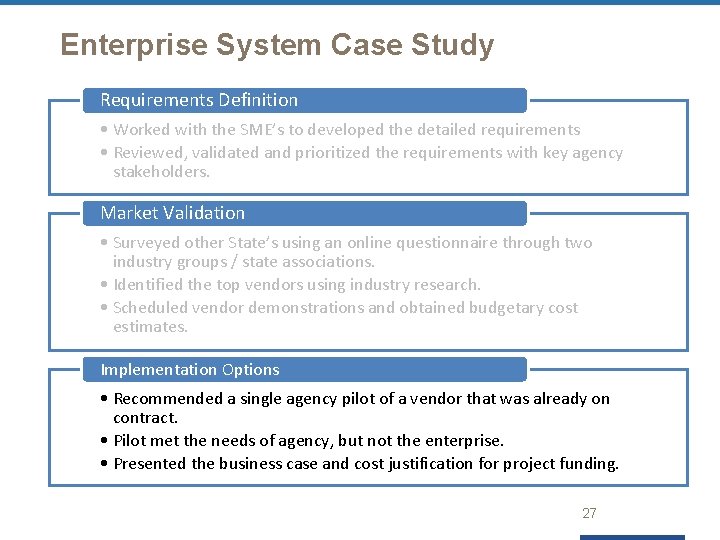
Enterprise System Case Study Requirements Definition • Worked with the SME’s to developed the detailed requirements • Reviewed, validated and prioritized the requirements with key agency stakeholders. Market Validation • Surveyed other State’s using an online questionnaire through two industry groups / state associations. • Identified the top vendors using industry research. • Scheduled vendor demonstrations and obtained budgetary cost estimates. Implementation Options • Recommended a single agency pilot of a vendor that was already on contract. • Pilot met the needs of agency, but not the enterprise. • Presented the business case and cost justification for project funding. 27
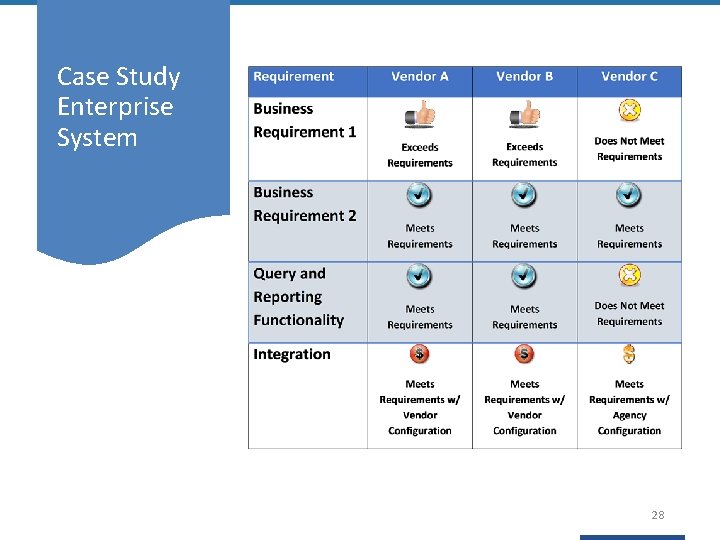
Case Study Enterprise System 28
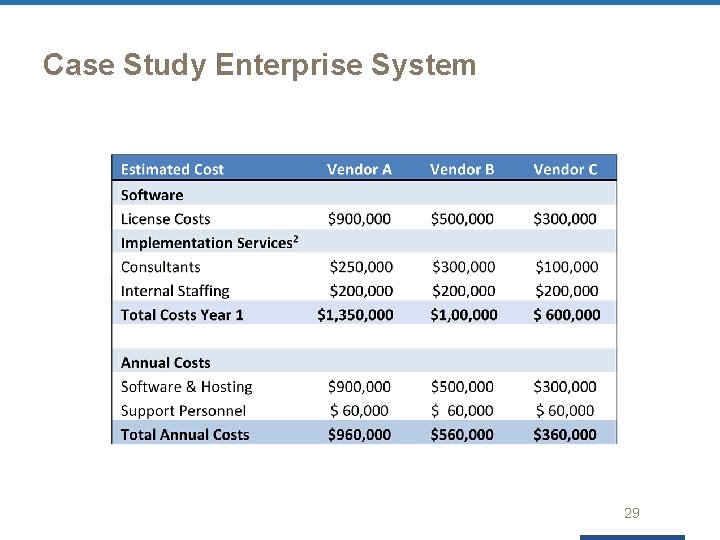
Case Study Enterprise System 29
Session Summary The Needs Assessment: § Conducted early in the project lifecycle before the RFP is written. § Defines the business and technical requirements of the project. § Identifies best practices by researching market trends and how other organizations are addressing similar issues. § Analyzes the options for meeting the project’s objectives. § Outlines the high-level implementation plan for the project. 30
Rob Prinzo rprinzo@Prinzo. Group. com www. Prinzo. Group. com State Purchasing
- Slides: 31