
Evaluating Scour Potential in Stormwater Catchbasin Sumps Using
Evaluating Scour Potential in Stormwater Catchbasin Sumps Using a Full-Scale Physical Model and CFD Modeling Humberto Avila Universidad del Norte, Department of Civil and Environmental Engineering, Barranquilla, Colombia. havila@uninorte. edu. co Robert Pitt The University of Alabama, Department of Civil, Construction, and Environmental Engineering, Tuscaloosa, AL, USA. rpitt@eng. ua. edu World Environmental & Water Resources Congress EWRI – ASCE 2009 1
Introduction Sediment removal measurements in catchbasin sumps and hydrodynamic separators does not necessarily imply the prevention of scour of previously captured sediment. Understanding scour mechanisms and losses in catchbasins and similar devices is critical when implementing stormwater management programs relying on these control practices. Simplified models were developed during this research to calculate sediment scour in catchbasin sumps. These can be implemented in stormwater management software packages, such as Win. SLAMM, to calculate the expected sediment scour. 2
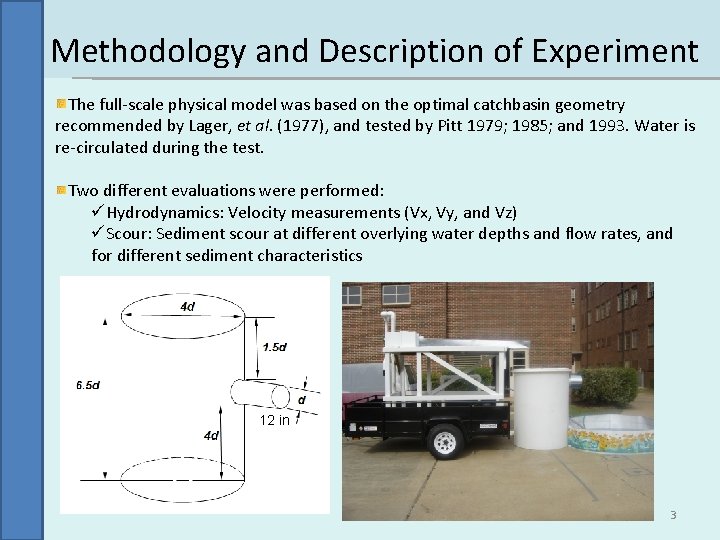
Methodology and Description of Experiment The full-scale physical model was based on the optimal catchbasin geometry recommended by Lager, et al. (1977), and tested by Pitt 1979; 1985; and 1993. Water is re-circulated during the test. Two different evaluations were performed: üHydrodynamics: Velocity measurements (Vx, Vy, and Vz) üScour: Sediment scour at different overlying water depths and flow rates, and for different sediment characteristics 12 in 3
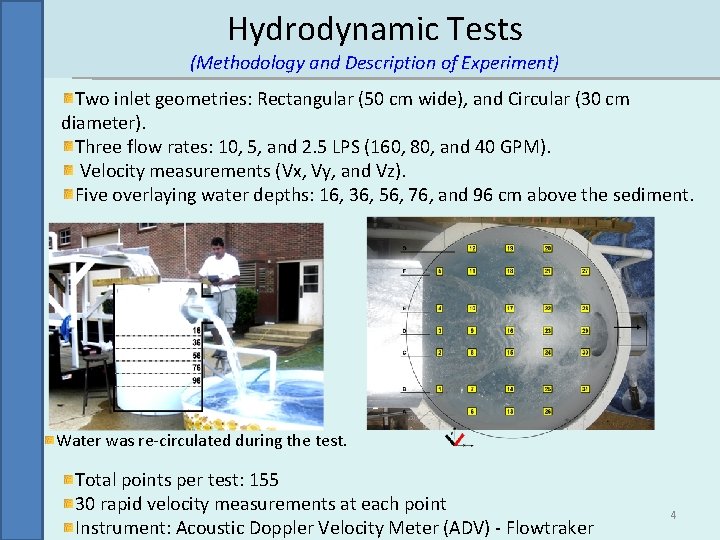
Hydrodynamic Tests (Methodology and Description of Experiment) Two inlet geometries: Rectangular (50 cm wide), and Circular (30 cm diameter). Three flow rates: 10, 5, and 2. 5 LPS (160, 80, and 40 GPM). Velocity measurements (Vx, Vy, and Vz). Five overlaying water depths: 16, 36, 56, 76, and 96 cm above the sediment. Water was re-circulated during the test. Total points per test: 155 30 rapid velocity measurements at each point Instrument: Acoustic Doppler Velocity Meter (ADV) - Flowtraker 4
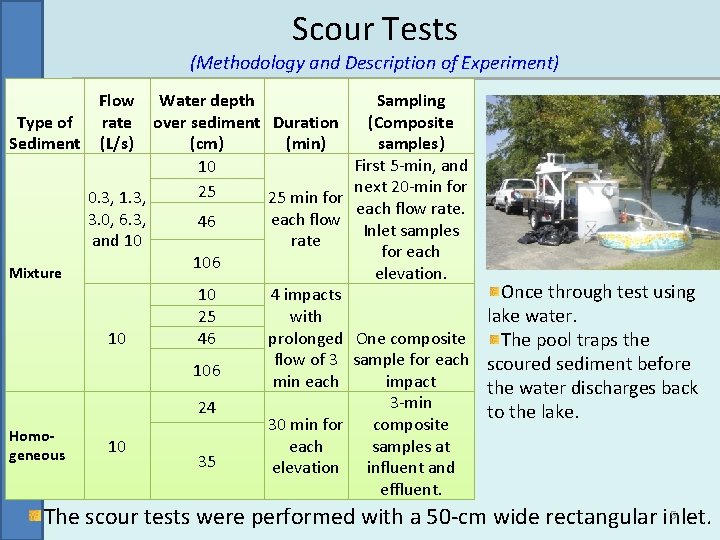
Scour Tests (Methodology and Description of Experiment) Flow rate (L/s) Water depth Sampling Type of over sediment Duration (Composite Sediment (cm) (min) samples) First 5 -min, and 10 next 20 -min for 25 0. 3, 1. 3, 25 min for each flow rate. 3. 0, 6. 3, each flow 46 Inlet samples and 10 rate for each 106 Mixture elevation. 10 4 impacts 25 with 46 10 prolonged One composite flow of 3 sample for each 106 min each impact 3 -min 24 30 min for composite Homo 10 each samples at geneous 35 elevation influent and effluent. Once through test using lake water. The pool traps the scoured sediment before the water discharges back to the lake. 5 The scour tests were performed with a 50 -cm wide rectangular inlet.

Scour Tests (Methodology and Description of Experiment) Sediment mixture (D 50 = 500 mm; uniformity coefficient = 11) Sediment with homogeneous particle size based on PSD found by Pitt (1997), Valiron and (D 50 = 180 mm; uniformity coefficient = 2. 5) Tabuchi (1992), and Pitt and Khambhammuttu (2006) D 90 = 2000 mm D 50 = 500 mm D 10 = 80 mm Develops armoring layer D 90 = 250 mm D 50 = 180 mm D 10 = 80 mm Only a minimal armoring layer developed. Data also used for CFD calibration and validation. 6

Scour Tests Installation of blocks to set the false bottom Measuring depth below the outlet (overlaying water depth above sediment) Cone splitter and sample bottles False bottom sealed on the border Performing scour test Leveling of sediment bed: 20 cm thick Sieve analysis 7
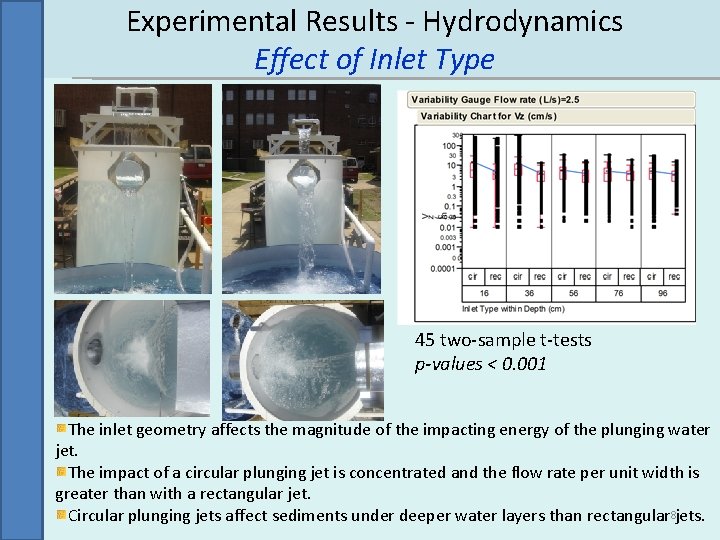
Experimental Results - Hydrodynamics Effect of Inlet Type 45 two-sample t-tests p-values < 0. 001 The inlet geometry affects the magnitude of the impacting energy of the plunging water jet. The impact of a circular plunging jet is concentrated and the flow rate per unit width is greater than with a rectangular jet. Circular plunging jets affect sediments under deeper water layers than rectangular 8 jets.
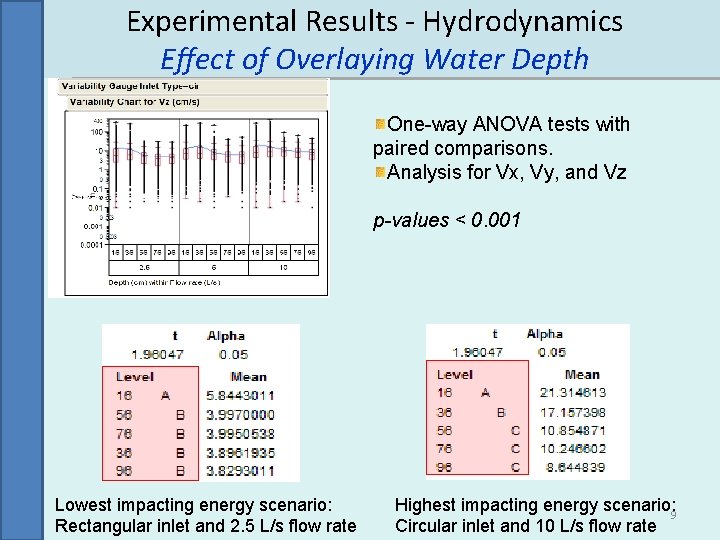
Experimental Results - Hydrodynamics Effect of Overlaying Water Depth One-way ANOVA tests with paired comparisons. Analysis for Vx, Vy, and Vz p-values < 0. 001 Lowest impacting energy scenario: Rectangular inlet and 2. 5 L/s flow rate Highest impacting energy scenario: 9 Circular inlet and 10 L/s flow rate
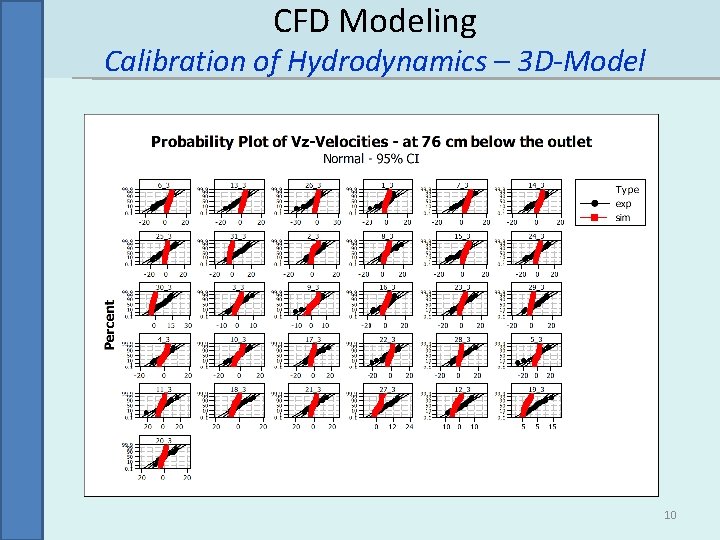
CFD Modeling Calibration of Hydrodynamics – 3 D-Model 10
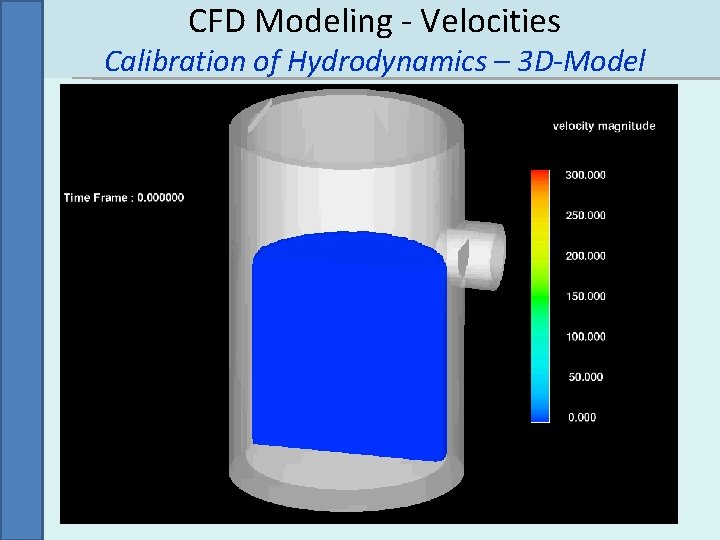
CFD Modeling - Velocities Calibration of Hydrodynamics – 3 D-Model 11
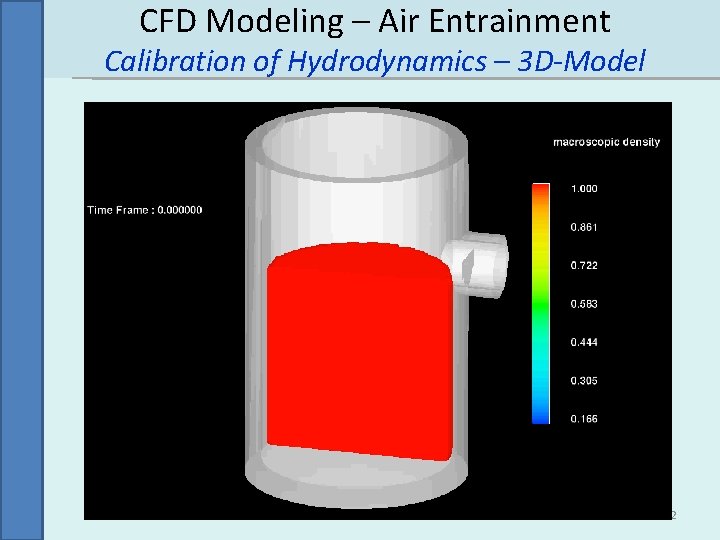
CFD Modeling – Air Entrainment Calibration of Hydrodynamics – 3 D-Model 12
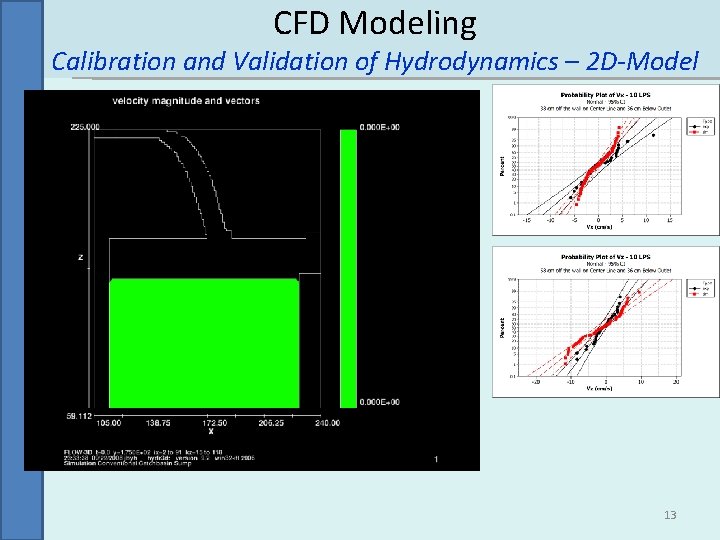
CFD Modeling Calibration and Validation of Hydrodynamics – 2 D-Model 13
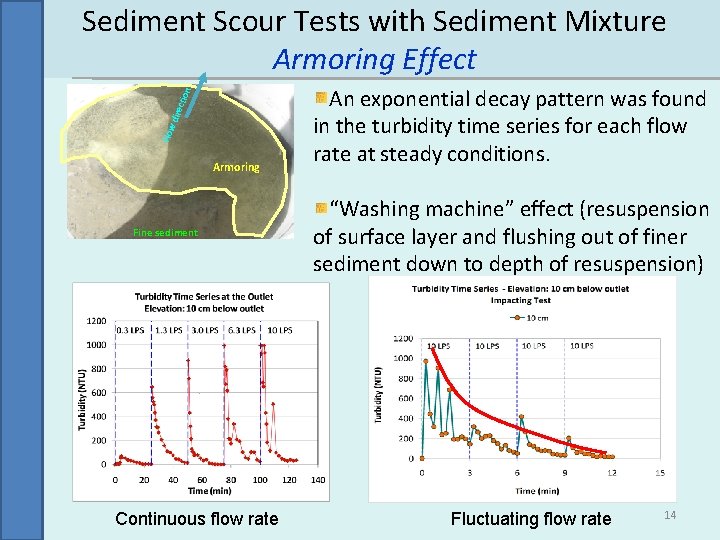
Flow dire c tion Sediment Scour Tests with Sediment Mixture Armoring Effect Armoring Fine sediment Continuous flow rate An exponential decay pattern was found in the turbidity time series for each flow rate at steady conditions. “Washing machine” effect (resuspension of surface layer and flushing out of finer sediment down to depth of resuspension) Fluctuating flow rate 14
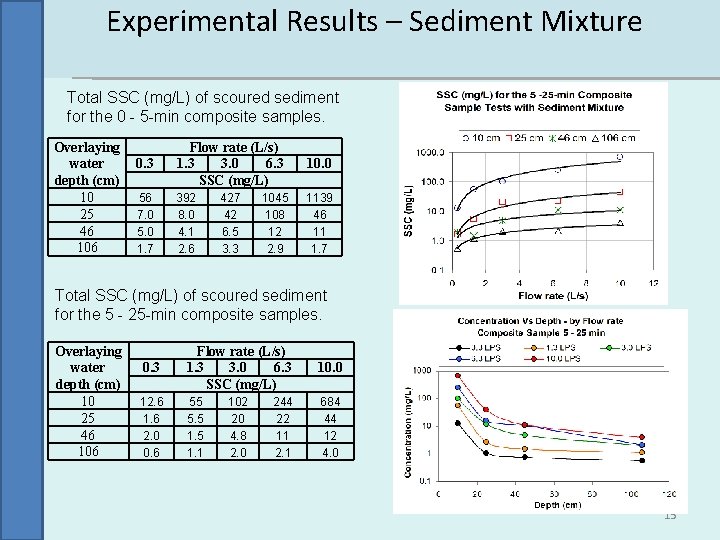
Experimental Results – Sediment Mixture Total SSC (mg/L) of scoured sediment for the 0 - 5 -min composite samples. Overlaying water depth (cm) 10 25 46 106 0. 3 Flow rate (L/s) 1. 3 3. 0 6. 3 SSC (mg/L) 10. 0 56 7. 0 5. 0 1. 7 392 8. 0 4. 1 2. 6 1139 46 11 1. 7 42 6. 5 3. 3 1045 108 12 2. 9 Total SSC (mg/L) of scoured sediment for the 5 - 25 -min composite samples. Overlaying water depth (cm) 10 25 46 106 0. 3 Flow rate (L/s) 1. 3 3. 0 6. 3 SSC (mg/L) 10. 0 12. 6 1. 6 2. 0 0. 6 55 5. 5 1. 1 684 44 12 4. 0 102 20 4. 8 2. 0 244 22 11 2. 1 15
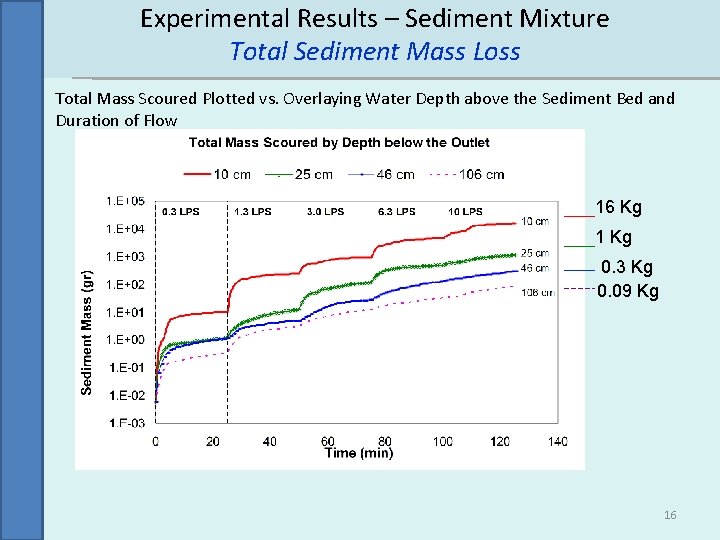
Experimental Results – Sediment Mixture Total Sediment Mass Loss Total Mass Scoured Plotted vs. Overlaying Water Depth above the Sediment Bed and Duration of Flow 16 Kg 1 Kg 0. 3 Kg 0. 09 Kg 16
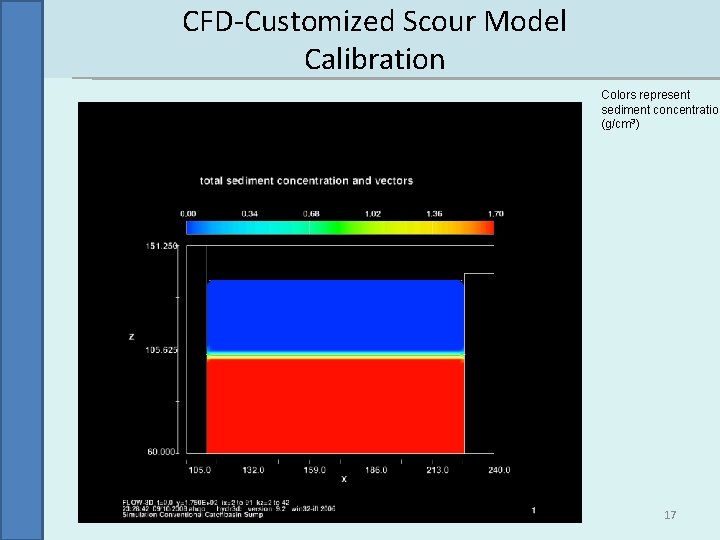
CFD-Customized Scour Model Calibration Colors represent sediment concentration (g/cm 3) 17
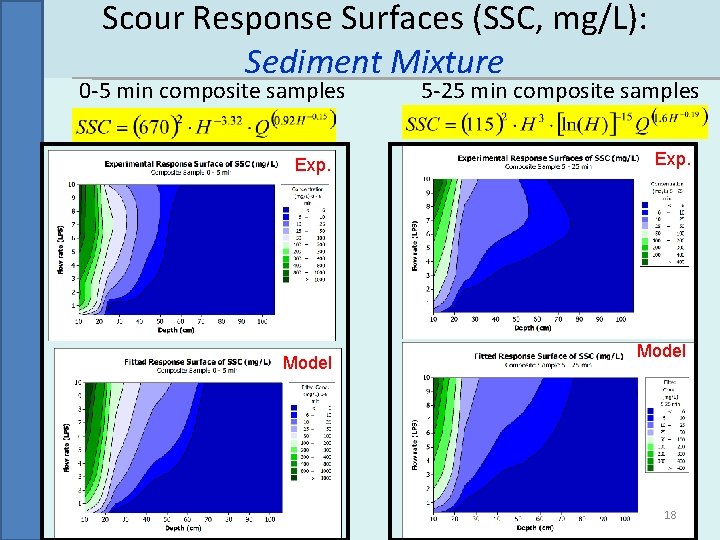
Scour Response Surfaces (SSC, mg/L): Sediment Mixture 0 -5 min composite samples Exp. Model 5 -25 min composite samples Exp. Model 18
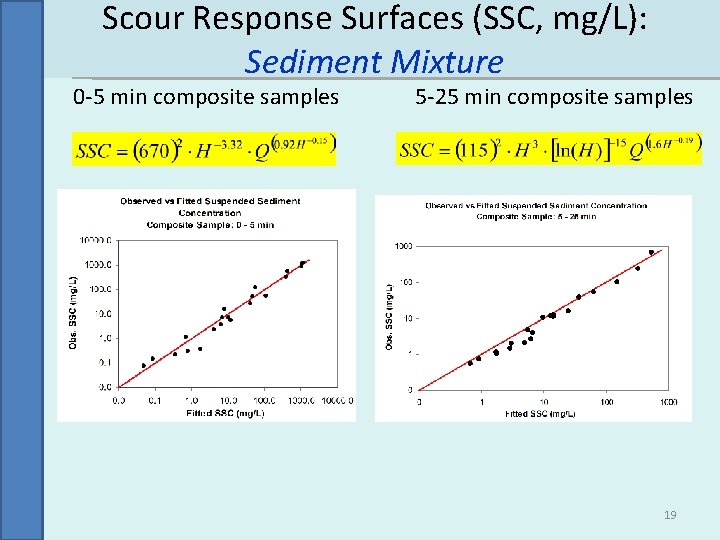
Scour Response Surfaces (SSC, mg/L): Sediment Mixture 0 -5 min composite samples 5 -25 min composite samples 19
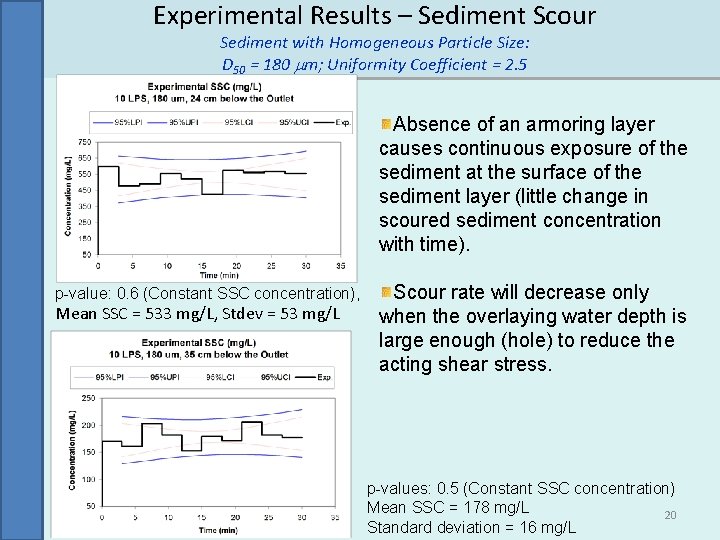
Experimental Results – Sediment Scour Sediment with Homogeneous Particle Size: D 50 = 180 mm; Uniformity Coefficient = 2. 5 Absence of an armoring layer causes continuous exposure of the sediment at the surface of the sediment layer (little change in scoured sediment concentration with time). p-value: 0. 6 (Constant SSC concentration), Mean SSC = 533 mg/L, Stdev = 53 mg/L +3 -3 +3 +2 -3 -1 Scour rate will decrease only when the overlaying water depth is large enough (hole) to reduce the acting shear stress. 0 -1 +6 -3 +3 -2 p-values: 0. 5 (Constant SSC concentration) Mean SSC = 178 mg/L 20 Standard deviation = 16 mg/L
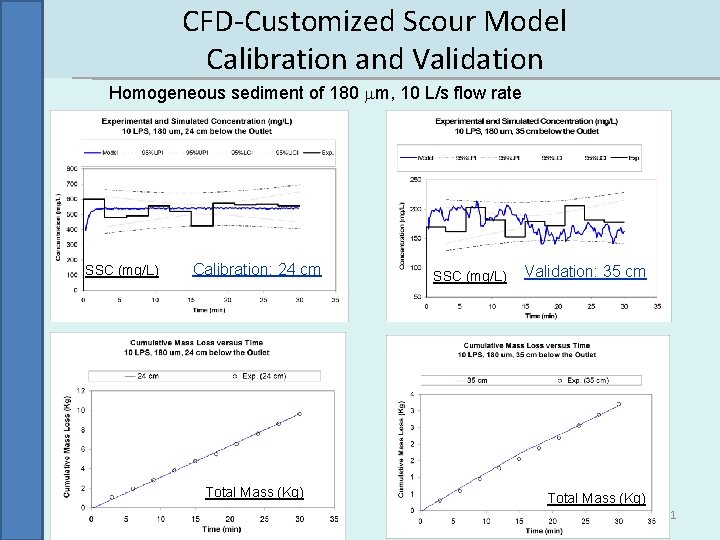
CFD-Customized Scour Model Calibration and Validation Homogeneous sediment of 180 mm, 10 L/s flow rate SSC (mg/L) Calibration: 24 cm Total Mass (Kg) SSC (mg/L) Validation: 35 cm Total Mass (Kg) 21
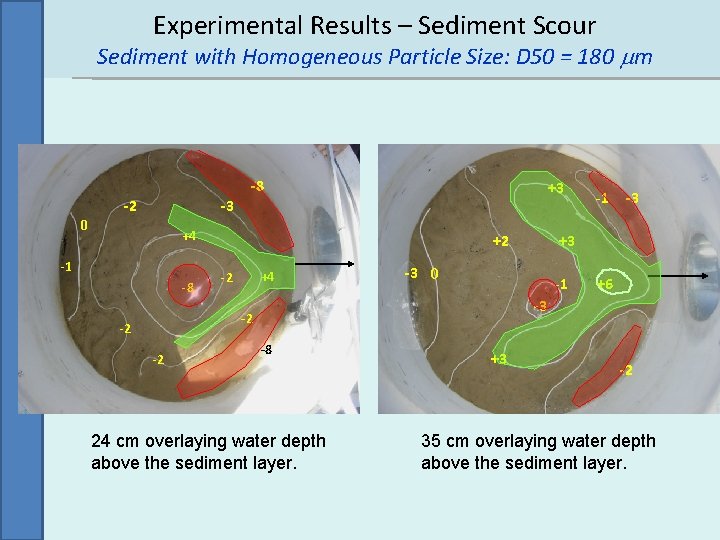
Experimental Results – Sediment Scour Sediment with Homogeneous Particle Size: D 50 = 180 mm -8 -2 +3 -3 0 +4 -1 -8 +4 -3 0 -1 -2 +6 -3 -2 -2 -3 +3 +2 -2 -1 -8 24 cm overlaying water depth above the sediment layer. +3 -2 35 cm overlaying water depth above the sediment layer.
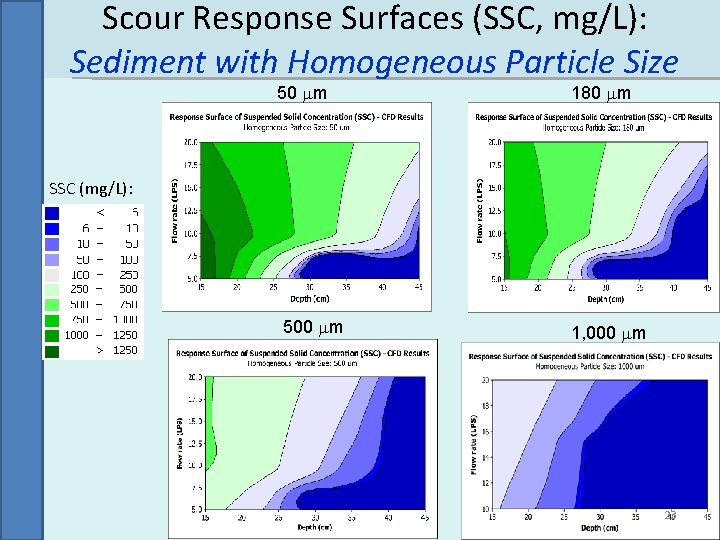
Scour Response Surfaces (SSC, mg/L): Sediment with Homogeneous Particle Size 50 mm 180 mm SSC (mg/L): 500 mm 1, 000 mm 23
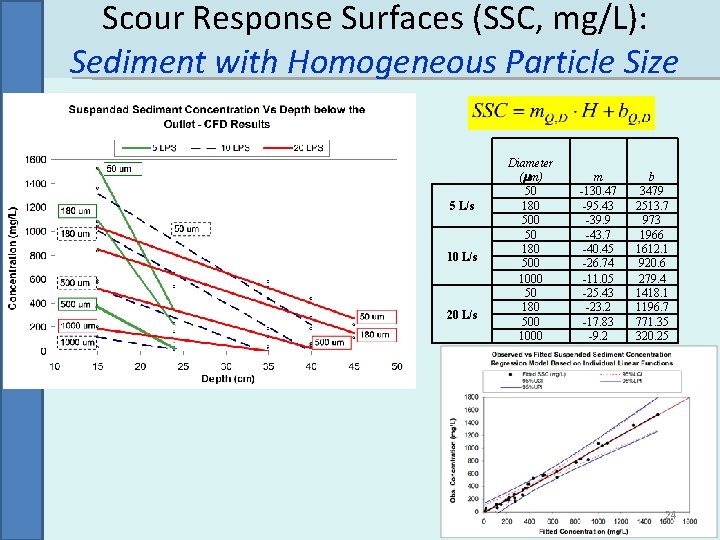
Scour Response Surfaces (SSC, mg/L): Sediment with Homogeneous Particle Size 5 L/s 10 L/s 20 L/s Diameter (mm) 50 180 500 1000 m -130. 47 -95. 43 -39. 9 -43. 7 -40. 45 -26. 74 -11. 05 -25. 43 -23. 2 -17. 83 -9. 2 b 3479 2513. 7 973 1966 1612. 1 920. 6 279. 4 1418. 1 1196. 7 771. 35 320. 25 24
Conclusions The overlaying water depth above the sediment is highly important in protecting the sediment from scour. SSC decreases with an exponential pattern as the overlaying water depth increases for a sediment mixture (with armoring), and with a linear pattern for sediment with a homogeneous particle size. The inlet geometry has a significant effect on the scour potential of sediments captured in conventional catchbasin sumps. Modifying the inlet flow to decrease the impacting energy and/or physically isolating the sediment from the impacting water provides a feasible alternative on catchbasins already installed. It is recommended to perform scour tests with fluctuating flow rates to account for the flow variability that actually occurs during rainfall events The scour response surface equations can be implemented in stormwater management software packages to calculate the loss of sediment scoured from catchbasin sumps and similar devices. 25
- Slides: 25