
Evaluating procurement strategies under uncertain demand risk of
![Scenario trees are built with moment matching method* n 1 st stage targets: E[D]=500](https://slidetodoc.com/presentation_image/3b94e10d18aa9c644fd6cc8d12736671/image-12.jpg "Scenario trees are built with moment matching method* n 1 st stage targets: E[D]=500")
- Slides: 23
Evaluating procurement strategies under uncertain demand risk of component unavailability Anssi Käki and Ahti Salo Systems Analysis Laboratory Aalto University School of Science and Technology P. O. Box 11100, 00076 Aalto FINLAND
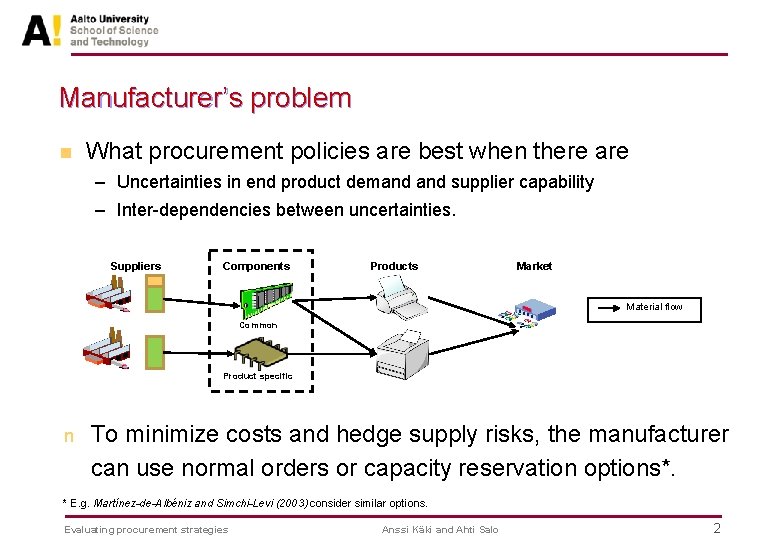
Manufacturer’s problem n What procurement policies are best when there are – Uncertainties in end product demand supplier capability – Inter-dependencies between uncertainties. Suppliers Components Products Market Material flow Common Product specific n To minimize costs and hedge supply risks, the manufacturer can use normal orders or capacity reservation options*. * E. g. Martínez-de-Albéniz and Simchi-Levi (2003) consider similar options. Evaluating procurement strategies Anssi Käki and Ahti Salo 2
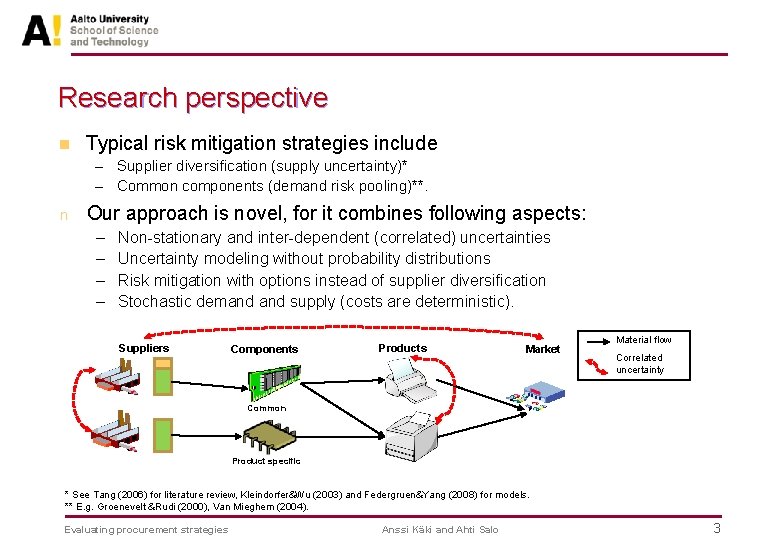
Research perspective n Typical risk mitigation strategies include – Supplier diversification (supply uncertainty)* – Common components (demand risk pooling)**. n Our approach is novel, for it combines following aspects: – – Non-stationary and inter-dependent (correlated) uncertainties Uncertainty modeling without probability distributions Risk mitigation with options instead of supplier diversification Stochastic demand supply (costs are deterministic). Suppliers Components Products Market Material flow Correlated uncertainty Common Product specific * See Tang (2006) for literature review, Kleindorfer&Wu (2003) and Federgruen&Yang (2008) for models. ** E. g. Groenevelt &Rudi (2000), Van Mieghem (2004). Evaluating procurement strategies Anssi Käki and Ahti Salo 3
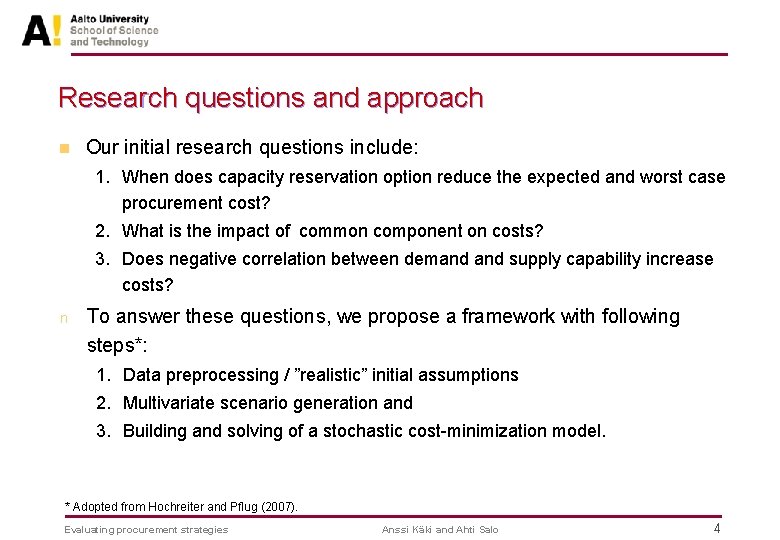
Research questions and approach n Our initial research questions include: 1. When does capacity reservation option reduce the expected and worst case procurement cost? 2. What is the impact of common component on costs? 3. Does negative correlation between demand supply capability increase costs? n To answer these questions, we propose a framework with following steps*: 1. Data preprocessing / ”realistic” initial assumptions 2. Multivariate scenario generation and 3. Building and solving of a stochastic cost-minimization model. * Adopted from Hochreiter and Pflug (2007). Evaluating procurement strategies Anssi Käki and Ahti Salo 4
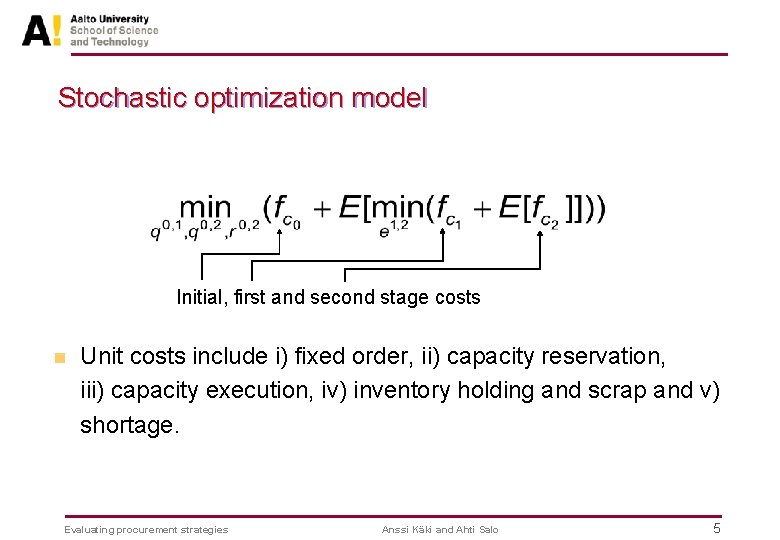
Stochastic optimization model Initial, first and second stage costs n Unit costs include i) fixed order, ii) capacity reservation, iii) capacity execution, iv) inventory holding and scrap and v) shortage. Evaluating procurement strategies Anssi Käki and Ahti Salo 5
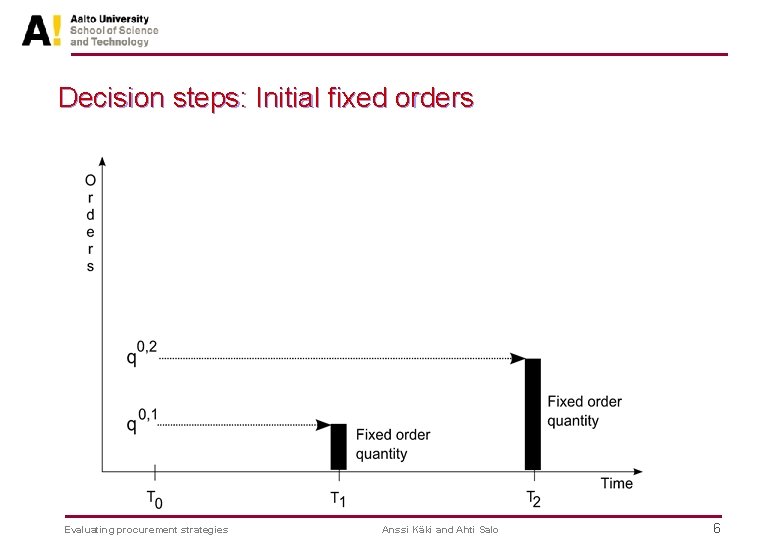
Decision steps: Initial fixed orders Evaluating procurement strategies Anssi Käki and Ahti Salo 6
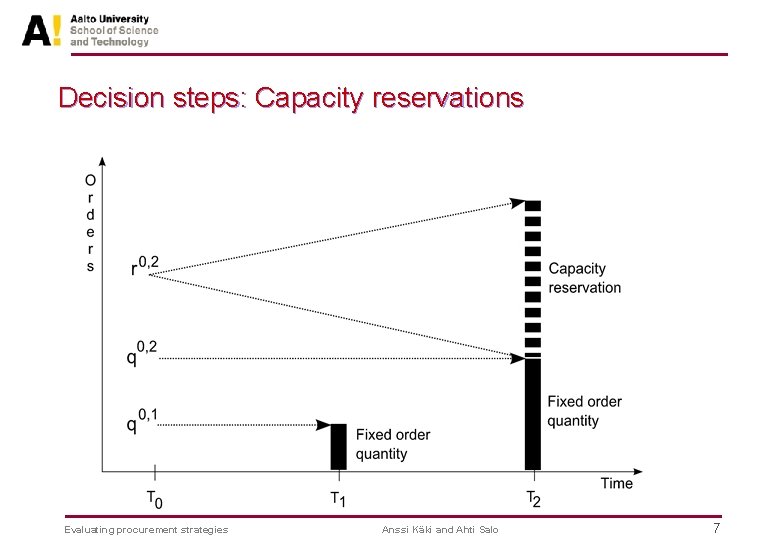
Decision steps: Capacity reservations Evaluating procurement strategies Anssi Käki and Ahti Salo 7
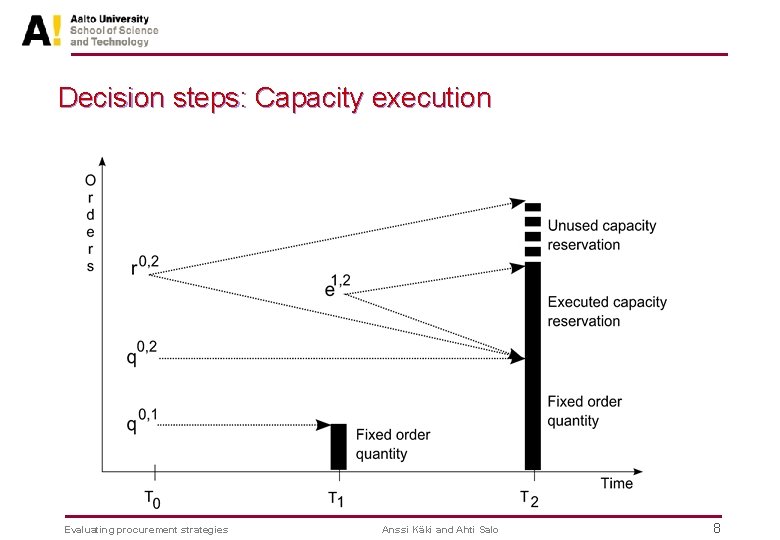
Decision steps: Capacity execution Evaluating procurement strategies Anssi Käki and Ahti Salo 8
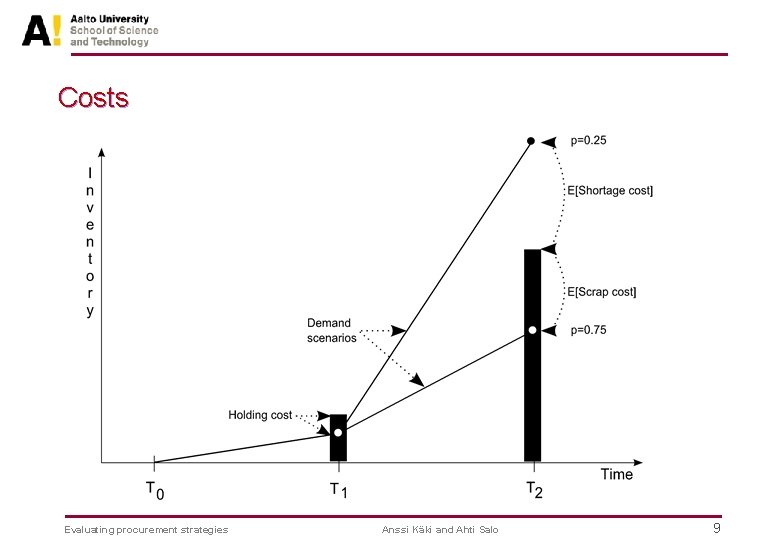
Costs Evaluating procurement strategies Anssi Käki and Ahti Salo 9
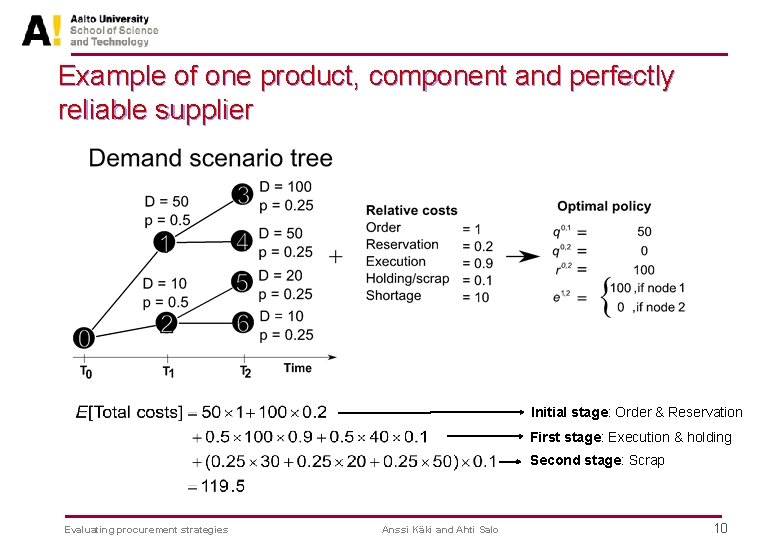
Example of one product, component and perfectly reliable supplier Initial stage: Order & Reservation First stage: Execution & holding Second stage: Scrap Evaluating procurement strategies Anssi Käki and Ahti Salo 10
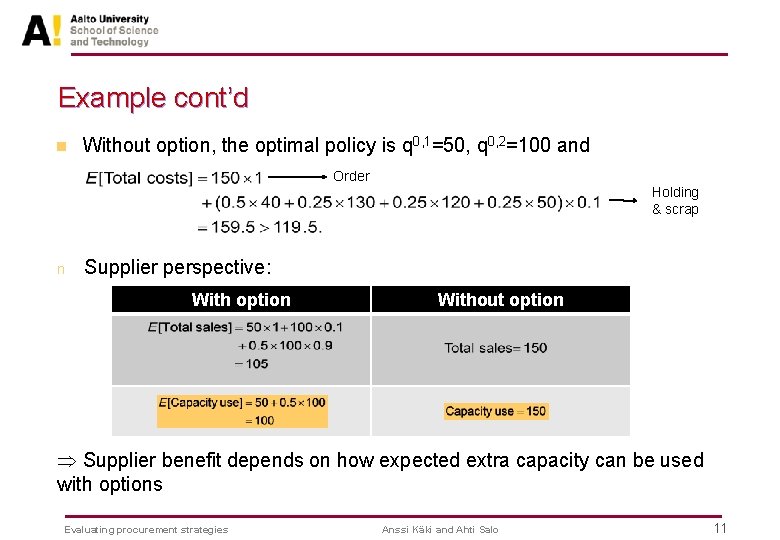
Example cont’d n Without option, the optimal policy is q 0, 1=50, q 0, 2=100 and Order Holding & scrap n Supplier perspective: With option Without option Supplier benefit depends on how expected extra capacity can be used with options Evaluating procurement strategies Anssi Käki and Ahti Salo 11
Scenario trees are built with moment matching method* n 1 st stage targets: E[D]=500 Var[D]=10 000 Skew[D]=2 2 nd stage targets: E[D] i, 2= 5 x Di, 1 Var[D] = 5 x Var[D] Skew[D]=2 Demand: » Expected product sales » Variance and skewness » Correlation between sales n Supply capability: » Expected capability (0… 100%) » Variance and skewness » Correlation between suppliers n Correlation between aggregated demand supply 1 st stage targets: E[S]=97% Var[S]=10% Skew[S] = -0. 5 2 nd stage targets: E[S] i, 2= Si, 1 Var[S] =Var[S] Skew[S]=-0. 5 * Hoyland Wallace (2001). Evaluating procurement strategies Anssi Käki and Ahti Salo 12
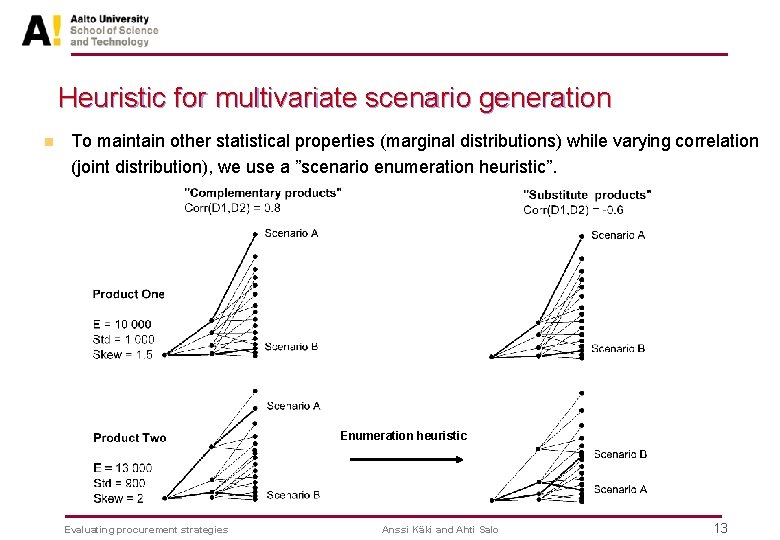
Heuristic for multivariate scenario generation n To maintain other statistical properties (marginal distributions) while varying correlation (joint distribution), we use a ”scenario enumeration heuristic”. Enumeration heuristic Evaluating procurement strategies Anssi Käki and Ahti Salo 13
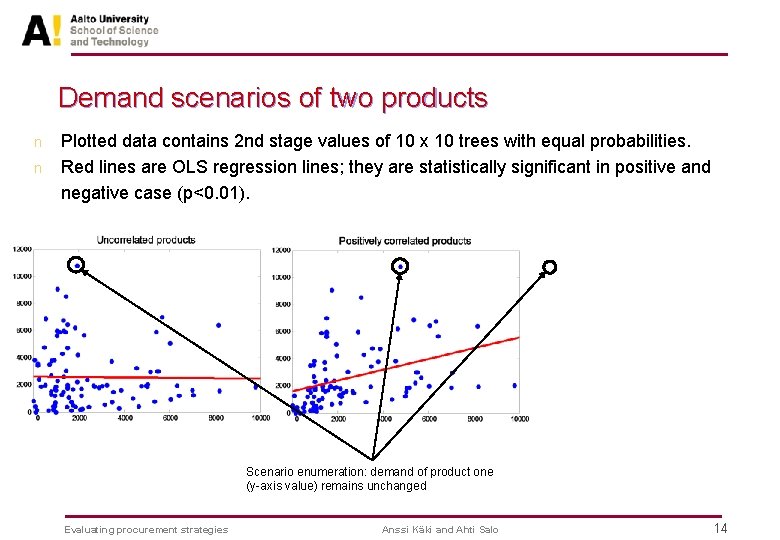
Demand scenarios of two products n n Plotted data contains 2 nd stage values of 10 x 10 trees with equal probabilities. Red lines are OLS regression lines; they are statistically significant in positive and negative case (p<0. 01). Scenario enumeration: demand of product one (y-axis value) remains unchanged Evaluating procurement strategies Anssi Käki and Ahti Salo 14
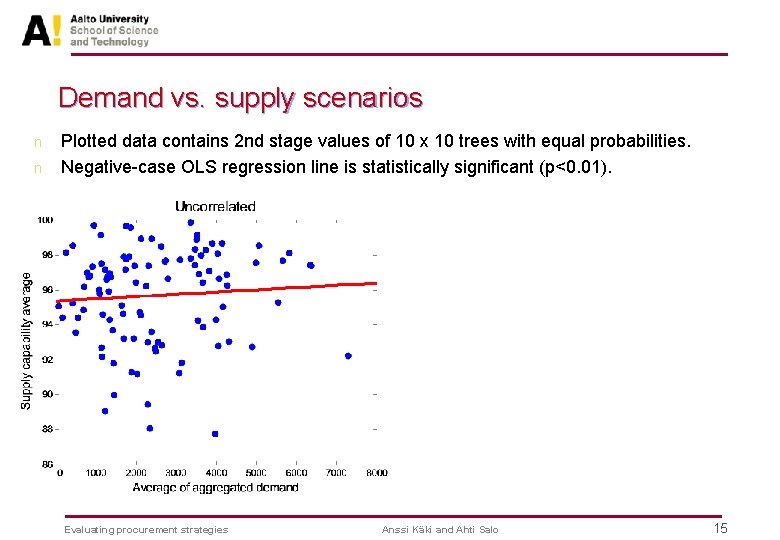
Demand vs. supply scenarios n n Plotted data contains 2 nd stage values of 10 x 10 trees with equal probabilities. Negative-case OLS regression line is statistically significant (p<0. 01). Evaluating procurement strategies Anssi Käki and Ahti Salo 15
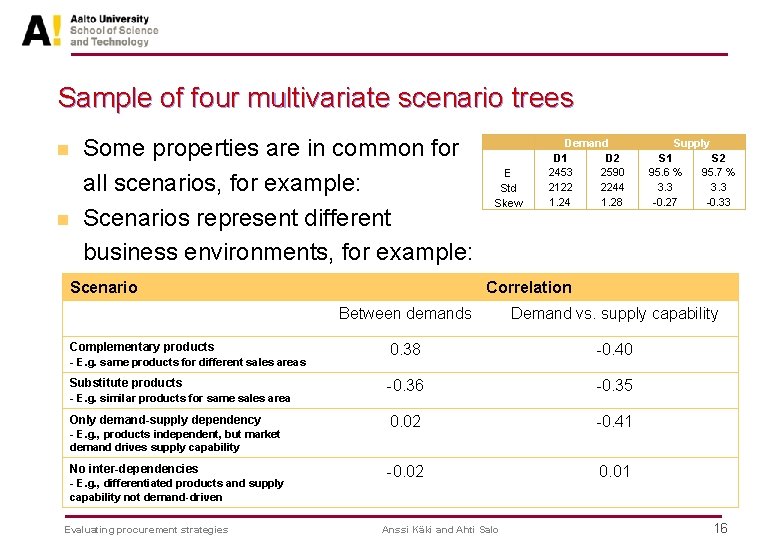
Sample of four multivariate scenario trees n n Some properties are in common for all scenarios, for example: Scenarios represent different business environments, for example: Scenario E Std Skew Demand D 1 D 2 2453 2590 2122 2244 1. 28 Supply S 1 95. 6 % 3. 3 -0. 27 S 2 95. 7 % 3. 3 -0. 33 Correlation Between demands Demand vs. supply capability Complementary products - E. g. same products for different sales areas 0. 38 -0. 40 Substitute products - E. g. similar products for same sales area -0. 36 -0. 35 Only demand-supply dependency - E. g. , products independent, but market 0. 02 -0. 41 -0. 02 0. 01 demand drives supply capability No inter-dependencies - E. g. , differentiated products and supply capability not demand-driven Evaluating procurement strategies Anssi Käki and Ahti Salo 16
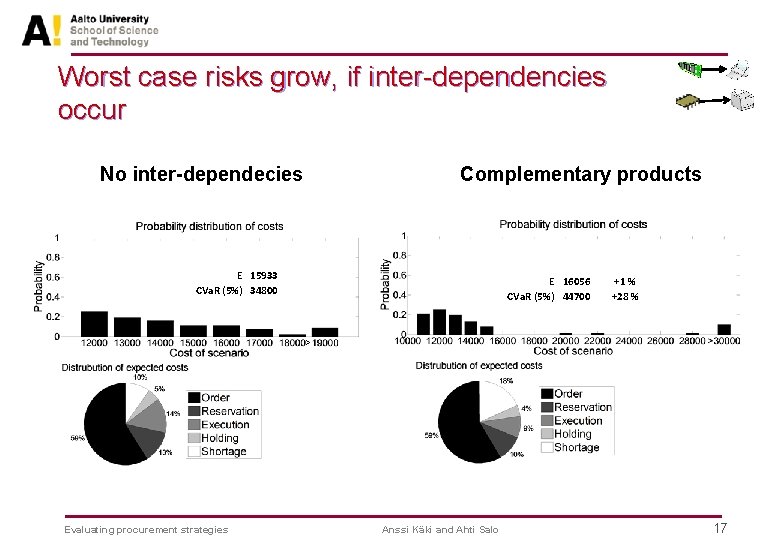
Worst case risks grow, if inter-dependencies occur No inter-dependecies Complementary products E 15933 CVa. R (5%) 34800 E 16056 CVa. R (5%) 44700 +1 % +28 % > Evaluating procurement strategies Anssi Käki and Ahti Salo 17
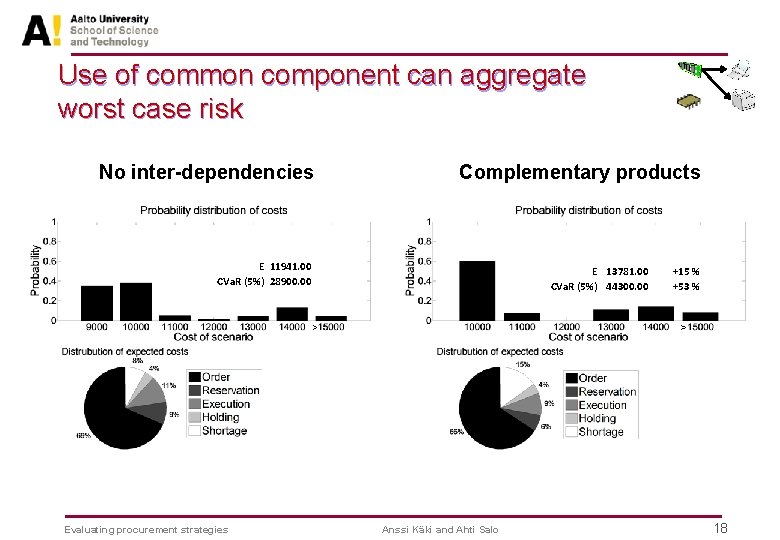
Use of common component can aggregate worst case risk No inter-dependencies Complementary products E 11941. 00 CVa. R (5%) 28900. 00 E 13781. 00 CVa. R (5%) 44300. 00 > > Evaluating procurement strategies +15 % +53 % Anssi Käki and Ahti Salo 18
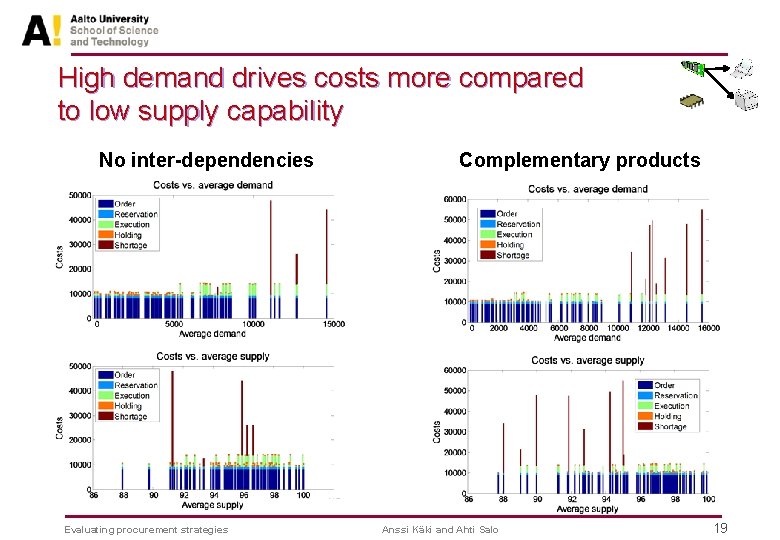
High demand drives costs more compared to low supply capability No inter-dependencies Evaluating procurement strategies Complementary products Anssi Käki and Ahti Salo 19
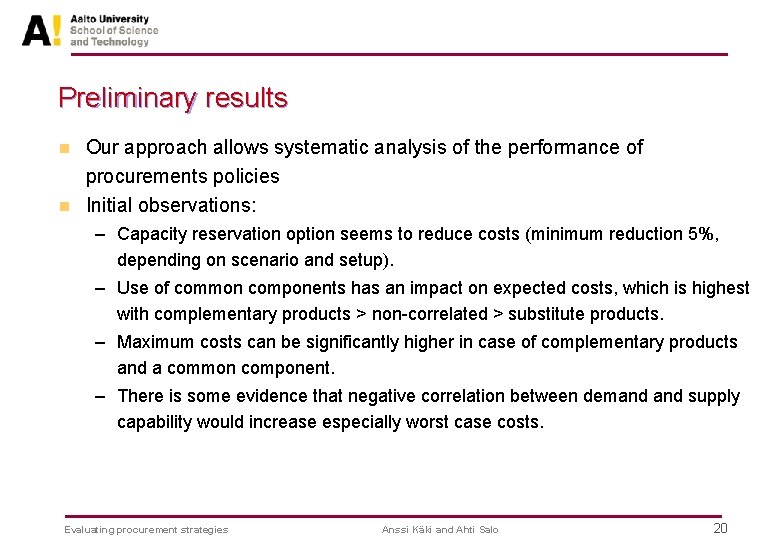
Preliminary results n n Our approach allows systematic analysis of the performance of procurements policies Initial observations: – Capacity reservation option seems to reduce costs (minimum reduction 5%, depending on scenario and setup). – Use of common components has an impact on expected costs, which is highest with complementary products > non-correlated > substitute products. – Maximum costs can be significantly higher in case of complementary products and a common component. – There is some evidence that negative correlation between demand supply capability would increase especially worst case costs. Evaluating procurement strategies Anssi Käki and Ahti Salo 20
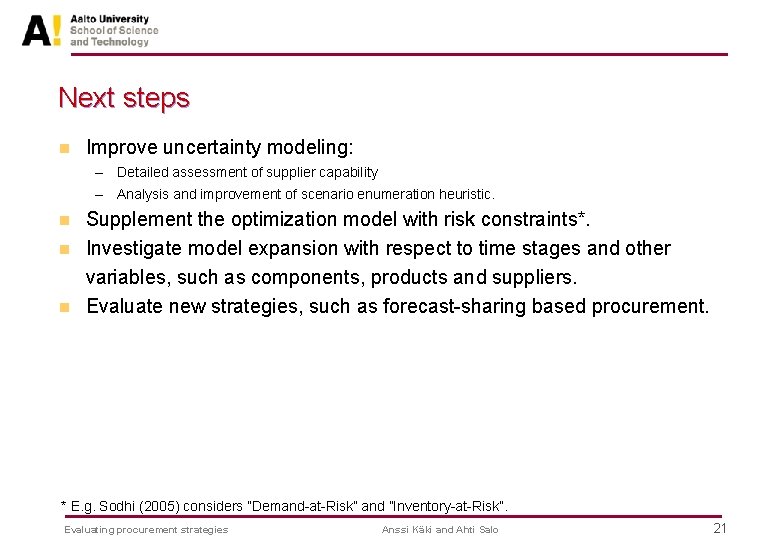
Next steps n Improve uncertainty modeling: – Detailed assessment of supplier capability – Analysis and improvement of scenario enumeration heuristic. n n n Supplement the optimization model with risk constraints*. Investigate model expansion with respect to time stages and other variables, such as components, products and suppliers. Evaluate new strategies, such as forecast-sharing based procurement. * E. g. Sodhi (2005) considers ”Demand-at-Risk” and ”Inventory-at-Risk”. Evaluating procurement strategies Anssi Käki and Ahti Salo 21
References Federgruen, A. and Yang, N. (2008). Selecting a portfolio of suppliers under demand supply risks. Operations Research, 56(4): 916 -936. Groenevelt, H. and Rudi N. (2000). Product design for component commonality and the effect of demand correlation. Working paper, University of Rochester, NY Hochreiter, R. and Pflug, G. C. (2007). Financial scenario generation for stochastic multi-stage decision processes as facility location problems. Annals of Operations Research, 152(1): 257 -272. Hoyland, K. and Wallace, S. W. (2001). Generating scenario trees for multi-stage decision problems. Management Science, 47(2): 295 -307. Kleindorfer, P. R. and Wu, D. J. (2003). Integrating long- and short-term contracting via business-to-business exchanges for capital intensive industries. Management Science, 49(11): 1597 -1615. Martínez-de-Albéniz, V. and Simchi-Levi, D. (2003). A portfolio approach to procurement contracts. MIT Sloan School of Management Paper 188, Available at http: //ebusiness. mit. edu/research/papers/188 DSlevi. Portfolio. Approach. pdf. Sodhi, M. S. (2005). Managing demand risk in tactical supply chain planning for a global consumer electronics company. Production and Operations Management, 14(1): 69 -79. Tang, C. S. (2006). Review: Perspectives in supply chain risk management. International Journal of Production Economics, 103: 451– 488. Van Mieghem, J. A. (2004). Commonality strategies: Value drivers and equivalence with flexible capacity and inventory substitution. Management Science, 50(3): 419 -424. Evaluating procurement strategies Anssi Käki and Ahti Salo 22
Appendix – Computational aspects n Scenario trees by moment matching is hard: – Non-linear, non-convex optimization problem – With constant probabilities, amount of variables is N 1+N 1 x. N 2 x. N 3+…, where Nn = amount of nodes of stage n – If probabilities are decision variables, problem is even harder – There are more efficient heuristics available* n Test runs show that the stochastic optimization model is solvable with e. g. 100 x 100 = 10 000 scenarios (solving time less than one minute with Lenovo SL 500 laptop and CPLEX 12. 0). * See: Hochreiter, R. (2009). Algorithmic aspects of scenario-based multi-stage decision process optimization. In: Rossi, F. , Tsoukias, A. (eds. ) Algorithmic Decision Theory 2009. LNCS, vol. 5783, pp. 365– 376. Springer, Heidelberg. Evaluating procurement strategies Anssi Käki and Ahti Salo 23