
Evaluating Managing Conflicts Conflict Response Modes Conflict Styles
- Slides: 49
Evaluating & Managing Conflicts
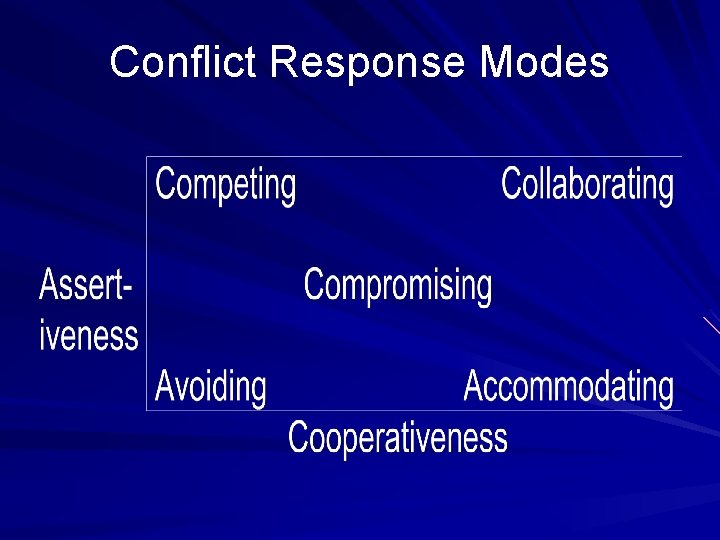
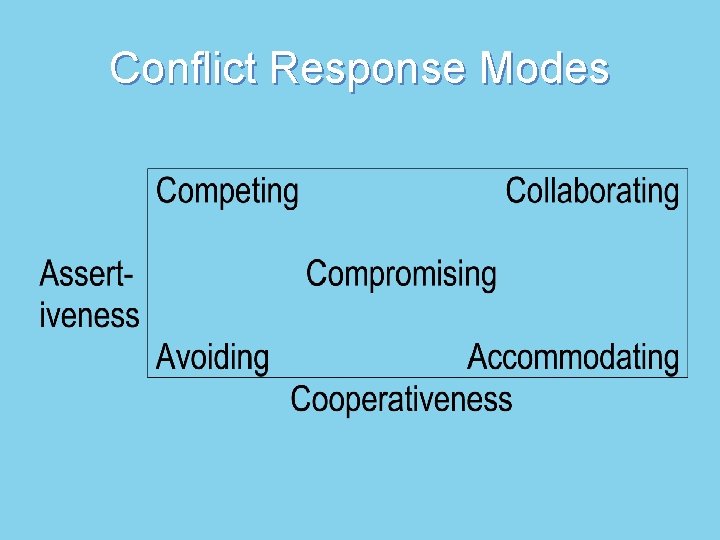
Conflict Response Modes
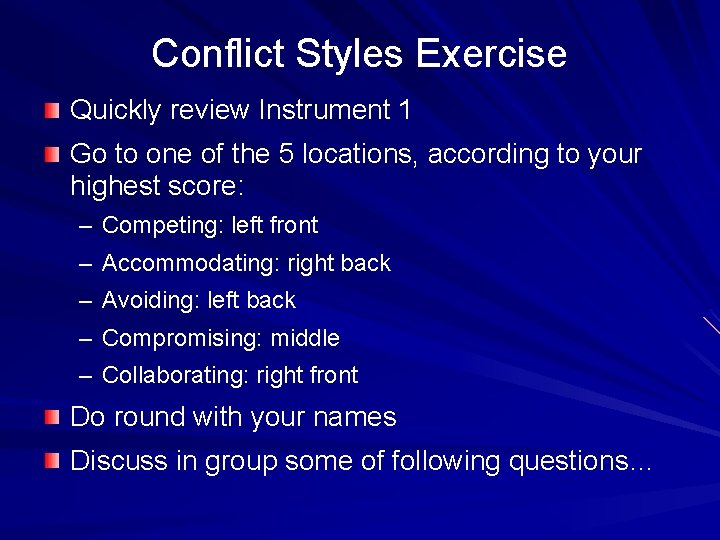
Conflict Styles Exercise Quickly review Instrument 1 Go to one of the 5 locations, according to your highest score: – Competing: left front – Accommodating: right back – Avoiding: left back – Compromising: middle – Collaborating: right front Do round with your names Discuss in group some of following questions…
Questions for Groups Some advantages of this conflict style Some disadvantages of this conflict style How are your advantages unfavorable for others? Situations in which this is a good style Situations in which this style probably shouldn’t be used
Conflict Response Modes
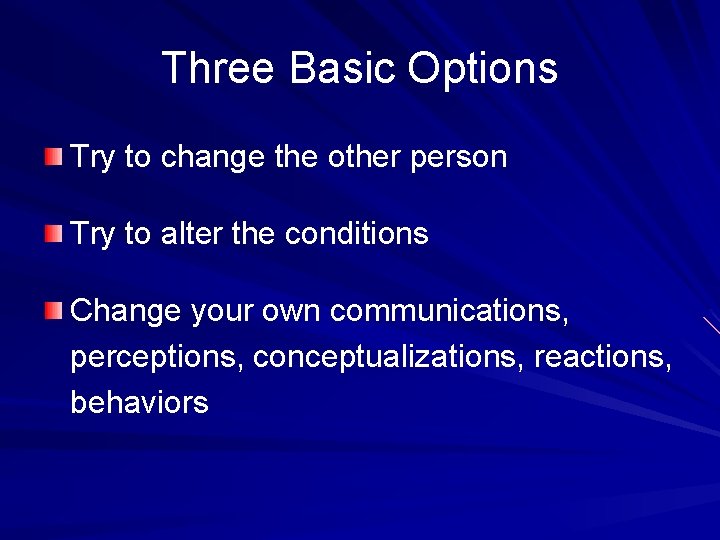
Three Basic Options Try to change the other person Try to alter the conditions Change your own communications, perceptions, conceptualizations, reactions, behaviors
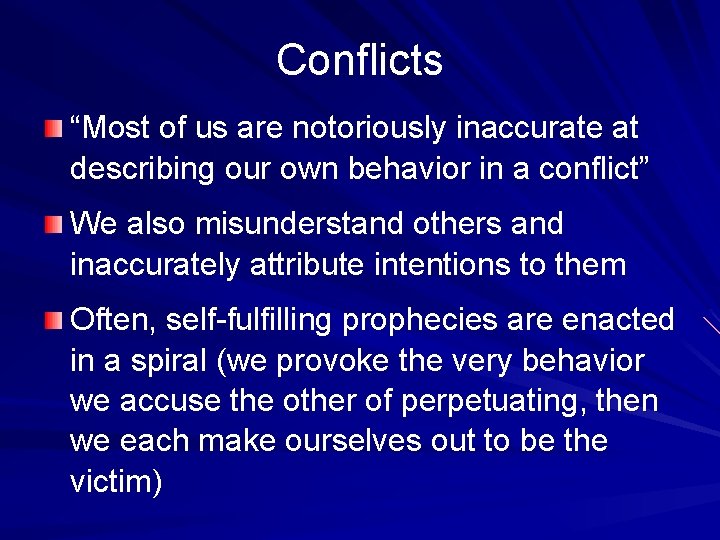
Conflicts “Most of us are notoriously inaccurate at describing our own behavior in a conflict” We also misunderstand others and inaccurately attribute intentions to them Often, self-fulfilling prophecies are enacted in a spiral (we provoke the very behavior we accuse the other of perpetuating, then we each make ourselves out to be the victim)
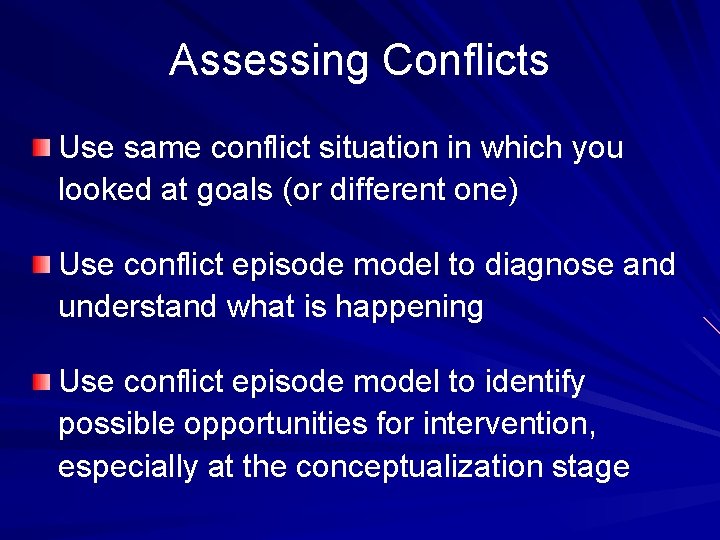
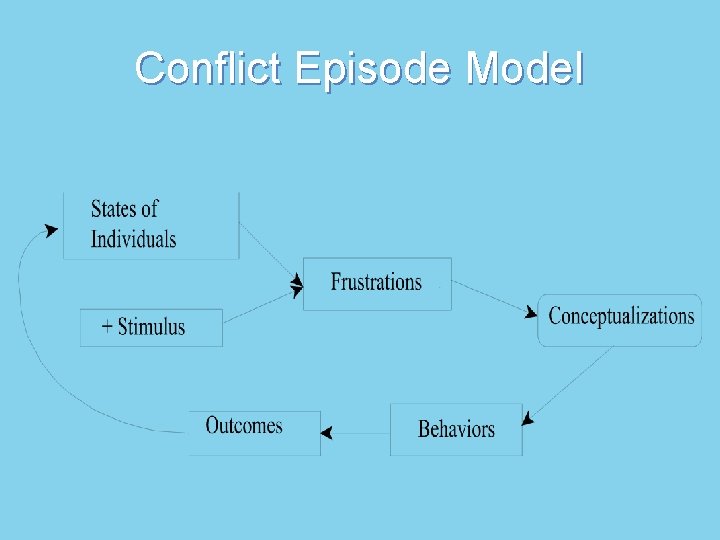
Assessing Conflicts Use same conflict situation in which you looked at goals (or different one) Use conflict episode model to diagnose and understand what is happening Use conflict episode model to identify possible opportunities for intervention, especially at the conceptualization stage
Conflict Episode Model
System Considerations Conflict serves the system in some ways – although not equally for all members Usually rules are tacit and undiscussible Understanding the system can help identify ways to intervene and manage the conflict
Using Systems Theory Assess the workings of the overall system (everyone connected to the conflict) Determine recurring patterns associated with conflict Identify individual contributions to the system and patterns
Some Systems Principles 219 -222 1. Conflict occurs in chain reactions (don’t look for villains or blame) 2. Each member gets labeled or type-cast in a role 3. Takes more than one to keep a conflict going 4. Coalitions & triangles often form
5. Systems develop rules for conflict that are followed even if they work poorly. Usually, there is a rule against knowing or stating the rules directly 6. The conflict serves the system in some way (even if poorly)
To Deduce System Rules Need to deal with specific events, e. g. , “microevents” (p. 256) Observe verbatim words and actual actions Describe behavior accurately, separate from inferences and attributions Inquire Look for patterns
System Rules (cont. ) It helps to identify & list the rules explicitly State them as prescriptions for behavior, e. g. , “When in context X, Y must (or must not) occur. ” Good ways to elicit system rules on p. 235 Then discuss how the rules help or harm conflict management, and consider changing some of the rules
Your Live Case – cont. Identify tacit system rules and payoffs in your conflict case (make use of some of the questions in Application 7. 1, p. 222 & suggestions on p. 235) Write individually Share in group and inquire to obtain additional insights and ideas
Metaphors Creating a metaphor or drawing a picture that represents a conflict provides a different form of data – Whole – Visual – Nonverbal – Symbolic
Metaphor Exercise 1. Use your ongoing conflict case (or another one in which you are a participant) 2. Generate a metaphor for this conflict (write individually): “We are a…. ” 3. One person shares her/his metaphor with the group, which asks clarifying questions, using the images in the metaphor 4. Group brainstorms about ways to resolve the conflict, still using the imaginary mode 5. Group translates these imaginary resolutions into practical steps for conflict management
More Ways to Assess Conflicts Briefly review the text sections on triangles and coalitions (p. 226 -233) Individually, analyze your conflict situation for possible triangles and coalitions
Triangles & Coalitions Cause Problems Block direct, constructive communication between individuals who should have this Produce toxic relationships and poor communication Escalate conflict Cause important issues to be unresolved Are self-justifying & self-reinforcing
Summary of Tools to Assess Conflict episode model Conflict response modes System patterns and rules Metaphors Analysis of triangles and coalitions
Conflict Case Individually, analyze and make notes, using some of the tools you haven’t used already (Possibly) discuss in group Short debriefing in total class
Emotions in Conflict
Feelings are much like waves, we can't stop them from coming, but we can choose which one to surf. When reason ends, then anger begins. Therefore, anger is a sign of weakness. - Dalai Lama Anyone can become angry. That is easy. But to be angry with the right person, to the right degree, at the right time, for the right purpose, and in the right way. . . that is not easy. - Aristotle Happiness is good health and a bad memory - Ingrid Bergman Laughter is the shortest distance between two people. Victor Borge People are just as happy as they make up their minds to be. - Abraham Lincoln -
Feelings are facts …not right or wrong … What you do with those feelings is a key element in managing conflict (p. 194)
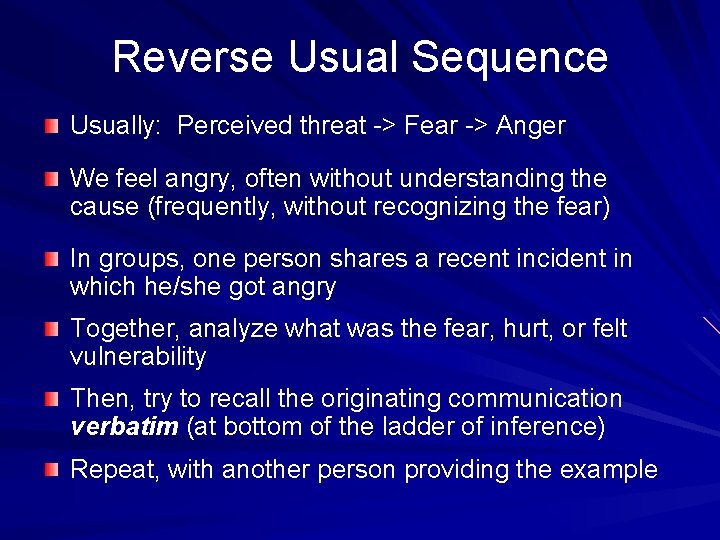
Reverse Usual Sequence Usually: Perceived threat -> Fear -> Anger We feel angry, often without understanding the cause (frequently, without recognizing the fear) In groups, one person shares a recent incident in which he/she got angry Together, analyze what was the fear, hurt, or felt vulnerability Then, try to recall the originating communication verbatim (at bottom of the ladder of inference) Repeat, with another person providing the example
Managing Anger and its Expression Manage fear-anger cycle Use your best communication skills, including “I-messages” Receive anger effectively Remember, we do not have to act the way we feel
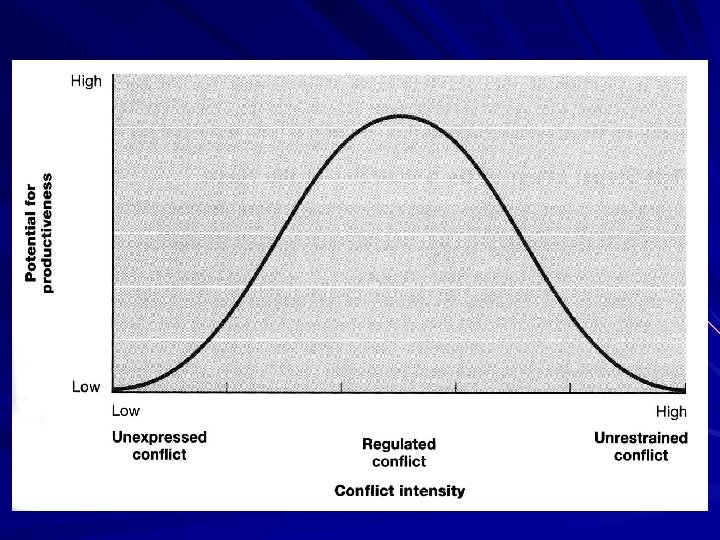
The midrange zone of potentially effective conflict management Neither extreme works well: – Suppressed, ineffectively avoided conflict – Unrestrained, escalating conflict
Moderating & Managing Conflicts
Three Basic Options Try to change the other person Try to alter the conditions Change your own communications, perceptions, conceptualizations, reactions, behaviors
Self-change has prerequisites 1. I have to care about the relationship 2. I am willing to accept that my own choices are influencing the conflict process (even if I can’t yet identify the effects) 3. I am willing to give up whatever I am currently gaining from the conflict (even if I haven’t yet analyzed this)
4. I choose not to avoid 5. I don’t wait for the other to change first
Some Helps in Managing Conflicts Evaluate situation well (previous 3 topics): – Use episode model to diagnose situation – Use episode model to ID opportunities for action – Identify tacit system rules & payoffs Apply excellent communication skills throughout Improve personal centering Manage conflict interaction dynamics
Manage Conflict Interaction Dynamics Engage in the mid-range between avoidance and unrestrained conflict Deal with fear-anger cycle Manage escalation and de-escalation of conflict Break conflict into manageable fractions Balance power Reframe (including from complaints to requests)
Managing Anger and its Expression (repeat) Manage fear-anger cycle Use your best communication skills, including “I-messages” Receive anger effectively Remember, we do not have to act the way we feel
Symptoms of Escalation (repeat) Competition Righteousness Not listening Spreading to new issues and situations Dealing in personalities Violating social norms Intentional hurt Insults and threats
De-Escalating (repeat) Breaking into manageable portions Listening, trying to understand Showing concern for others’ feelings Appealing/suggesting de-escalation Goodwill gestures, concessions Expressing feelings Finding integrative alternatives “Recognizing” the other human being
Prevent Destructive Escalation Use previous materials Set and keep ground rules for interactions Limit issues, not expand them Look for ways to reframe the other’s behavior in positive ways Talk about the process and spiral
Power Inbalance Badly unbalanced power can lead to: – Abuse – Passive-aggressive behavior – Withdrawal – Destructive spiral – Unstable agreements
Power Inbalance Often, both parties feel low power Then, continually make moves to increase their power at the other’s expense Constructive realignment of power is often helpful, even necessary
Power Balancing Approaches By higher-power parties: – Restraint – Enhancing power of others By lower-power parties: – Focus on interdependence – Assertiveness, calm persistence – Stay actively engaged By both: talk about the process
Make use of reframing - including bridge frames - and moving from complaints to requests
Additional Things to Help Identify and focus on causes Deal with avoidance (yours and of others) Use dance metaphor (Throughout) improve your interpersonal skills and reactions to conflict
Identify & Deal with Causes Rescue crew fable Need to find out what is causing the problems Put energy into preventing further problems
Deal With Avoidance Create safety, ease, comfort Frame discussion as relationship-building Vary mode of communication Take breaks Initiate discussions Ask for help when needed
Dance Metaphor Can vary closeness Need to get close enough to engage But not too close, too quickly Go toward smaller, rather than larger scope (for romantic ending)
Conflict management focuses on preventing and reducing the negative or destructive aspects of conflict, while preserving and enhancing the positive aspects.
Let’s Process Recent Sessions What was useful about the class materials and process – and should be done in the future? What could be improved in the future?