
Evaluating HSI with AIEnabled Systems What should you
Evaluating HSI with AI-Enabled Systems: What should you consider in a TEMP? Dr. Jane Pinelis, Chief, TE&A Joint Artificial Intelligence Center Rachel Haga, Daniel Porter, Brian Vickers Institute for Defense Analyses DATAWorks 2021 4/13/2021 1
1 2 3 4 Offloading warfighter work to AI doesn’t make HSI less important. It makes it more important than ever. 2
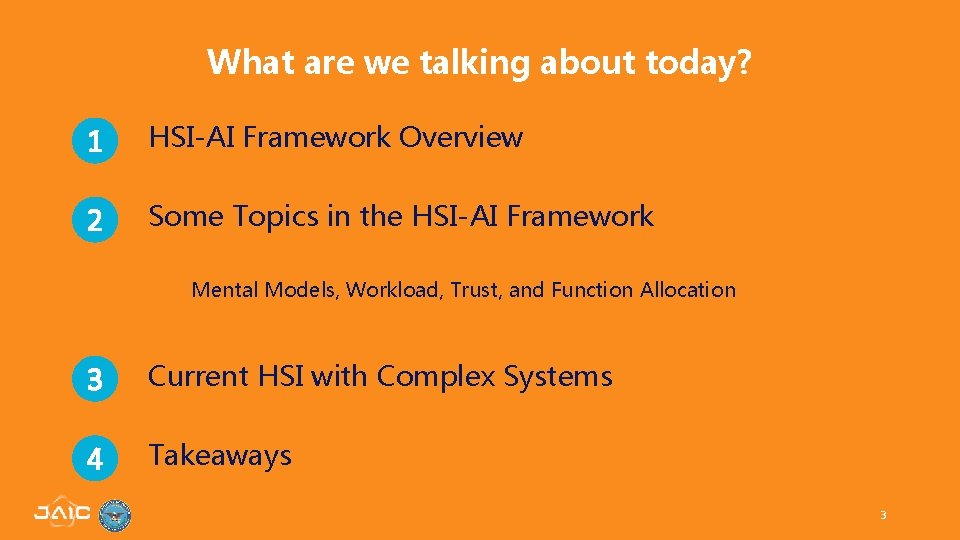
What are we talking about today? 1 HSI-AI Framework Overview 2 Some Topics in the HSI-AI Framework Mental Models, Workload, Trust, and Function Allocation 3 Current HSI with Complex Systems 4 Takeaways 3
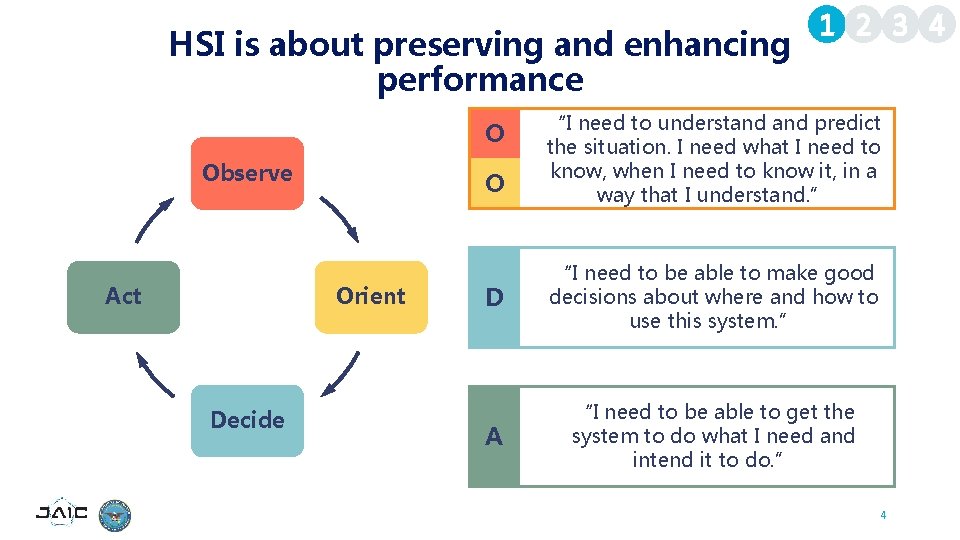
HSI is about preserving and enhancing performance O Observe Act O Orient Decide 1 2 3 4 “I need to understand predict the situation. I need what I need to know, when I need to know it, in a way that I understand. ” D “I need to be able to make good decisions about where and how to use this system. ” A “I need to be able to get the system to do what I need and intend it to do. ” 4
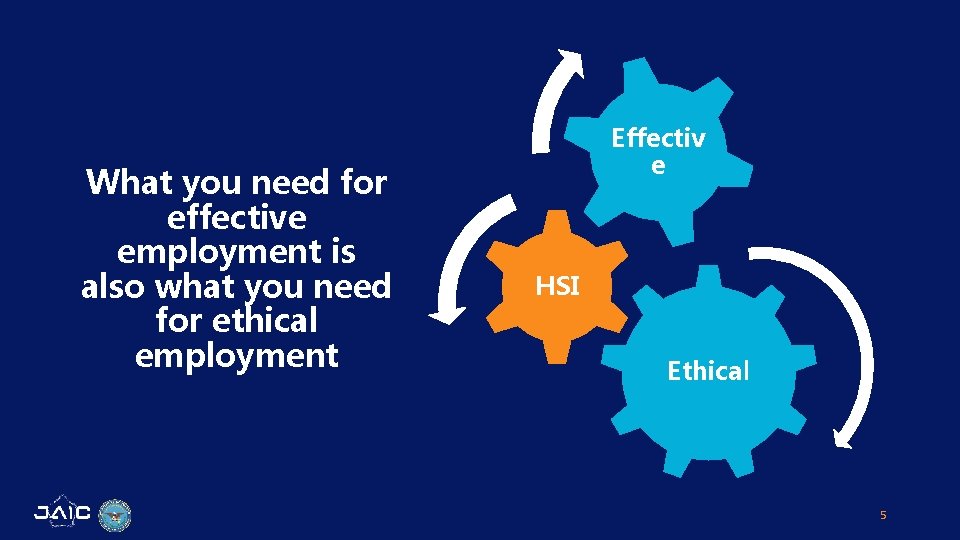
What you need for effective employment is also what you need for ethical employment Effectiv e HSI Ethical 5
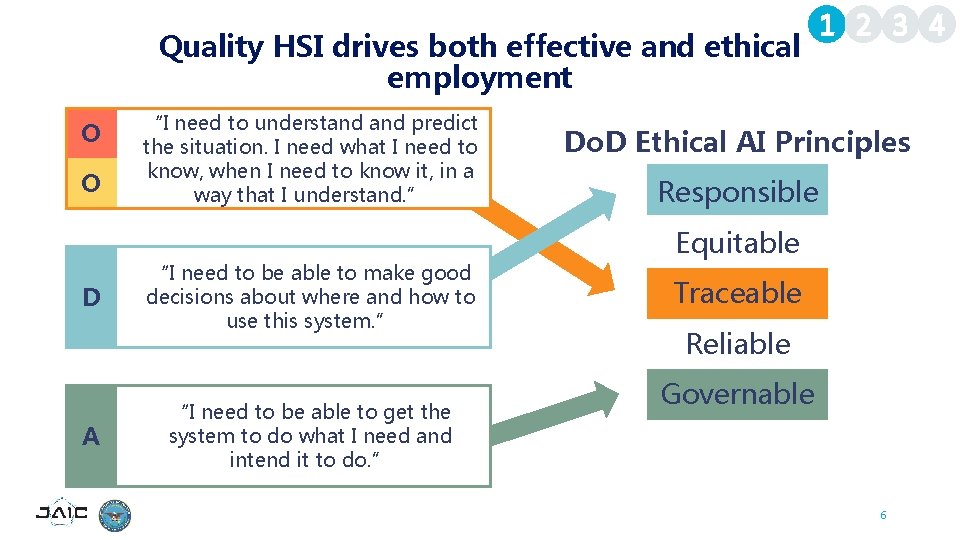
Quality HSI drives both effective and ethical employment O O D A “I need to understand predict the situation. I need what I need to know, when I need to know it, in a way that I understand. ” “I need to be able to make good decisions about where and how to use this system. ” “I need to be able to get the system to do what I need and intend it to do. ” 1 2 3 4 Do. D Ethical AI Principles Responsible Equitable Traceable Reliable Governable 6
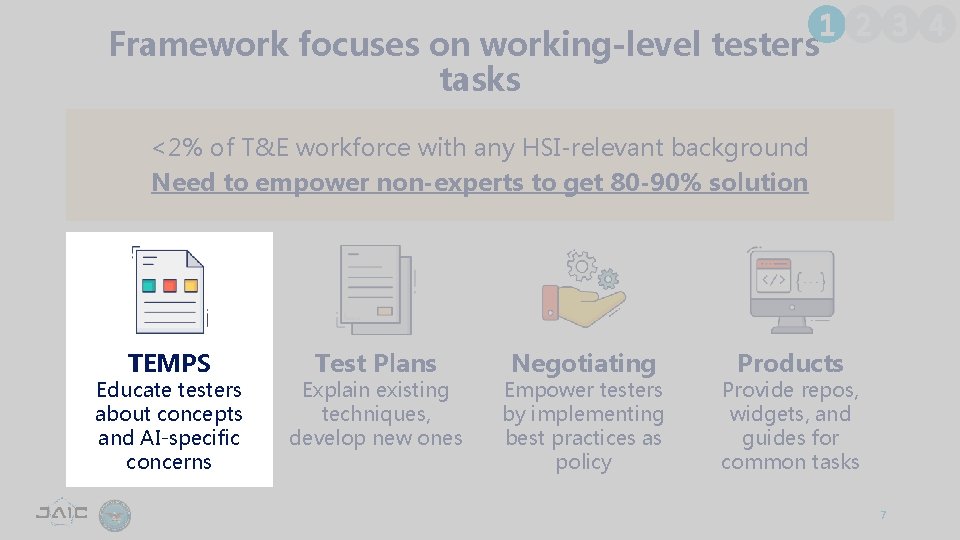
1 2 3 4 Framework focuses on working-level testers’ tasks <2% of T&E workforce with any HSI-relevant background Need to empower non-experts to get 80 -90% solution TEMPS Educate testers about concepts and AI-specific concerns Test Plans Explain existing techniques, develop new ones Negotiating Empower testers by implementing best practices as policy Products Provide repos, widgets, and guides for common tasks 7
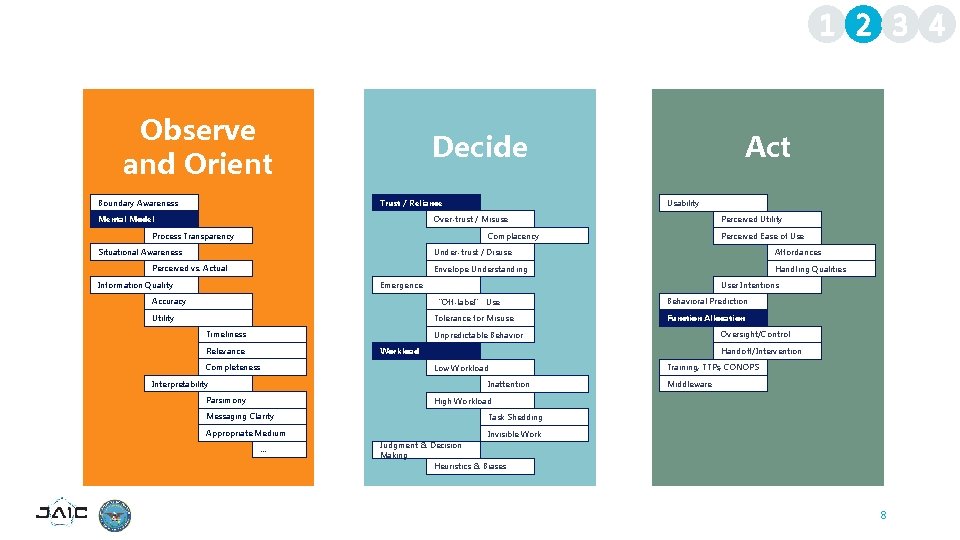
1 2 3 4 Observe and Orient Boundary Awareness Decide Trust / Reliance Mental Model Act Usability Over-trust / Misuse Process Transparency Perceived Utility Complacency Situational Awareness Perceived vs. Actual Information Quality Perceived Ease of Use Under-trust / Disuse Affordances Envelope Understanding Handling Qualities User Intentions Emergence Accuracy “Off-label” Use Behavioral Prediction Utility Tolerance for Misuse Function Allocation Timeliness Oversight/Control Unpredictable Behavior Relevance Handoff/Intervention Workload Completeness Interpretability Low Workload Inattention Parsimony Training, TTPs, CONOPS Middleware High Workload Messaging Clarity Appropriate Medium … Task Shedding Invisible Work Judgment & Decision Making Heuristics & Biases 8
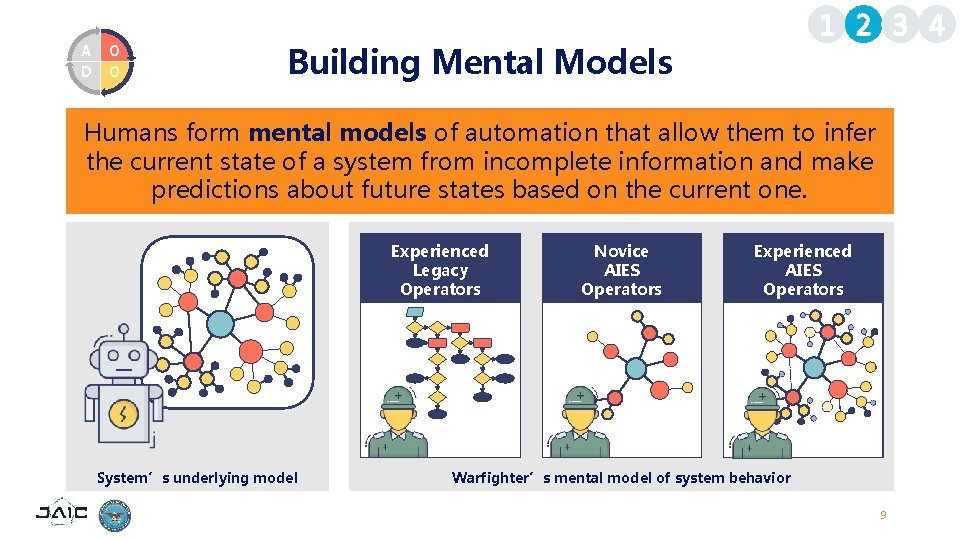
A D O O 1 2 3 4 Building Mental Models Humans form mental models of automation that allow them to infer the current state of a system from incomplete information and make predictions about future states based on the current one. Experienced Legacy Operators System’s underlying model Novice AIES Operators Experienced AIES Operators Warfighter’s mental model of system behavior 9
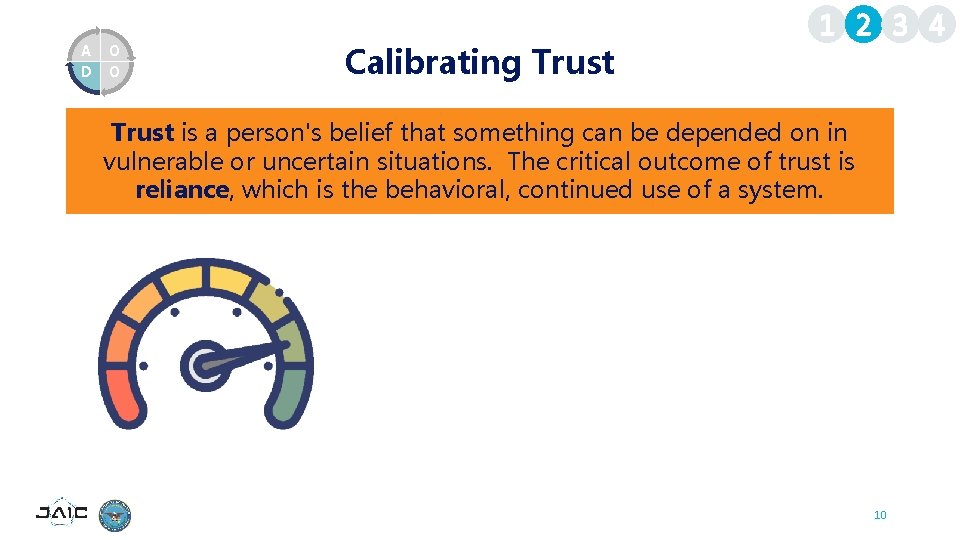
A D O O Calibrating Trust 1 2 3 4 Trust is a person's belief that something can be depended on in vulnerable or uncertain situations. The critical outcome of trust is reliance, which is the behavioral, continued use of a system. 10
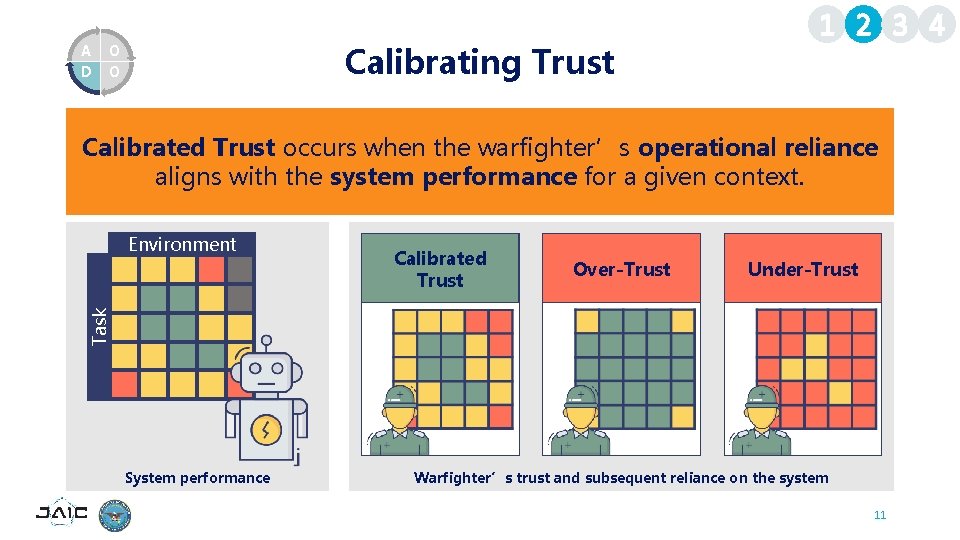
A D Calibrating Trust O O 1 2 3 4 Trust is a person's belief that something can be depended on in Calibrated Trust occurs when the warfighter’s operational reliance vulnerable or uncertain situations. The critical outcome of trust is aligns with the system performance for a given context. reliance, which is the behavioral, continued use of a system. Calibrated Trust Over-Trust Under-Trust Task Environment System performance Warfighter’s trust and subsequent reliance on the system 11
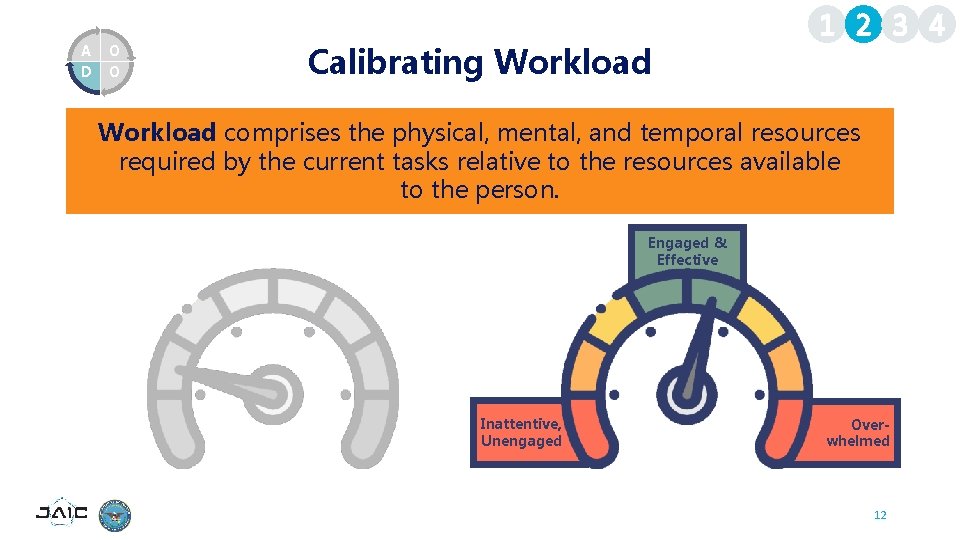
A D O O Calibrating Workload 1 2 3 4 Workload comprises the physical, mental, and temporal resources required by the current tasks relative to the resources available to the person. Engaged & Effective Inattentive, Unengaged Overwhelmed 12
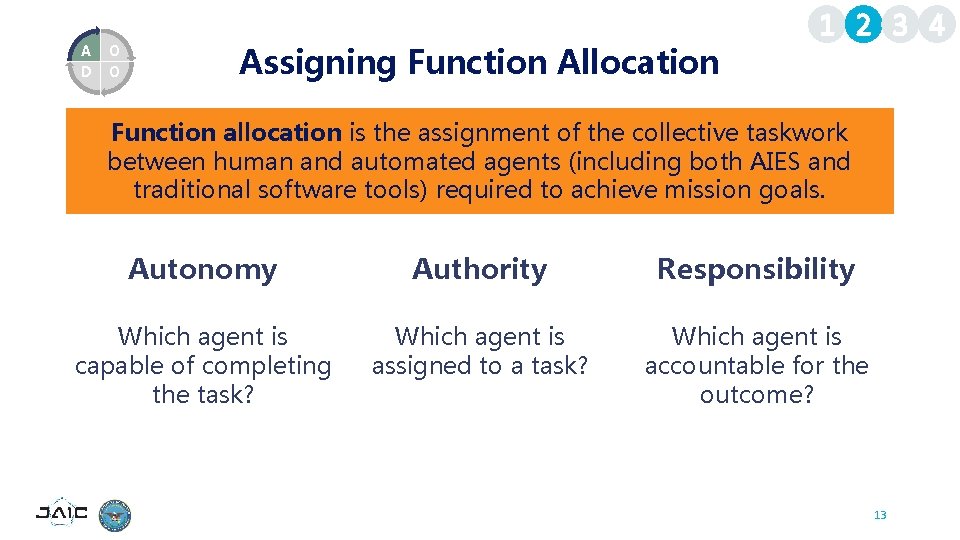
A D O O Assigning Function Allocation 1 2 3 4 Function allocation is the assignment of the collective taskwork between human and automated agents (including both AIES and traditional software tools) required to achieve mission goals. Autonomy Authority Responsibility Which agent is capable of completing the task? Which agent is assigned to a task? Which agent is accountable for the outcome? 13
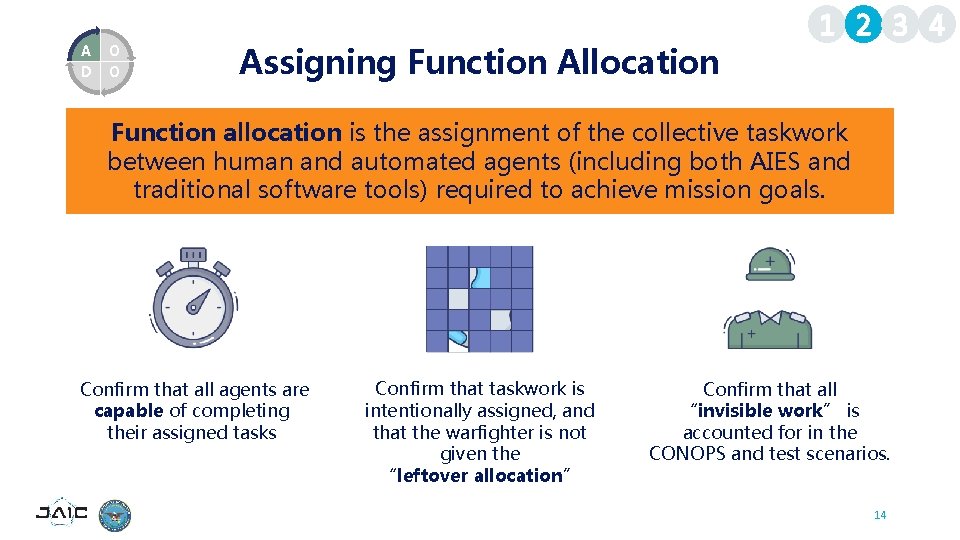
A D O O Assigning Function Allocation 1 2 3 4 Function allocation is the assignment of the collective taskwork between human and automated agents (including both AIES and traditional software tools) required to achieve mission goals. Confirm that all agents are capable of completing their assigned tasks Confirm that taskwork is intentionally assigned, and that the warfighter is not given the “leftover allocation” Confirm that all “invisible work” is accounted for in the CONOPS and test scenarios. 14
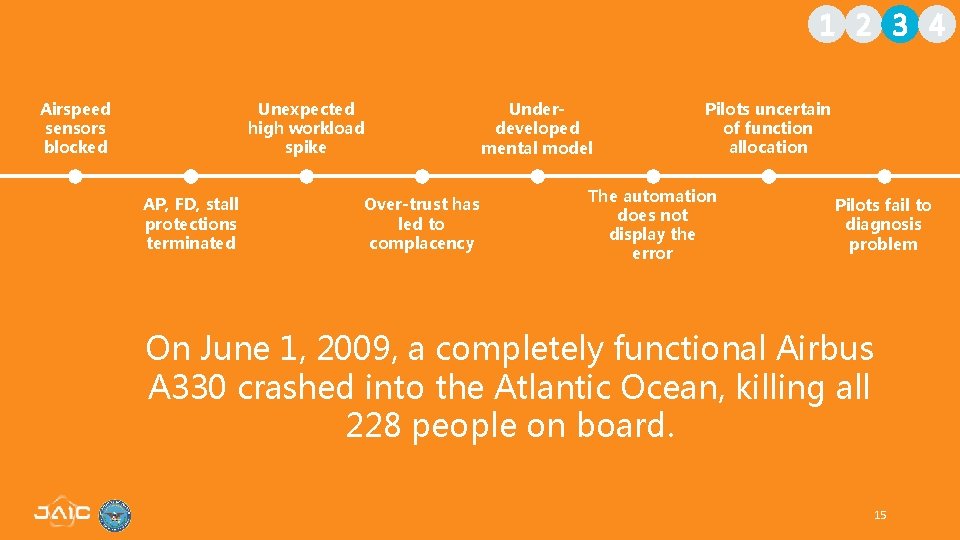
1 2 3 4 Airspeed sensors blocked Unexpected high workload spike AP, FD, stall protections terminated Over-trust has led to complacency Underdeveloped mental model Pilots uncertain of function allocation The automation does not display the error Pilots fail to diagnosis problem On June 1, 2009, a completely functional Airbus A 330 crashed into the Atlantic Ocean, killing all 228 people on board. 15
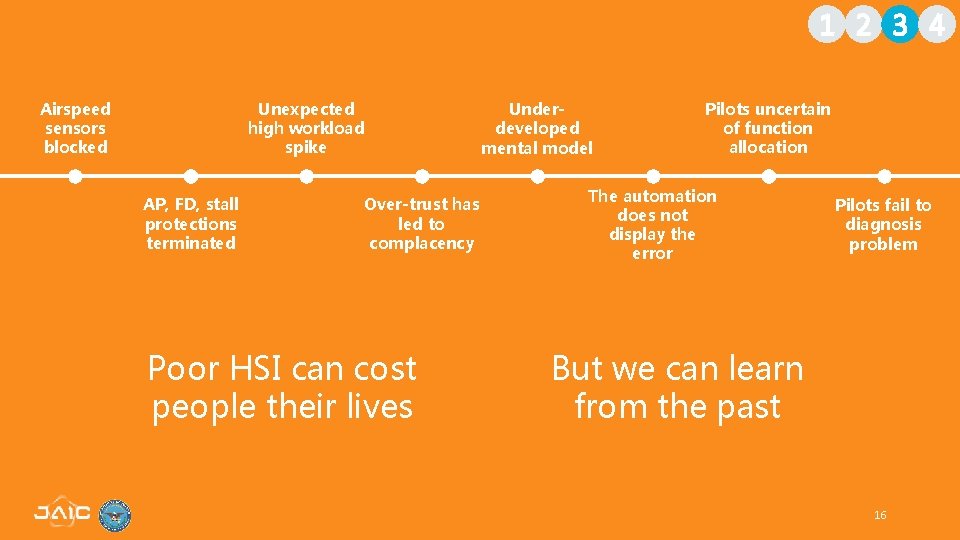
1 2 3 4 Airspeed sensors blocked Unexpected high workload spike AP, FD, stall protections terminated Over-trust has led to complacency Poor HSI can cost people their lives Underdeveloped mental model Pilots uncertain of function allocation The automation does not display the error Pilots fail to diagnosis problem But we can learn from the past 16
1 2 3 4 In a world of AI and Autonomy, the human is still relevant The JAIC is putting together an HSI-AI Framework to identify issues This has all happened before and it will happen again 17

Questions? Connect with us: AI. mil Twitter: @Do. DJAIC Linked. In: Do. D Joint Artificial Intelligence Center 18
- Slides: 18