
Evaluating Health Programmes By Geoff Middleton Lecturer Health
Evaluating Health Programmes By Geoff Middleton Lecturer: Health Promotion & Exercise Faculty of Health Life and Social Sciences

Why Evaluate? • To describe and/or assess what was intended? (goals/aims/objectives/KPIs? ) • May be to describe what was unintended? • What was actually implemented? • What outcomes/results where achieved? • What are the implications of the findings? (actions/recommendations? ) • To answer three basic questions: WHAT? SO WHAT? NOW WHAT? Adopted from: Patton (2008)
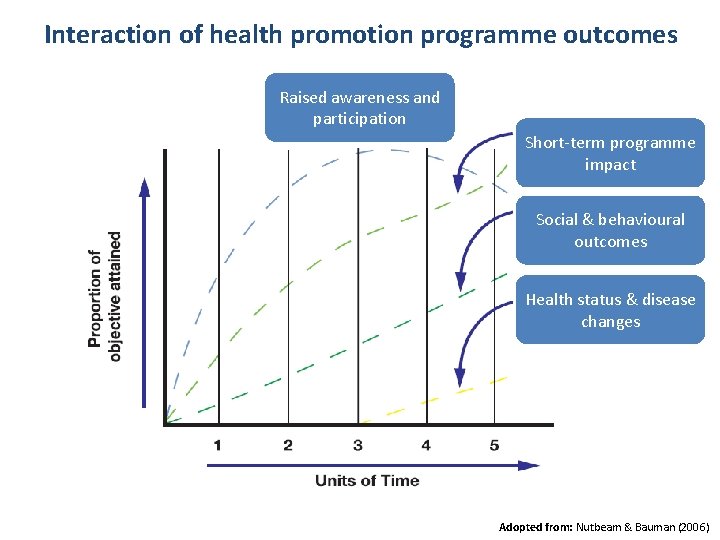
Interaction of health promotion programme outcomes Raised awareness and participation Short-term programme impact Social & behavioural outcomes Health status & disease changes Adopted from: Nutbeam & Bauman (2006)
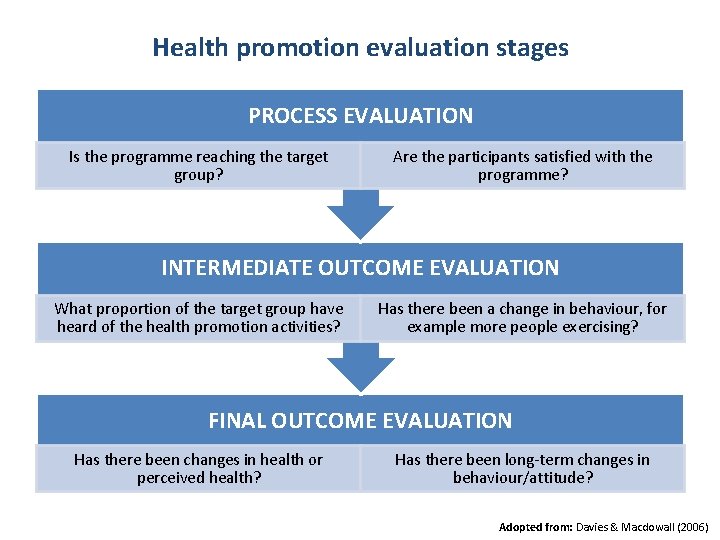
Health promotion evaluation stages PROCESS EVALUATION Is the programme reaching the target group? Are the participants satisfied with the programme? INTERMEDIATE OUTCOME EVALUATION What proportion of the target group have heard of the health promotion activities? Has there been a change in behaviour, for example more people exercising? FINAL OUTCOME EVALUATION Has there been changes in health or perceived health? Has there been long-term changes in behaviour/attitude? Adopted from: Davies & Macdowall (2006)

Health promotion actions Health promotion outcomes (outcomes of the process of intervention) Examples include patient education, school education and broadcast media communication. HEALTH LITERACY Measures include healthknowledge, attitude, motivation, behavioural intentions, personal skills and self efficacy. SOCIAL MOBILISATION Examples include community development, group facilitation and technical advice. SOCIAL ACTION & INFLUENCE Measures include community participation, community empowerment, social norms and public opinion. EDUCATION ADVOCACY Examples include lobbying, political organisation and activism and overcoming bureaucratic inertia. HEALTHY PUBLIC POLICY & ORGANISATIONAL PRACTICE Measures include policy statements, legislation, regulation and resource allocation and organisational practices. Intermediate health outcomes (programme impact or short-term outcomes) HEALTHY LIFESTYLES Measures include tobacco use, physical activity, food choices, alcohol and illicit drug use. EFFECTIVE PREVENTATIVE HEALTH SERVICE Measures include access to and provision of relevant and preventative services. Social health outcomes (long-term outcomes) SOCIAL OUTCOMES Measures include quality of life, functional independence, social capacity and equity. HEALTH OUTCOMES HEALTHY ENVIRONMENTS Measures include safe physical environment, supportive economic and social conditions, suitable food supply and restricted access to alcohol/tobacco. Measures include increased morbidity, reduced disability and avoidable mortality. Adopted from: Nutbeam & Bauman (2006)
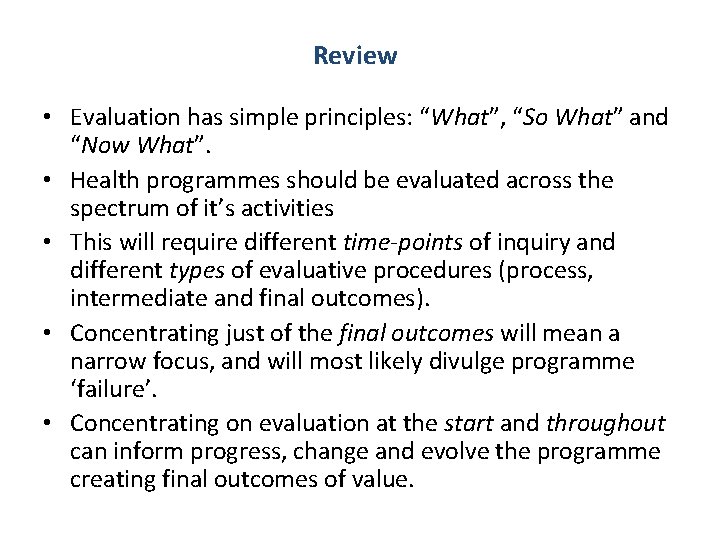
Review • Evaluation has simple principles: “What”, “So What” and “Now What”. • Health programmes should be evaluated across the spectrum of it’s activities • This will require different time-points of inquiry and different types of evaluative procedures (process, intermediate and final outcomes). • Concentrating just of the final outcomes will mean a narrow focus, and will most likely divulge programme ‘failure’. • Concentrating on evaluation at the start and throughout can inform progress, change and evolve the programme creating final outcomes of value.
References • Nutbeam, D. , Bauman, A. (2006) Evaluation in a Nutshell: A practical guide to the evaluation of health promotion programmes. Mc. Graw Hill: New York, USA. • Davies, M. , Macdowall, W. (2006) Health Promotion Theory: Understanding Public Health. Open University Press: Maidenhead, UK. • Patton, M. (2008) Utilisation-focused Evaluation. SAGE: London, UK. Contact details Geoff Middleton, MSc, RNut School of Sport, Coaching and Exercise Science University of Lincoln Sports Centre: 1 st Floor offices Brayford Campus Lincolnshire LN 6 7 TS Tel: 01522 837308 Email: gmiddleton@lincoln. ac. uk
- Slides: 7