
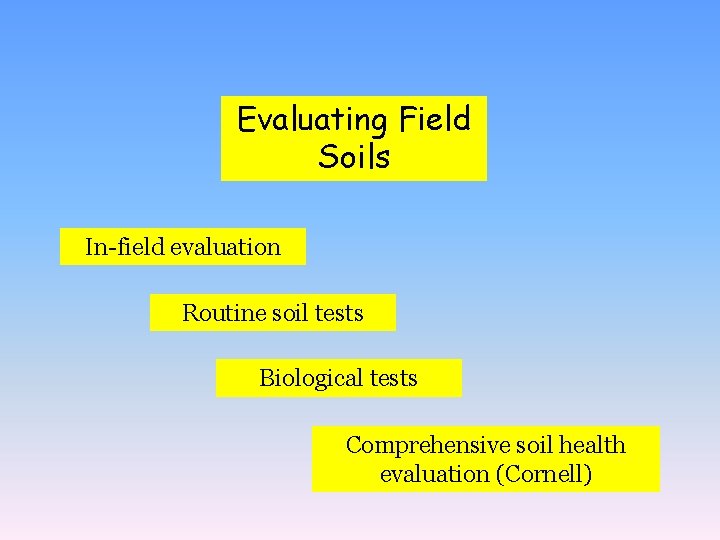
Evaluating Field Soils Infield evaluation Routine soil tests




- Slides: 27
Evaluating Field Soils In-field evaluation Routine soil tests Biological tests Comprehensive soil health evaluation (Cornell)
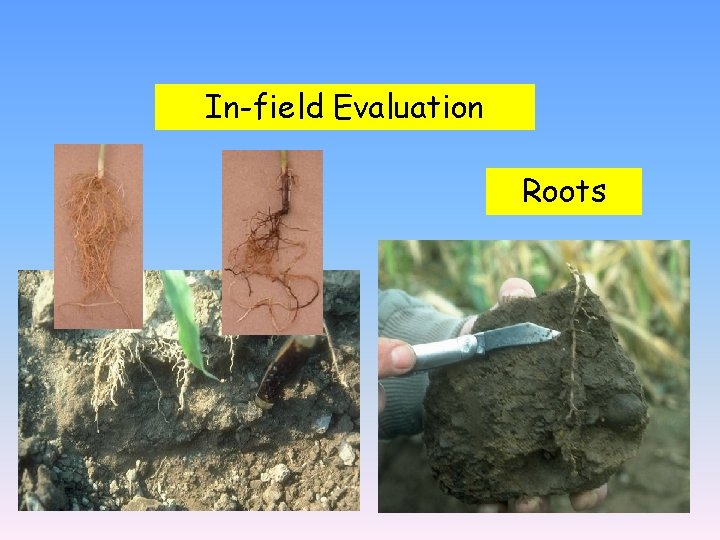
In-field Evaluation Roots
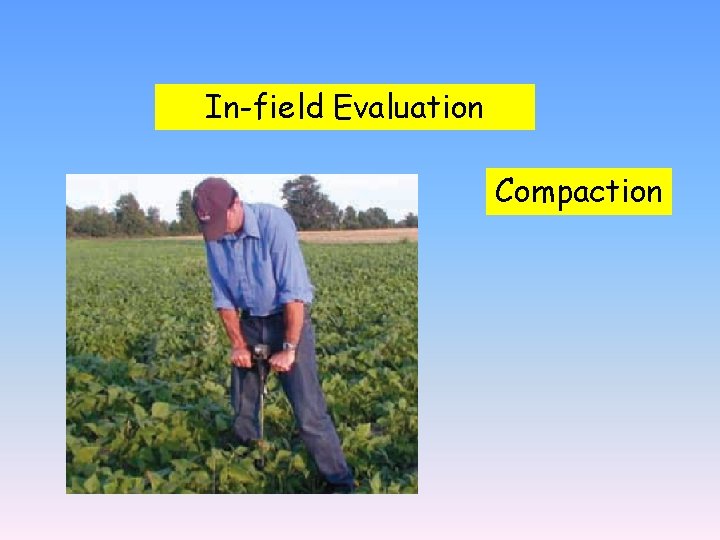
In-field Evaluation Compaction
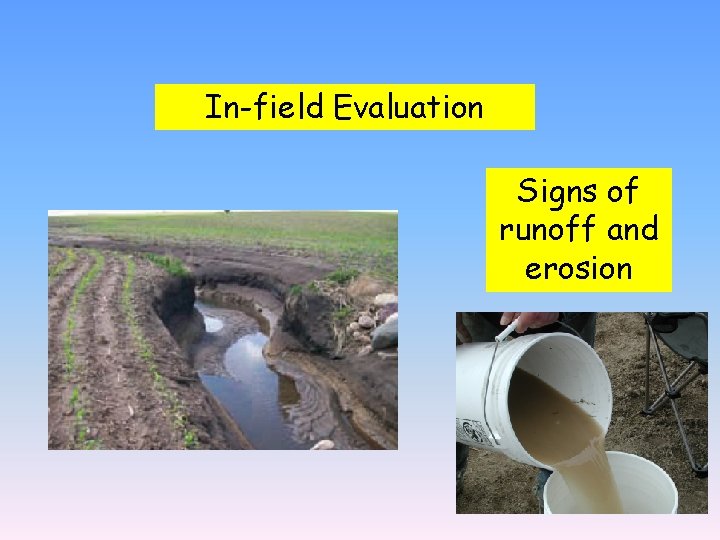
In-field Evaluation Signs of runoff and erosion
In-field Evaluation Earthworms, Wet spots Etc.
Getting the most from your soil tests
Getting the most from your soil tests What do soil tests tell us?
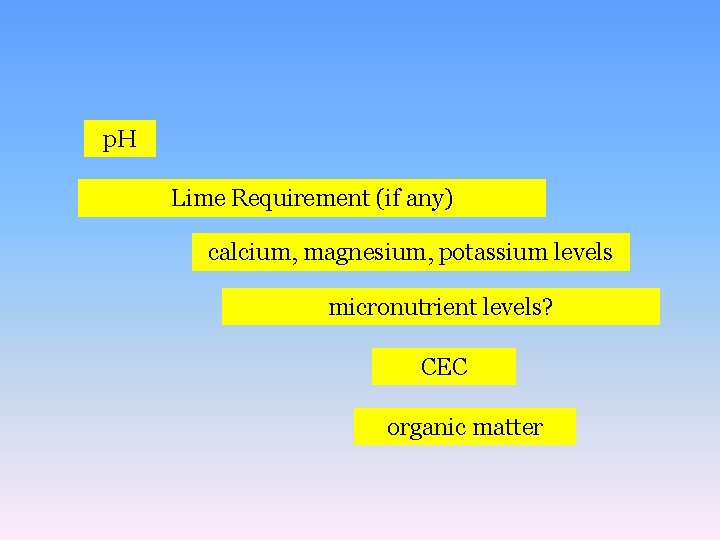
p. H Lime Requirement (if any) calcium, magnesium, potassium levels micronutrient levels? CEC organic matter
For Nitrogen PSNT is a separate test, taken at a different time of the year than routine soil tests
Getting the most from your soil tests What don’t routine soil tests tell us?
Soil testing is only one part of nutrient management Nutrient flows Nutrient cycles Organic matter management
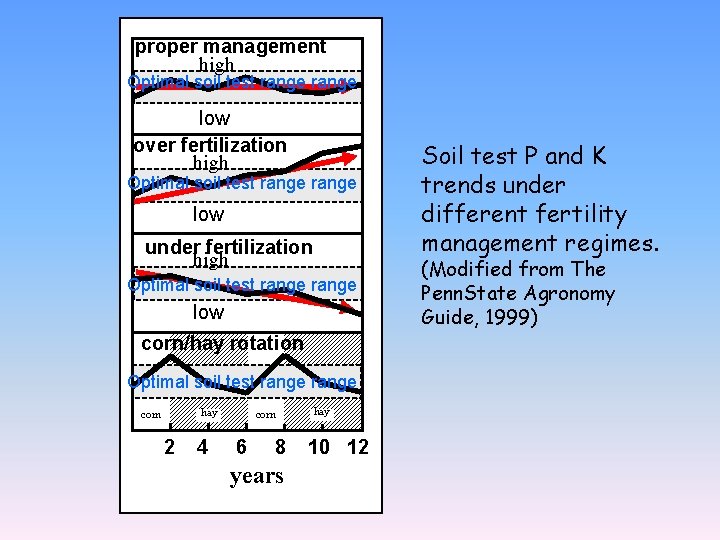
proper management high Optimal soil test range low over fertilization high Optimal soil test range low under fertilization high Optimal soil test range low corn/hay rotation Optimal soil test range hay corn 2 4 corn 6 8 years hay 10 12 Soil test P and K trends under different fertility management regimes. (Modified from The Penn. State Agronomy Guide, 1999)
? Getting the most from your soil tests ? ? Causes of confusion ? ü Different lab procedures ? ? ü Various ways to report results ? ? ü Numerous recommendation systems ? ? ?
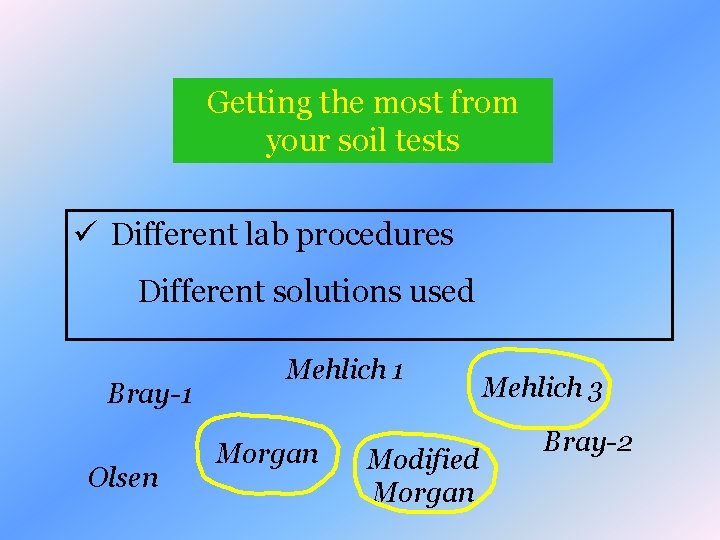
Getting the most from your soil tests ü Different lab procedures Different solutions used Bray-1 Olsen Mehlich 1 Morgan Modified Morgan Mehlich 3 Bray-2
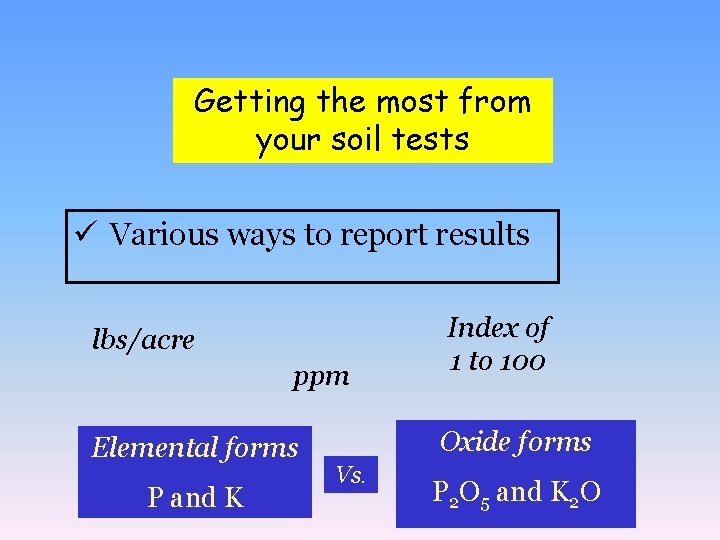
Getting the most from your soil tests ü Various ways to report results lbs/acre ppm Elemental forms P and K Index of 1 to 100 Oxide forms Vs. P 2 O 5 and K 2 O
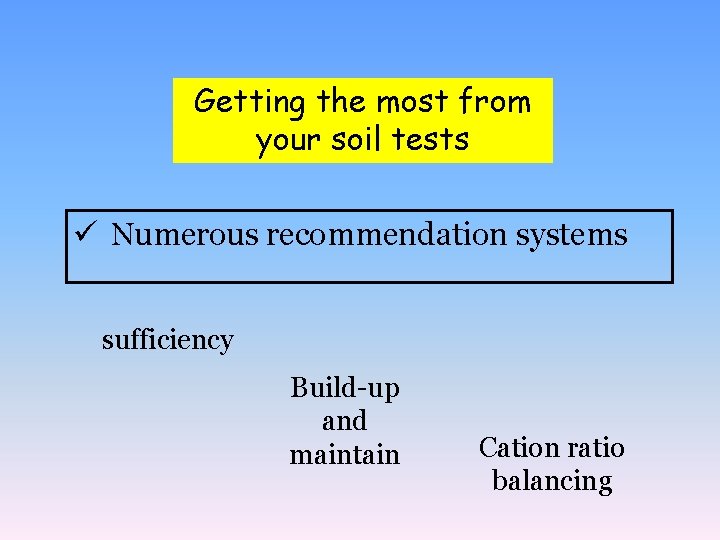
Getting the most from your soil tests ü Numerous recommendation systems sufficiency Build-up and maintain Cation ratio balancing
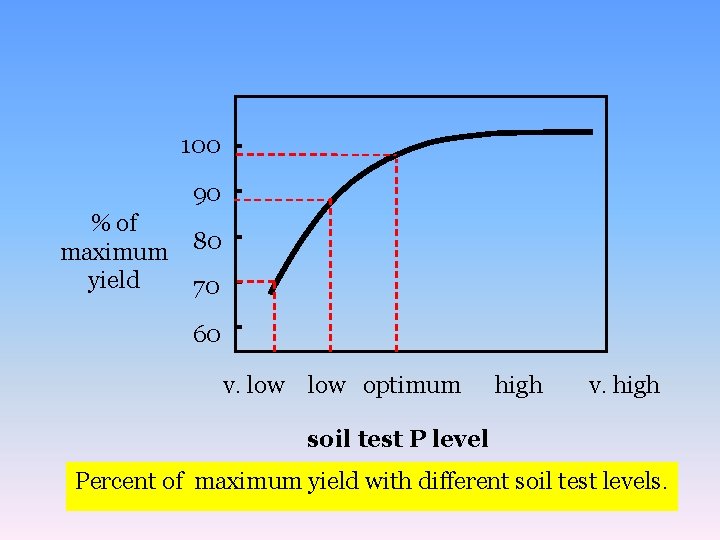
100 90 % of maximum yield 80 70 60 v. low optimum high v. high soil test P level Percent of maximum yield with different soil test levels.
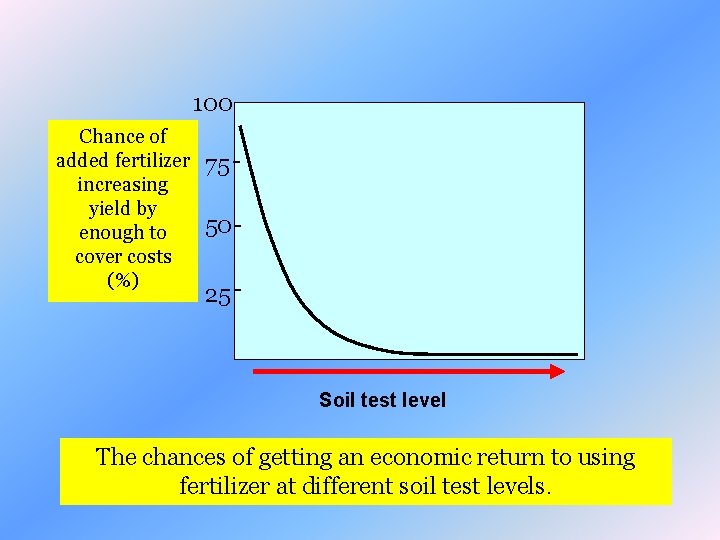
100 Chance of added fertilizer increasing yield by enough to cover costs (%) 75 50 25 Soil test level The chances of getting an economic return to using fertilizer at different soil test levels.
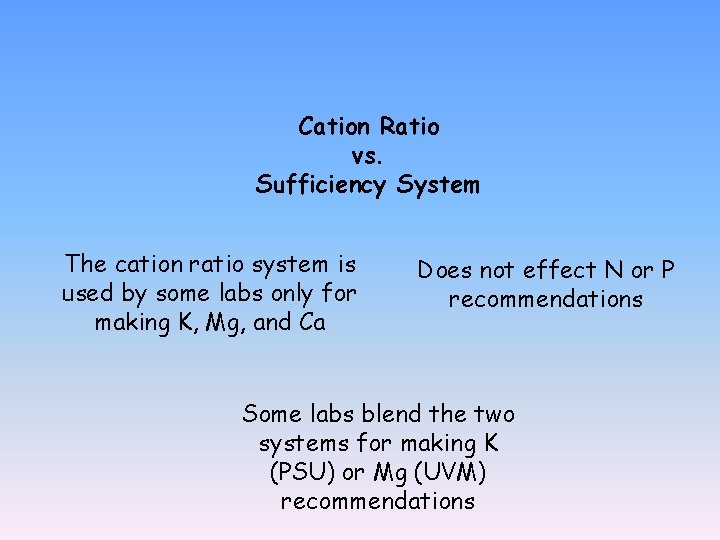
Cation Ratio vs. Sufficiency System The cation ratio system is used by some labs only for making K, Mg, and Ca Does not effect N or P recommendations Some labs blend the two systems for making K (PSU) or Mg (UVM) recommendations
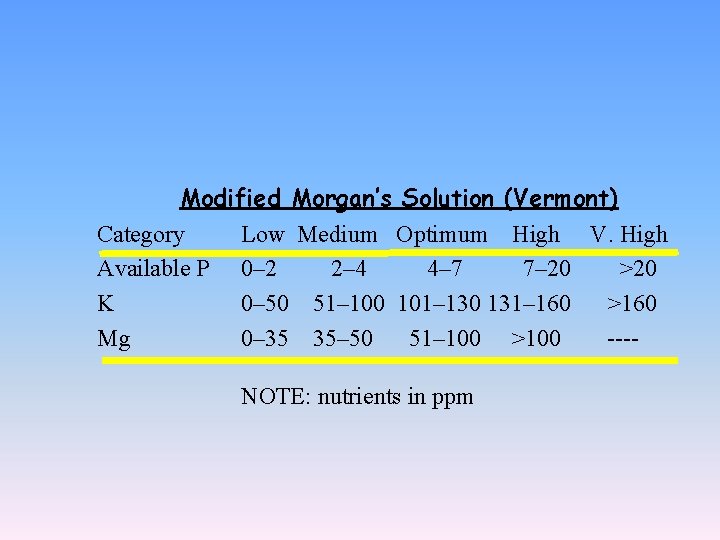
Modified Morgan’s Solution (Vermont) Category Low Medium Optimum High V. High Available P 0– 2 2– 4 4– 7 7– 20 >20 K 0– 50 51– 100 101– 130 131– 160 >160 Mg 0– 35 35– 50 51– 100 >100 ---NOTE: nutrients in ppm
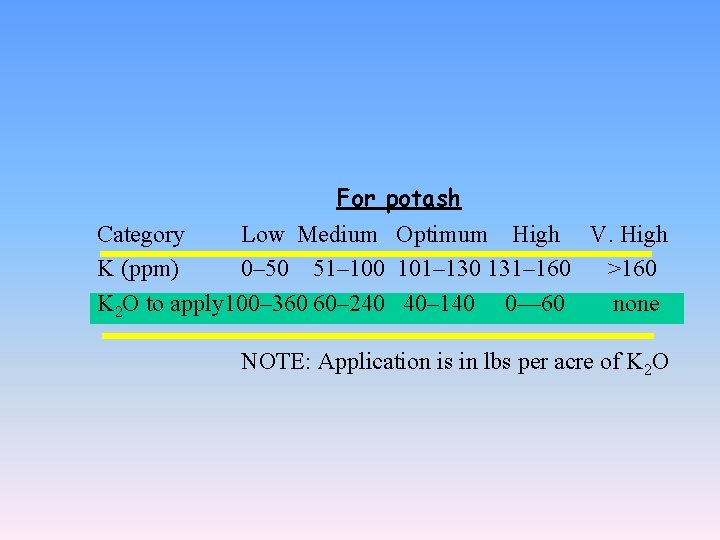
For potash Category Low Medium Optimum High V. High K (ppm) 0– 50 51– 100 101– 130 131– 160 >160 K 2 O to apply 100– 360 60– 240 40– 140 0— 60 none NOTE: Application is in lbs per acre of K 2 O
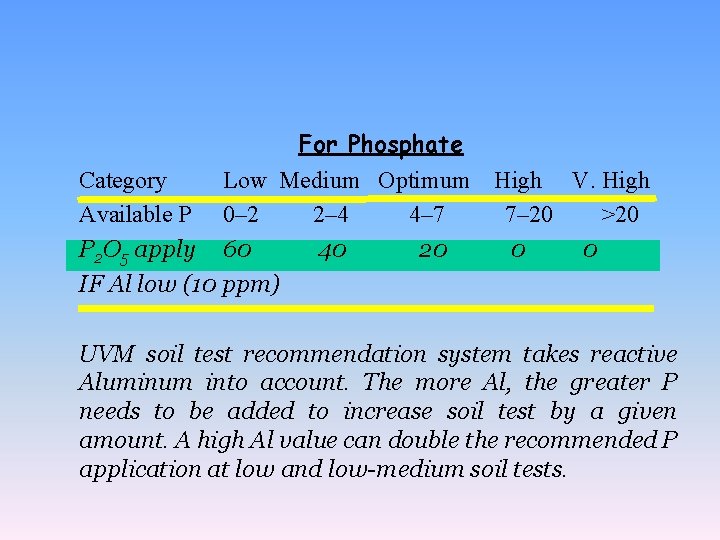
For Phosphate Category Low Medium Optimum Available P 0– 2 2– 4 4– 7 P 2 O 5 apply 60 40 20 IF Al low (10 ppm) High V. High 7– 20 >20 0 0 UVM soil test recommendation system takes reactive Aluminum into account. The more Al, the greater P needs to be added to increase soil test by a given amount. A high Al value can double the recommended P application at low and low-medium soil tests.
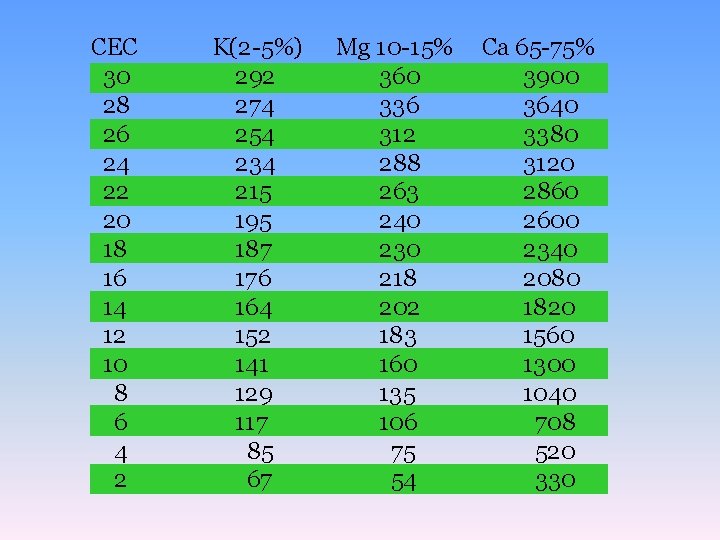
Basic Cation Saturation Ratio System
CEC 30 28 26 24 22 20 18 16 14 12 10 8 6 4 2 K(2 -5%) 292 274 254 234 215 195 187 176 164 152 141 129 117 85 67 Mg 10 -15% 360 336 312 288 263 240 230 218 202 183 160 135 106 75 54 Ca 65 -75% 3900 3640 3380 3120 2860 2600 2340 2080 1820 1560 1300 1040 708 520 330
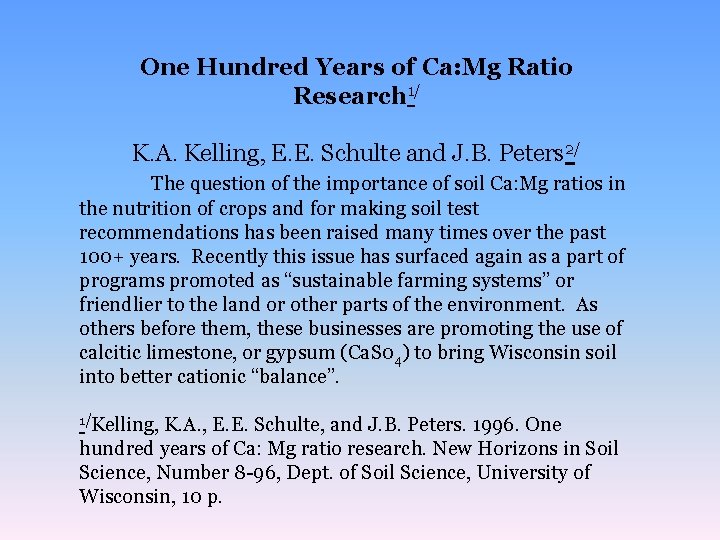
One Hundred Years of Ca: Mg Ratio Research 1/ K. A. Kelling, E. E. Schulte and J. B. Peters 2/ The question of the importance of soil Ca: Mg ratios in the nutrition of crops and for making soil test recommendations has been raised many times over the past 100+ years. Recently this issue has surfaced again as a part of programs promoted as “sustainable farming systems” or friendlier to the land or other parts of the environment. As others before them, these businesses are promoting the use of calcitic limestone, or gypsum (Ca. S 04) to bring Wisconsin soil into better cationic “balance”. 1/Kelling, K. A. , E. E. Schulte, and J. B. Peters. 1996. One hundred years of Ca: Mg ratio research. New Horizons in Soil Science, Number 8 -96, Dept. of Soil Science, University of Wisconsin, 10 p.
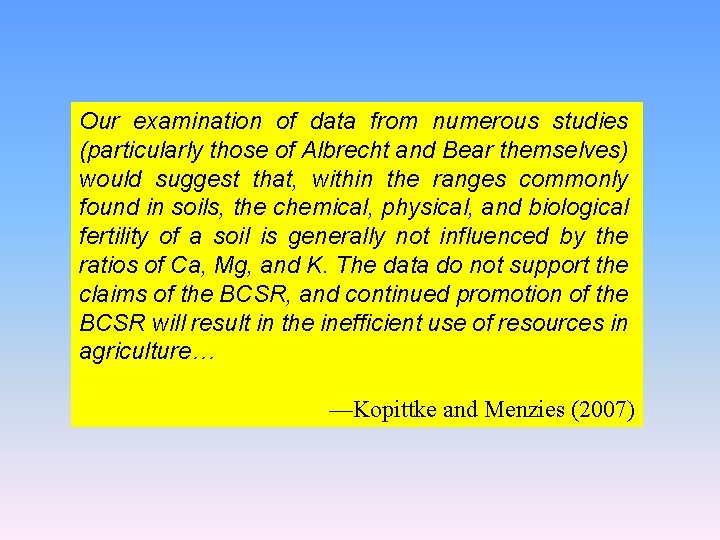
Our examination of data from numerous studies (particularly those of Albrecht and Bear themselves) would suggest that, within the ranges commonly found in soils, the chemical, physical, and biological fertility of a soil is generally not influenced by the ratios of Ca, Mg, and K. The data do not support the claims of the BCSR, and continued promotion of the BCSR will result in the inefficient use of resources in agriculture… —Kopittke and Menzies (2007)