
Evaluating College Writing Formative Assessment of Student Essays
- Slides: 26
Evaluating College Writing: Formative Assessment of Student Essays as the Set Up for the Writing Conference USING TARGETED, MINIMAL GRADING STRATEGIES TO GUIDE THE WRITING CONFERENCE Prepared by Dr. Amy Berry October 4, 2011
Using Writing Conferences Fosters Students’ Growth as Writers Writing conferences focus students on the discovery, writing, and revising process as well as on the written product Targeted minimal grading and comment strategies coupled with the writing conference can help instructors to handle heavy paper grading loads Prepared by Dr. Amy Berry October 4, 2011
Summary Using targeted, minimal grading strategies in grading student essays is perfect way to set up the writing conference This discussion presents strategies and models that will help you to grade essays more efficiently The comments you make on student essays are used to focus and guide the writing conference Prepared by Dr. Amy Berry October 4, 2011
The Writing Conference and Freshman Composition The Writing Conference is central to fostering growth in writing, especially when working with college freshmen, who are novices in the academic discourse community The Writing Conference is a place of discovery, where you have an opportunity to discuss the writing process, to direct required revision focusing on higher order concerns as well as correctness issues, and to help writers to understand develop their writing and revising awareness and strategies Prepared by Dr. Amy Berry October 4, 2011
The Writing Conference is the Teachable Moment The Writing Conference provides immediacy in discussing the essay. Focus talk on helping students to understand the targeted comments, clarifying questions, and the limited and judicious direct corrections that you note on the essay Use targeted, minimal grading strategies described in this presentation to focus and direct the writing conference to help novice college writers to understand the writing process, especially invention and revision Use this precious time to explain the most important revisions you expect the writer to make and to discuss strategies for making those revisions Prepared by Dr. Amy Berry October 4, 2011
The Basic Premise Students expect their instructors to ‘fix’ the written assignment through written comments “Just show me what I need to fix to get an ‘A’ is not a mindset conducive to growth as a writer or discovery revision Minimal grading and conferencing makes the writer do the work The goal of writing instruction is to, as Stephen North tells us, “make sure that writers, and not necessarily their texts, are what get changed by instruction. ” The goal of writing instruction is to produce better writers, not just better texts Targeted minimal grading strategies focuses, guides, and sets up the writing conference The goal of the writing conference is to help students to reflect on, understand improve their discovery, planning, drafting, and revision processes Prepared by Dr. Amy Berry October 4, 2011
What is Minimal Grading? Minimal grading does not mean that you will not assess the student’s writing closely and carefully Minimal grading moves students away from the ‘editing’ mindset toward an audience-based awareness of the aims of discourse, modes of discourse, and message—and the writing process Minimal grading is a less prescriptive approach that focuses on directing students to do deep revision for meaning, development, support, structure, etc. This does not mean that you do not provide direction. You direct the student in what to do, but comments make the student do the work Minimal grading intends to stimulate student reflection on the act of revising, and requires the student to do the work Prepared by Dr. Amy Berry October 4, 2011
Targeted Minimal Grading is More than Just Checks in the Margin I propose using more than simple minimal grading strategies in assessing student writing Targeted minimal grading provides students with correction comments designed to clarify needed revisions and the writer’s creative process The strategy is designed to focus attention on the both strengths and weaknesses of the text and the process that created the text Targeted minimal grading manages the type, length, and complexity of comments to a level that novice college writers can understand use to improve their writing process to include global revision, and focuses away from exclusive sentence/word level proofreading that students tend to think is real revision Prepared by Dr. Amy Berry October 4, 2011
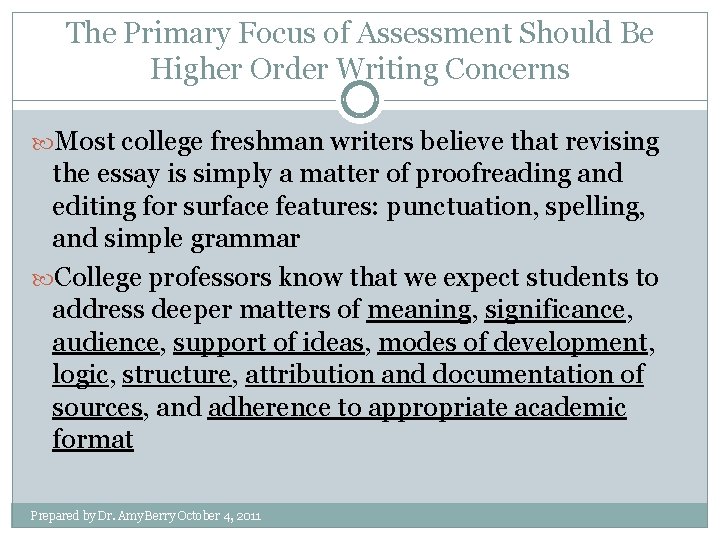
The Primary Focus of Assessment Should Be Higher Order Writing Concerns Most college freshman writers believe that revising the essay is simply a matter of proofreading and editing for surface features: punctuation, spelling, and simple grammar College professors know that we expect students to address deeper matters of meaning, significance, audience, support of ideas, modes of development, logic, structure, attribution and documentation of sources, and adherence to appropriate academic format Prepared by Dr. Amy Berry October 4, 2011
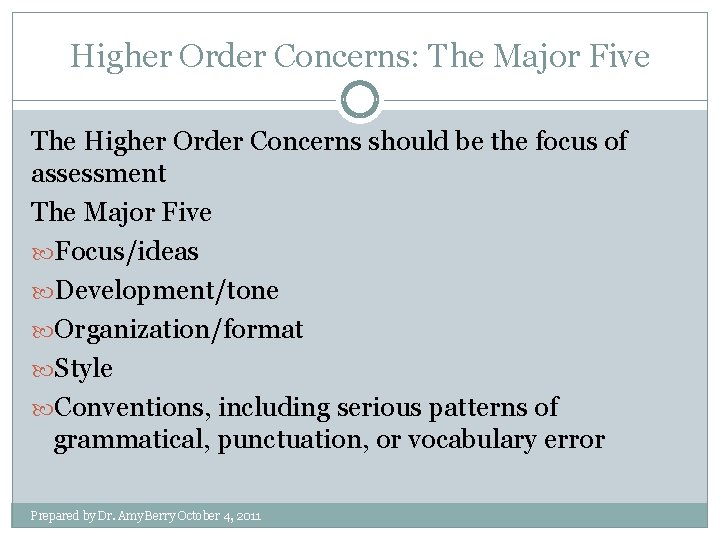
Higher Order Concerns: The Major Five The Higher Order Concerns should be the focus of assessment The Major Five Focus/ideas Development/tone Organization/format Style Conventions, including serious patterns of grammatical, punctuation, or vocabulary error Prepared by Dr. Amy Berry October 4, 2011
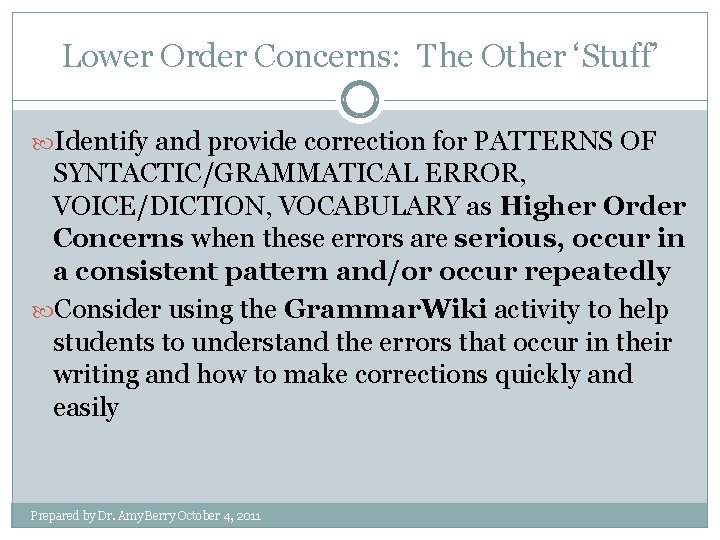
Lower Order Concerns: The Other ‘Stuff’ Identify and provide correction for PATTERNS OF SYNTACTIC/GRAMMATICAL ERROR, VOICE/DICTION, VOCABULARY as Higher Order Concerns when these errors are serious, occur in a consistent pattern and/or occur repeatedly Consider using the Grammar. Wiki activity to help students to understand the errors that occur in their writing and how to make corrections quickly and easily Prepared by Dr. Amy Berry October 4, 2011
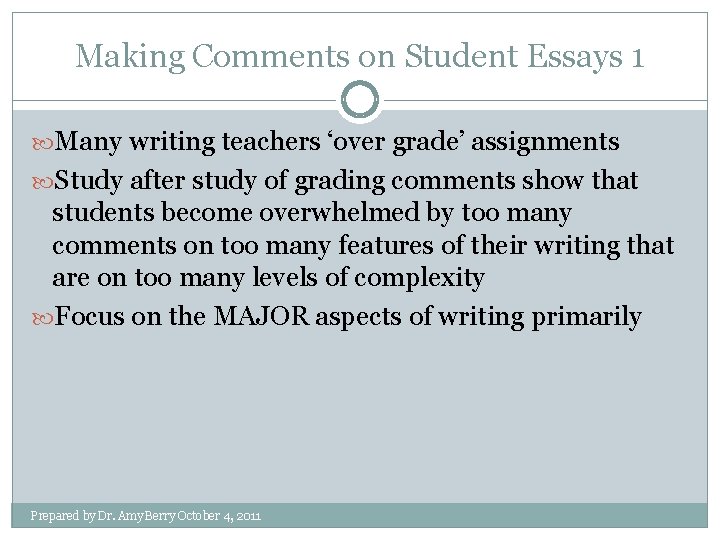
Making Comments on Student Essays 1 Many writing teachers ‘over grade’ assignments Study after study of grading comments show that students become overwhelmed by too many comments on too many features of their writing that are on too many levels of complexity Focus on the MAJOR aspects of writing primarily Prepared by Dr. Amy Berry October 4, 2011
Making Comments on Student Essays 2 Focus targeted comments and use them to help you to direct the writing conference Connect comments to rubric requirements and other assessment information for clarity Use comments and directive questions to focus student attention on essay strengths and weaknesses and to foster metacognitive monitoring Prepared by Dr. Amy Berry October 4, 2011
Marginal Comments and Questions Should Be Used to Guide Discussion and Reflection Use comments and questions to guide your discussion of the essay in conference and to stimulate student awareness and reflection of the strengths of their writing and their essay, not only the weaknesses and errors Keep your comments specific and brief Focus is the key Prepared by Dr. Amy Berry October 4, 2011
Specify, Specify! Marginal comments should Be Specific Point to the Assignment Rubric and Associated Writing Traits Guide discussion in the writing conference Prepared by Dr. Amy Berry October 4, 2011
Specify 2 Marginal Comments Should Help the student to reflect on strengths and weaknesses in the writing process that produce strong and weak writing Foster metacognitive monitoring of the writing and revising process Foster Deep Revision for the Major Five Foster awareness of patterns of error that distract the reader from the message and intent of the essay Prepared by Dr. Amy Berry October 4, 2011
Specify 3 Marginal Comments Should Foster metacognitive monitoring of the writing and revising process Foster Deep Revision for the Major Five Foster awareness of patterns of error and correction strategies that distract the reader from the message and intent of the essay Help the student to ask the right questions in conference Prepared by Dr. Amy Berry October 4, 2011
Where to Begin Make targeted and economical comment notes, focusing on major issues first Remember, your task is to make the student do the work of revision. Asking questions to clarify, interpret, and direct reflection and revision rather than “fixing”— rewriting-- the essay for the student is the best strategy to focus the writer’s attention on major, higher-order issues. Modeling written strategies is best done in small quantities and in conference discussion Also remember that you will use these targeted minimal grading strategies and questions to direct the writing conference Prepared by Dr. Amy Berry October 4, 2011
FOCUS the COMMENTS Over-grading and writing too many long comments on disparate issues within the draft can overwhelm the novice college writer. Focus any comments on the most serious issues, first Keep it Simple for best results Prepared by Dr. Amy Berry October 4, 2011
No More than Three Weaknesses Choose two or three major aspects of the essay that need correction and revision Address these in individual marginal and end note or grid comments Comment on both strong and weak aspects of the essay, directing the writer’s attention and encouraging reflection on writing as discovery, the student’s unique writing process, and the deep revision process Prepared by Dr. Amy Berry October 4, 2011
Make an End Note A three-to-five sentence comment at the end of the essay that summarizes the revisions you want to see in the next draft will help students to have an overview of what must be done in the next revision Address serious surface error judiciously in the end note. Direct the writers to their textbooks or handbooks for specific information and guidance on how to correct the error Prepared by Dr. Amy Berry October 4, 2011
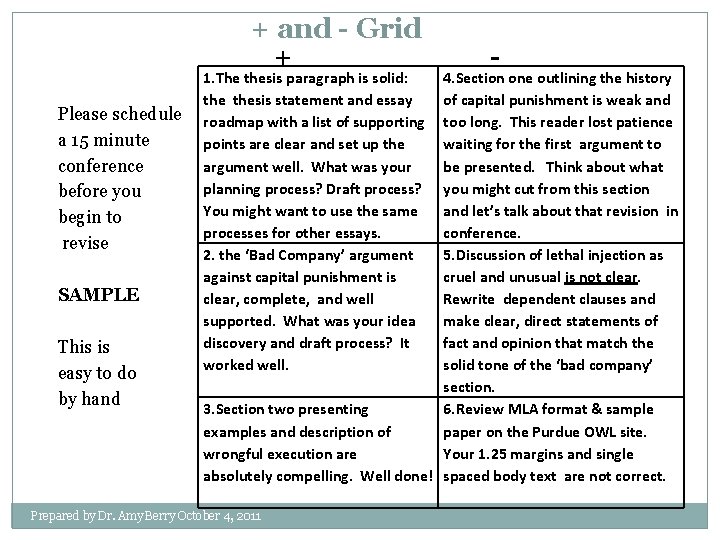
Or Use a + and – Grid Instead of an End Note, make a Grid This grid is a visual summary of major strengths and weaknesses that students need to address Number comments in the grid. After you complete comments in the essay and on the grid, go back and add the grid item number to each associated written comment Focus on the Major Five and any surface errors that impact clarity of meaning or distract attention from meaning Using the grid is an excellent way to keep conference discussion on track. Students like the grid Prepared by Dr. Amy Berry October 4, 2011
+ and - Grid + Please schedule a 15 minute conference before you begin to revise SAMPLE This is easy to do by hand 1. The thesis paragraph is solid: thesis statement and essay roadmap with a list of supporting points are clear and set up the argument well. What was your planning process? Draft process? You might want to use the same processes for other essays. 2. the ‘Bad Company’ argument against capital punishment is clear, complete, and well supported. What was your idea discovery and draft process? It worked well. - 4. Section one outlining the history of capital punishment is weak and too long. This reader lost patience waiting for the first argument to be presented. Think about what you might cut from this section and let’s talk about that revision in conference. 5. Discussion of lethal injection as cruel and unusual is not clear. Rewrite dependent clauses and make clear, direct statements of fact and opinion that match the solid tone of the ‘bad company’ section. 3. Section two presenting 6. Review MLA format & sample examples and description of paper on the Purdue OWL site. wrongful execution are Your 1. 25 margins and single absolutely compelling. Well done! spaced body text are not correct. Prepared by Dr. Amy Berry October 4, 2011
Planning and Conducting the Conference Be clear about the goals you want to accomplish in the conference Review targeted comments before the conference to focus the discussion This means that sometimes student questions must be deferred until the end of the session At other times, you may need to invite the student to ask questions at the beginning of the session Hone your one-to-one teaching strategies to make the writing conference conversation productive Prepared by Dr. Amy Berry October 4, 2011
Sample Essay Please see the sample essay that accompanies this presentation for model comments, endnote, and grid Prepared by Dr. Amy Berry October 4, 2011
Works Cited Harris, Muriel. 1979. “The Overgraded Paper: Another Case of More Is Less. ” In How to Handle the Paper Load, ed. Gene Stanford and the Committee on Classroom Practices, 91– 94. Urbana, Ill. : National Council of Teachers of English. Horvath, Brooke K. 1984. “The Components of Written Response: A Practical Synthesis of Current Views. ” Rhetoric Review 2: 136– 56. Lauer, Janice M. , et al. 1991. Four Worlds of Writing. 3 d ed. New York: Harper. Collins. Mailloux, Steven. 1989. Rhetorical Power. Ithaca, N. Y. : Cornell University Press. Murray, Donald M. 1979. “The Listening Eye: Reflections on the Writing Conference. ” College English 41: 13– 18. Rose, Alan. 1982. “Spoken versus Written Criticism of Student Writing—Some Advantages of the Conference Method. ” College Composition and Communication 33: 326– 30. Shuman, R. Baird. 1979. “How to Grade Student Writing. ” In How to Handle the Paper Load, ed. Gene Stanford and the Committee on Classroom Practices, 95– 96. Urbana, Ill. : National Council of Teachers of English. Sommers, Nancy. 1999. “Responding to Student Writing. ” In The New St. Martin’s Guide to Teaching Writing, ed. Robert Connors and Cheryl Glenn, 339– 47. Boston: Bedford/St. Martin’s. Prepared by Dr. Amy Berry October 4, 2011