
Evaluating Aircraft Positioning Methods for Airborne Gravimetry Results
Evaluating Aircraft Positioning Methods for Airborne Gravimetry: Results from GRAV-D’s “Kinematic GPS Processing Challenge” Theresa M. Damiani, Andria Bilich, and Gerald L. Mader NOAA- National Geodetic Survey, Geosciences Research Division
Overview Motivation: GRAV-D Background: Airborne Gravity Positioning Challenge Data and Response Position Analysis Gravity Analysis Conclusions
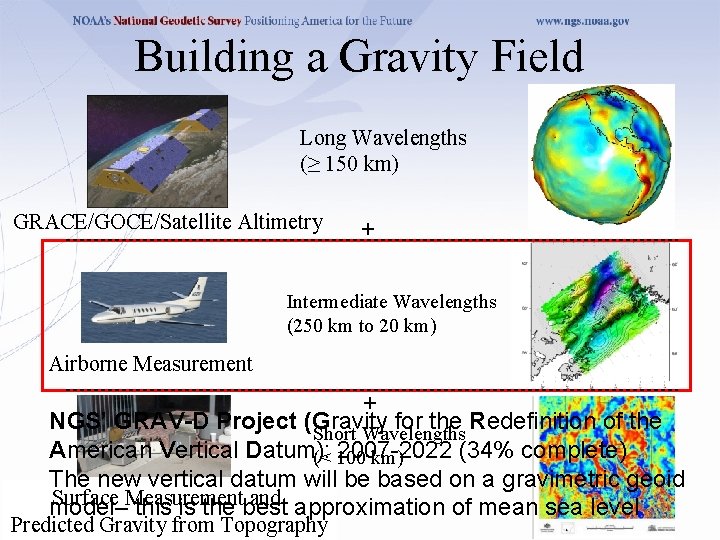
Building a Gravity Field Long Wavelengths (≥ 150 km) GRACE/GOCE/Satellite Altimetry + Intermediate Wavelengths (250 km to 20 km) Airborne Measurement + NGS’ GRAV-D Project (Gravity for the Redefinition of the Short Wavelengths American Vertical Datum): 2007 -2022 (34% complete) (< 100 km) The new vertical datum will be based on a gravimetric geoid Surface Measurement and approximation of mean sea level model– this is the best Predicted Gravity from Topography
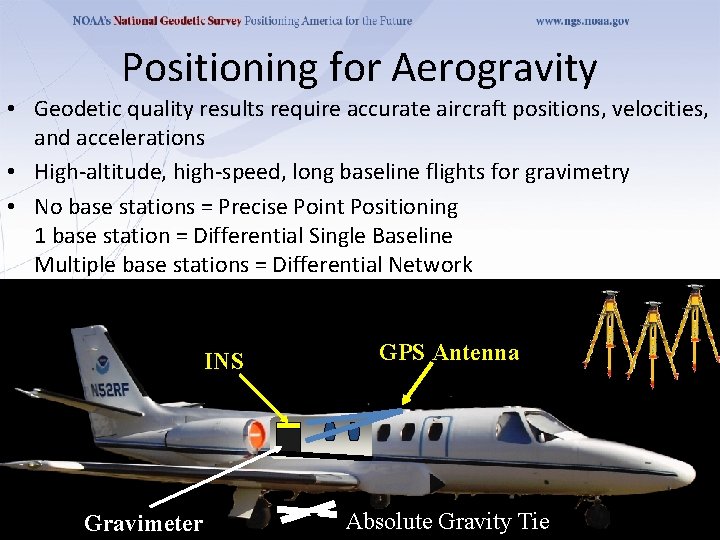
Positioning for Aerogravity • Geodetic quality results require accurate aircraft positions, velocities, and accelerations • High-altitude, high-speed, long baseline flights for gravimetry • No base stations = Precise Point Positioning 1 base station = Differential Single Baseline Multiple base stations = Differential Network INS Gravimeter GPS Antenna Absolute Gravity Tie
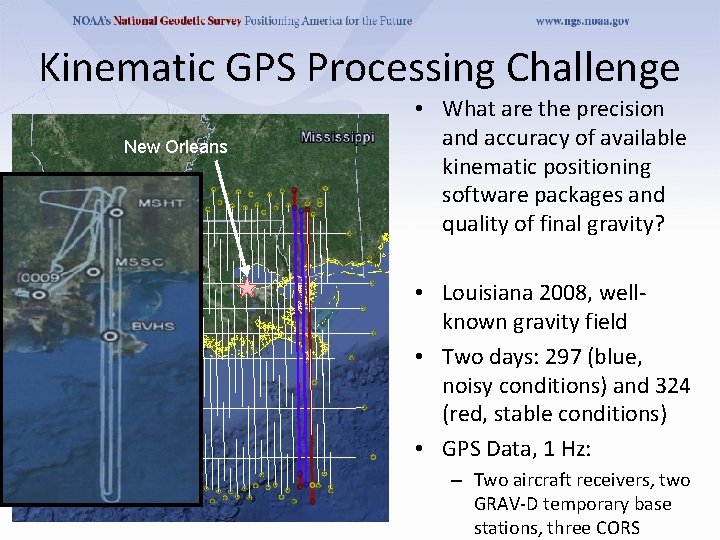
Kinematic GPS Processing Challenge New Orleans • What are the precision and accuracy of available kinematic positioning software packages and quality of final gravity? • Louisiana 2008, wellknown gravity field • Two days: 297 (blue, noisy conditions) and 324 (red, stable conditions) • GPS Data, 1 Hz: – Two aircraft receivers, two GRAV-D temporary base stations, three CORS
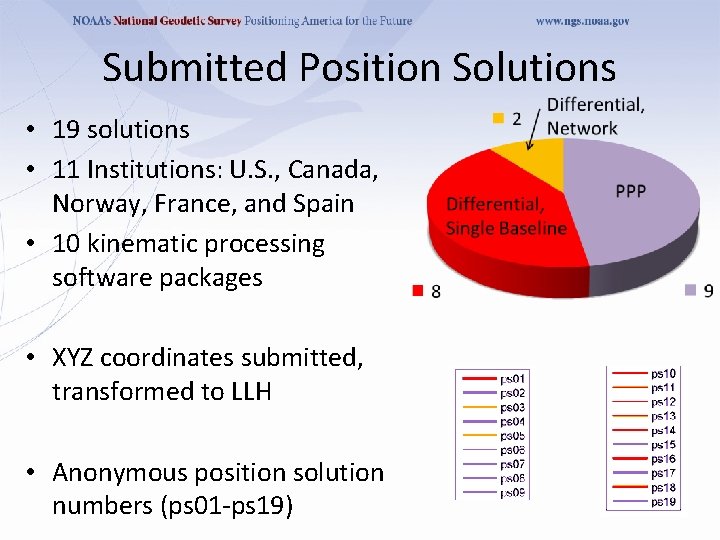
Submitted Position Solutions • 19 solutions • 11 Institutions: U. S. , Canada, Norway, France, and Spain • 10 kinematic processing software packages • XYZ coordinates submitted, transformed to LLH • Anonymous position solution numbers (ps 01 -ps 19)
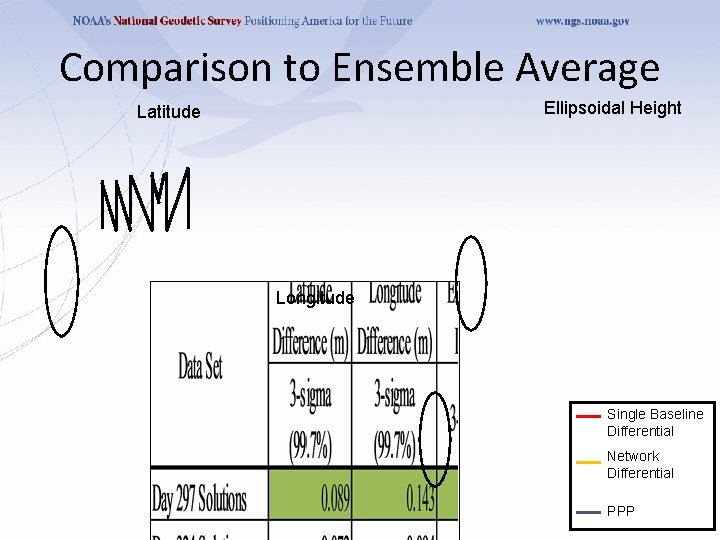
Comparison to Ensemble Average Ellipsoidal Height Latitude Longitude Single Baseline Differential Network Differential PPP
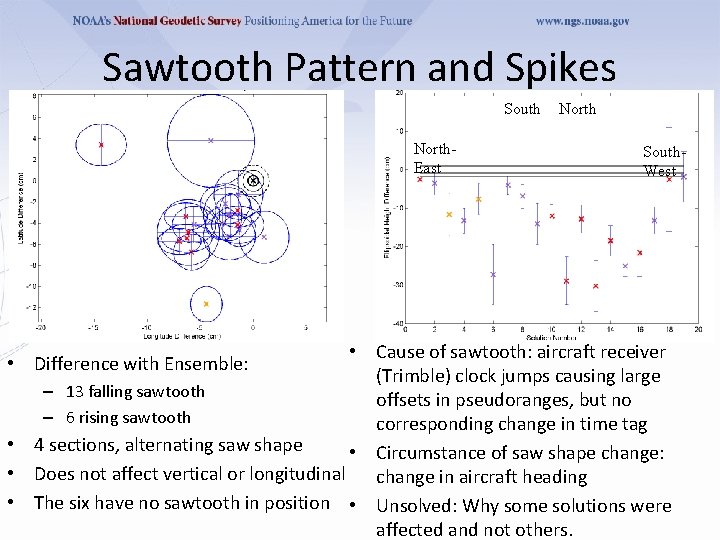
Sawtooth Pattern and Spikes South North. East North South. West • Cause of sawtooth: aircraft receiver (Trimble) clock jumps causing large – 13 falling sawtooth offsets in pseudoranges, but no – 6 rising sawtooth corresponding change in time tag • 4 sections, alternating saw shape • Circumstance of saw shape change: • Does not affect vertical or longitudinal change in aircraft heading • The six have no sawtooth in position • Unsolved: Why some solutions were affected and not others. • Difference with Ensemble:
Confidence Intervals 99. 7% points for any position solution of a GRAV-D flight, created with modern kinematic software and an experienced user, should be precise to within +/- 3 -sigma. Latitude most precise, Ellipsoidal Height least precise
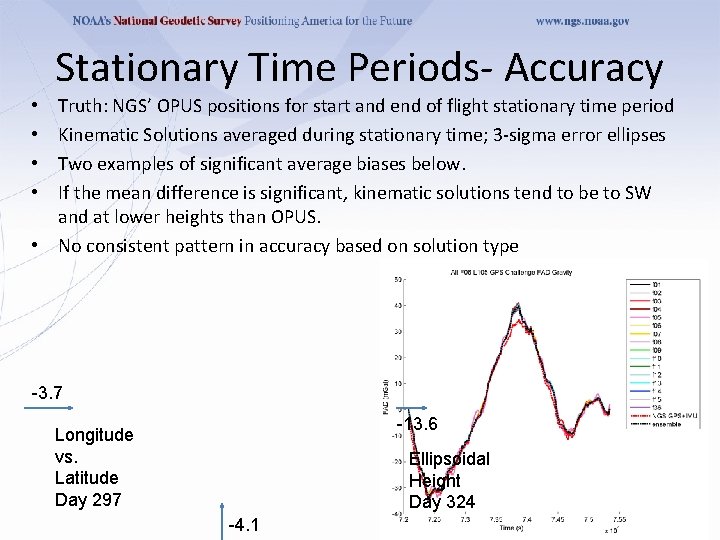
Stationary Time Periods- Accuracy Truth: NGS’ OPUS positions for start and end of flight stationary time period Kinematic Solutions averaged during stationary time; 3 -sigma error ellipses Two examples of significant average biases below. If the mean difference is significant, kinematic solutions tend to be to SW and at lower heights than OPUS. • No consistent pattern in accuracy based on solution type • • -3. 7 -13. 6 Longitude vs. Latitude Day 297 Ellipsoidal Height Day 324 -4. 1
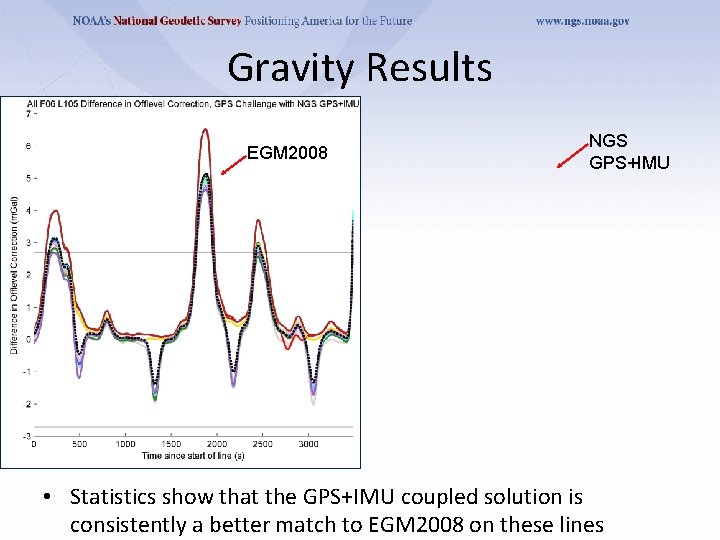
Gravity Results EGM 2008 NGS GPS+IMU • Statistics show that the GPS+IMU coupled solution is consistently a better match to EGM 2008 on these lines
Impact of Sawtooth on Gravity • For reflown line, solutions without sawtooth have best correlations.
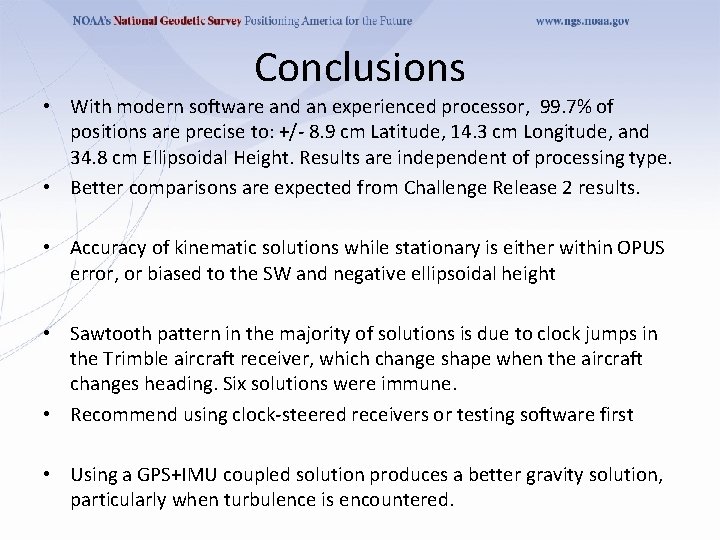
Conclusions • With modern software and an experienced processor, 99. 7% of positions are precise to: +/- 8. 9 cm Latitude, 14. 3 cm Longitude, and 34. 8 cm Ellipsoidal Height. Results are independent of processing type. • Better comparisons are expected from Challenge Release 2 results. • Accuracy of kinematic solutions while stationary is either within OPUS error, or biased to the SW and negative ellipsoidal height • Sawtooth pattern in the majority of solutions is due to clock jumps in the Trimble aircraft receiver, which change shape when the aircraft changes heading. Six solutions were immune. • Recommend using clock-steered receivers or testing software first • Using a GPS+IMU coupled solution produces a better gravity solution, particularly when turbulence is encountered.
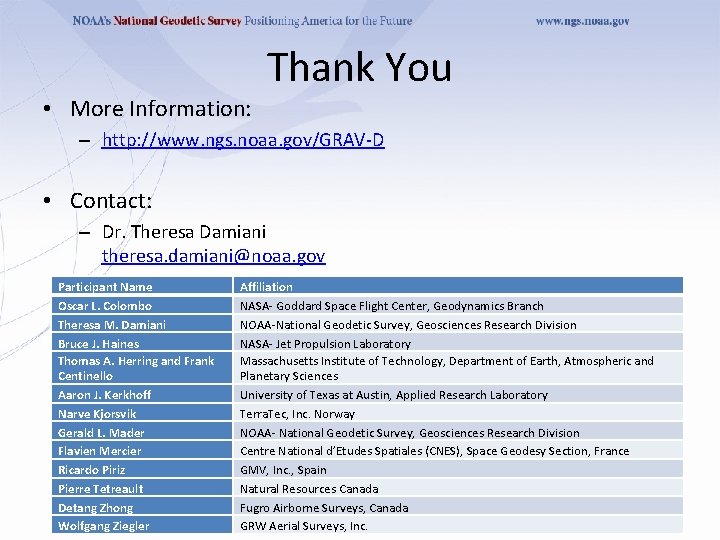
Thank You • More Information: – http: //www. ngs. noaa. gov/GRAV-D • Contact: – Dr. Theresa Damiani theresa. damiani@noaa. gov Participant Name Oscar L. Colombo Theresa M. Damiani Bruce J. Haines Thomas A. Herring and Frank Centinello Aaron J. Kerkhoff Narve Kjorsvik Gerald L. Mader Flavien Mercier Ricardo Piriz Pierre Tetreault Detang Zhong Wolfgang Ziegler Affiliation NASA- Goddard Space Flight Center, Geodynamics Branch NOAA-National Geodetic Survey, Geosciences Research Division NASA- Jet Propulsion Laboratory Massachusetts Institute of Technology, Department of Earth, Atmospheric and Planetary Sciences University of Texas at Austin, Applied Research Laboratory Terra. Tec, Inc. Norway NOAA- National Geodetic Survey, Geosciences Research Division Centre National d’Etudes Spatiales (CNES), Space Geodesy Section, France GMV, Inc. , Spain Natural Resources Canada Fugro Airborne Surveys, Canada GRW Aerial Surveys, Inc.
- Slides: 14