
EVAL 6970 MetaAnalysis Review of Principles and Practice
- Slides: 15
EVAL 6970: Meta-Analysis Review of Principles and Practice of Meta-Analysis Dr. Chris L. S. Coryn Spring 2011
Agenda • Review of principles and practice of meta-analysis • Questions
Why Effect Sizes? • Imagine your doctor gave you the following information – Research shows that people with your body-mass index and sedentary lifestyle score on average 2 points lower on a cardiac risk assessment test in comparison to active people with a healthy body weight • Would this prompt you to make drastic changes to your lifestyle?
Why Effect Sizes? • Now imagine your doctor said this to you instead – Research shows that people with your body-mass index and sedentary lifestyle are four times as likely to suffer a serious heart attack within 10 years in comparison to people with a normal body weight • Would this prompt you to make drastic changes to your lifestyle?
The Problem of Interpretation • It is not sufficient to know the size and direction of an effect • Effect magnitudes must be interpreted to extract meaning • Effects by themselves are meaningless unless they can be contextualized against some frame of reference
The Problem of Interpretation • Medicine is a special case when it comes to reporting results in metrics that are widely understood – Most people have heard of cholesterol, blood pressure, the body-mass index, blood-sugar levels – These metrics are easily amenable to interpretation
The Problem of Interpretation • In the social sciences many phenomena can be observed only indirectly – Self-esteem, trust, satisfaction, and depression are typically measured using scales and such scales are usually considered arbitrary when there is no obvious connection between a score and an individual’s actual state or when it is not known how a one-unit change on the score reflects change in the underlying construct – These metrics are useful for gauging effect sizes, but make interpretation difficult
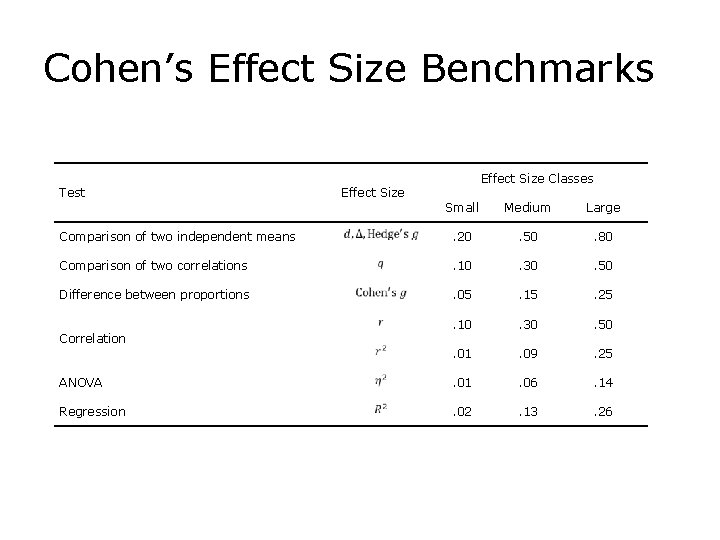
Cohen’s Effect Size Benchmarks Effect Size Classes Test Effect Size Small Medium Large Comparison of two independent means . 20 . 50 . 80 Comparison of two correlations . 10 . 30 . 50 Difference between proportions . 05 . 15 . 25 . 10 . 30 . 50 . 01 . 09 . 25 ANOVA . 01 . 06 . 14 Regression . 02 . 13 . 26 Correlation
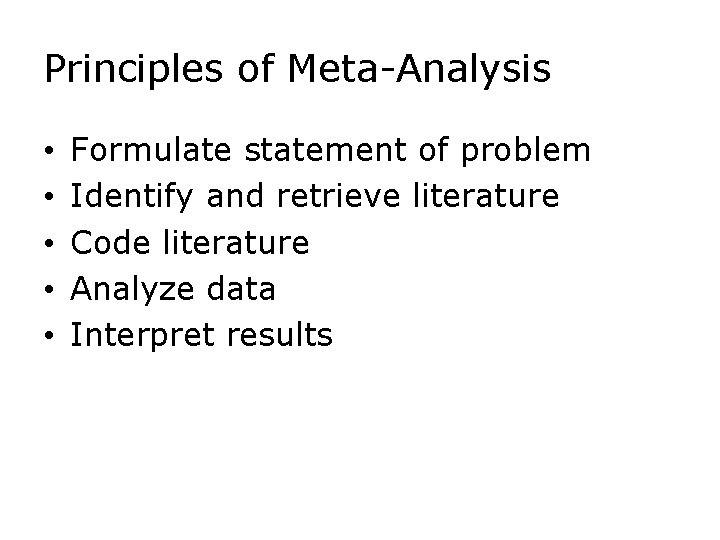
Principles of Meta-Analysis • • • Formulate statement of problem Identify and retrieve literature Code literature Analyze data Interpret results
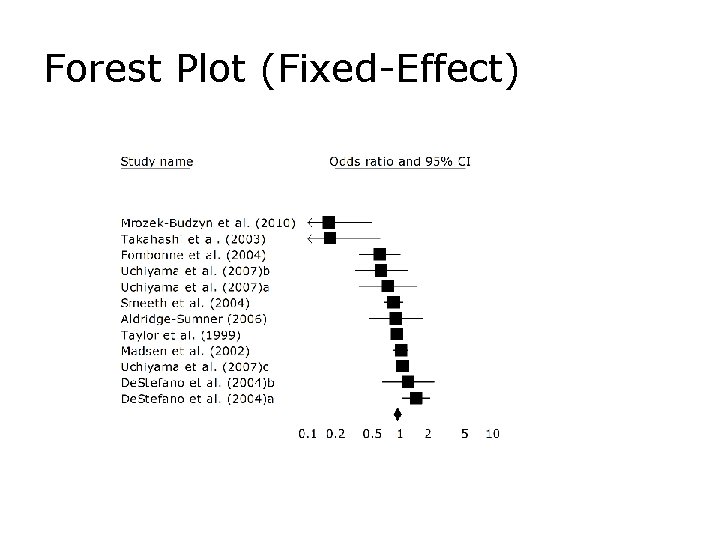
Forest Plot (Fixed-Effect)
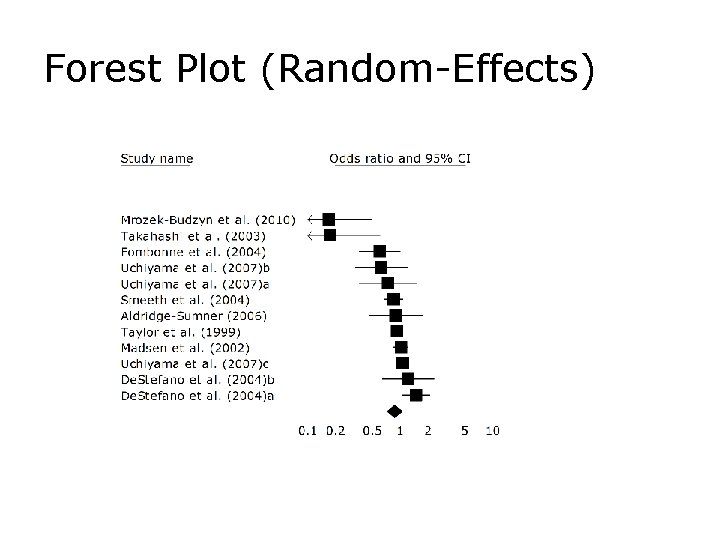
Forest Plot (Random-Effects)
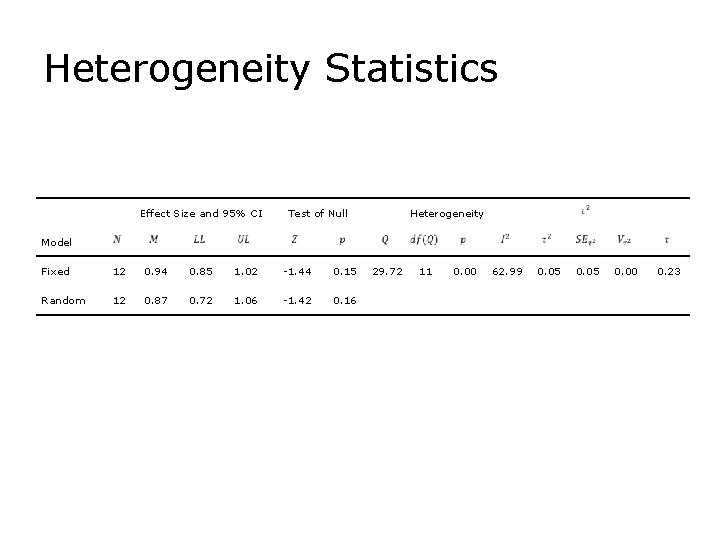
Heterogeneity Statistics Effect Size and 95% CI Test of Null Heterogeneity Model Fixed 12 0. 94 0. 85 1. 02 -1. 44 0. 15 Random 12 0. 87 0. 72 1. 06 -1. 42 0. 16 29. 72 11 0. 00 62. 99 0. 05 0. 00 0. 23
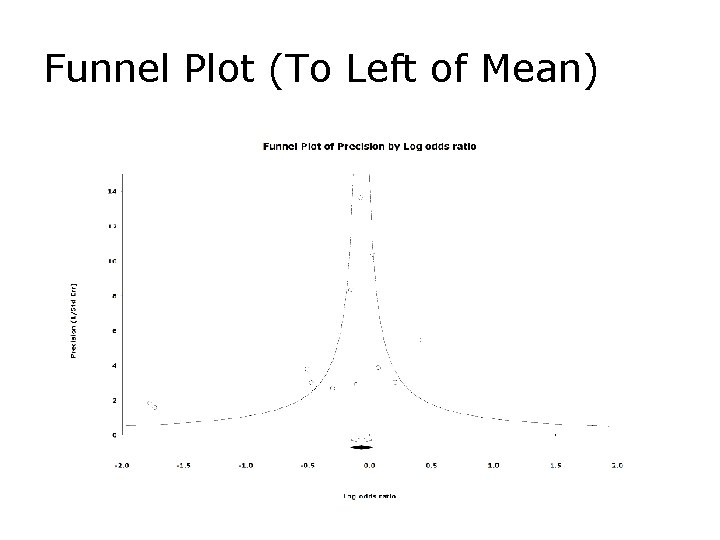
Funnel Plot (To Left of Mean)
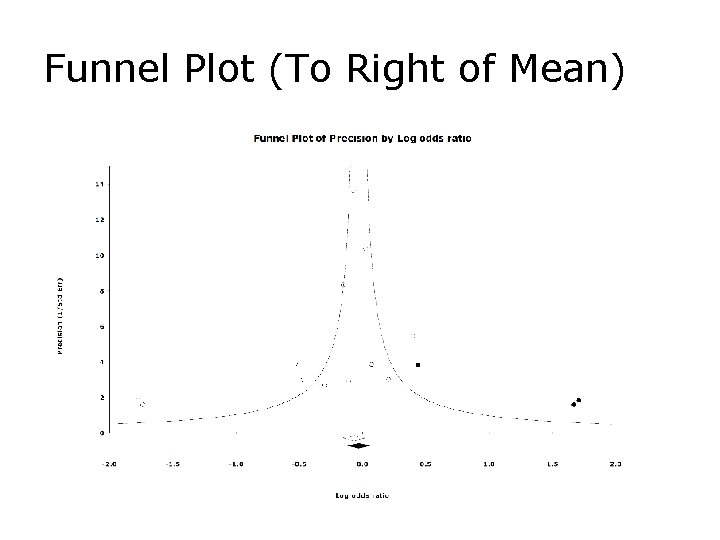
Funnel Plot (To Right of Mean)
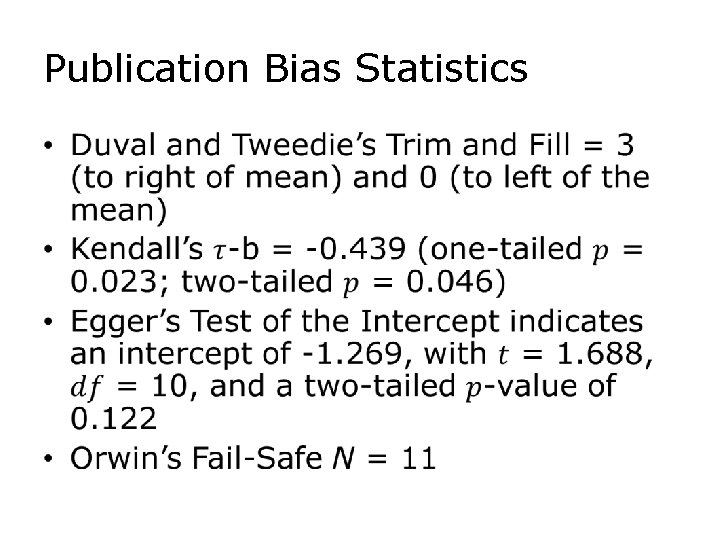
Publication Bias Statistics •