
EVA Technology Collaboration Workshop ISS EVA State of

EVA Technology Collaboration Workshop ISS EVA – State of the Art Brian Johnson EVA Exploration Office, Manager NASA / Johnson Space Center 1
ISS / EMU Background • ISS EVA Operations – ISS operational life has been baselined to 2024 – Per ISS Program direction, the EVA Office is planning continued EVA support thru at least 2024 using the EMU, including strategic planning for use of EMU to 2028 • ISS operations is a significant learning opportunity for EVA – Operation (Assembly and Maintenance of ISS) with the EMU and associated EVA tools provide a constant assessment of the state of the art • To support high fidelity demonstration or nominal operations of advanced suit systems, only minor ISS modifications are anticipated – ISS Program has been very supportive in the study of interface accommodation changes for advanced EVA hardware Implementation of advanced operational EVA capabilities on ISS is feasible, beneficial, and a tremendous opportunity for Exploration 2
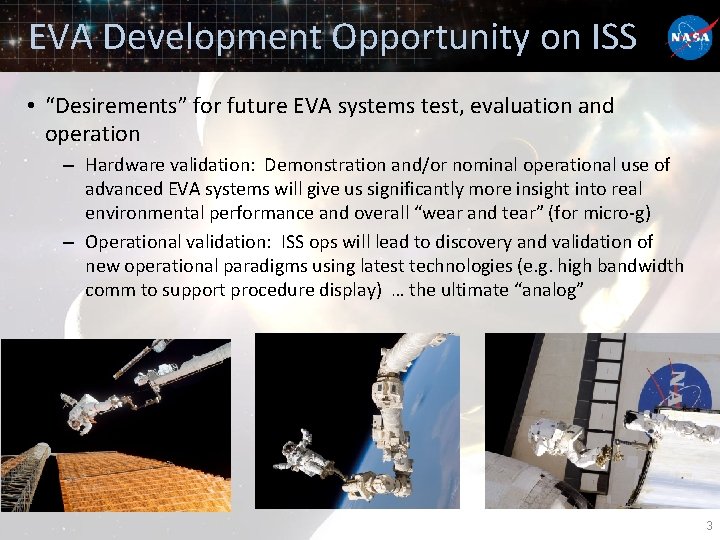
EVA Development Opportunity on ISS • “Desirements” for future EVA systems test, evaluation and operation – Hardware validation: Demonstration and/or nominal operational use of advanced EVA systems will give us significantly more insight into real environmental performance and overall “wear and tear” (for micro-g) – Operational validation: ISS ops will lead to discovery and validation of new operational paradigms using latest technologies (e. g. high bandwidth comm to support procedure display) … the ultimate “analog” 3

SHUTTLE/ISS ISS/EIxploration EVA Need (US only) Several critical ISS EVAs ahead of us. (ISS Batts & AMS) Beyond ISS EVA Planning horizon Source (11/11/15): https: //evahistoricalarchive. jsc. nasa. gov/ or http: //www. nasa. gov/mission_pages/station/spacewalks 4
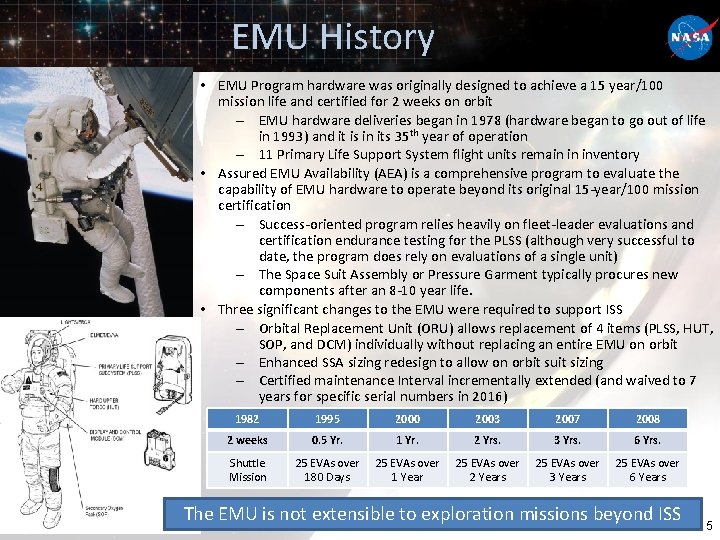
EMU History • EMU Program hardware was originally designed to achieve a 15 year/100 mission life and certified for 2 weeks on orbit – EMU hardware deliveries began in 1978 (hardware began to go out of life in 1993) and it is in its 35 th year of operation – 11 Primary Life Support System flight units remain in inventory • Assured EMU Availability (AEA) is a comprehensive program to evaluate the capability of EMU hardware to operate beyond its original 15 -year/100 mission certification – Success-oriented program relies heavily on fleet-leader evaluations and certification endurance testing for the PLSS (although very successful to date, the program does rely on evaluations of a single unit) – The Space Suit Assembly or Pressure Garment typically procures new components after an 8 -10 year life. • Three significant changes to the EMU were required to support ISS – Orbital Replacement Unit (ORU) allows replacement of 4 items (PLSS, HUT, SOP, and DCM) individually without replacing an entire EMU on orbit – Enhanced SSA sizing redesign to allow on orbit suit sizing – Certified maintenance Interval incrementally extended (and waived to 7 years for specific serial numbers in 2016) 1982 1995 2000 2003 2007 2008 2 weeks 0. 5 Yr. 1 Yr. 2 Yrs. 3 Yrs. 6 Yrs. Shuttle Mission 25 EVAs over 180 Days 25 EVAs over 1 Year 25 EVAs over 2 Years 25 EVAs over 3 Years 25 EVAs over 6 Years The EMU is not extensible to exploration missions beyond ISS 5
EVA Lessons Learned • EMU Lessons Learned Papers – AIAA-2012 -3411 -926 AEMU to Shuttle EMU Comparison – ICES-2015 -327 EMU FIAR History – 2005 -01 -3013 Lessons Learned Operating and Maintaining the EMU • Listing of all significant findings up through 2005 – EMU shoulder injury tiger team report NASA Technical Report TM-2003– 212058 • Williams DR, Johnson BJ (2003) NASA Johnson Space Center, Houston, TX – Extravehicular mobility unit training and astronaut injuries • Strauss S, Krog RL, Feiveson AH (2005). Aviation, Space, and Environmental Medicine 76(5): 469 -74 – Musculoskeletal injuries and minor trauma in space: incidence and injury mechanisms in U. S. astronauts. • Scheuring RA, Mathers CH, Jones JA, Wear ML (2009) Aviation, Space, and Environmental Medicine 80(2): 117 -24 • EVA Knowledge Capture – US Spacesuit Knowledge Capture Series (http: //nescacademy. nasa. gov/category/5/sub/27) • Mishap Reports – EVA-23 Water Intrusion Mishap Investigation Board Report • IRIS Case Number: S-2013 -199 -00005 (publicly available redacted version) • EVA Reference Documentation – EMU Mini Databook (EAR Export Classification: ECCN [9 E 515. a]) – EMU Requirements Evolution (Rev. B 2005 - EAR Export Classification: ECCN [9 E 515. a] ) • EVA Operations Lessons Learned – Flight and Increment Lessons Center • • EVA CCB lessons learned, Crew Consensus Reports, EMU Failure Tracking https: //nasa-ice. nasa. gov/portal/web/eva/flight-lessons-center (behind NASA firewall) 6

ISS EVA Lessons Learned EVA History on ISS Lesson Learned for Advanced EVA Development EMU availability decrease due to issues with water intrusion into the vent loop Separate the water and ventilation loops EMU heat rejection (sublimator) sensitivity to water More robust heat rejection systems and/or filter chemistry advancements (reduce sensitivity to operation in multiple spacecraft) EMU has several single fault tolerant systems Utilize advanced technologies to effectively add redundancy EMU PLSS was not originally designed to be maintained on-orbit. Utilize modular interfaces and packaging methods to enable R&R of critical components EMU PLSS was not designed to be readily upgraded with newer components. Utilize modular interfaces and packaging methods to enable removal and upgrade of components. Long duration operation (years) on-orbit can and will reveal issues that can’t be replicated on the ground. Next generation system should be used in LEO for as long as possible (years) prior to first long duration mission. Flight development and certification of batteries is hard! Working with NESC to ensure best practices go into design and battery selection Crew injury during training aggravated by suit design and suit fit Remove as many injury mechanisms as possible. Ex. Rear entry, improved scye bearing placement, improved fit for wider anthro range 7
- Slides: 7