
EVA ECONOMIC VALUE ADDED AN OPPORTUNITY COST The


- Slides: 10
EVA ECONOMIC VALUE ADDED (AN OPPORTUNITY COST)
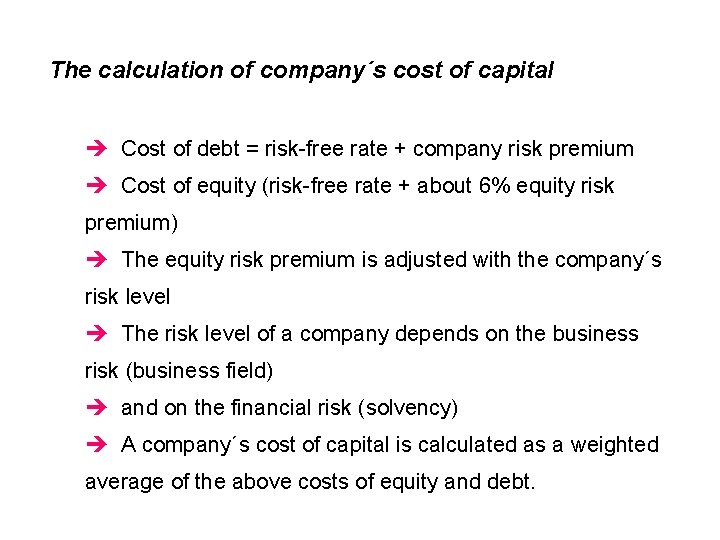
The calculation of company´s cost of capital è Cost of debt = risk-free rate + company risk premium è Cost of equity (risk-free rate + about 6% equity risk premium) è The equity risk premium is adjusted with the company´s risk level è The risk level of a company depends on the business risk (business field) è and on the financial risk (solvency) è A company´s cost of capital is calculated as a weighted average of the above costs of equity and debt.
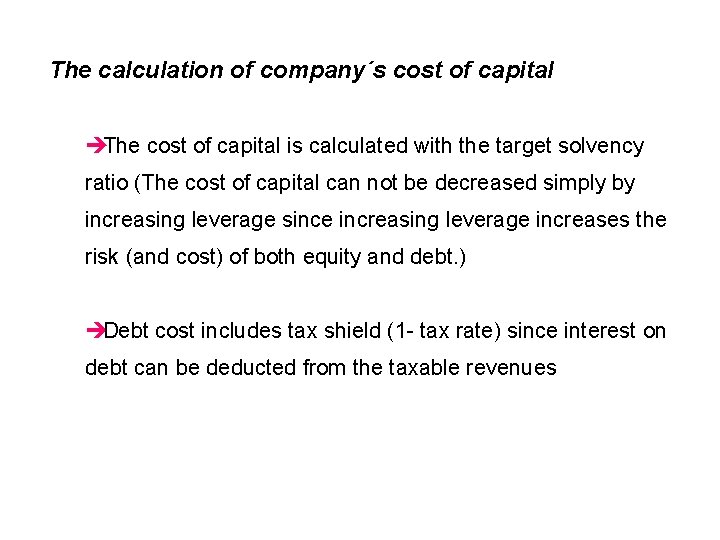
The calculation of company´s cost of capital èThe cost of capital is calculated with the target solvency ratio (The cost of capital can not be decreased simply by increasing leverage since increasing leverage increases the risk (and cost) of both equity and debt. ) èDebt cost includes tax shield (1 - tax rate) since interest on debt can be deducted from the taxable revenues
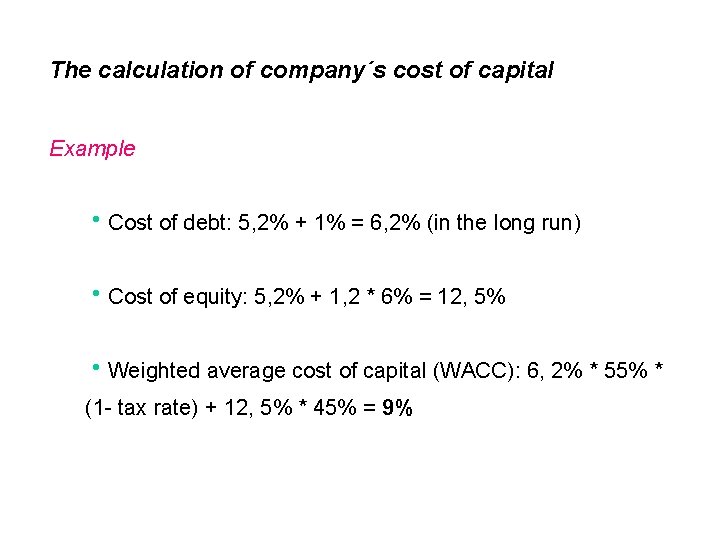
The calculation of company´s cost of capital Example h. Cost of debt: 5, 2% + 1% = 6, 2% (in the long run) h. Cost of equity: 5, 2% + 1, 2 * 6% = 12, 5% h. Weighted average cost of capital (WACC): 6, 2% * 55% * (1 - tax rate) + 12, 5% * 45% = 9%
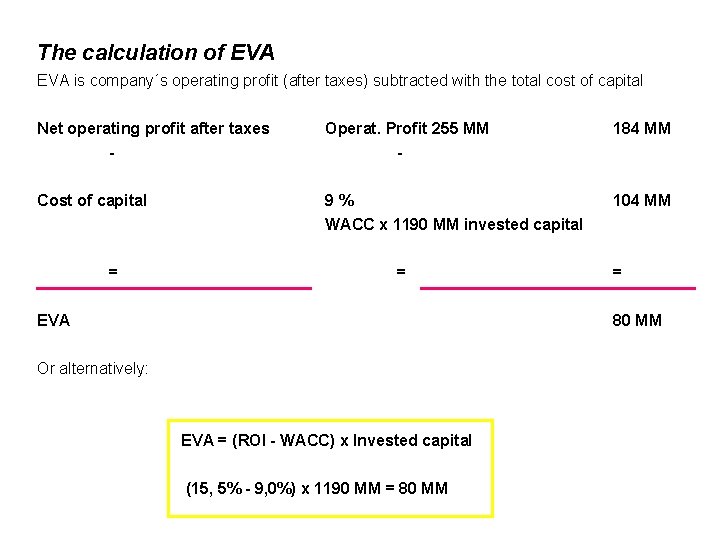
The calculation of EVA is company´s operating profit (after taxes) subtracted with the total cost of capital Net operating profit after taxes - Operat. Profit 255 MM - 184 MM Cost of capital 9% WACC x 1190 MM invested capital 104 MM = = EVA = 80 MM Or alternatively: EVA = (ROI - WACC) x Invested capital (15, 5% - 9, 0%) x 1190 MM = 80 MM
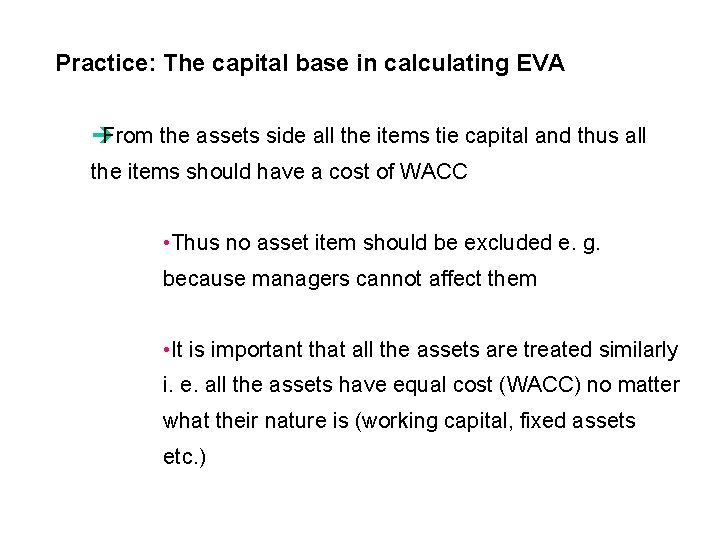
Practice: The capital base in calculating EVA è From the assets side all the items tie capital and thus all the items should have a cost of WACC • Thus no asset item should be excluded e. g. because managers cannot affect them • It is important that all the assets are treated similarly i. e. all the assets have equal cost (WACC) no matter what their nature is (working capital, fixed assets etc. )
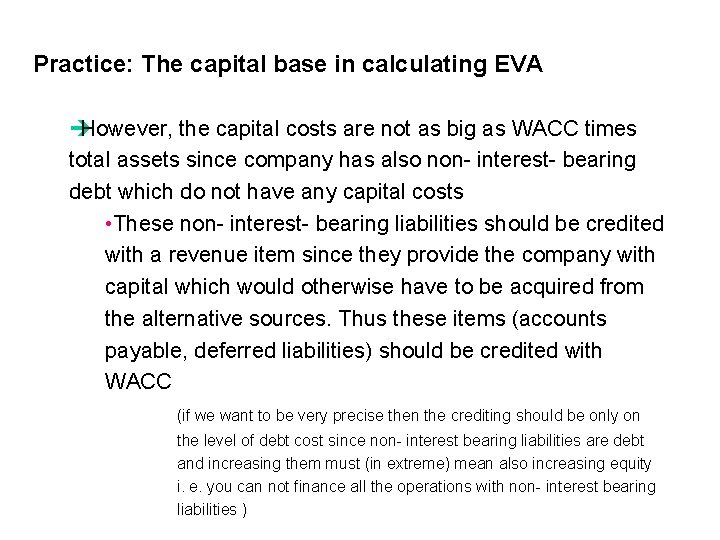
Practice: The capital base in calculating EVA è However, the capital costs are not as big as WACC times total assets since company has also non- interest- bearing debt which do not have any capital costs • These non- interest- bearing liabilities should be credited with a revenue item since they provide the company with capital which would otherwise have to be acquired from the alternative sources. Thus these items (accounts payable, deferred liabilities) should be credited with WACC (if we want to be very precise then the crediting should be only on the level of debt cost since non- interest bearing liabilities are debt and increasing them must (in extreme) mean also increasing equity i. e. you can not finance all the operations with non- interest bearing liabilities )
Practice: Income statement è EVA calculation begins with Operating profit which is deducted with taxes and capital costs in order to get EVA • Financial incomes can be added to Operating profit since they are part of normal operations (and besides cash and bank are with when capital costs are defined) but usually financial incomes are so small in industrial companies that they can be left out • Taxes are calculated simply: Operating profit x tax rate Taxes are of course not normally so high because of interest on debt and because of reserves or execess depreciation but these things are taken into account elsewhere (tax shield of interest rates are taken into account in calculating WACC and taxes on reserves etc. can be considered as non- interest bearing debt which do not have any capital costs)
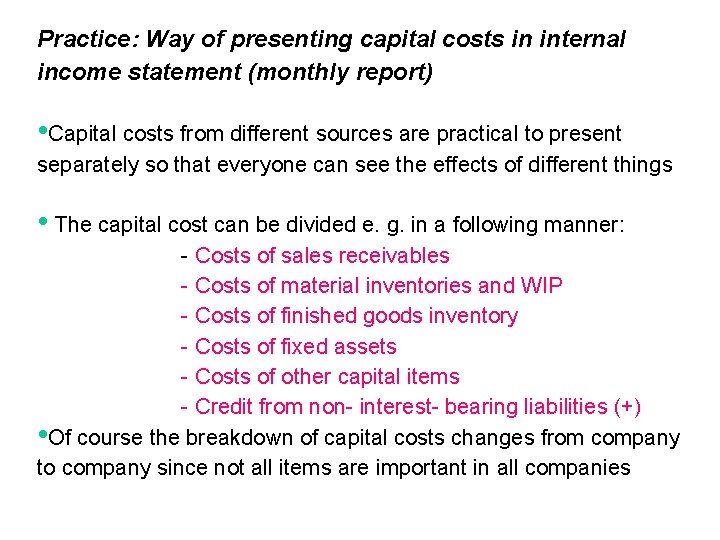
Practice: Way of presenting capital costs in internal income statement (monthly report) • Capital costs from different sources are practical to present separately so that everyone can see the effects of different things • The capital cost can be divided e. g. in a following manner: - Costs of sales receivables - Costs of material inventories and WIP - Costs of finished goods inventory - Costs of fixed assets - Costs of other capital items - Credit from non- interest- bearing liabilities (+) • Of course the breakdown of capital costs changes from company to company since not all items are important in all companies
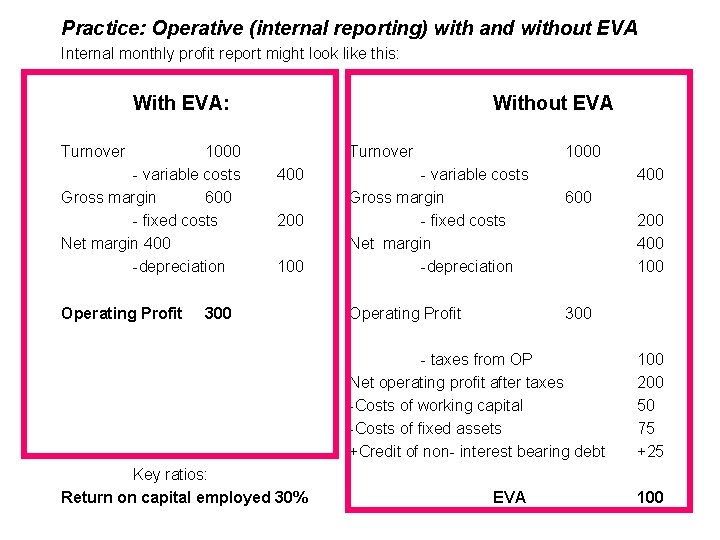
Practice: Operative (internal reporting) with and without EVA Internal monthly profit report might look like this: With EVA: 1000 - variable costs Gross margin 600 - fixed costs Net margin 400 -depreciation Without EVA Turnover Operating Profit Turnover 400 200 100 300 1000 - variable costs Gross margin - fixed costs Net margin -depreciation Operating Profit 400 600 200 400 100 300 - taxes from OP Net operating profit after taxes -Costs of working capital -Costs of fixed assets +Credit of non- interest bearing debt Key ratios: Return on capital employed 30% EVA 100 200 50 75 +25 100