
EV TA The Efficacy and Safety of Varenicline


- Slides: 19
EV TA The Efficacy and Safety of Varenicline, a Selective α 4β 2 Nicotinic Receptor Partial Agonist, for Smoking Cessation in Patients Hospitalized with Acute Coronary Syndrome: A Randomized Controlled Trial Mark J. Eisenberg, Sarah B. Windle, Nathalie Roy, Wayne Old, François Grondin, Iqbal Bata, Ayman Iskander, Claude Lauzon, Nalin Srivastava, Adam Clarke, Daniel Cassavar, Danielle Dion, Herbert Haught, Shamir Mehta, Jean-François Baril, Charles Lambert, Mina Madan, Beth L. Abramson, and Payam Dehghani for the Evaluation of Varenicline in Smoking Cessation for Patients Post-Acute Coronary Syndrome (EVITA) Trial Investigators Embargoed Until 10: 45 a. m. ET, Monday, Nov. 9, 2015
Disclosures EV TA • Drs. Eisenberg, Dehghani and Madan received honoraria from Pfizer Inc. for providing continuing medical education on smoking cessation • Dr. Eisenberg received funding and study drug/placebo from Pfizer Inc. , to perform the Evaluation of Varenicline in Smoking Cessation for Patients Post-Acute Coronary Syndrome [EVITA] Trial; NCT 00794573).
Background EV TA • Morbidity and mortality substantially increased among patients who continue to smoke following ACS • Less than 1/3 remain abstinent after discharge • Nicotine replacement therapies (NRTs) – frequently prescribed in-hospital but no RCTs • Bupropion (non-NRT) – 3 RCTs and not found to be efficacious • Varenicline (non-NRT) – efficacious in healthy smokers and stable CVD patients • Little is known about varenicline’s efficacy in ACS patients References: JAMA 2003; 290: 86 -97. Am J Cardiol 2011; 108: 804 -8. How Tobacco Smoking Causes Disease: The Biology and Behavioral Basis for Smoking-Attributable Disease: A Report of the Surgeon General, 2010. The Health Consequences of Smoking: A Report of the Surgeon General, 2004. J Am Coll Cardiol 2013; 61: 524 -32. Arch Intern Med 2011; 171: 1055 -60. Am J Med 2006; 119: 1080 -7. JAMA 2015; 313: 687 -94. JAMA 2006; 296: 56 -63. Circulation. 2010; 121: 221 -9.
Objective EV TA To assess the efficacy of varenicline in smokers hospitalized with ACS
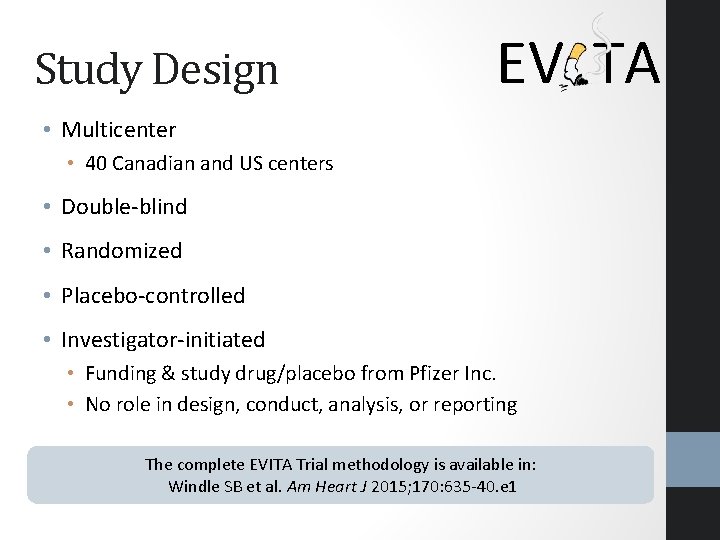
Study Design EV TA • Multicenter • 40 Canadian and US centers • Double-blind • Randomized • Placebo-controlled • Investigator-initiated • Funding & study drug/placebo from Pfizer Inc. • No role in design, conduct, analysis, or reporting The complete EVITA Trial methodology is available in: Windle SB et al. Am Heart J 2015; 170: 635 -40. e 1
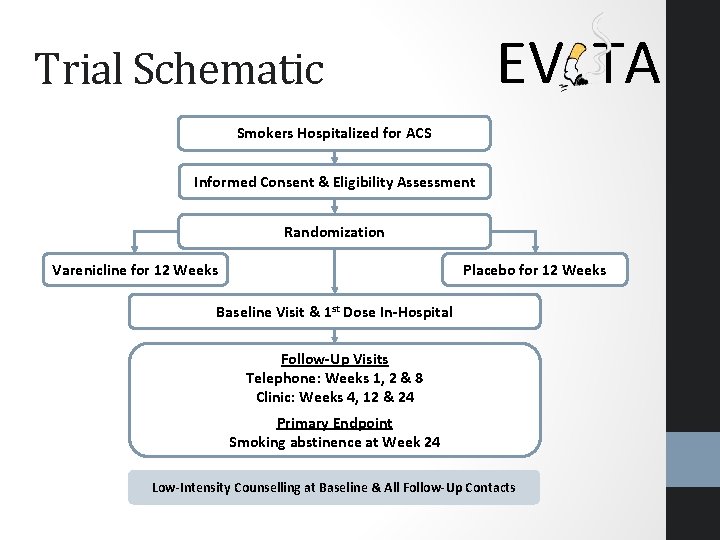
EV TA Trial Schematic Smokers Hospitalized for ACS Informed Consent & Eligibility Assessment Randomization Varenicline for 12 Weeks Placebo for 12 Weeks Baseline Visit & 1 st Dose In-Hospital Follow-Up Visits Telephone: Weeks 1, 2 & 8 Clinic: Weeks 4, 12 & 24 Primary Endpoint Smoking abstinence at Week 24 Low-Intensity Counselling at Baseline & All Follow-Up Contacts
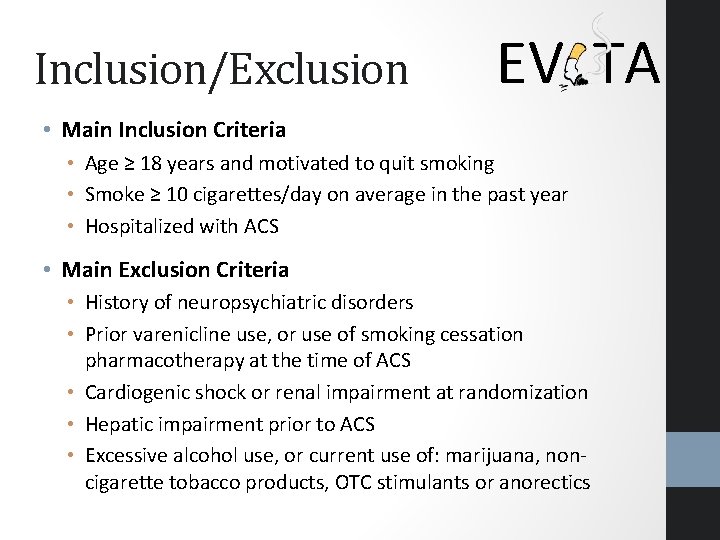
Inclusion/Exclusion EV TA • Main Inclusion Criteria • Age ≥ 18 years and motivated to quit smoking • Smoke ≥ 10 cigarettes/day on average in the past year • Hospitalized with ACS • Main Exclusion Criteria • History of neuropsychiatric disorders • Prior varenicline use, or use of smoking cessation pharmacotherapy at the time of ACS • Cardiogenic shock or renal impairment at randomization • Hepatic impairment prior to ACS • Excessive alcohol use, or current use of: marijuana, noncigarette tobacco products, OTC stimulants or anorectics
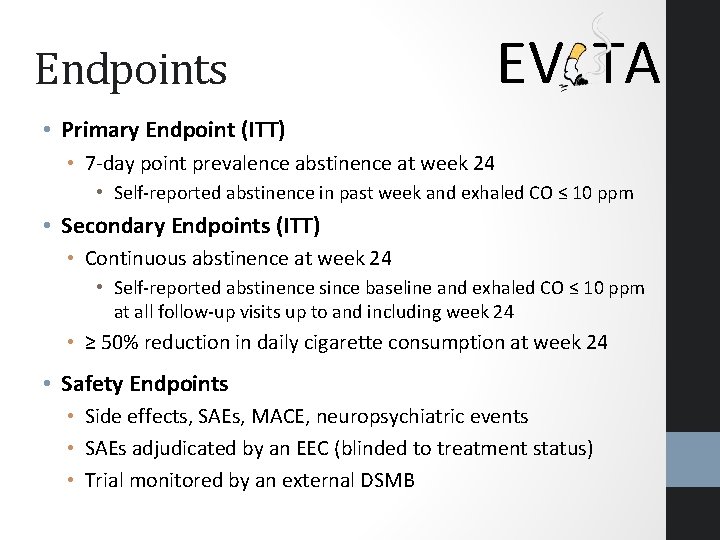
Endpoints EV TA • Primary Endpoint (ITT) • 7 -day point prevalence abstinence at week 24 • Self-reported abstinence in past week and exhaled CO ≤ 10 ppm • Secondary Endpoints (ITT) • Continuous abstinence at week 24 • Self-reported abstinence since baseline and exhaled CO ≤ 10 ppm at all follow-up visits up to and including week 24 • ≥ 50% reduction in daily cigarette consumption at week 24 • Safety Endpoints • Side effects, SAEs, MACE, neuropsychiatric events • SAEs adjudicated by an EEC (blinded to treatment status) • Trial monitored by an external DSMB
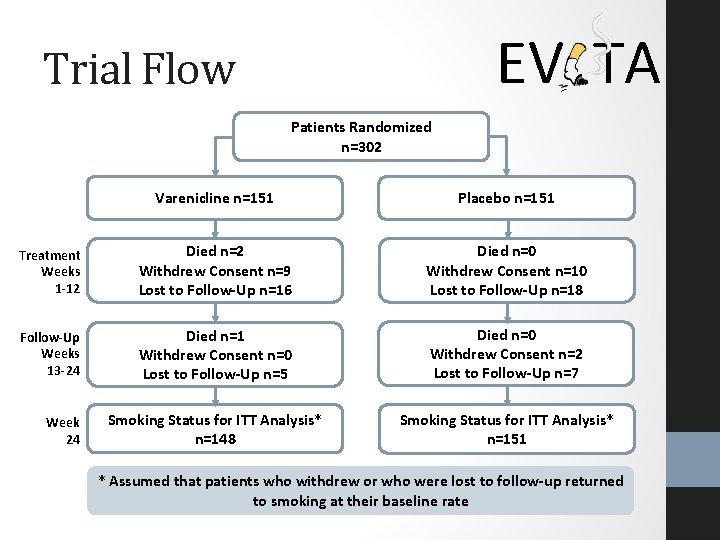
EV TA Trial Flow Patients Randomized n=302 Varenicline n=151 Placebo n=151 Treatment Weeks 1 -12 Died n=2 Withdrew Consent n=9 Lost to Follow-Up n=16 Died n=0 Withdrew Consent n=10 Lost to Follow-Up n=18 Follow-Up Weeks 13 -24 Died n=1 Withdrew Consent n=0 Lost to Follow-Up n=5 Died n=0 Withdrew Consent n=2 Lost to Follow-Up n=7 Smoking Status for ITT Analysis* n=148 Smoking Status for ITT Analysis* n=151 Week 24 * Assumed that patients who withdrew or who were lost to follow-up returned to smoking at their baseline rate
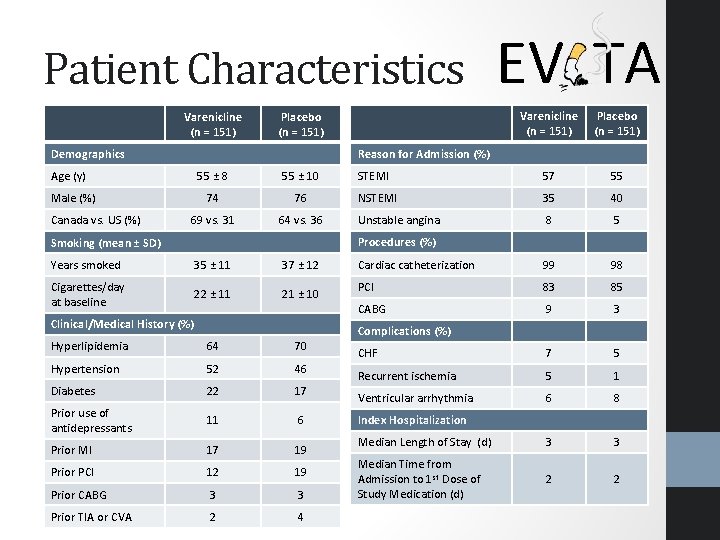
Patient Characteristics Varenicline (n = 151) Placebo (n = 151) STEMI 57 55 NSTEMI 35 40 Unstable angina 8 5 Cardiac catheterization 99 98 PCI 83 85 CABG 9 3 CHF 7 5 Recurrent ischemia 5 1 Ventricular arrhythmia 6 8 Median Length of Stay (d) 3 3 Median Time from Admission to 1 st Dose of Study Medication (d) 2 2 Placebo (n = 151) Reason for Admission (%) Demographics 55 ± 8 55 ± 10 74 76 69 vs. 31 64 vs. 36 Age (y) Male (%) Canada vs. US (%) EV TA Procedures (%) Smoking (mean ± SD) Years smoked 35 ± 11 37 ± 12 Cigarettes/day at baseline 22 ± 11 21 ± 10 Clinical/Medical History (%) Hyperlipidemia 64 70 Hypertension 52 46 Diabetes 22 17 Prior use of antidepressants 11 6 Prior MI 17 19 Prior PCI 12 19 Prior CABG 3 3 Prior TIA or CVA 2 4 Complications (%) Index Hospitalization
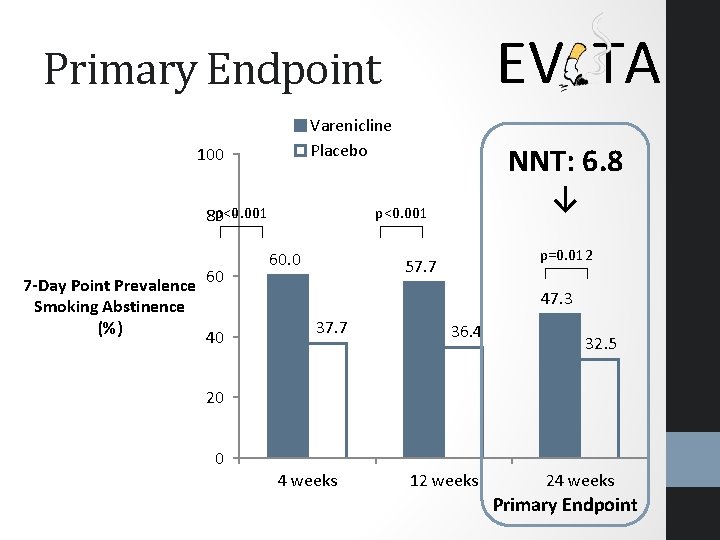
EV TA Primary Endpoint Varenicline Placebo 100 80 p<0. 001 7 -Day Point Prevalence 60 Smoking Abstinence (%) 40 NNT: 6. 8 ↓ p<0. 001 60. 0 p=0. 012 57. 7 47. 3 37. 7 36. 4 32. 5 20 0 4 weeks 12 weeks 24 weeks Primary Endpoint
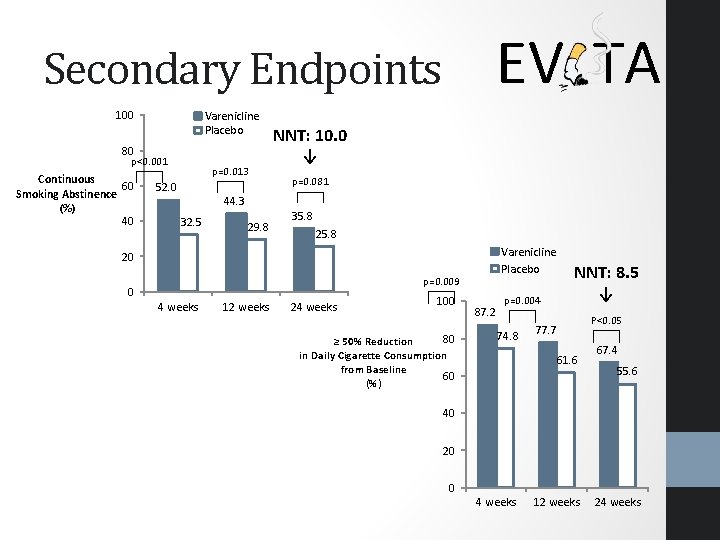
EV TA Secondary Endpoints 100 Varenicline Placebo 80 p<0. 001 Continuous 60 Smoking Abstinence (%) 40 p=0. 013 52. 0 NNT: 10. 0 ↓ p=0. 081 44. 3 32. 5 29. 8 35. 8 25. 8 Varenicline Placebo 20 p=0. 009 0 4 weeks 12 weeks 24 weeks 100 80 ≥ 50% Reduction in Daily Cigarette Consumption from Baseline 60 (%) 87. 2 p=0. 004 74. 8 NNT: 8. 5 ↓ P<0. 05 77. 7 61. 6 67. 4 55. 6 40 20 0 4 weeks 12 weeks 24 weeks
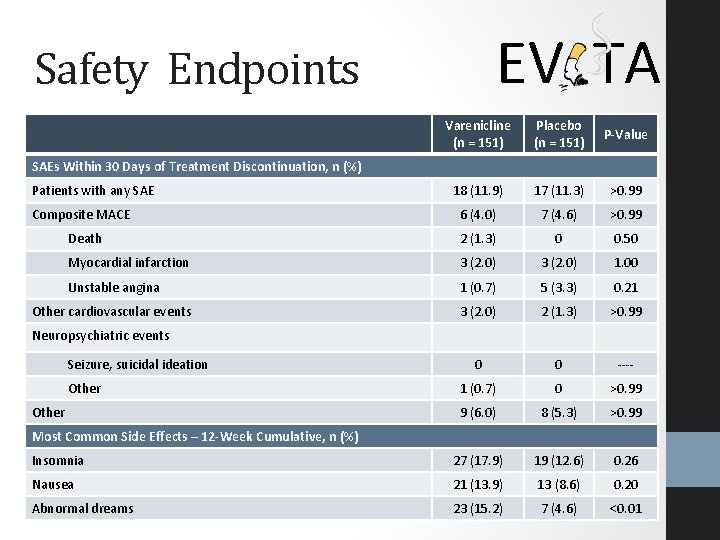
EV TA Safety Endpoints Varenicline (n = 151) Placebo (n = 151) P-Value 18 (11. 9) 17 (11. 3) >0. 99 Composite MACE 6 (4. 0) 7 (4. 6) >0. 99 Death 2 (1. 3) 0 0. 50 Myocardial infarction 3 (2. 0) 1. 00 Unstable angina 1 (0. 7) 5 (3. 3) 0. 21 Other cardiovascular events 3 (2. 0) 2 (1. 3) >0. 99 0 0 ---- 1 (0. 7) 0 >0. 99 9 (6. 0) 8 (5. 3) >0. 99 Insomnia 27 (17. 9) 19 (12. 6) 0. 26 Nausea 21 (13. 9) 13 (8. 6) 0. 20 Abnormal dreams 23 (15. 2) 7 (4. 6) <0. 01 SAEs Within 30 Days of Treatment Discontinuation, n (%) Patients with any SAE Neuropsychiatric events Seizure, suicidal ideation Other Most Common Side Effects – 12 -Week Cumulative, n (%)
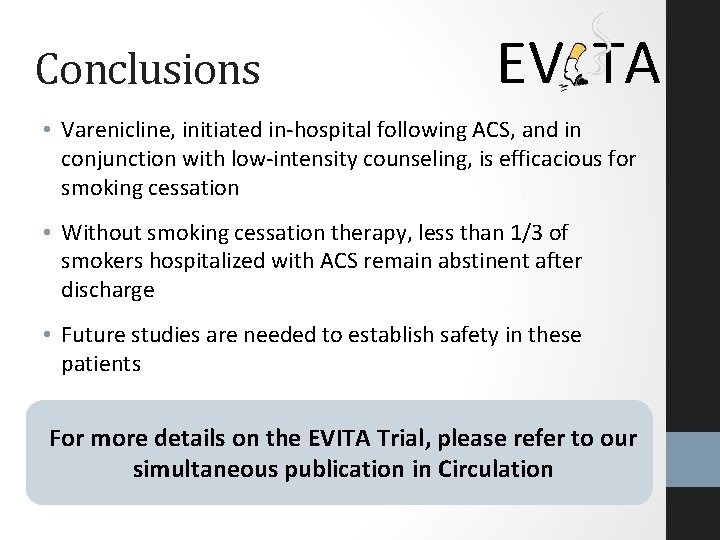
Conclusions EV TA • Varenicline, initiated in-hospital following ACS, and in conjunction with low-intensity counseling, is efficacious for smoking cessation • Without smoking cessation therapy, less than 1/3 of smokers hospitalized with ACS remain abstinent after discharge • Future studies are needed to establish safety in these patients For more details on the EVITA Trial, please refer to our simultaneous publication in Circulation
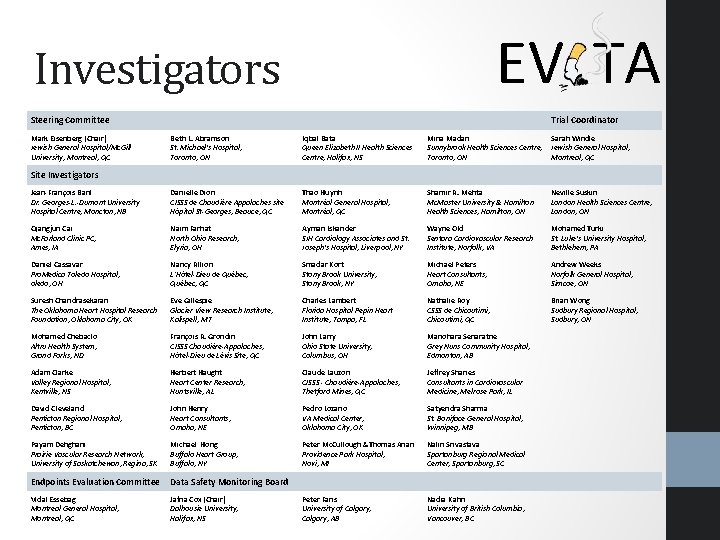
EV TA Investigators Steering Committee Mark Eisenberg (Chair) Jewish General Hospital/Mc. Gill University, Montreal, QC Trial Coordinator Beth L. Abramson St. Michael's Hospital, Toronto, ON Iqbal Bata Queen Elizabeth II Health Sciences Centre, Halifax, NS Mina Madan Sunnybrook Health Sciences Centre, Toronto, ON Sarah Windle Jewish General Hospital, Montreal, QC Jean-François Baril Dr. Georges-L. -Dumont University Hospital Centre, Moncton, NB Danielle Dion CISSS de Chaudière Appalaches site Hôpital St-Georges, Beauce, QC Thao Huynh Montréal General Hospital, Montréal, QC Shamir R. Mehta Mc. Master University & Hamilton Health Sciences, Hamilton, ON Neville Suskin London Health Sciences Centre, London, ON Qiangjun Cai Mc. Farland Clinic PC, Ames, IA Naim Farhat North Ohio Research, Elyria, OH Ayman Iskander SJH Cardiology Associates and St. Joseph's Hospital, Liverpool, NY Wayne Old Sentara Cardiovascular Research Institute, Norfolk, VA Mohamed Turki St. Luke's University Hospital, Bethlehem, PA Daniel Cassavar Pro. Medica Toledo Hospital, oledo, OH Nancy Fillion L’Hôtel-Dieu de Québec, QC Smadar Kort Stony Brook University, Stony Brook, NY Michael Peters Heart Consultants, Omaha, NE Andrew Weeks Norfolk General Hospital, Simcoe, ON Suresh Chandrasekaran The Oklahoma Heart Hospital Research Foundation, Oklahoma City, OK Eve Gillespie Glacier View Research Institute, Kalispell, MT Charles Lambert Florida Hospital Pepin Heart Institute, Tampa, FL Nathalie Roy CSSS de Chicoutimi, QC Brian Wong Sudbury Regional Hospital, Sudbury, ON Mohamed Chebaclo Altru Health System, Grand Forks, ND François R. Grondin CISSS Chaudière-Appalaches, Hôtel-Dieu de Lévis Site, QC John Larry Ohio State University, Columbus, OH Manohara Senaratne Grey Nuns Community Hospital, Edmonton, AB Adam Clarke Valley Regional Hospital, Kentville, NS Herbert Haught Heart Center Research, Huntsville, AL Claude Lauzon CISSS - Chaudière-Appalaches, Thetford Mines, QC Jeffrey Shanes Consultants in Cardiovascular Medicine, Melrose Park, IL David Cleveland Penticton Regional Hospital, Penticton, BC John Henry Heart Consultants, Omaha, NE Pedro Lozano VA Medical Center, Oklahoma City, OK Satyendra Sharma St. Boniface General Hospital, Winnipeg, MB Payam Dehghani Prairie Vascular Research Network, University of Saskatchewan, Regina, SK Michael Hong Buffalo Heart Group, Buffalo, NY Peter Mc. Cullough &Thomas Anan Providence Park Hospital, Novi, MI Nalin Srivastava Spartanburg Regional Medical Center, Spartanburg, SC Endpoints Evaluation Committee Data Safety Monitoring Board Vidal Essebag Montreal General Hospital, Montreal, QC Jafna Cox (Chair) Dalhousie University, Halifax, NS Peter Faris University of Calgary, AB Nadia Kahn University of British Columbia, Vancouver, BC Site Investigators
EV TA
EV TA
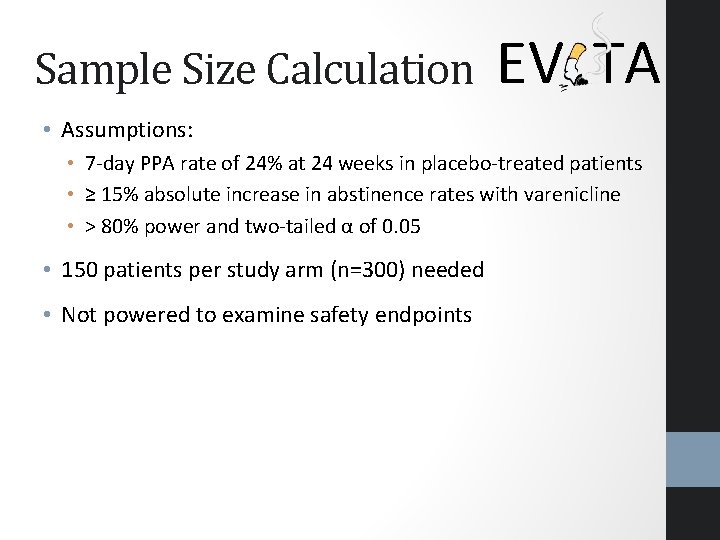
Sample Size Calculation EV TA • Assumptions: • 7 -day PPA rate of 24% at 24 weeks in placebo-treated patients • ≥ 15% absolute increase in abstinence rates with varenicline • > 80% power and two-tailed α of 0. 05 • 150 patients per study arm (n=300) needed • Not powered to examine safety endpoints
Limitations EV TA • Only enrolled patients motivated to quit smoking • Smoking abstinence rates likely optimistic vs. real-world • Small sample size • Limits ability to definitively address the cardiovascular safety of varenicline • Smokers represent a challenging patient population • As with other smoking cessation trials, a not insubstantial number of patients withdrew or were lost to follow-up • Low-intensity counseling • High-intensity counselling could have improved quit rates