
EV HEV Safety NISSAN MOTOR CO LTD Copyright


- Slides: 26
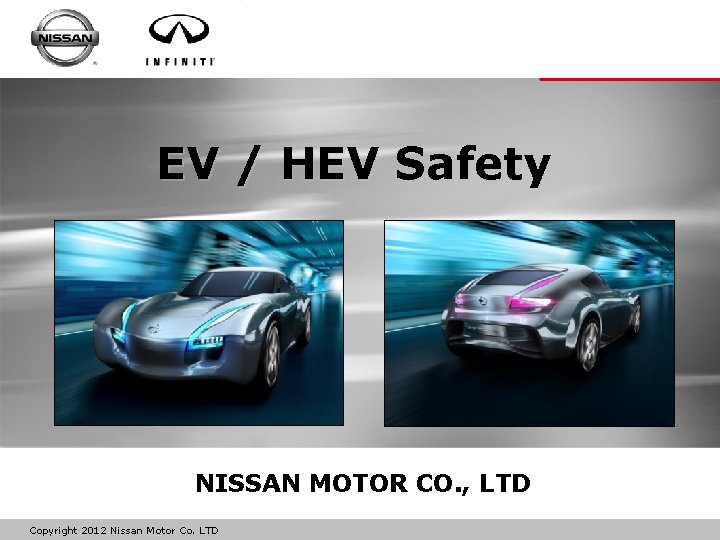
EV / HEV Safety NISSAN MOTOR CO. , LTD Copyright 2012 Nissan Motor Co. LTD
Agenda 1. LEAF Overview 2. Lithium Battery Development at Nissan 3. Lithium Battery System Design and Safety Copyright 2012 Nissan Motor Co. LTD
Agenda 1. LEAF Overview 2. Lithium Battery Development at Nissan 3. Lithium Battery System Design and Safety Copyright 2012 Nissan Motor Co. LTD
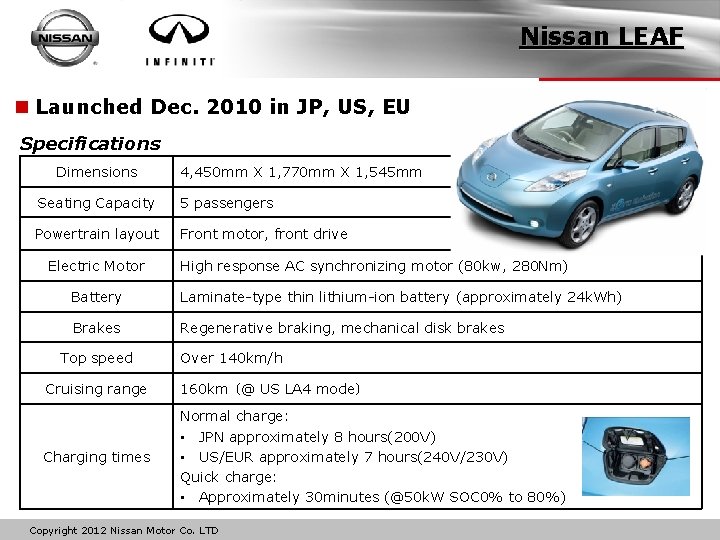
Nissan LEAF n Launched Dec. 2010 in JP, US, EU Specifications Dimensions 4, 450 mm X 1, 770 mm X 1, 545 mm Seating Capacity 5 passengers Powertrain layout Front motor, front drive Electric Motor High response AC synchronizing motor (80 kw, 280 Nm) Battery Laminate-type thin lithium-ion battery (approximately 24 k. Wh) Brakes Regenerative braking, mechanical disk brakes Top speed Over 140 km/h Cruising range 160 km (@ US LA 4 mode) Charging times Normal charge: • JPN approximately 8 hours(200 V) • US/EUR approximately 7 hours(240 V/230 V) Quick charge: • Approximately 30 minutes (@50 k. W SOC 0% to 80%) Copyright 2012 Nissan Motor Co. LTD
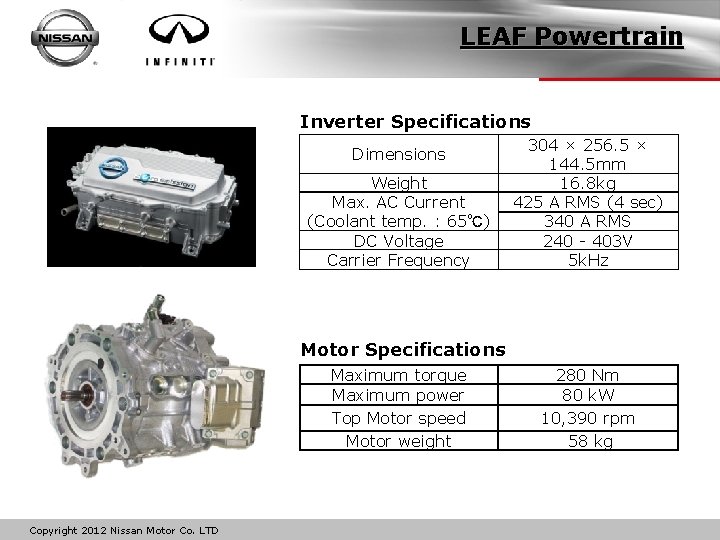
LEAF Powertrain Inverter Specifications Dimensions Weight Max. AC Current (Coolant temp. : 65℃) DC Voltage Carrier Frequency 304 × 256. 5 × 144. 5 mm 16. 8 kg 425 A RMS (4 sec) 340 A RMS 240 - 403 V 5 k. Hz Motor Specifications Maximum torque Maximum power Top Motor speed Motor weight Copyright 2012 Nissan Motor Co. LTD 280 Nm 80 k. W 10, 390 rpm 58 kg
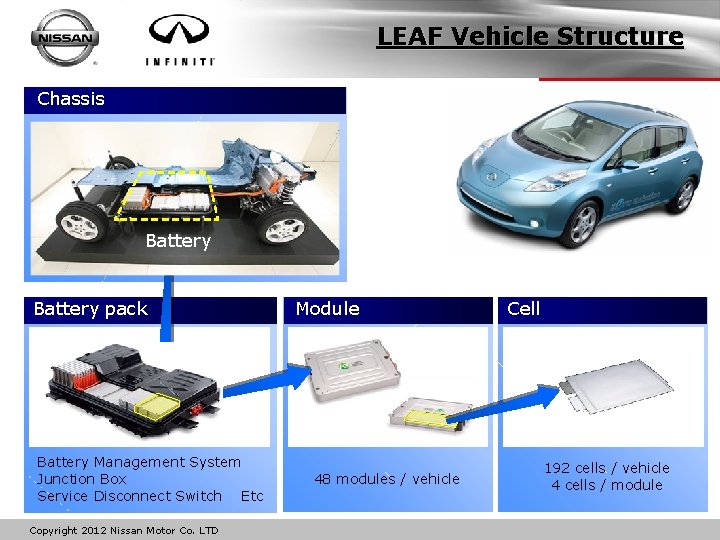
LEAF Vehicle Structure Chassis Battery pack Battery Management System Junction Box Service Disconnect Switch Etc Copyright 2012 Nissan Motor Co. LTD Module 48 modules / vehicle Cell 192 cells / vehicle 4 cells / module
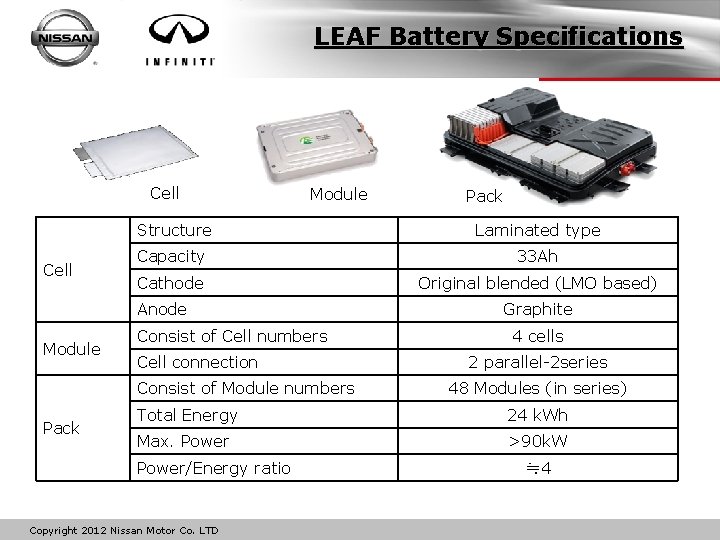
LEAF Battery Specifications Cell Module Structure Laminated type Capacity 33 Ah Cathode Original blended (LMO based) Anode Module Consist of Cell numbers Cell connection Consist of Module numbers Pack Graphite 4 cells 2 parallel-2 series 48 Modules (in series) Total Energy 24 k. Wh Max. Power >90 k. W Power/Energy ratio Copyright 2012 Nissan Motor Co. LTD ≒ 4
Agenda 1. LEAF Overview 2. Lithium Battery Development at Nissan 3. Lithium Battery System Design and Safety Copyright 2012 Nissan Motor Co. LTD
Nissan Li Battery History n In 1992, R&D began on lithium batteries for automobile applications. 1991 2000 2010 ‘ 91 The world’s first LB (for cellular phone) ’ 92 Research start Lithium Battery Co type ‘ 07 AESC founded Mn type Laminated cell Cylindrical cell EV Vehicle Prairie EV Altra EV LEAF Hyper Mini HEV / FCV Tino HEV 03 FCV 05 FCV FUGA Hybrid Copyright 2012 Nissan Motor Co. LTD
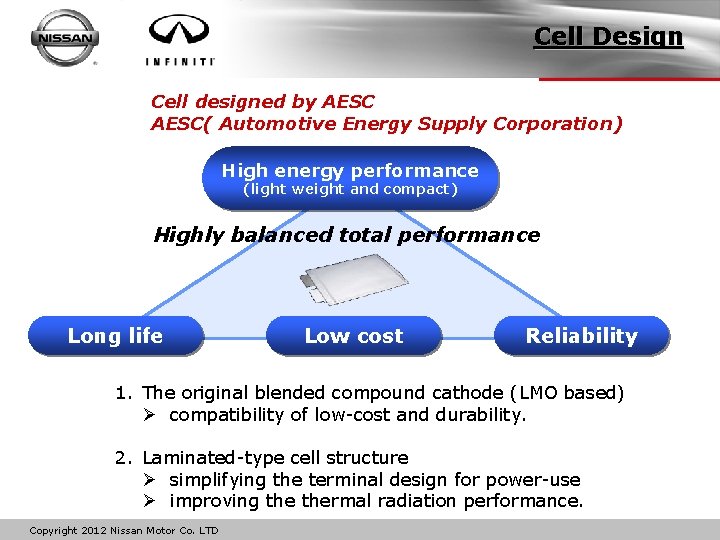
Cell Design Cell designed by AESC( Automotive Energy Supply Corporation) High energy performance (light weight and compact) Highly balanced total performance Long life Low cost Reliability 1. The original blended compound cathode (LMO based) Ø compatibility of low-cost and durability. 2. Laminated-type cell structure Ø simplifying the terminal design for power-use Ø improving thermal radiation performance. Copyright 2012 Nissan Motor Co. LTD
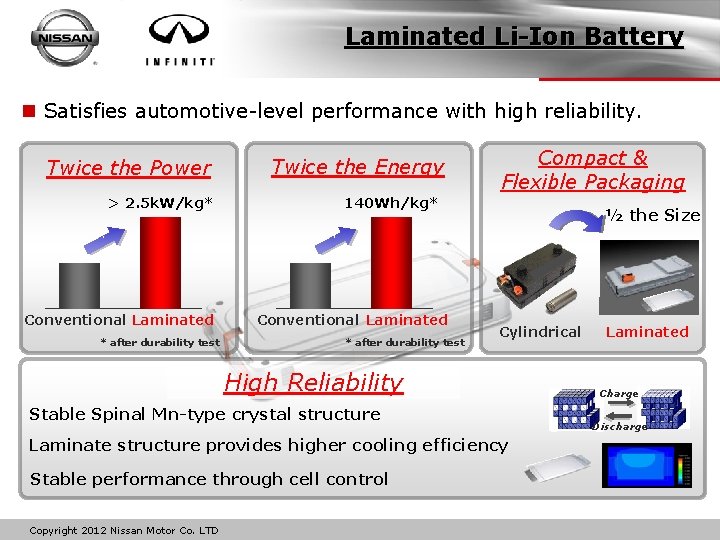
Laminated Li-Ion Battery n Satisfies automotive-level performance with high reliability. Twice the Power > 2. 5 k. W/kg* Conventional Laminated * after durability test Twice the Energy Compact & Flexible Packaging 140 Wh/kg* Conventional Laminated * after durability test ½ the Size Cylindrical High Reliability Stable Spinal Mn-type crystal structure Laminate structure provides higher cooling efficiency Stable performance through cell control Copyright 2012 Nissan Motor Co. LTD Laminated Charge Discharge
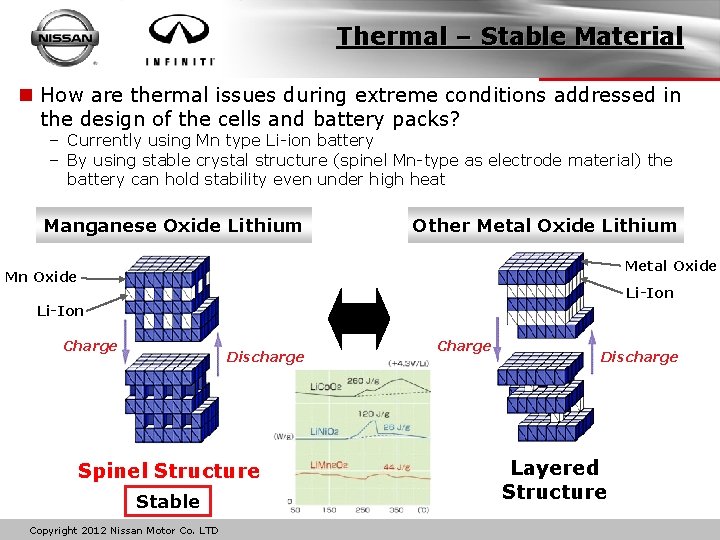
Thermal – Stable Material n How are thermal issues during extreme conditions addressed in the design of the cells and battery packs? – Currently using Mn type Li-ion battery – By using stable crystal structure (spinel Mn-type as electrode material) the battery can hold stability even under high heat Manganese Oxide Lithium Other Metal Oxide Lithium Metal Oxide Mn Oxide Li-Ion Charge Discharge Spinel Structure Stable Copyright 2012 Nissan Motor Co. LTD Charge Discharge Layered Structure
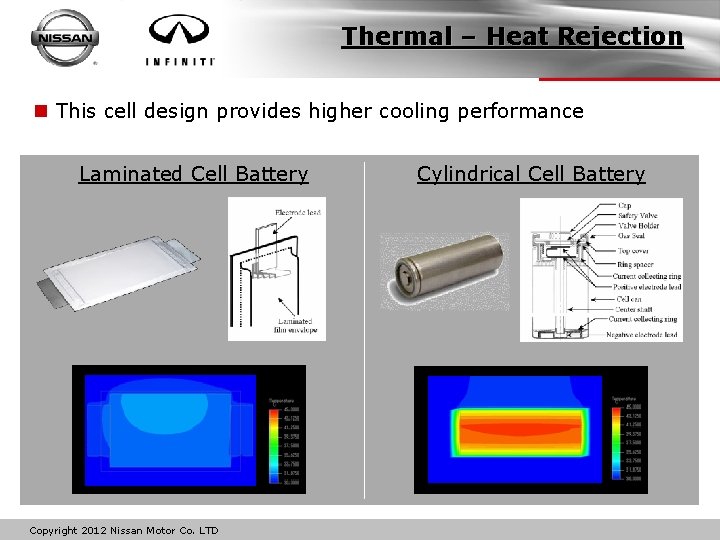
Thermal – Heat Rejection n This cell design provides higher cooling performance Laminated Cell Battery Copyright 2012 Nissan Motor Co. LTD Cylindrical Cell Battery
Agenda 1. LEAF Overview 2. Lithium Battery Development at Nissan 3. Lithium Battery System Design and Safety Copyright 2012 Nissan Motor Co. LTD
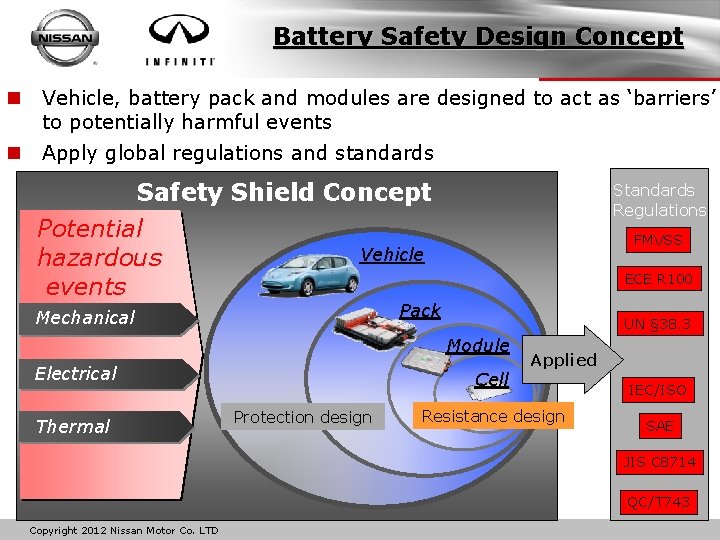
Battery Safety Design Concept n Vehicle, battery pack and modules are designed to act as ‘barriers’ to potentially harmful events n Apply global regulations and standards Safety Shield Concept Potential hazardous events Standards Regulations FMVSS Vehicle ECE R 100 Pack Mechanical UN § 38. 3 Module Electrical Thermal Cell Protection design Applied Resistance design IEC/ISO SAE JIS C 8714 QC/T 743 Copyright 2012 Nissan Motor Co. LTD
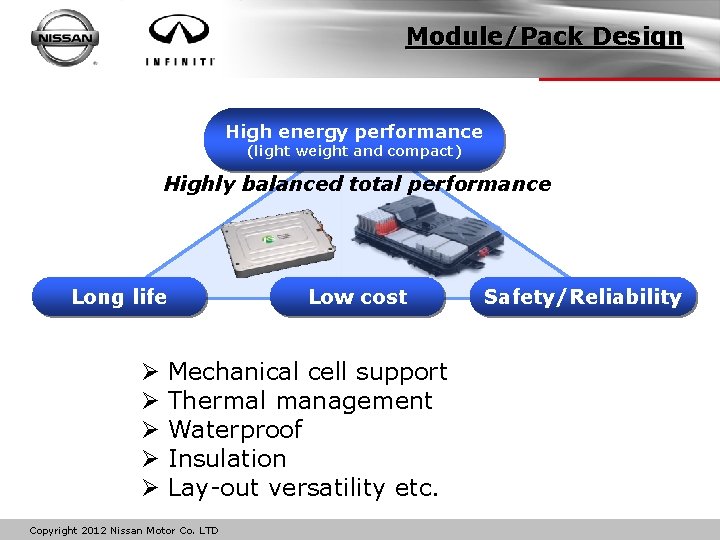
Module/Pack Design High energy performance (light weight and compact) Highly balanced total performance Long life Ø Ø Ø Low cost Mechanical cell support Thermal management Waterproof Insulation Lay-out versatility etc. Copyright 2012 Nissan Motor Co. LTD Safety/Reliability
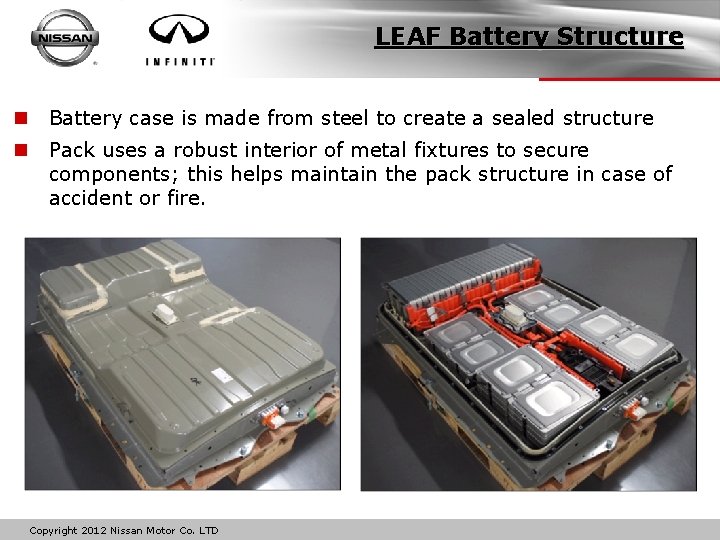
LEAF Battery Structure n Battery case is made from steel to create a sealed structure n Pack uses a robust interior of metal fixtures to secure components; this helps maintain the pack structure in case of accident or fire. Copyright 2012 Nissan Motor Co. LTD
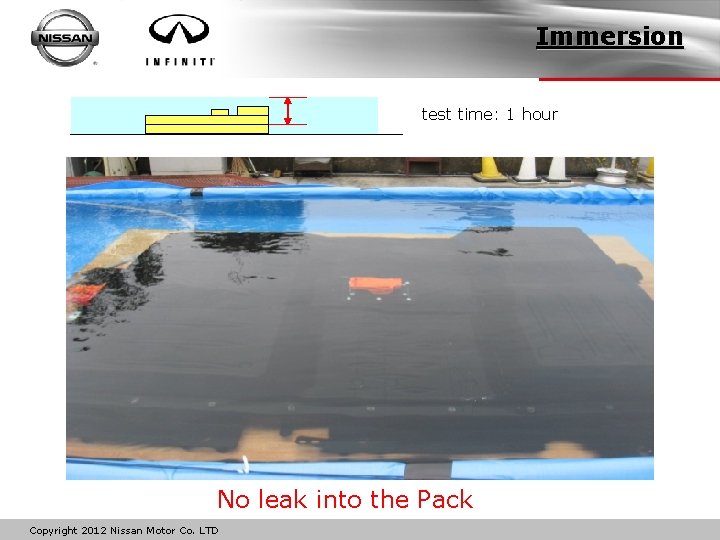
Immersion test time: 1 hour No leak into the Pack Copyright 2012 Nissan Motor Co. LTD
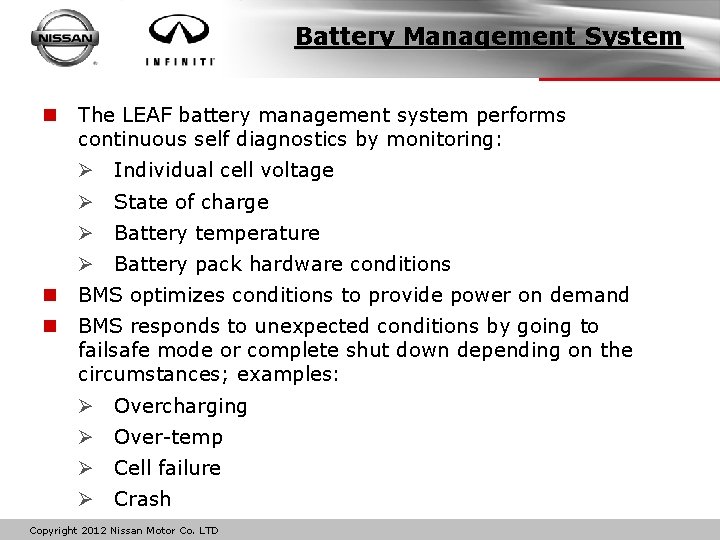
Battery Management System n The LEAF battery management system performs continuous self diagnostics by monitoring: Ø Individual cell voltage Ø State of charge Ø Battery temperature Ø Battery pack hardware conditions n BMS optimizes conditions to provide power on demand n BMS responds to unexpected conditions by going to failsafe mode or complete shut down depending on the circumstances; examples: Ø Overcharging Ø Over-temp Ø Cell failure Ø Crash Copyright 2012 Nissan Motor Co. LTD
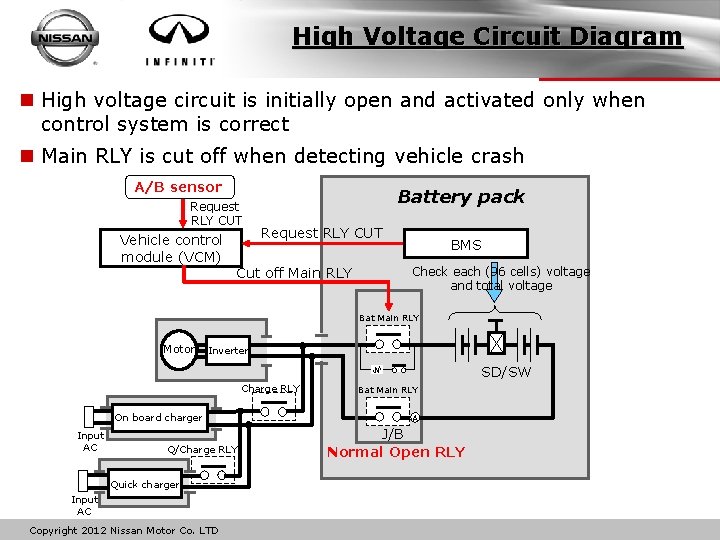
High Voltage Circuit Diagram n High voltage circuit is initially open and activated only when control system is correct n Main RLY is cut off when detecting vehicle crash A/B sensor Request RLY CUT Vehicle control module (VCM) Battery pack Request RLY CUT Cut off Main RLY BMS Check each (96 cells) voltage and total voltage Bat Main RLY Motor Inverter SD/SW Charge RLY On board charger Input AC Q/Charge RLY Quick charger Input AC Copyright 2012 Nissan Motor Co. LTD Bat Main RLY A J/B Normal Open RLY
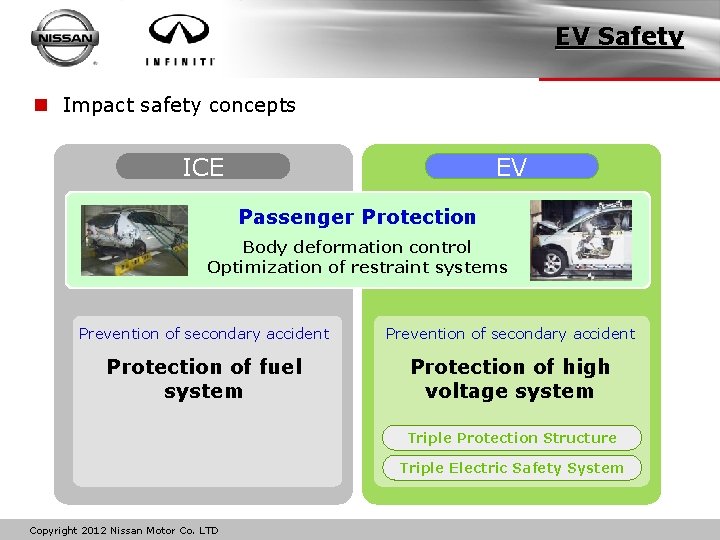
EV Safety n Impact safety concepts ICE EV Passenger Protection Body deformation control Optimization of restraint systems Prevention of secondary accident Protection of fuel system Protection of high voltage system Triple Protection Structure Triple Electric Safety System Copyright 2012 Nissan Motor Co. LTD
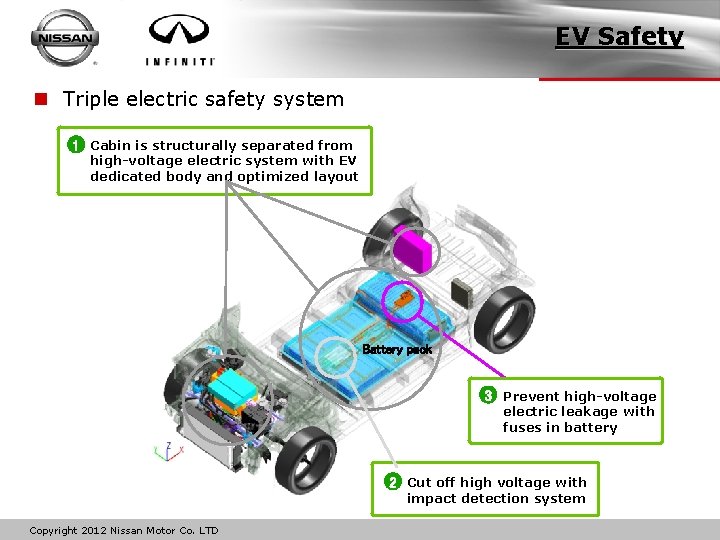
EV Safety n Triple electric safety system 1 Cabin is structurally separated from high-voltage electric system with EV dedicated body and optimized layout Battery pack 3 Prevent high-voltage electric leakage with fuses in battery 2 Cut off high voltage with impact detection system Copyright 2012 Nissan Motor Co. LTD
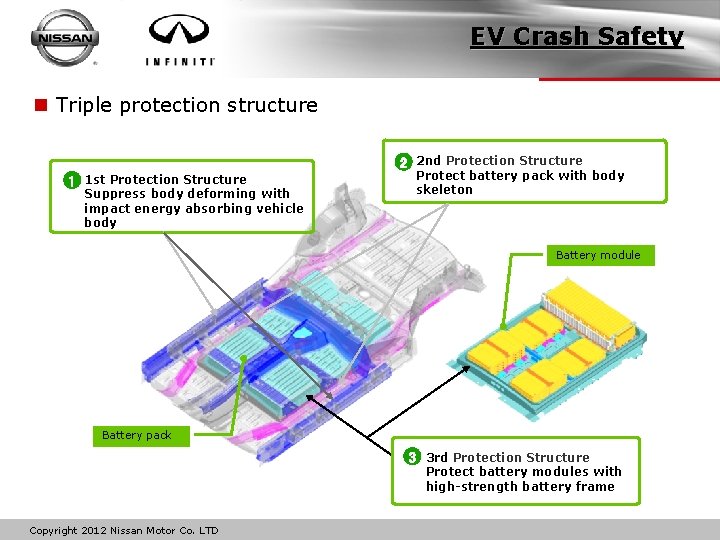
EV Crash Safety n Triple protection structure 2 1 1 st Protection Structure Suppress body deforming with impact energy absorbing vehicle body 2 nd Protection Structure Protect battery pack with body skeleton Battery module Battery pack 3 Copyright 2012 Nissan Motor Co. LTD 3 rd Protection Structure Protect battery modules with high-strength battery frame
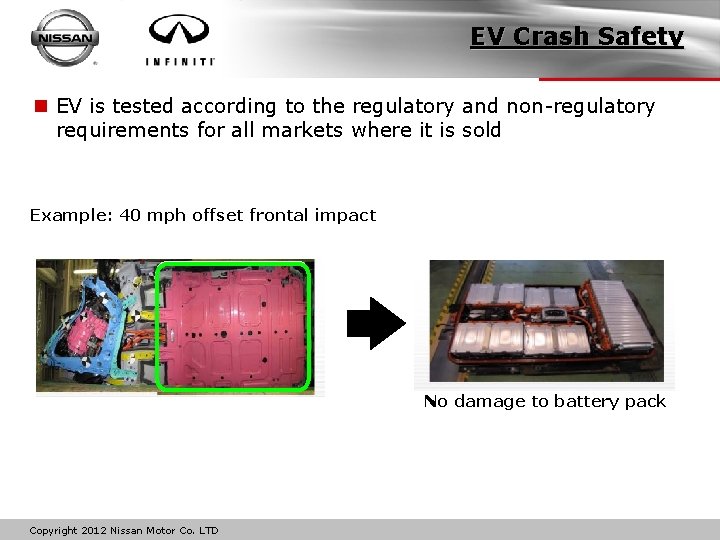
EV Crash Safety n EV is tested according to the regulatory and non-regulatory requirements for all markets where it is sold Example: 40 mph offset frontal impact No damage to battery pack Copyright 2012 Nissan Motor Co. LTD
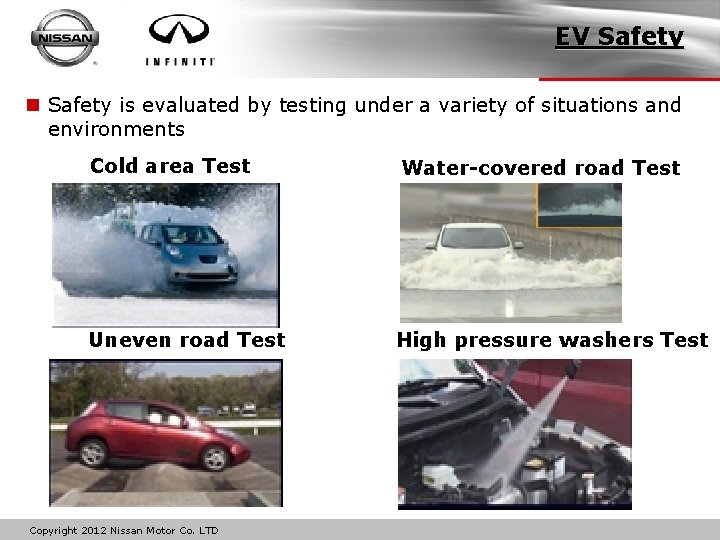
EV Safety n Safety is evaluated by testing under a variety of situations and environments Cold area Test Water-covered road Test Uneven road Test High pressure washers Test Copyright 2012 Nissan Motor Co. LTD
Thank You Copyright 2012 Nissan Motor Co. LTD