
EUV Imaging Spectrometer EIS Instrument Checkout Performance Verification
![2. EIS Engineering Tests Pre-Clamshell Opening Study Activity [Day/Orbit] • COMENG 01 ICU on](https://slidetodoc.com/presentation_image/378c0ffdc67a096219cfcd4ddf6cf3c4/image-11.jpg "2. EIS Engineering Tests Pre-Clamshell Opening Study Activity [Day/Orbit] • COMENG 01 ICU on")
![2. EIS Engineering Tests Post-Clamshell Opening Study Activity [Day/Orbit [1 / 1] Day 1](https://slidetodoc.com/presentation_image/378c0ffdc67a096219cfcd4ddf6cf3c4/image-12.jpg "2. EIS Engineering Tests Post-Clamshell Opening Study Activity [Day/Orbit [1 / 1] Day 1")
- Slides: 29
EUV Imaging Spectrometer (EIS): Instrument Checkout, Performance Verification and Initial 90 Day Observing Plan Extended Solar Optical Telescope Meeting 17 th – 20 th April, 2006 at NAOJ Len Culhane for the EIS Team
SUMMARY • EIS Instrument Outline • Instrument Performance Tests • Post-launch activities – Spacecraft – EIS Engineering – EIS Calibration • EIS Initial Science Plan • EIS Planning Tool Software • Conclusions 2 Extended SOT Meeting, NAOJ, 17 th – 20 th April, 2006
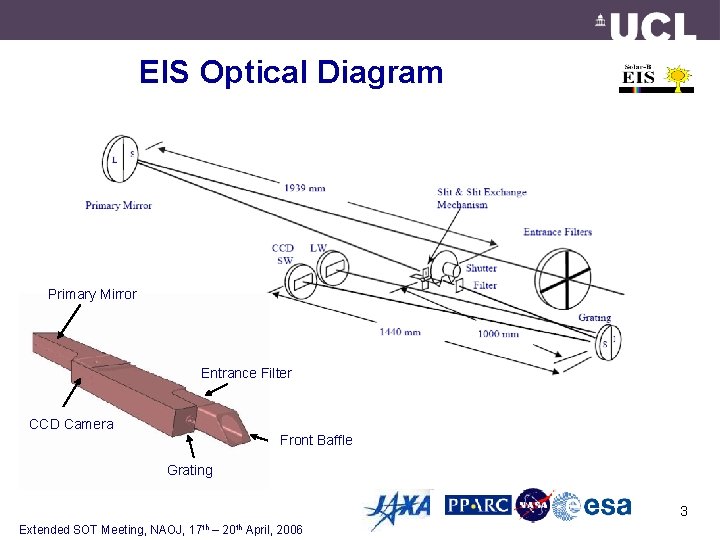
EIS Optical Diagram Primary Mirror Entrance Filter CCD Camera Front Baffle Grating 3 Extended SOT Meeting, NAOJ, 17 th – 20 th April, 2006
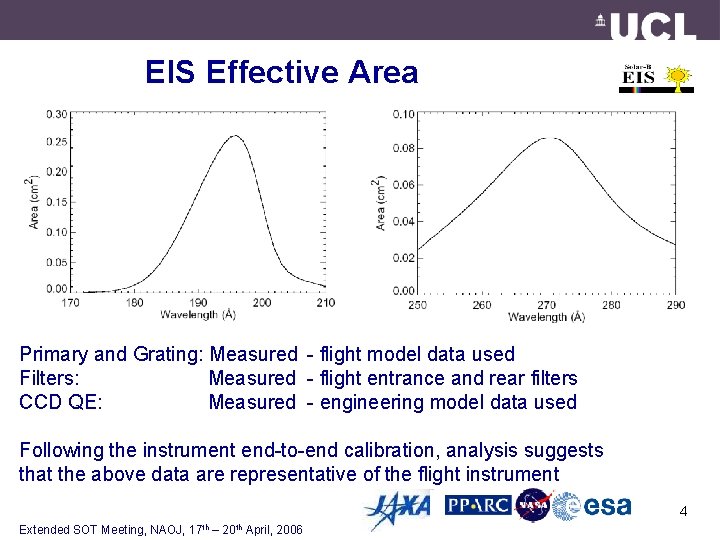
EIS Effective Area Primary and Grating: Measured - flight model data used Filters: Measured - flight entrance and rear filters CCD QE: Measured - engineering model data used Following the instrument end-to-end calibration, analysis suggests that the above data are representative of the flight instrument 4 Extended SOT Meeting, NAOJ, 17 th – 20 th April, 2006
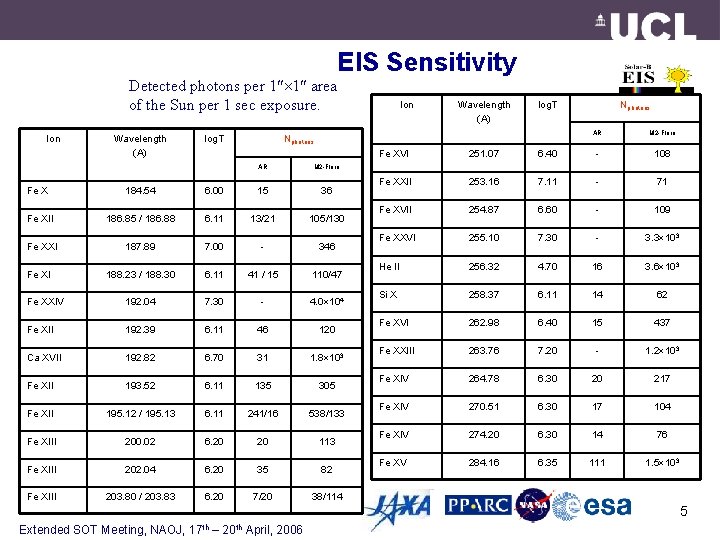
EIS Sensitivity Detected photons per 1 1 area of the Sun per 1 sec exposure. Ion Wavelength (A) log. T Nphotons AR M 2 -Flare Fe X 184. 54 6. 00 15 36 Fe XII 186. 85 / 186. 88 6. 11 13/21 105/130 Fe XXI 187. 89 7. 00 - 346 188. 23 / 188. 30 6. 11 41 / 15 110/47 Fe XXIV 192. 04 7. 30 - 4. 0 104 Fe XII 192. 39 6. 11 46 120 Ca XVII 192. 82 6. 70 31 1. 8 103 Fe XII 193. 52 6. 11 135 305 Fe XII 195. 12 / 195. 13 6. 11 241/16 538/133 Fe XIII 200. 02 6. 20 20 113 Fe XIII 202. 04 6. 20 35 82 Fe XIII 203. 80 / 203. 83 6. 20 7/20 38/114 Fe XI Ion Nphotons AR M 2 -Flare Fe XVI 251. 07 6. 40 - 108 Fe XXII 253. 16 7. 11 - 71 Fe XVII 254. 87 6. 60 - 109 Fe XXVI 255. 10 7. 30 - 3. 3 103 He II 256. 32 4. 70 16 3. 6 103 Si X 258. 37 6. 11 14 62 Fe XVI 262. 98 6. 40 15 437 Fe XXIII 263. 76 7. 20 - 1. 2 103 Fe XIV 264. 78 6. 30 20 217 Fe XIV 270. 51 6. 30 17 104 Fe XIV 274. 20 6. 30 14 76 Fe XV 284. 16 6. 35 111 1. 5 103 5 Extended SOT Meeting, NAOJ, 17 th – 20 th April, 2006
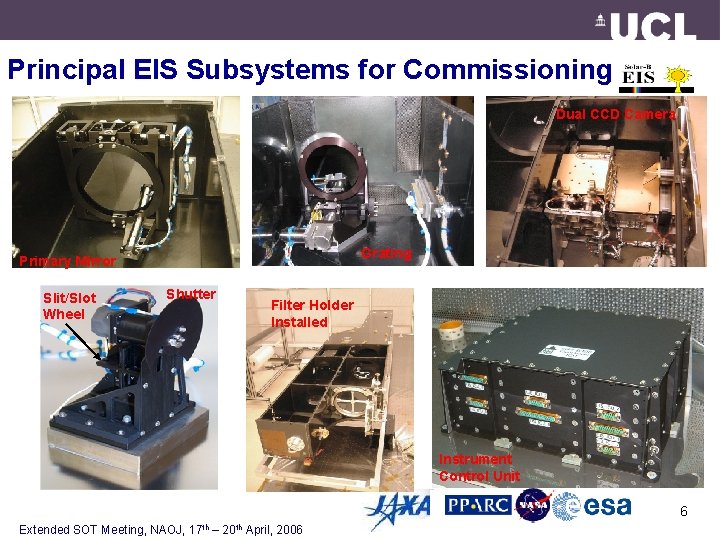
Principal EIS Subsystems for Commissioning Dual CCD Camera Grating Primary Mirror Slit/Slot Wheel Shutter Filter Holder Installed Instrument Control Unit 6 Extended SOT Meeting, NAOJ, 17 th – 20 th April, 2006
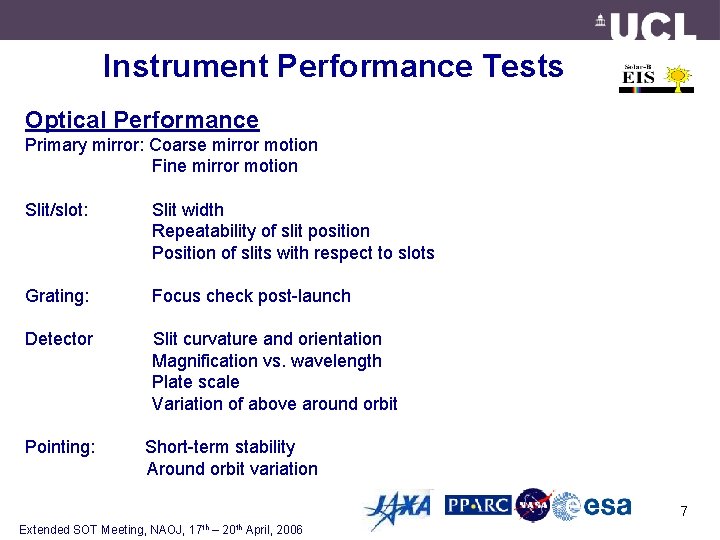
Instrument Performance Tests Optical Performance Primary mirror: Coarse mirror motion Fine mirror motion Slit/slot: Slit width Repeatability of slit position Position of slits with respect to slots Grating: Focus check post-launch Detector Slit curvature and orientation Magnification vs. wavelength Plate scale Variation of above around orbit Pointing: Short-term stability Around orbit variation 7 Extended SOT Meeting, NAOJ, 17 th – 20 th April, 2006
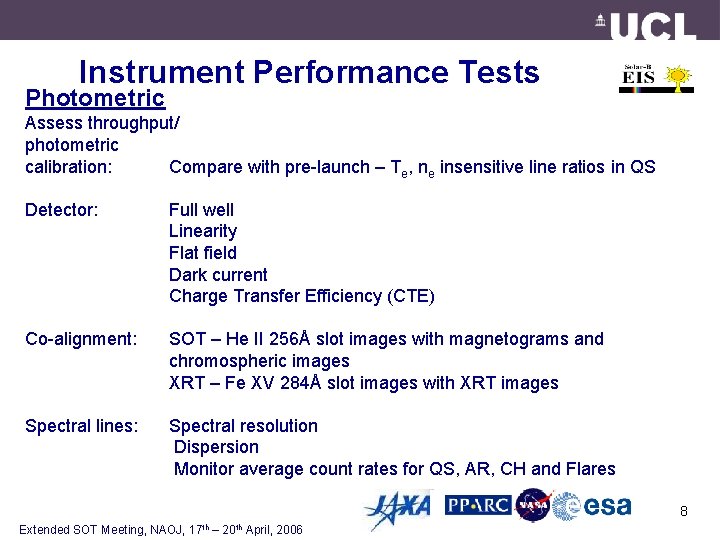
Instrument Performance Tests Photometric Assess throughput/ photometric calibration: Compare with pre-launch – Te, ne insensitive line ratios in QS Detector: Full well Linearity Flat field Dark current Charge Transfer Efficiency (CTE) Co-alignment: SOT – He II 256Å slot images with magnetograms and chromospheric images XRT – Fe XV 284Å slot images with XRT images Spectral lines: Spectral resolution Dispersion Monitor average count rates for QS, AR, CH and Flares 8 Extended SOT Meeting, NAOJ, 17 th – 20 th April, 2006
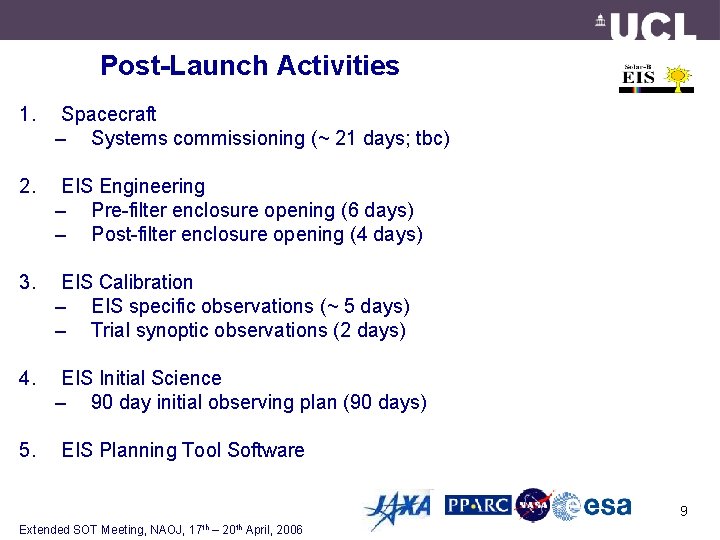
Post-Launch Activities 1. Spacecraft – Systems commissioning (~ 21 days; tbc) 2. EIS Engineering – Pre-filter enclosure opening (6 days) – Post-filter enclosure opening (4 days) 3. EIS Calibration – EIS specific observations (~ 5 days) – Trial synoptic observations (2 days) 4. EIS Initial Science – 90 day initial observing plan (90 days) 5. EIS Planning Tool Software 9 Extended SOT Meeting, NAOJ, 17 th – 20 th April, 2006
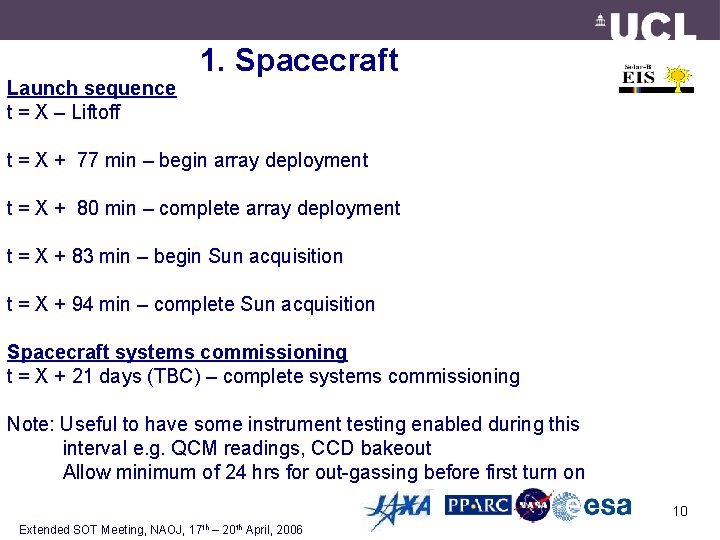
Launch sequence t = X – Liftoff 1. Spacecraft t = X + 77 min – begin array deployment t = X + 80 min – complete array deployment t = X + 83 min – begin Sun acquisition t = X + 94 min – complete Sun acquisition Spacecraft systems commissioning t = X + 21 days (TBC) – complete systems commissioning Note: Useful to have some instrument testing enabled during this interval e. g. QCM readings, CCD bakeout Allow minimum of 24 hrs for out-gassing before first turn on 10 Extended SOT Meeting, NAOJ, 17 th – 20 th April, 2006
2. EIS Engineering Tests Pre-Clamshell Opening Study Activity [Day/Orbit] • COMENG 01 ICU on - software checks (memory) [1 / 2] Day 1 is Day 21 • COMENG 02 MHC on – load code, QCMs on [2 / 1] • COMENG 20 Initial QCM readings [2 / 2] • REGENG 00 QCM 1/2; readings once per day [2 / 2] • COMENG 03 Op. heaters on for temp. stabilisation [2 / 3] • COMENG 04 Mechanism tests for Slit/Slot selection [4 / 1] • COMENG 05 Mechanism tests for Shutter [4 / 2] • COMENG 10 CCDs on - load/initiate test sequence - start Camera data assessment [5 / 1] [5 / 2] Note: X days elapsed time allowed for complete EIS out-gassing and camera data assessment before front filter doors opened 11 Extended SOT Meeting, NAOJ, 17 th – 20 th April, 2006
2. EIS Engineering Tests Post-Clamshell Opening Study Activity [Day/Orbit [1 / 1] Day 1 is Day (21 + X) [1 / 2] • COMENG 99 Opening of filter enclosure doors • COMCAL 00 Test sequences of full CCD • COMENG 07 Mechanism tests for Fine Mirror [2 / 1] • COMENG 08 Mechanism tests for Grating – grating focus [3 / 1] • COMENG 06 Mechanism tests for Coarse Mirror [5 / 1] 12 Extended SOT Meeting, NAOJ, 17 th – 20 th April, 2006
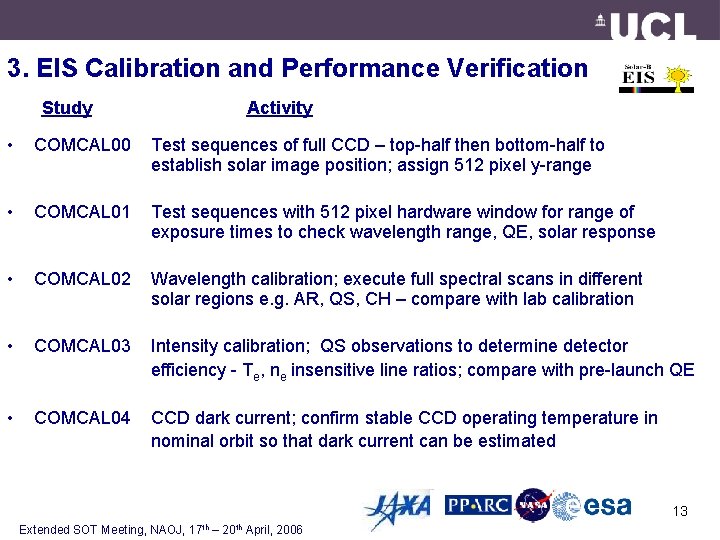
3. EIS Calibration and Performance Verification Study Activity • COMCAL 00 Test sequences of full CCD – top-half then bottom-half to establish solar image position; assign 512 pixel y-range • COMCAL 01 Test sequences with 512 pixel hardware window for range of exposure times to check wavelength range, QE, solar response • COMCAL 02 Wavelength calibration; execute full spectral scans in different solar regions e. g. AR, QS, CH – compare with lab calibration • COMCAL 03 Intensity calibration; QS observations to determine detector efficiency - Te, ne insensitive line ratios; compare with pre-launch QE • COMCAL 04 CCD dark current; confirm stable CCD operating temperature in nominal orbit so that dark current can be estimated 13 Extended SOT Meeting, NAOJ, 17 th – 20 th April, 2006
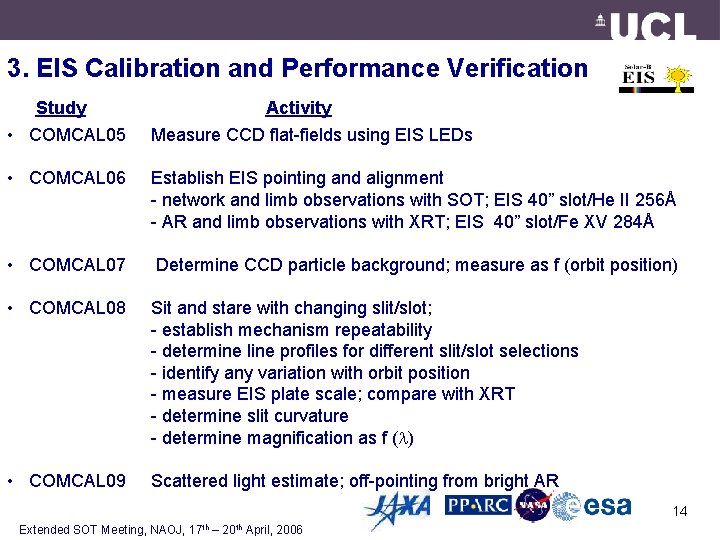
3. EIS Calibration and Performance Verification Study Activity • COMCAL 05 Measure CCD flat-fields using EIS LEDs • COMCAL 06 Establish EIS pointing and alignment - network and limb observations with SOT; EIS 40” slot/He II 256Å - AR and limb observations with XRT; EIS 40” slot/Fe XV 284Å • COMCAL 07 Determine CCD particle background; measure as f (orbit position) • COMCAL 08 Sit and stare with changing slit/slot; - establish mechanism repeatability - determine line profiles for different slit/slot selections - identify any variation with orbit position - measure EIS plate scale; compare with XRT - determine slit curvature - determine magnification as f (l) • COMCAL 09 Scattered light estimate; off-pointing from bright AR 14 Extended SOT Meeting, NAOJ, 17 th – 20 th April, 2006
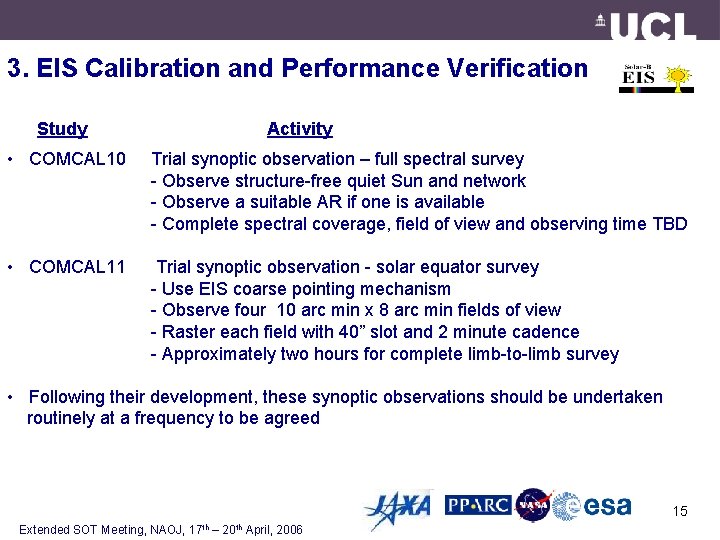
3. EIS Calibration and Performance Verification Study Activity • COMCAL 10 Trial synoptic observation – full spectral survey - Observe structure-free quiet Sun and network - Observe a suitable AR if one is available - Complete spectral coverage, field of view and observing time TBD • COMCAL 11 Trial synoptic observation - solar equator survey - Use EIS coarse pointing mechanism - Observe four 10 arc min x 8 arc min fields of view - Raster each field with 40” slot and 2 minute cadence - Approximately two hours for complete limb-to-limb survey • Following their development, these synoptic observations should be undertaken routinely at a frequency to be agreed 15 Extended SOT Meeting, NAOJ, 17 th – 20 th April, 2006
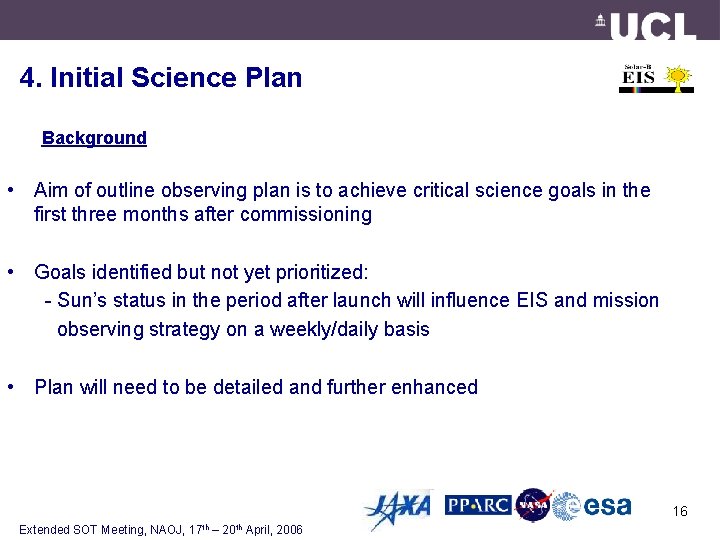
4. Initial Science Plan Background • Aim of outline observing plan is to achieve critical science goals in the first three months after commissioning • Goals identified but not yet prioritized: - Sun’s status in the period after launch will influence EIS and mission observing strategy on a weekly/daily basis • Plan will need to be detailed and further enhanced 16 Extended SOT Meeting, NAOJ, 17 th – 20 th April, 2006
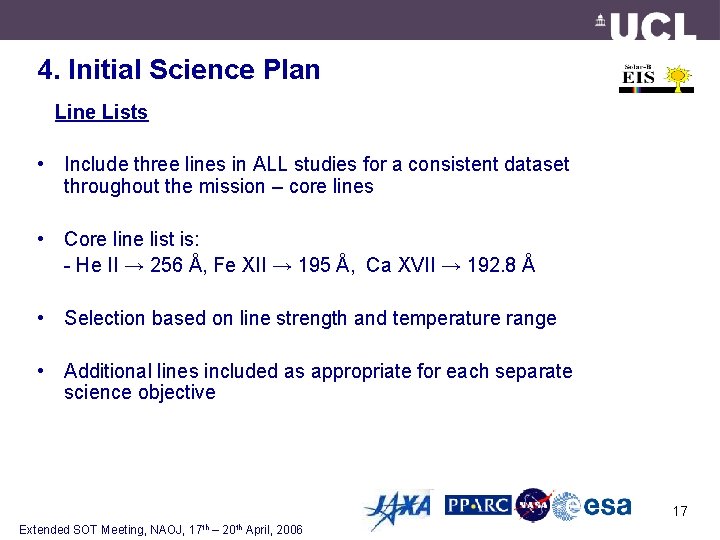
4. Initial Science Plan Line Lists • Include three lines in ALL studies for a consistent dataset throughout the mission – core lines • Core line list is: - He II → 256 Å, Fe XII → 195 Å, Ca XVII → 192. 8 Å • Selection based on line strength and temperature range • Additional lines included as appropriate for each separate science objective 17 Extended SOT Meeting, NAOJ, 17 th – 20 th April, 2006
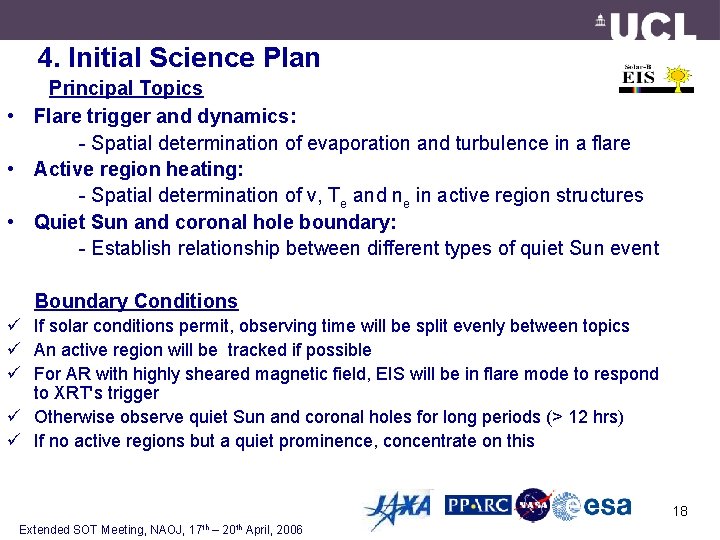
4. Initial Science Plan Principal Topics • Flare trigger and dynamics: - Spatial determination of evaporation and turbulence in a flare • Active region heating: - Spatial determination of v, Te and ne in active region structures • Quiet Sun and coronal hole boundary: - Establish relationship between different types of quiet Sun event Boundary Conditions ü If solar conditions permit, observing time will be split evenly between topics ü An active region will be tracked if possible ü For AR with highly sheared magnetic field, EIS will be in flare mode to respond to XRT's trigger ü Otherwise observe quiet Sun and coronal holes for long periods (> 12 hrs) ü If no active regions but a quiet prominence, concentrate on this 18 Extended SOT Meeting, NAOJ, 17 th – 20 th April, 2006
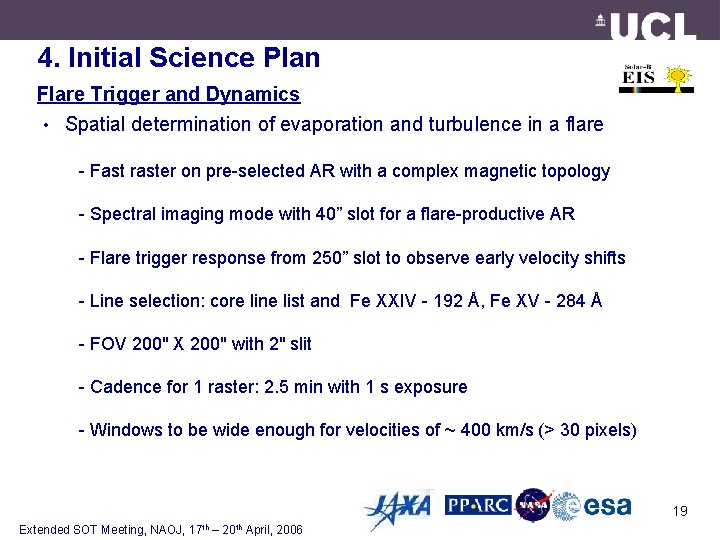
4. Initial Science Plan Flare Trigger and Dynamics • Spatial determination of evaporation and turbulence in a flare - Fast raster on pre-selected AR with a complex magnetic topology - Spectral imaging mode with 40” slot for a flare-productive AR - Flare trigger response from 250” slot to observe early velocity shifts - Line selection: core line list and Fe XXIV - 192 Å, Fe XV - 284 Å - FOV 200" X 200" with 2" slit - Cadence for 1 raster: 2. 5 min with 1 s exposure - Windows to be wide enough for velocities of ~ 400 km/s (> 30 pixels) 19 Extended SOT Meeting, NAOJ, 17 th – 20 th April, 2006
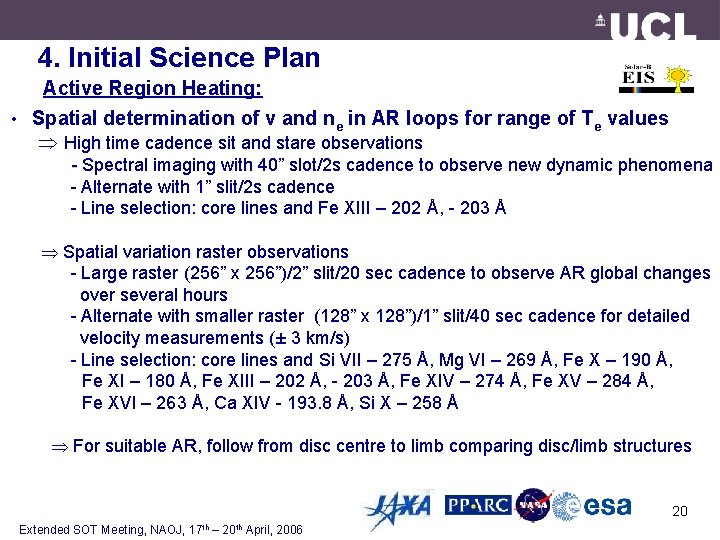
4. Initial Science Plan Active Region Heating: • Spatial determination of v and ne in AR loops for range of Te values High time cadence sit and stare observations - Spectral imaging with 40” slot/2 s cadence to observe new dynamic phenomena - Alternate with 1” slit/2 s cadence - Line selection: core lines and Fe XIII – 202 Å, - 203 Å Spatial variation raster observations - Large raster (256” x 256”)/2” slit/20 sec cadence to observe AR global changes over several hours - Alternate with smaller raster (128” x 128”)/1” slit/40 sec cadence for detailed velocity measurements (± 3 km/s) - Line selection: core lines and Si VII – 275 Å, Mg VI – 269 Å, Fe X – 190 Å, Fe XI – 180 Å, Fe XIII – 202 Å, - 203 Å, Fe XIV – 274 Å, Fe XV – 284 Å, Fe XVI – 263 Å, Ca XIV - 193. 8 Å, Si X – 258 Å For suitable AR, follow from disc centre to limb comparing disc/limb structures 20 Extended SOT Meeting, NAOJ, 17 th – 20 th April, 2006
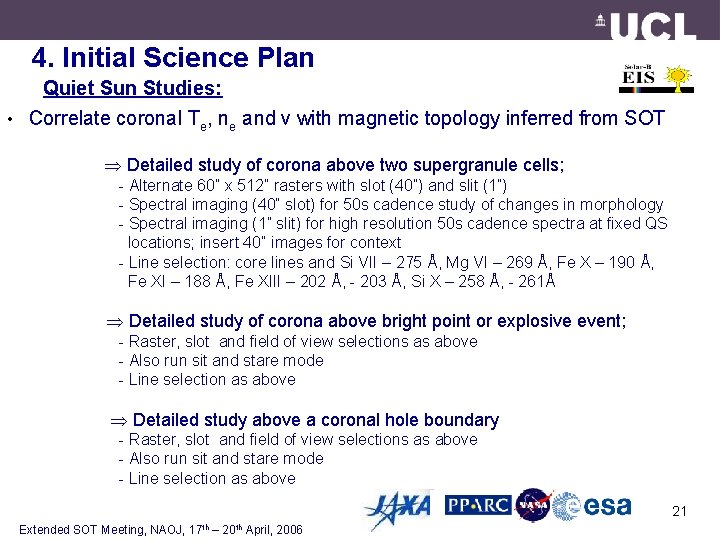
4. Initial Science Plan Quiet Sun Studies: • Correlate coronal Te, ne and v with magnetic topology inferred from SOT Detailed study of corona above two supergranule cells; - Alternate 60” x 512” rasters with slot (40”) and slit (1”) - Spectral imaging (40” slot) for 50 s cadence study of changes in morphology - Spectral imaging (1” slit) for high resolution 50 s cadence spectra at fixed QS locations; insert 40” images for context - Line selection: core lines and Si VII – 275 Å, Mg VI – 269 Å, Fe X – 190 Å, Fe XI – 188 Å, Fe XIII – 202 Å, - 203 Å, Si X – 258 Å, - 261Å Detailed study of corona above bright point or explosive event; - Raster, slot and field of view selections as above - Also run sit and stare mode - Line selection as above Detailed study above a coronal hole boundary - Raster, slot and field of view selections as above - Also run sit and stare mode - Line selection as above 21 Extended SOT Meeting, NAOJ, 17 th – 20 th April, 2006
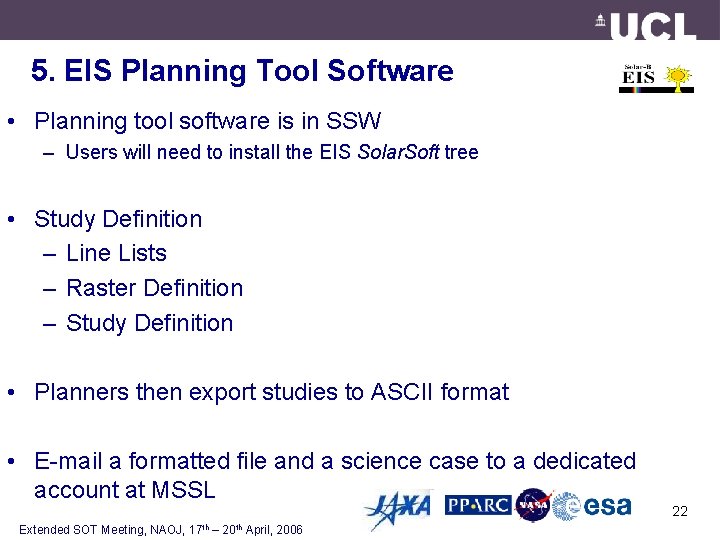
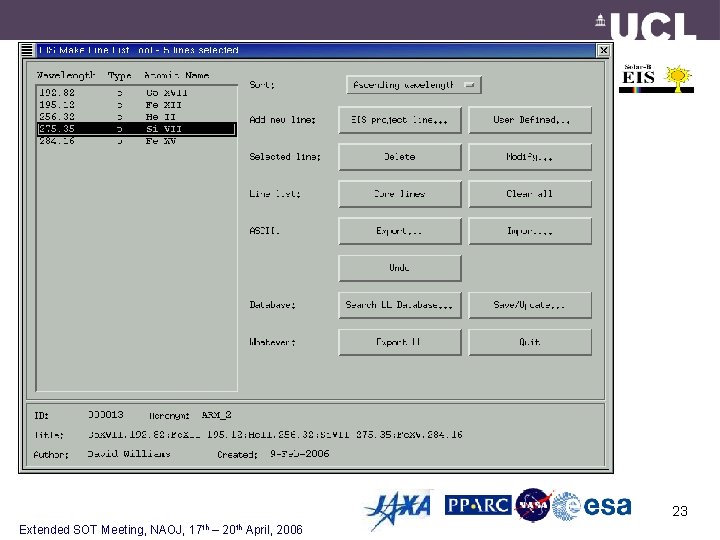
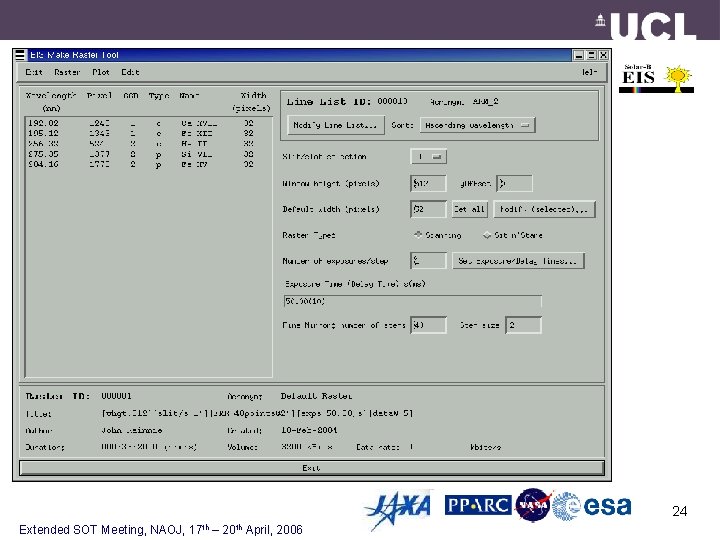
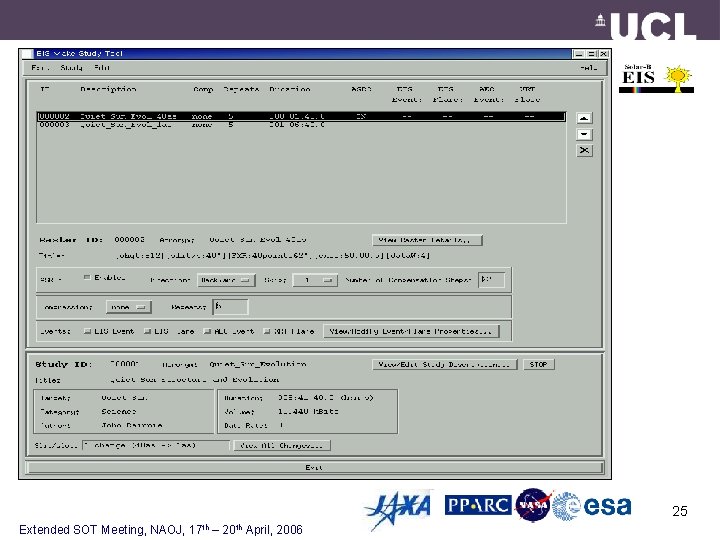
5. EIS Planning Tool Software • Planning tool software is in SSW – Users will need to install the EIS Solar. Soft tree • Study Definition – Line Lists – Raster Definition – Study Definition • Planners then export studies to ASCII format • E-mail a formatted file and a science case to a dedicated account at MSSL 22 Extended SOT Meeting, NAOJ, 17 th – 20 th April, 2006
5. Planning Tool - line list interface 23 Extended SOT Meeting, NAOJ, 17 th – 20 th April, 2006
5. Planning Tool – make/edit raster 24 Extended SOT Meeting, NAOJ, 17 th – 20 th April, 2006
5. Planning Tool – make/edit study 25 Extended SOT Meeting, NAOJ, 17 th – 20 th April, 2006
EIS Core Science Programme • • AR Heating → dynamic phenomena in loops Coronal/Photospheric velocity field comparison in AR Coronal Seismology → waves in AR structures AR Helicity content → CMEs, magnetic clouds Evolution of trans-equatorial Loops Flare produced plasma → source, location and triggering Flare reconnection → inflow and outflow Quiet Sun transient events → network, network boundaries, CH boundaries, size scales • CME Onsets → dimming, filaments, flux-ropes, flaring AR, transequatorial Loops • Evolution of large coronal structures → streamers, large-scale reconnection, slow Solar Wind 26 Extended SOT Meeting, NAOJ, 17 th – 20 th April, 2006
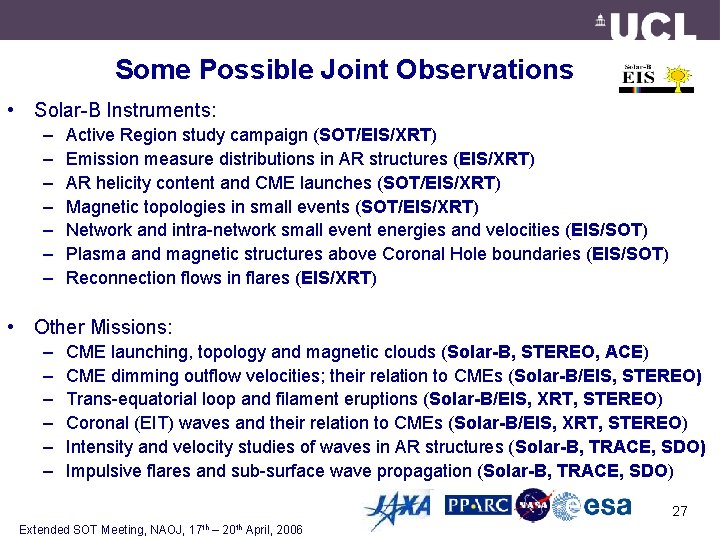
Some Possible Joint Observations • Solar-B Instruments: – – – – Active Region study campaign (SOT/EIS/XRT) Emission measure distributions in AR structures (EIS/XRT) AR helicity content and CME launches (SOT/EIS/XRT) Magnetic topologies in small events (SOT/EIS/XRT) Network and intra-network small event energies and velocities (EIS/SOT) Plasma and magnetic structures above Coronal Hole boundaries (EIS/SOT) Reconnection flows in flares (EIS/XRT) • Other Missions: – – – CME launching, topology and magnetic clouds (Solar-B, STEREO, ACE) CME dimming outflow velocities; their relation to CMEs (Solar-B/EIS, STEREO) Trans-equatorial loop and filament eruptions (Solar-B/EIS, XRT, STEREO) Coronal (EIT) waves and their relation to CMEs (Solar-B/EIS, XRT, STEREO) Intensity and velocity studies of waves in AR structures (Solar-B, TRACE, SDO) Impulsive flares and sub-surface wave propagation (Solar-B, TRACE, SDO) 27 Extended SOT Meeting, NAOJ, 17 th – 20 th April, 2006
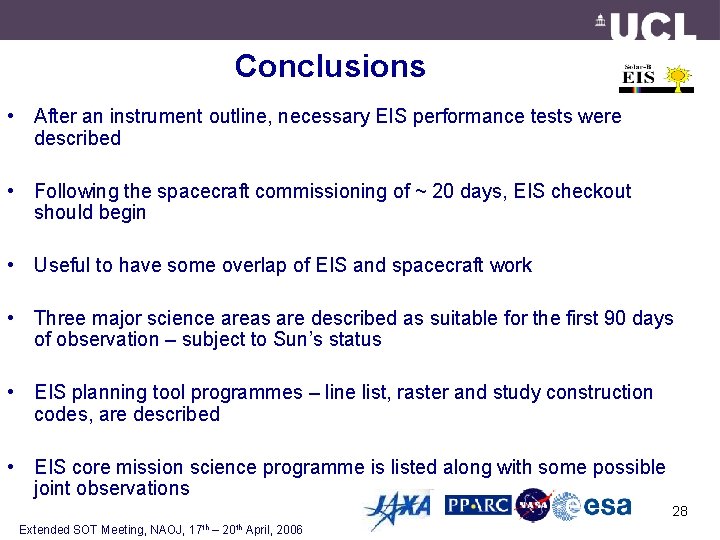
Conclusions • After an instrument outline, necessary EIS performance tests were described • Following the spacecraft commissioning of ~ 20 days, EIS checkout should begin • Useful to have some overlap of EIS and spacecraft work • Three major science areas are described as suitable for the first 90 days of observation – subject to Sun’s status • EIS planning tool programmes – line list, raster and study construction codes, are described • EIS core mission science programme is listed along with some possible joint observations 28 Extended SOT Meeting, NAOJ, 17 th – 20 th April, 2006
END OF TALK 29 Extended SOT Meeting, NAOJ, 17 th – 20 th April, 2006