
EURussia Relations in the new international context Francesc
- Slides: 39
EU-Russia Relations in the new international context Francesc Serra Massansalvador (Universitat Autònoma de Barcelona, Spain) Francesc. serra@uab. cat
• Background and periods • Institutional framework • Misperceptions, misunderstandings and misleads • The energy issues • Conclusions.
Conceptual framework • Russia, a part of Europe or apart of Europe? – Historic debate with identity consequences in Russia; – Pragmatical view from Western Europe: Russan cannot be Europe. • Russia against the West: – Russia needs an assertive foreign policy to justify her role as a world power; – The West powers adapt well themselves to that strategy.
• Russia and Europe need each other – Their economies and trade have developed in complementarity; – They are both in search of regional stability and peace • They can use the USA as the third partner in a complex and flexible triangular relationship
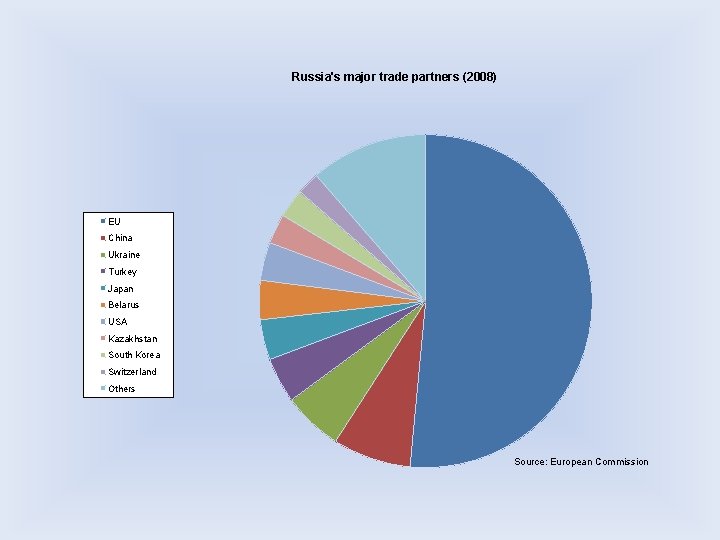
Russia's major trade partners (2008) EU China Ukraine Turkey Japan Belarus USA Kazakhstan South Korea Switzerland Others Source: European Commission
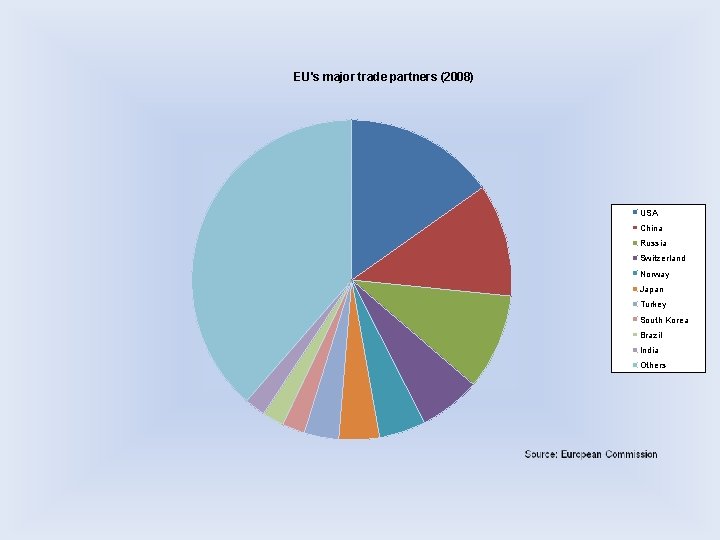
EU's major trade partners (2008) USA China Russia Switzerland Norway Japan Turkey South Korea Brazil India Others
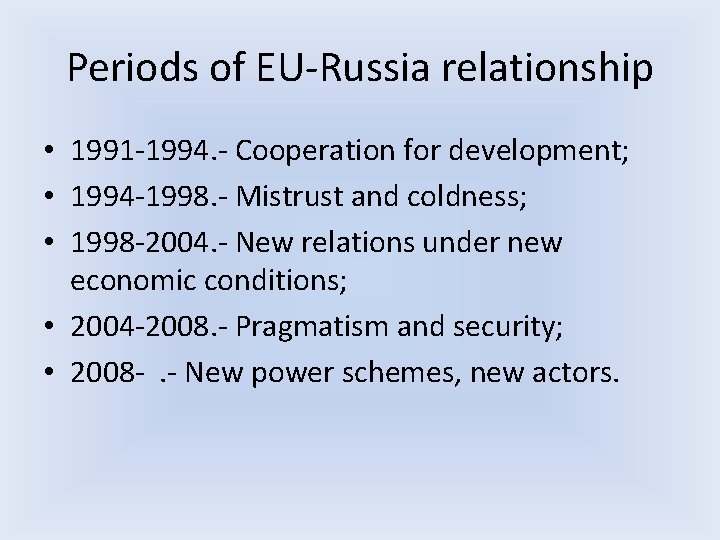
Periods of EU-Russia relationship • 1991 -1994. - Cooperation for development; • 1994 -1998. - Mistrust and coldness; • 1998 -2004. - New relations under new economic conditions; • 2004 -2008. - Pragmatism and security; • 2008 -. - New power schemes, new actors.
Main institution framework for EU-Russia relations • • TACIS Program; PCA; Common Strategies; Other kinds of cooperation.
TACIS program and ENPI • Launched in 1991, the Technical Assistance to CIS countries Programme brought 2. 7 B€ to Russia (about half of the total). • Through TACIS, 1, 500 projects in 58 Russian regions have been funded. • Since 2007, TACIS has been replaced by the European Neighbourhood and Partnership Instrument (ENPI). The change tends to ensure co-financing and focus on strategic goals.
Partnership and Cooperation Agreement (PCA) • Signed in 1994, it was not ratified until 1997. • Valid for a 10 -year period, it was automatically renewed in 2007 because of a lack of political consensus to reach a new agreement. • The PCA is controlled by three different committees: – The Co-operation Council (later Permanent Partnership Council) meets at ministerial level once a year; – The Co-operation Committee, composed of senior EU and Russian civil servants, assists the Cooperation Council; – The Parliamentary Cooperation Committee, made up of Members of the European Parliament and the Federal Assembly of the Russian Federation, can make recommendations to the Cooperation Council.
PCA institutional organs • Two annual summits where meet the President of the European Council, the President of the Commission and the President of the Russian Federation. • Permanent Partnership Council, at ministry level, twice a year. • Cooperation Committees, usually meet once a year. • Nine technical subcommittees: – – – – – Trade and industry; Energy, Environment and nuclear issues; Science and Technology; Transport, Communications and Outer Space; Coal and Steel; Competence and Fight against Crime; Customs and Border Co-operation; Agriculture, Fishing and Protection to Consumers; Financial and Economic Issues and Statistics.
Other cooperation structures related to PCA • Ministry-level meetings (troika format, twice a year); • Political directors (four times a year) • Experts (15 FSCP work teams, meet twice a year with Russian counterparts); • Since 2001, the Political and Security troika meets every month with the Russian ambassador before the EU. • Since 2004 the Cooperation Council was replaced by the Permanent Partnership Council, which can meet not only under the foreign Affairs Formation, but also under other formations such as JHA and environment.
1999 Common Strategy • The first Common Strategy, instrument designed by the Amsterdam Treaty (1997), was focused on Russia (1999/414/CFSP). • It was on application until 2004, but not renewed because it was considered as “superfluous”.
Other cooperation areas • EU-Russia Energy Dialogue – Launched in 2000; – Progress reports issued every six months. • Dialogue on Kaliningrad – There is a structural cooperation on the area since 2002. – The agreements allow Kaliningrad citizens to travel to mainland Russia through EU territory; – The Commission committed 40 M€ for the region’s development, plus additional 25 M€ under the TACIS programme. • Northern dimension (2006); – It embraces an area North of Europe which includes NW Russia; – Its members are Russia, the EU, Norway and Iceland; – It meets at a ministerial level since 2008.
Four common spaces • Established after the St. Petersburg summit of 2003, it focuses the cooperation between EU and Russia in 4 fields: – common economic space; – common space for freedom, security, and justice; – common space for external security; and – common space for education, research and culture.
Problems of communication? Misperceptions, misleads and mistrusts between Russia and the West
Main sensitive issues • • • Chechen wars (1994, 1999) Kosovo and the Balkans (1992 -95, 1999, 2008) Color revolutions (2003, 2004) Georgian conflict (2008) Energy issues
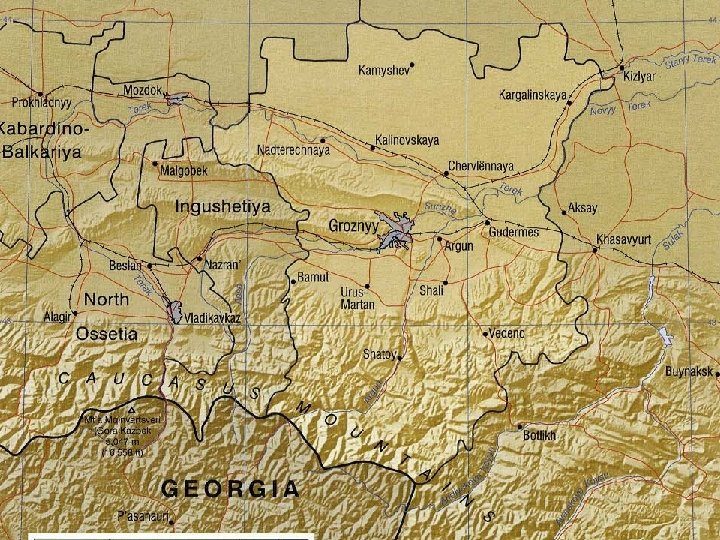
Chechen wars (1994, 1999) • To Russia, it is a domestic issue, in a region which is undeniably Russian. – Chechnya was an out-of-law region which threatened to expand its violence towards neighbouring regions, with a danger of Islamic integrism in Chechnya. – There was a misleading and misperceived concern in the West media, due to bad will strategic interests. • To the West, Russian army has violated Human Rights and international War Rights in its offensive. – There has been a lack of sensitiveness towards Muslim and other ethnic minorities in all the conflict.
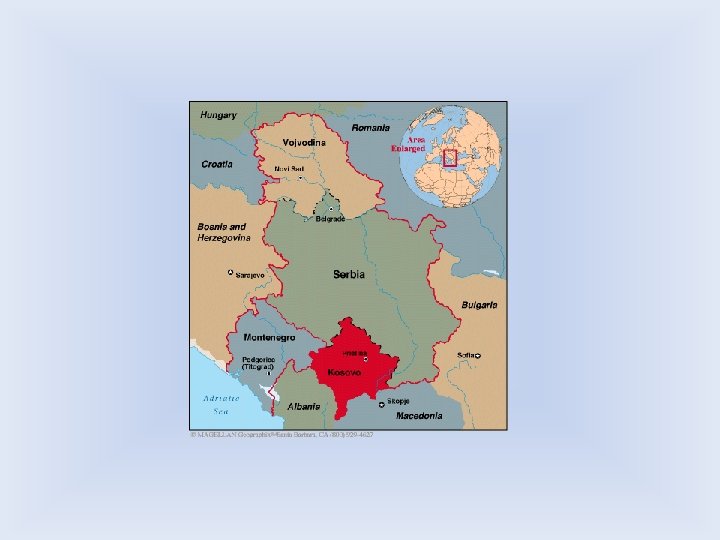
Kosovo Issue (1999, 2008) • Russia considers that, as a world power, has the right to participate in the future decisions on the region; – 1999 NATO actions were an unlawful aggression against a sovereign country; – There is not such a thing as an internationally recognised selfdetermination right; • After the Rambouillet ultimatum, the NATO considers itself legitimated to act on Serbia; – The NATO‘s New Strategic Concept (NSC) is in itself a tool for action in international arena. – There was a threat of genocide in Kosovo which legitimates this “humanitarian intervention”. – The Kosovo independence is a legitimate, but exceptional, action in international right.
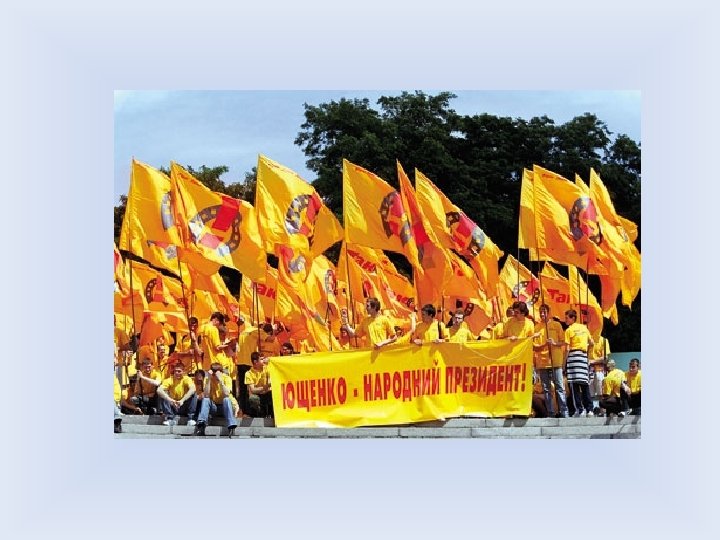
Color revolutions (2003, 2004) • There is a clear interest of Western powers behind all those revolutions; – To Russia, those “revolutions” had been prepared and sponsored by Western NGOs; – The new leaders are corrupt, unpopular and far to be democratic. • According to European powers, the revolutions were popular and spontaneous, motivated by a real desire of running away from Russian pressure and influence; – The processes have been neat and democratic and point out a real nationalist and Europeanist will of these peoples; – Russian reaction is explained by her need to preserve by force her regional influence area.
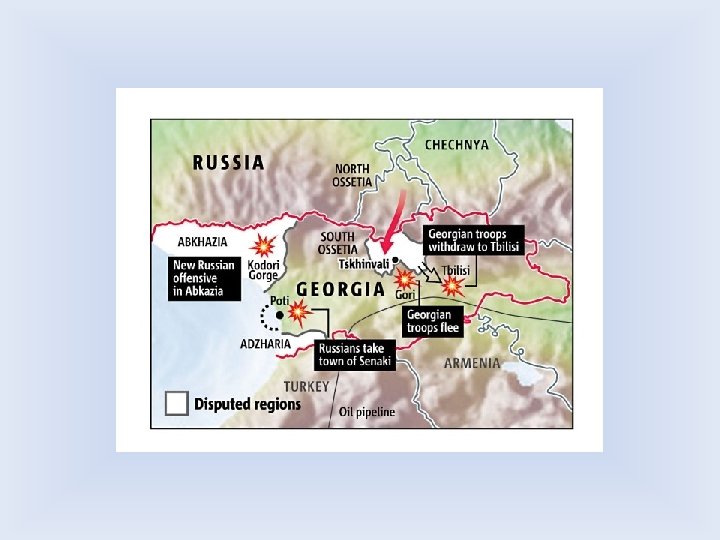
Georgian conflict • To Russia, South Ossetia and Abkhazia are nations which have the right to self-determination; – Most (90%) of South Ossetia inhabitants are Russian citizens, and Russia has the duty to protect them; – Georgia broke off the rules when they intervened against the peace process started in 1992. – There was serious risk of genocide during the Georgian attack. – There was a suspicious presence of NATO and USA troops and diplomats during the conflict. • To the West, all the conflict happened in Georgian territory, so it was supposed to be a domestic issue. – Russia acted against international law and against the peace process invading foreign lands. – It was a miscalculated (and maybe provoked) act of force and a new Russian show of strength.
The problem of the energy supplies A main issue in EU-Russia relationship
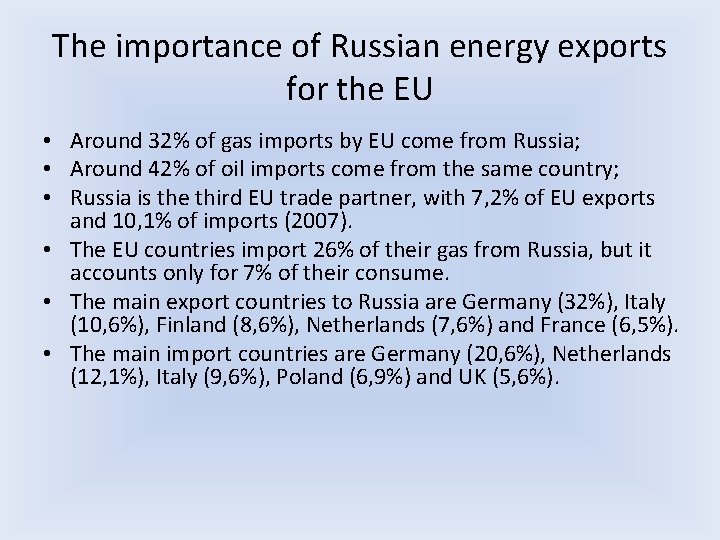
The importance of Russian energy exports for the EU • Around 32% of gas imports by EU come from Russia; • Around 42% of oil imports come from the same country; • Russia is the third EU trade partner, with 7, 2% of EU exports and 10, 1% of imports (2007). • The EU countries import 26% of their gas from Russia, but it accounts only for 7% of their consume. • The main export countries to Russia are Germany (32%), Italy (10, 6%), Finland (8, 6%), Netherlands (7, 6%) and France (6, 5%). • The main import countries are Germany (20, 6%), Netherlands (12, 1%), Italy (9, 6%), Poland (6, 9%) and UK (5, 6%).
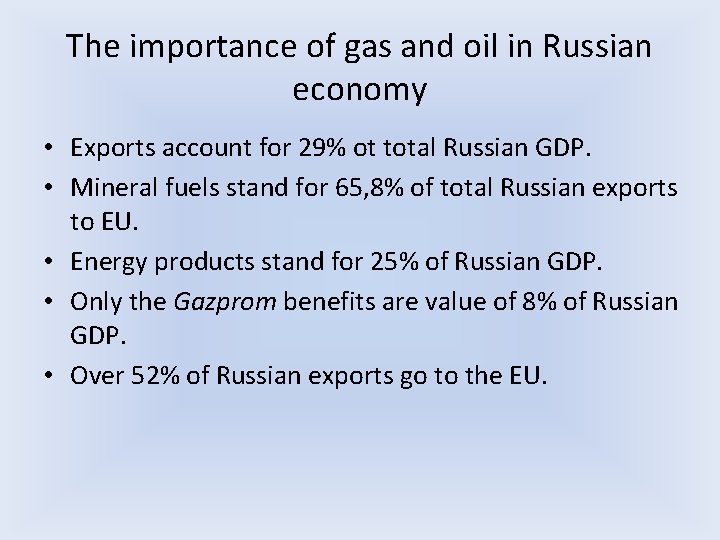
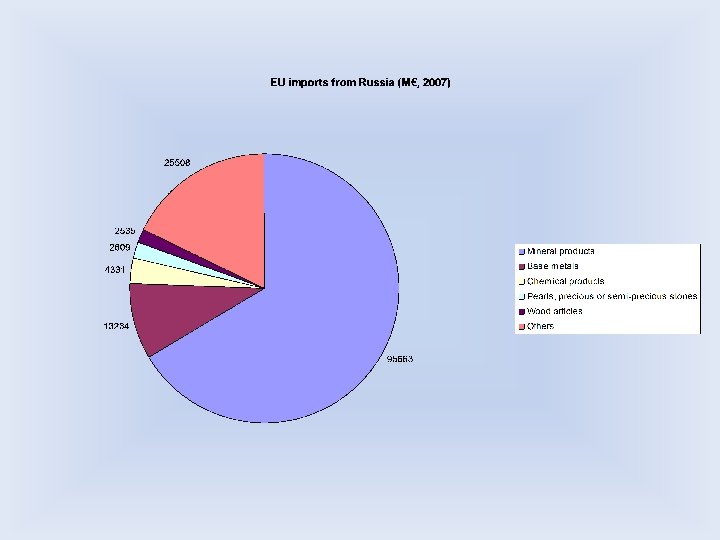
The importance of gas and oil in Russian economy • Exports account for 29% ot total Russian GDP. • Mineral fuels stand for 65, 8% of total Russian exports to EU. • Energy products stand for 25% of Russian GDP. • Only the Gazprom benefits are value of 8% of Russian GDP. • Over 52% of Russian exports go to the EU.
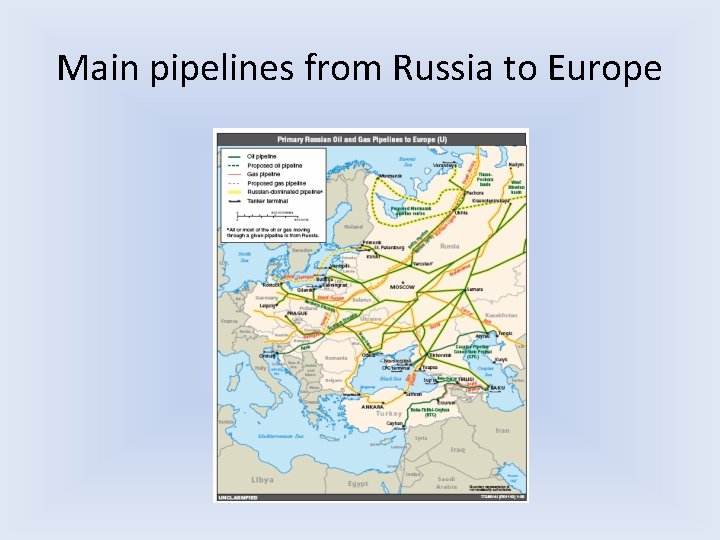
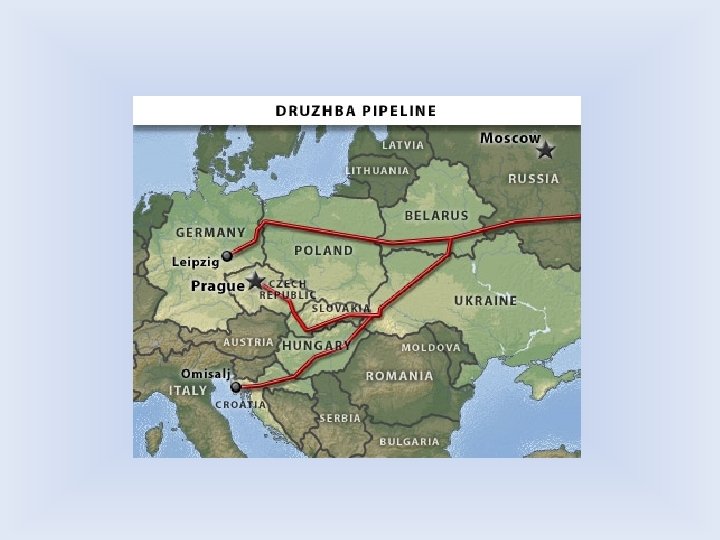
Main pipelines from Russia to Europe
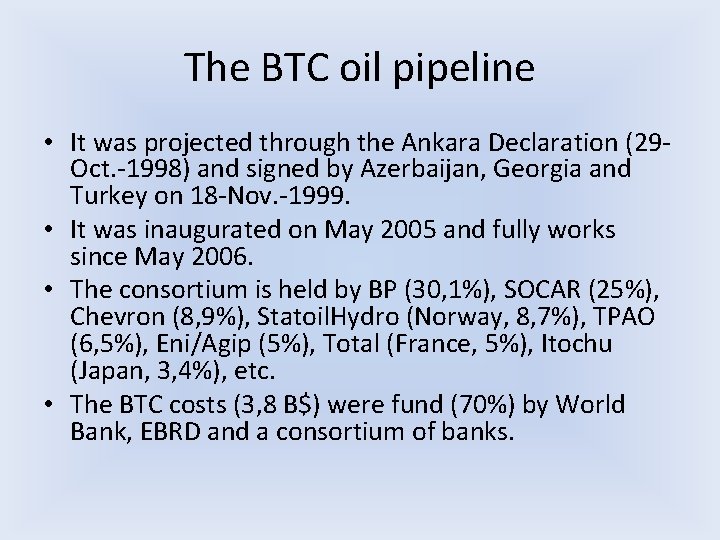
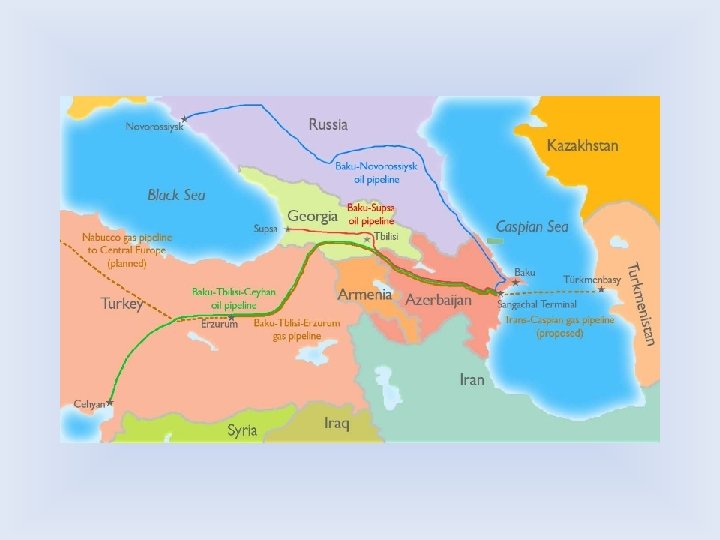
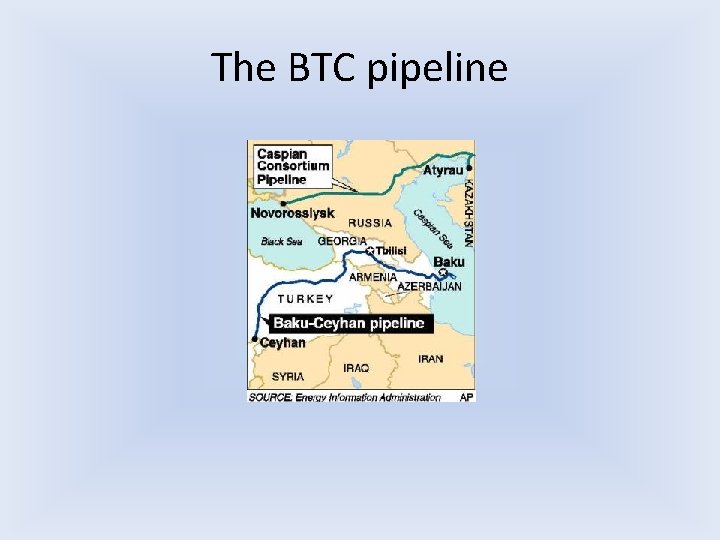
The BTC oil pipeline • It was projected through the Ankara Declaration (29 Oct. -1998) and signed by Azerbaijan, Georgia and Turkey on 18 -Nov. -1999. • It was inaugurated on May 2005 and fully works since May 2006. • The consortium is held by BP (30, 1%), SOCAR (25%), Chevron (8, 9%), Statoil. Hydro (Norway, 8, 7%), TPAO (6, 5%), Eni/Agip (5%), Total (France, 5%), Itochu (Japan, 3, 4%), etc. • The BTC costs (3, 8 B$) were fund (70%) by World Bank, EBRD and a consortium of banks.
Main routes of gas • Druzhba (“Friendship”) pipeline bounds oil and gas to Europe through Ukraine. It brings about 80% of total gas exports to the EU. It carries around 120 bcm of gas a year. • Yamal pipeline crosses Belarus and Poland from the Arctic to Frankfurt-on-Oder. Its capacity can reach 30 bcm of gas a year. • Blue Stream pipeline goes from Russia to Turkey through the Black Sea.
Main projects for gas EU imports • Yamal-Europe Pipeline: The expansion of the pipeline, expected for 2010, should boost capacity to 67 bcm of gas a year. • Galsi Pipeline: Sponsored by Sonatrach (Algeria) and Enel (Italy), is expected to work on 2012, with a capacity of 10 bcm. • Transmed Pipeline: Already working (being expanded), belongs to Sonatrach, exports gas to Italy (27 bcm) through Tunisia. • Medgaz Pipeline: The project involves Cepsa, Iberdrola, Endesa (Spain) and GDF Suez (France); it plans to bring Algerian gas to Spain (8 bcm a year) on 2010
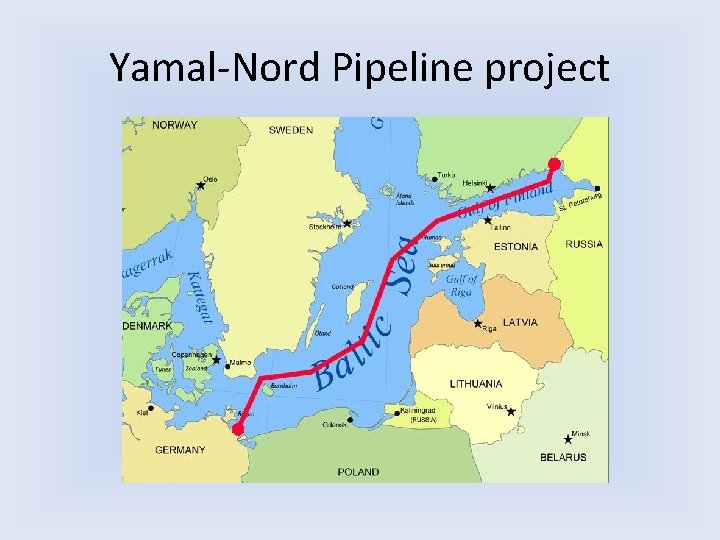
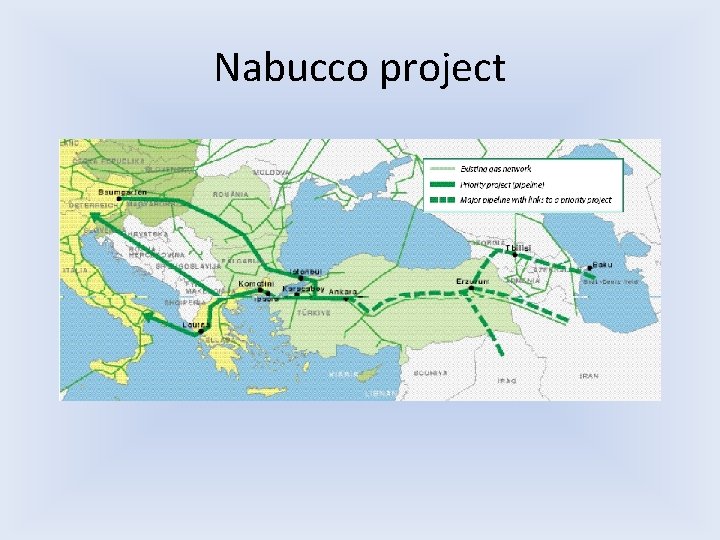
• Baltic Sea Pipeline (Nord Stream): Hold mainly by Gazprom, with BASF, E. ON (Germany) and Gasunie (Netherlands), will bring on 2010 55 bcm a year straight from Vyborg to Germany. • Nabucco Pipeline: The consortium leaded by OMV (Austria), with MOL (Hungary), Botas (Turkey), Bulgargaz and Transgaz (Romania), will operate 13 bcm a year on 2013. • Caspian Gas Pipeline: A 2006 deal between Russia, Kazakhstan and Turkmenistan plan to deliver 10 bcm per year around the caspian Sea. • South Stream Pipeline: Gazprom and Eni plan a new route through the Black Sea to Turkey.
Yamal-Nord Pipeline project
The BTC pipeline
Nabucco project