
EUROPEAN UNION Project financed under Phare MERI NCDTVET
- Slides: 49
EUROPEAN UNION Project financed under Phare MERI/ NCDTVET - PIU Staff continuing professional development from the perspective of quality assurance in initial VET Material produced under Phare 2006 financial support Phare TVET RO RO 2006/018 -147. 04. 01. 02. 01. 03. 01
EUROPEAN UNION Project financed under Phare MERI/ NCDTVET - PIU “The most sophisticated means of reaching the highest quality (in education) is by enhancing motivation and involvement of all stakeholders in education”. Michael Ormston and Marian Shaw Material produced under Phare 2006 financial support Phare TVET RO RO 2006/018 -147. 04. 01. 02. 01. 03. 01
EUROPEAN UNION Education and training Project financed under Phare MERI/ NCDTVET - PIU “Education must strive to follow nature course, no matter how far it might lead us. It fulfills its mission, which is improvement of man” J. H. Pestalozzi • Education is a complex process of training and preparing man for social life form all viewpoints, having a permanent nature, addressing all ages and aiming at creating a positive motivational attitude towards self-training and self-education. Material produced under Phare 2006 financial support Phare TVET RO RO 2006/018 -147. 04. 01. 02. 01. 03. 01
EUROPEAN UNION Education and training Project financed under Phare MERI/ NCDTVET - PIU • Training is the core function of education (expressed as permanent training-development necessary for the optimum social integration of the human personality). • From a functional view training subordinates “education which is only a particular case of training”. Material produced under Phare 2006 financial support Phare TVET RO RO 2006/018 -147. 04. 01. 02. 01. 03. 01
EUROPEAN UNION Project financed under Phare Implementation of a quality system MERI/ NCDTVET - PIU Quality assurance is: • A privilege of competitiveness and compatibility; • An expected result of the educational and development process • A priority issue in the relationships between employers and educational institutions; Material produced under Phare 2006 financial support Phare TVET RO RO 2006/018 -147. 04. 01. 02. 01. 03. 01
EUROPEAN UNION Project financed under Phare MERI/ NCDTVET - PIU Reform in the quality assurance field may: q Reveal difficulties related to certification and students progress, to teachers skills and training. q Reveal difficulties related to national standards and didactic training materials; q Reveal difficulties weak links between initial and continuing training; q Reveal infrastructure problems; q Reveal certain weaknesses of partnerships with employers; q Impact on existing relationships; Material produced under Phare 2006 financial support Phare TVET RO RO 2006/018 -147. 04. 01. 02. 01. 03. 01
EUROPEAN UNION Project financed under Phare MERI/ NCDTVET - PIU Teachers’ training – fundamental component of the quality assurance process 1. 2. 3. 4. Identification of customer requirements and curriculum related requirements Drafting procedures to meet these requirements Defining clear roles and responsibilities Analysing activities and procedures Material produced under Phare 2006 financial support Phare TVET RO RO 2006/018 -147. 04. 01. 02. 01. 03. 01
EUROPEAN UNION Project financed under Phare MERI/ NCDTVET - PIU 5. 6. 7. 8. Applying corrective actions Working for continuing improvement Maintaining certain documentation and registers Adequate training courses for the entire staff Material produced under Phare 2006 financial support Phare TVET RO RO 2006/018 -147. 04. 01. 02. 01. 03. 01
EUROPEAN UNION Project financed under Phare MERI/ NCDTVET - PIU Change and progress in school organisations Plans for change and progress in school organisations: q School improvement, involving reconversion, adaptation and structural and management changes; q Staff development, involving teachers’ training and development. Material produced under Phare 2006 financial support Phare TVET RO RO 2006/018 -147. 04. 01. 02. 01. 03. 01
EUROPEAN UNION Project financed under Phare Professional development strategy MERI/ NCDTVET - PIU • The professional development strategy is developed based on : § Specific organisational context; § Employees particularities; § External influence factors. Material produced under Phare 2006 financial support Phare TVET RO RO 2006/018 -147. 04. 01. 02. 01. 03. 01
EUROPEAN UNION Project financed under Phare MERI/ NCDTVET - PIU From the quality assurance perspective, professional development may be viewed under two perspectives: q Qualitative – level of teachers’ participation to didactic innovation; q Quantitative – investment in continuing training, in career development Material produced under Phare 2006 financial support Phare TVET RO RO 2006/018 -147. 04. 01. 02. 01. 03. 01
EUROPEAN UNION Project financed under Phare Continuing training MERI/ NCDTVET - PIU Continuing training “may be defined as the set of activities and practices that require involvement of educators to enhance own knowledge, improve skills, analyse and develop professional attitudes” (EURYDICE. Information Network on Education in Europe). Material produced under Phare 2006 financial support Phare TVET RO RO 2006/018 -147. 04. 01. 02. 01. 03. 01
EUROPEAN UNION Continuing training Project financed under Phare MERI/ NCDTVET - PIU q Continuing training of teachers comprises two essential aspects: q Improvement and renewal of professional practices by “updating knowledge acquired during initial training”; q Completion of initial training, including “possible change of professional pathway, with new competences certified by diplomas”. Material produced under Phare 2006 financial support Phare TVET RO RO 2006/018 -147. 04. 01. 02. 01. 03. 01
EUROPEAN UNION Project financed under Phare Objectives of continuing training MERI/ NCDTVET - PIU q Personal and social and professional development of teachers Specific objectives: Updating basic competences (pedagogical, specialist); q Acquiring new competences; q Applying basic competences at the level of specialty/specialties didactics; q Initiation in using new teaching-learning-assessment strategies, methods, means; q Material produced under Phare 2006 financial support Phare TVET RO RO 2006/018 -147. 04. 01. 02. 01. 03. 01
EUROPEAN UNION Project financed under Phare MERI/ NCDTVET - PIU q Improvement of continuing training system/institutions, courses provision, pedagogical practices specific objectives: Fostering interdisciplinarity capitalising on basic concepts; q Fostering pedagogical research/innovation at individual and group/team level; q Application of educational paradigms at school and class level/curriculum theory; education management; q Development of psycho-social behaviours necessary for human q resources management; Material produced under Phare 2006 financial support Phare TVET RO RO 2006/018 -147. 04. 01. 02. 01. 03. 01
EUROPEAN UNION Project financed under Phare MERI/ NCDTVET - PIU q Knowledge of pedagogical and social environment specific objectives: q Fostering school relationship with various social actors: economic, community, cultural, politic etc. ; q Relating the educational system to the social and economic interests; q Adaptation to social and cultural changes specific to post-industrial/information society; q Studying the psycho-social factors influencing students’ behaviours Material produced under Phare 2006 financial support Phare TVET RO RO 2006/018 -147. 04. 01. 02. 01. 03. 01
EUROPEAN UNION Project financed under Phare MERI/ NCDTVET - PIU Professional development strategy Good practice examples Material produced under Phare 2006 financial support Phare TVET RO RO 2006/018 -147. 04. 01. 02. 01. 03. 01
EUROPEAN UNION Professional development strategy Project financed under Phare MERI/ NCDTVET - PIU Should consider various training needs and should be developed so that it meets the requirements of: • Students, who want learning possibilities matching their professional and personal aspiration. These qualifications should be a “passport” for employment, certifying student’s skills and competences; • Employers, who want valid and reliable qualifications, recognised by the accreditation of employees’ quality and level of competence; • Public sectors, who want the TVET provision to be able to sustain economic development and support governmental policies Material produced under Phare 2006 financial support Phare TVET RO RO 2006/018 -147. 04. 01. 02. 01. 03. 01
EUROPEAN UNION Project financed under Phare MERI/ NCDTVET - PIU • • • What needs to be done: Identification of “heritage” of talent, knowledge and experiences in school Identification of training needs, as maintaining a balance between the systemic and individual needs is essential; Identification of agreed training institutions; Identification of types of agreed courses and their delivery Identification of weaknesses and strenghts in the current teachers’ continuing training system; Identification of the main motivational structures involved in the process of teachers’ continuing training Material produced under Phare 2006 financial support Phare TVET RO RO 2006/018 -147. 04. 01. 02. 01. 03. 01
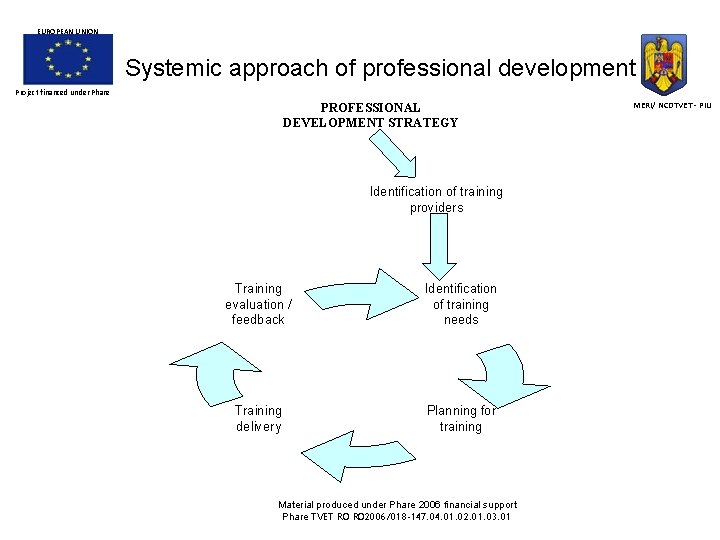
EUROPEAN UNION Systemic approach of professional development Project financed under Phare PROFESSIONAL DEVELOPMENT STRATEGY Identification of training providers Training evaluation / feedback Identification of training needs Training delivery Planning for training Material produced under Phare 2006 financial support Phare TVET RO RO 2006/018 -147. 04. 01. 02. 01. 03. 01 MERI/ NCDTVET - PIU
EUROPEAN UNION Identification of training needs Project financed under Phare • • • MERI/ NCDTVET - PIU Surveys among: – Teachers – Students and parents – Employers Assessment of teachers’ performance by means of: – Lesson observation, followed by discussions with teachers and development of an improvement plan, as appropriate (assistance/interassistance); – Observation of non-formal activities, determining implications on participants and result monitoring – Questionnaires designed for both direct beneficiaries (students) and indirect beneficiaries (parents, partners employers) of the educational process Self-assessment at the level of: – teachers – department: undertaken by the head of department – school: undertaken by the QAEC coordinator Material produced under Phare 2006 financial support Phare TVET RO RO 2006/018 -147. 04. 01. 02. 01. 03. 01
EUROPEAN UNION Project financed under Phare MERI/ NCDTVET - PIU • Self-assessment is finalised with: – SWOT analysis – Development of improvement plan for priority weaknesses Material produced under Phare 2006 financial support Phare TVET RO RO 2006/018 -147. 04. 01. 02. 01. 03. 01
EUROPEAN UNION Project financed under Phare MERI/ NCDTVET - PIU Questionnaire for identifying teachers’ continuing training needs - excerpt Material produced under Phare 2006 financial support Phare TVET RO RO 2006/018 -147. 04. 01. 02. 01. 03. 01
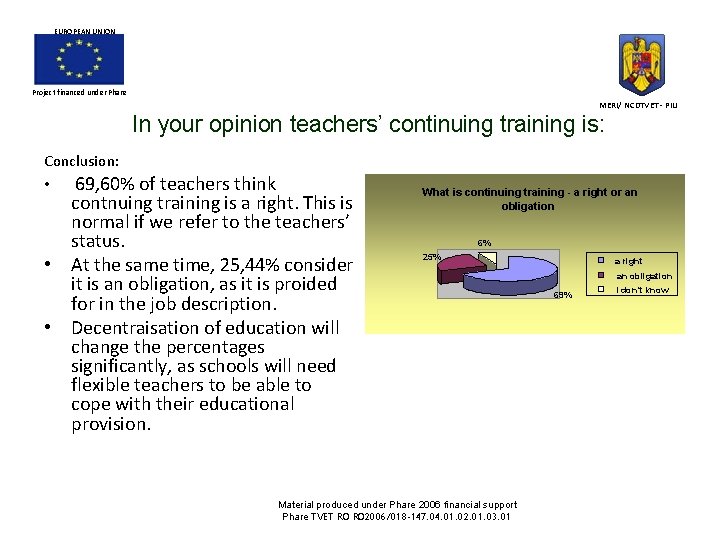
EUROPEAN UNION Project financed under Phare MERI/ NCDTVET - PIU In your opinion teachers’ continuing training is: Conclusion: • 69, 60% of teachers think contnuing training is a right. This is normal if we refer to the teachers’ status. • At the same time, 25, 44% consider it is an obligation, as it is proided for in the job description. • Decentraisation of education will change the percentages significantly, as schools will need flexible teachers to be able to cope with their educational provision. What is continuing training - a right or an obligation 6% 25% Material produced under Phare 2006 financial support Phare TVET RO RO 2006/018 -147. 04. 01. 02. 01. 03. 01 a right an obligation 69% I don’t know
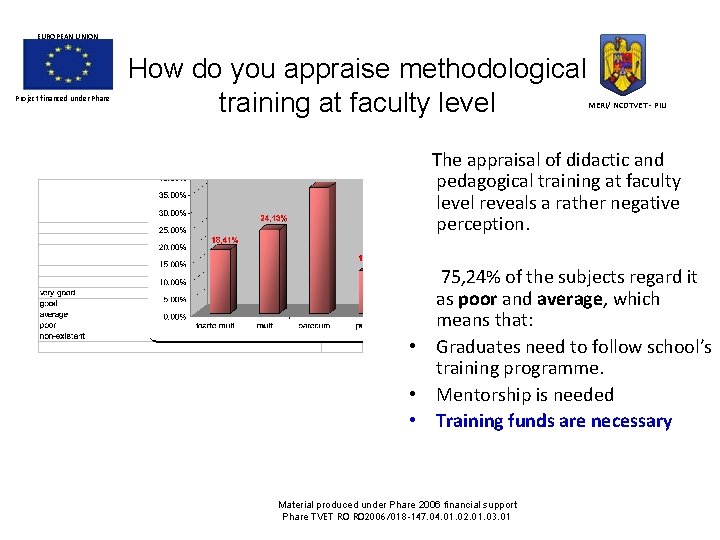
EUROPEAN UNION Project financed under Phare How do you appraise methodological training at faculty level MERI/ NCDTVET - PIU The appraisal of didactic and pedagogical training at faculty level reveals a rather negative perception. 75, 24% of the subjects regard it as poor and average, which means that: • Graduates need to follow school’s training programme. • Mentorship is needed • Training funds are necessary Material produced under Phare 2006 financial support Phare TVET RO RO 2006/018 -147. 04. 01. 02. 01. 03. 01
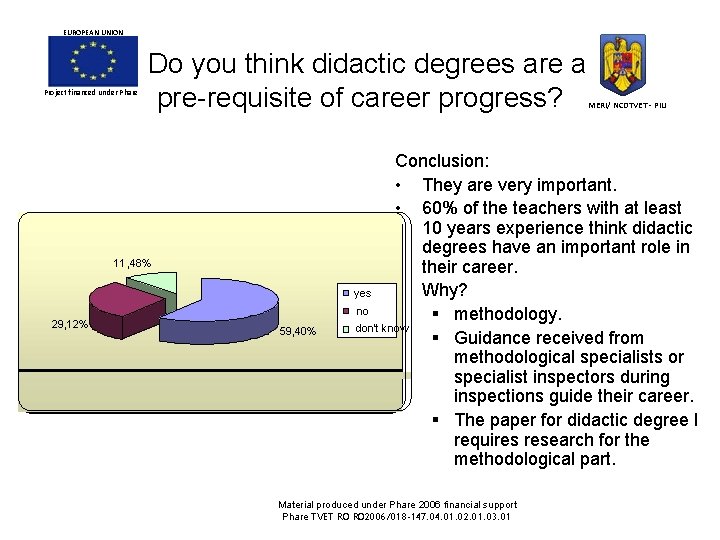
EUROPEAN UNION Project financed under Phare Do you think didactic degrees are a pre-requisite of career progress? 11, 48% 29, 12% 59, 40% MERI/ NCDTVET - PIU Conclusion: • They are very important. • 60% of the teachers with at least 10 years experience think didactic degrees have an important role in their career. • Why? yes no § methodology. don’t know § Guidance received from methodological specialists or specialist inspectors during inspections guide their career. § The paper for didactic degree I requires research for the methodological part. Material produced under Phare 2006 financial support Phare TVET RO RO 2006/018 -147. 04. 01. 02. 01. 03. 01
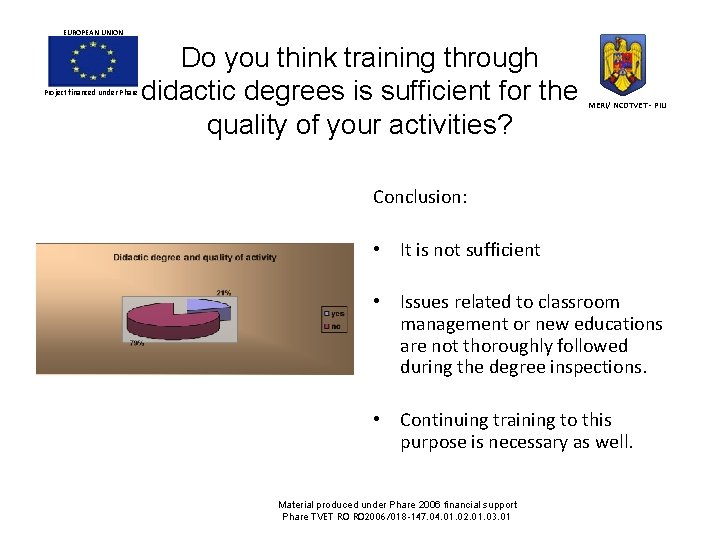
EUROPEAN UNION Project financed under Phare Do you think training through didactic degrees is sufficient for the quality of your activities? MERI/ NCDTVET - PIU Conclusion: • It is not sufficient • Issues related to classroom management or new educations are not thoroughly followed during the degree inspections. • Continuing training to this purpose is necessary as well. Material produced under Phare 2006 financial support Phare TVET RO RO 2006/018 -147. 04. 01. 02. 01. 03. 01
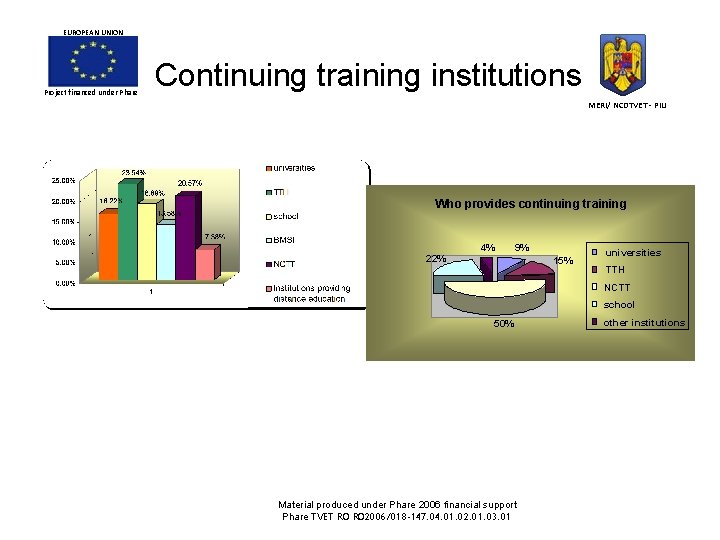
EUROPEAN UNION Project financed under Phare Continuing training institutions MERI/ NCDTVET - PIU Who provides continuing training 22% 4% 9% 15% universities TTH NCTT school 50% Material produced under Phare 2006 financial support Phare TVET RO RO 2006/018 -147. 04. 01. 02. 01. 03. 01 other institutions
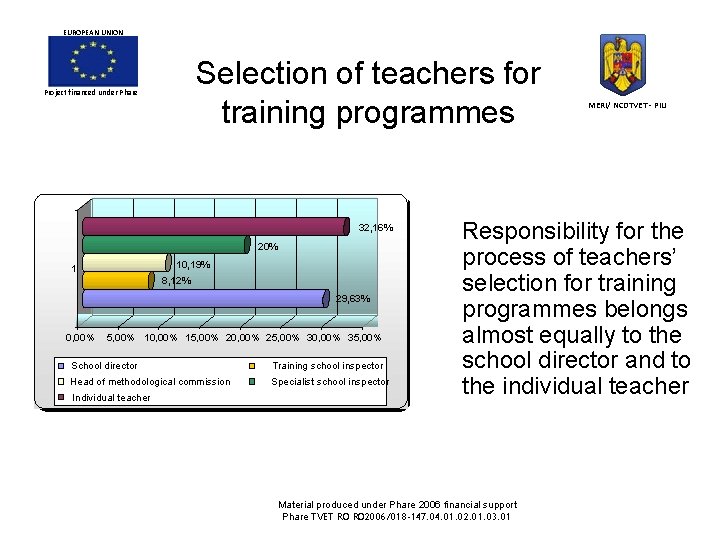
EUROPEAN UNION Selection of teachers for training programmes Project financed under Phare 32, 16% 20% 10, 19% 1 8, 12% 29, 63% 0, 00% 5, 00% 10, 00% 15, 00% 20, 00% 25, 00% 30, 00% 35, 00% School director Training school inspector Head of methodological commission Specialist school inspector Individual teacher MERI/ NCDTVET - PIU Responsibility for the process of teachers’ selection for training programmes belongs almost equally to the school director and to the individual teacher Material produced under Phare 2006 financial support Phare TVET RO RO 2006/018 -147. 04. 01. 02. 01. 03. 01
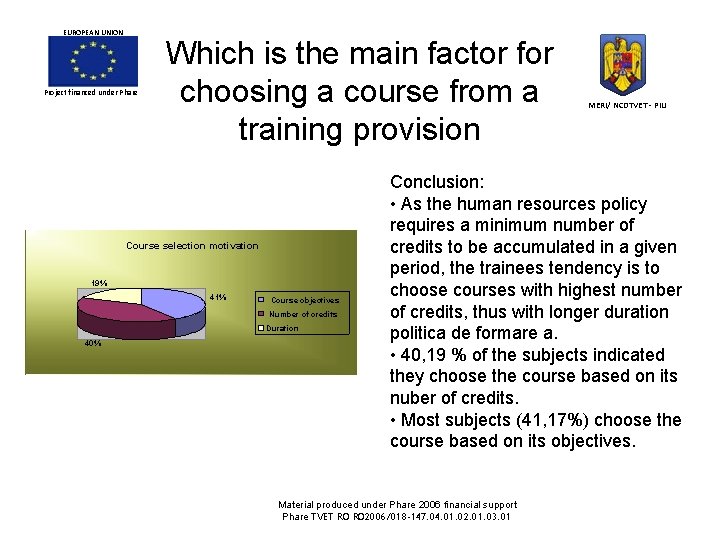
EUROPEAN UNION Project financed under Phare Which is the main factor for choosing a course from a training provision Course selection motivation 19% 41% Course objectives Number of credits Duration 40% MERI/ NCDTVET - PIU Conclusion: • As the human resources policy requires a minimum number of credits to be accumulated in a given period, the trainees tendency is to choose courses with highest number of credits, thus with longer duration politica de formare a. • 40, 19 % of the subjects indicated they choose the course based on its nuber of credits. • Most subjects (41, 17%) choose the course based on its objectives. Material produced under Phare 2006 financial support Phare TVET RO RO 2006/018 -147. 04. 01. 02. 01. 03. 01
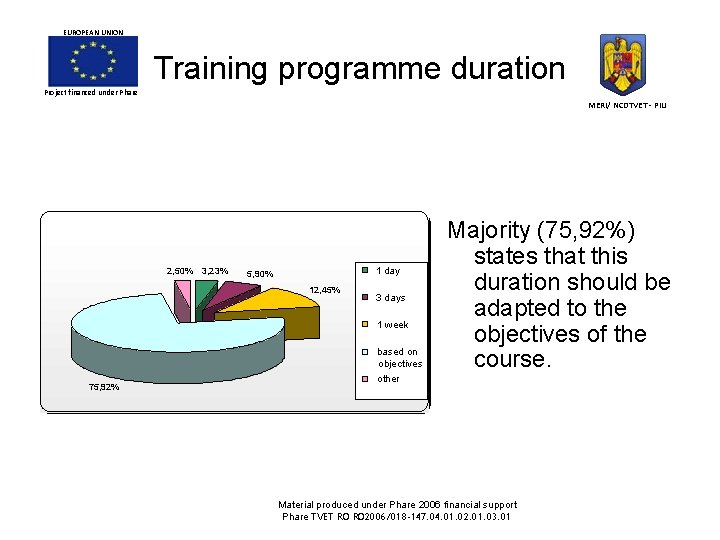
EUROPEAN UNION Training programme duration Project financed under Phare MERI/ NCDTVET - PIU 2, 50% 3, 23% 1 day 5, 90% 12, 45% 3 days 1 week 75, 92% based on objectives other Majority (75, 92%) states that this duration should be adapted to the objectives of the course. Material produced under Phare 2006 financial support Phare TVET RO RO 2006/018 -147. 04. 01. 02. 01. 03. 01
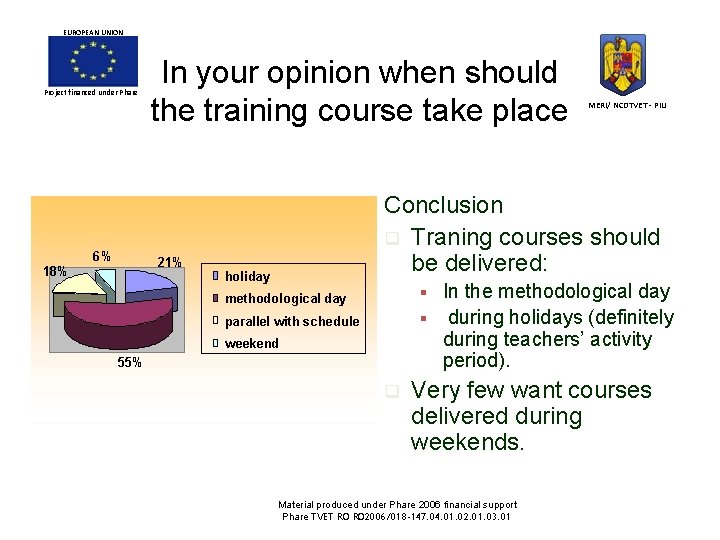
EUROPEAN UNION Project financed under Phare 6% In your opinion when should the training course take place 21% 18% MERI/ NCDTVET - PIU Conclusion q Traning courses should be delivered: holiday In the methodological day § during holidays (definitely during teachers’ activity period). § methodological day parallel with schedule weekend 55% q Very few want courses delivered during weekends. Material produced under Phare 2006 financial support Phare TVET RO RO 2006/018 -147. 04. 01. 02. 01. 03. 01
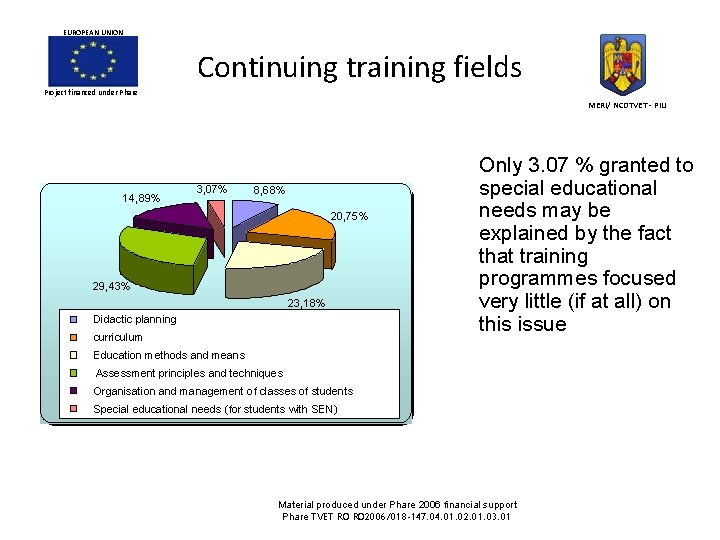
EUROPEAN UNION Continuing training fields Project financed under Phare MERI/ NCDTVET - PIU 14, 89% 3, 07% 8, 68% 20, 75% 29, 43% 23, 18% Didactic planning curriculum Only 3. 07 % granted to special educational needs may be explained by the fact that training programmes focused very little (if at all) on this issue Education methods and means Assessment principles and techniques Organisation and management of classes of students Special educational needs (for students with SEN) Material produced under Phare 2006 financial support Phare TVET RO RO 2006/018 -147. 04. 01. 02. 01. 03. 01
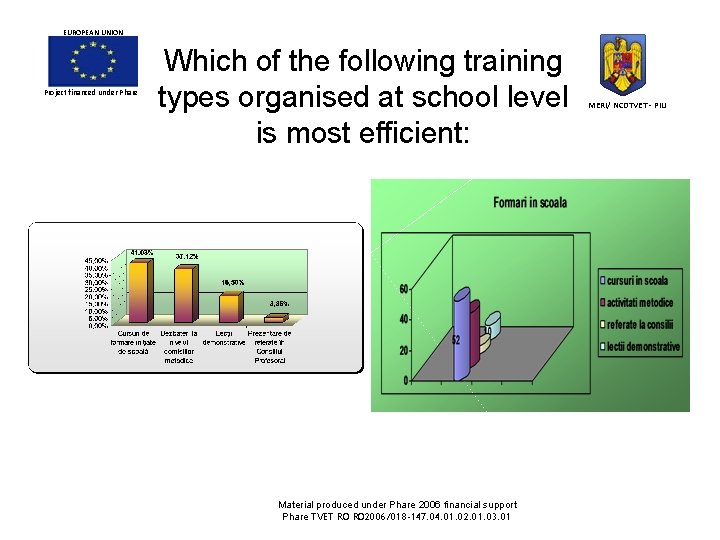
EUROPEAN UNION Project financed under Phare Which of the following training types organised at school level is most efficient: Material produced under Phare 2006 financial support Phare TVET RO RO 2006/018 -147. 04. 01. 02. 01. 03. 01 MERI/ NCDTVET - PIU
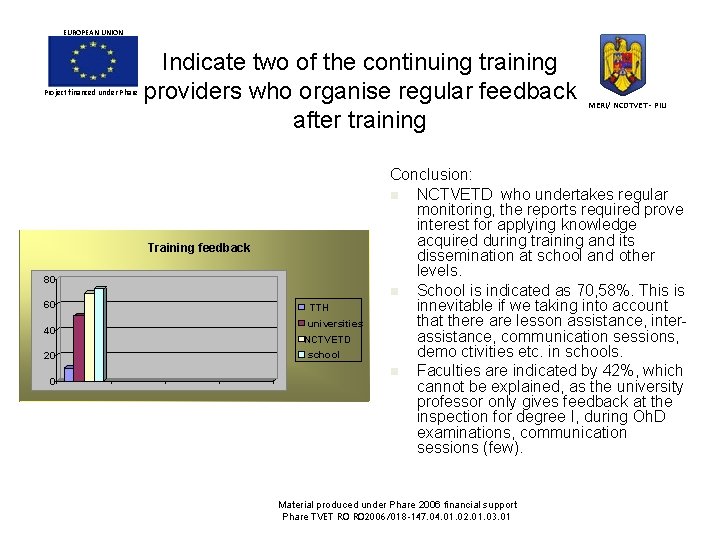
EUROPEAN UNION Project financed under Phare Indicate two of the continuing training providers who organise regular feedback after training Training feedback 80 60 40 20 0 TTH universities NCTVETD school MERI/ NCDTVET - PIU Conclusion: n NCTVETD who undertakes regular monitoring, the reports required prove interest for applying knowledge acquired during training and its dissemination at school and other levels. n School is indicated as 70, 58%. This is innevitable if we taking into account that there are lesson assistance, interassistance, communication sessions, demo ctivities etc. in schools. n Faculties are indicated by 42%, which cannot be explained, as the university professor only gives feedback at the inspection for degree I, during Oh. D examinations, communication sessions (few). Material produced under Phare 2006 financial support Phare TVET RO RO 2006/018 -147. 04. 01. 02. 01. 03. 01
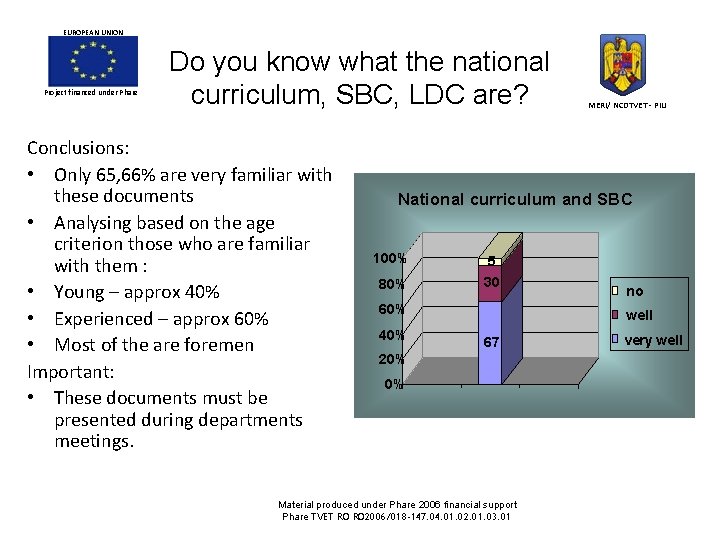
EUROPEAN UNION Project financed under Phare Do you know what the national curriculum, SBC, LDC are? Conclusions: • Only 65, 66% are very familiar with these documents • Analysing based on the age criterion those who are familiar with them : • Young – approx 40% • Experienced – approx 60% • Most of the are foremen Important: • These documents must be presented during departments meetings. MERI/ NCDTVET - PIU National curriculum and SBC 100% 5 80% 30 60% 40% no well 67 20% 0% Material produced under Phare 2006 financial support Phare TVET RO RO 2006/018 -147. 04. 01. 02. 01. 03. 01 very well
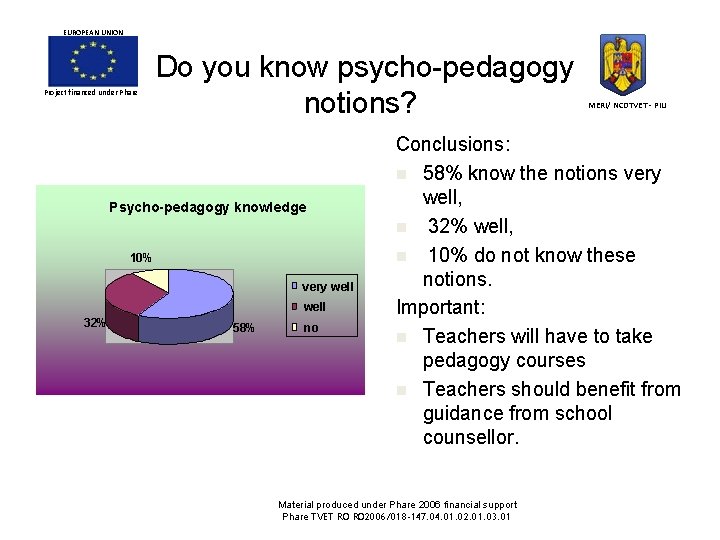
EUROPEAN UNION Project financed under Phare Do you know psycho-pedagogy notions? Psycho-pedagogy knowledge 10% very well 32% 58% no MERI/ NCDTVET - PIU Conclusions: n 58% know the notions very well, n 32% well, n 10% do not know these notions. Important: n Teachers will have to take pedagogy courses n Teachers should benefit from guidance from school counsellor. Material produced under Phare 2006 financial support Phare TVET RO RO 2006/018 -147. 04. 01. 02. 01. 03. 01
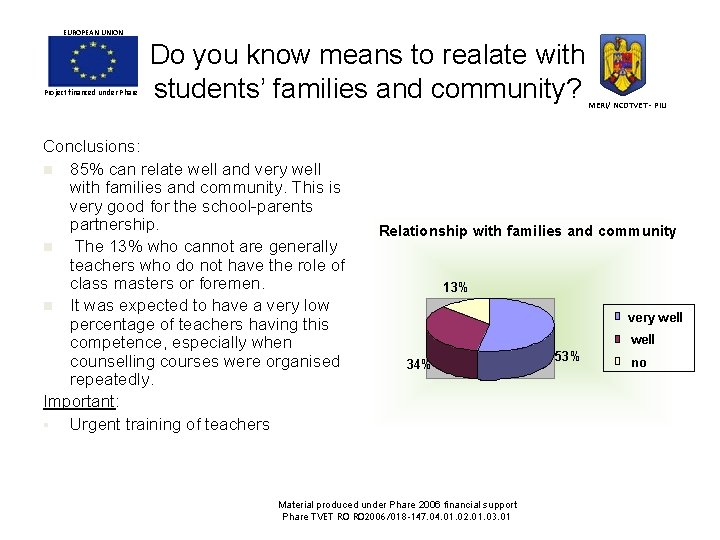
EUROPEAN UNION Project financed under Phare Do you know means to realate with students’ families and community? Conclusions: n 85% can relate well and very well with families and community. This is very good for the school-parents partnership. n The 13% who cannot are generally teachers who do not have the role of class masters or foremen. n It was expected to have a very low percentage of teachers having this competence, especially when counselling courses were organised repeatedly. Important: § Urgent training of teachers MERI/ NCDTVET - PIU Relationship with families and community 13% very well 34% Material produced under Phare 2006 financial support Phare TVET RO RO 2006/018 -147. 04. 01. 02. 01. 03. 01 53% no
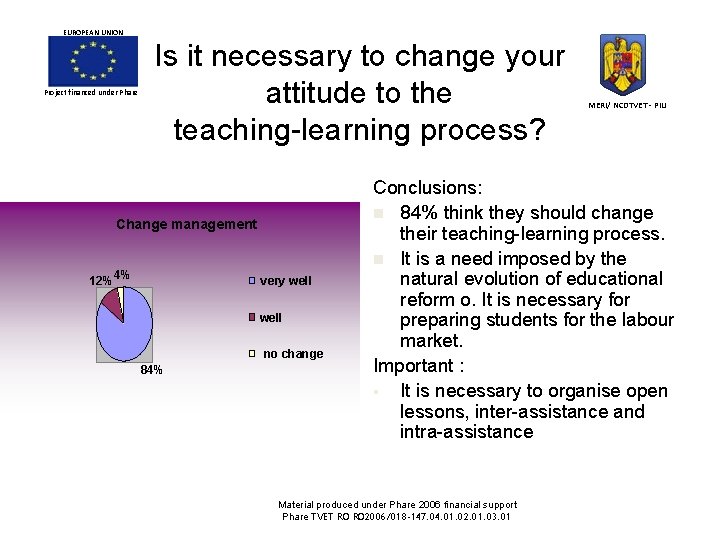
EUROPEAN UNION Project financed under Phare Is it necessary to change your attitude to the teaching-learning process? Change management 12% 4% very well no change 84% MERI/ NCDTVET - PIU Conclusions: n 84% think they should change their teaching-learning process. n It is a need imposed by the natural evolution of educational reform o. It is necessary for preparing students for the labour market. Important : § It is necessary to organise open lessons, inter-assistance and intra-assistance Material produced under Phare 2006 financial support Phare TVET RO RO 2006/018 -147. 04. 01. 02. 01. 03. 01
EUROPEAN UNION Project financed under Phare MERI/ NCDTVET - PIU q Based on the interpretation of information collected for identifying the training needs we determined q A training plan comprising : q Staff improvement needs, based on school and individual priorities de q Action plan for courses delivery q The person who will coordinate this programme q The necessary resources. Material produced under Phare 2006 financial support Phare TVET RO RO 2006/018 -147. 04. 01. 02. 01. 03. 01
EUROPEAN UNION Project financed under Phare Training programme. Courses MERI/ NCDTVET - PIU q Provided by school : q „Student-centred learning” q „Development of learning materials” q „Quality assurance in education” q We used the national trainers from schools, as well as the teachers trained under PHARE TVET. They became true champions of change. Material produced under Phare 2006 financial support Phare TVET RO RO 2006/018 -147. 04. 01. 02. 01. 03. 01
EUROPEAN UNION Project financed under Phare Training programme. Courses MERI/ NCDTVET - PIU q Provided by TTH: q Mentorship courses q „Class masters’ school” q „European integration and international projects” „Vocational guidance and counselling” q „Communication competences in English q „Informatics through the ODD system” q „Initiation in ITC” Material produced under Phare 2006 financial support Phare TVET RO RO 2006/018 -147. 04. 01. 02. 01. 03. 01
EUROPEAN UNION Training programme. Courses Project financed under Phare MERI/ NCDTVET - PIU q Provided by CREDIS: „Information technology and communication” q Provided by foundations: q Tineri pentru tineri: q „Young people at life’s doorstep”, q „Education for family life” q ASIS: “I am a citizen, I know my rights” q Salvaţi copiii – Youth Centre q P. S. I. : ”I do what I want but I know what I do” Material produced under Phare 2006 financial support Phare TVET RO RO 2006/018 -147. 04. 01. 02. 01. 03. 01
EUROPEAN UNION Project financed under Phare Self-assessment Report Improvement plan - examples MERI/ NCDTVET - PIU After the first self-assessment cycle (school year 2004 – 2005) • Issues identified: – Teaching-learning methods – Assessment methods • Solutions identified: – Training – Dissemination and discussions – Open lessons – Improvement of endowment – Procurement of new didactic materials Material produced under Phare 2006 financial support Phare TVET RO RO 2006/018 -147. 04. 01. 02. 01. 03. 01
EUROPEAN UNION Project financed under Phare MERI/ NCDTVET - PIU After the second self-assessment cycle (school year 2005 – 2006) • Issue identified : – vocational guidance and counselling • Solutions identified : – participation to training course “Guidance and Counselling” – self-knowledge questionnaires, personal development – partnerships with competent institutions : • For career planning - CAE • For creating a lifestyle – Psycho-pedagogical Assistance Centre, Drug Consumption Prevention Service • Involvement of human resources departments at partner employers Material produced under Phare 2006 financial support Phare TVET RO RO 2006/018 -147. 04. 01. 02. 01. 03. 01
EUROPEAN UNION Project financed under Phare MERI/ NCDTVET - PIU q General provisions, as well as very targeted ones were presented in order to meet teachers’ individual interests as well as school needs q The main change that must be brought to the organisation of continuing training is moving the focus at school level schimbare ce se impune în privinţa modului de organizare a formării continue este deplasarea centrului de greutate la nivelul şcolii. q Continuing training should become an institutional component of schools Material produced under Phare 2006 financial support Phare TVET RO RO 2006/018 -147. 04. 01. 02. 01. 03. 01
EUROPEAN UNION Project financed under Phare MERI/ NCDTVET - PIU By adopting a systematic approach on professional development, the school should have several benefits: q. Increase of professional performance; q. Higher quality of services; q. Increase of motivation by staff involvement. Material produced under Phare 2006 financial support Phare TVET RO RO 2006/018 -147. 04. 01. 02. 01. 03. 01
EUROPEAN UNION Project financed under Phare MERI/ NCDTVET - PIU q Introduction of a quality system is not easy. Various difficulties may occur but if customers and curriculum requirements are identified, procedures are written for these requirements, procedures are complied with, clear roles an responsibilities are defined (staff proving commitment at all levels), actions and procedures are analysed, corrective measures are applied, teachers’ training is approached in a systemic manner, then we can speak of successful implementation of a quality system Material produced under Phare 2006 financial support Phare TVET RO RO 2006/018 -147. 04. 01. 02. 01. 03. 01
EUROPEAN UNION Project financed under Phare MERI/ NCDTVET - PIU The entire quality assurance process depends on teachers’ involvement and on their professional-pedagogical competence. Material produced under Phare 2006 financial support Phare TVET RO RO 2006/018 -147. 04. 01. 02. 01. 03. 01