
European Union as the common market International Business
European Union as the common market International Business Transactions Monika Grottel monika. grottel@ug. edu. pl
Common market - definition • Group formed by countries within a geographical area to promote duty free trade and free movement of labor and capital among its members. • European community (as a legal entity within the framework of European Union) is the best known example. • Common markets impose common external tariff (CET) on imports from non-member countries.
Common Market • • Single Market Internal Market Eurpean Market Unified Market
Stages of development of the Common Market 1. Free Trade Area 2. Customs Union 3. Common Market

1. Free Trade Area – different external trade policy – different import quotas – free goods flow between participants
Free Trade Area – EU case • Paris Treaty (April 18, 1951) – the European Coal and Steel Community (ECSC), • Rome Treaty (March 25, 1957) – the European Economic Community (EEC) – birth of the free trade zone
2. Customs Union – Free Trade Area between participants countries – common trade policy (CTP) – common external customs tariff – common customs documents
Customs Union and Common Customs Tariff of the European Union were established in 1968
The fundamental effects of common customs policy A. trade creation effect B. trade diversion effect C. common market (single market)
A. Trade creation effect • the abolition of customs taxes and other barriers in the goods exchange between members states • expensive domestic manufactures were replaced by the cheaper and more concurrence commodities from other members states • domestic resources can be used more effectively
B. Trade diversion effect • domestic goods become to be cheaper and more concurrence than imported goods • the consumers prefer to buy domestic goods, than imported goods • the participation of member states in common trade increases
C. Common market – as an effect of common customs policy people, goods, services and money can move around the integrated area as freely as they do within a single country
3. Common Market – last stage of economic integration - EU case • „White Book” – approved by the European Council in Milan, June 1985, recommended establishing a single European market • Single European Act (SEA) – became effective on July 1, 1987 – provided for establishment of a single internal market – until the end of 1992 • the Treaty on the European Union (TEU) – Maastricht, February 1992 – changed the name of European Community to European Union
the Treaty on the Eurpean Union has declared: • • support for sustainable socio-economic growth creating an area with no internal borders promoting economic and social cohesion common currency
3. Common European Market - finally established in 1993 Based on four freedoms of flow: 1. flow of goods 2. flow of economic activity and services 3. flow of persons and employees 4. flow of capital
The Lisbon Treaty - UE reforms • became effective with the conclusion of ratification processes in all member states on December 1, 2009 • the functioning of the EU is based on two equally vaild treaties: – the Treaty on the European Union (TEU) – the Treaty on the Functioning of the European Union (TFEU)
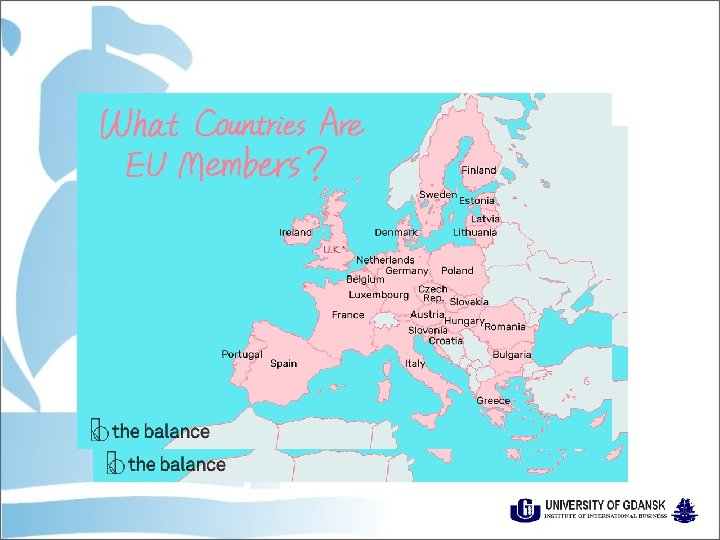
What Countries Are EU Members? • • • Austria, Belgium, Bulgaria, Croatia, Cyprus, Czech Republic, Denmark, Estonia, Finland, France, Germany, Greece, Hungary, Ireland, Italy, Latvia, Lithuania, Luxembourg, Malta, Netherlands, Poland, Portugal, Romania, Slovakia, Slovenia, Spain, Sweden.
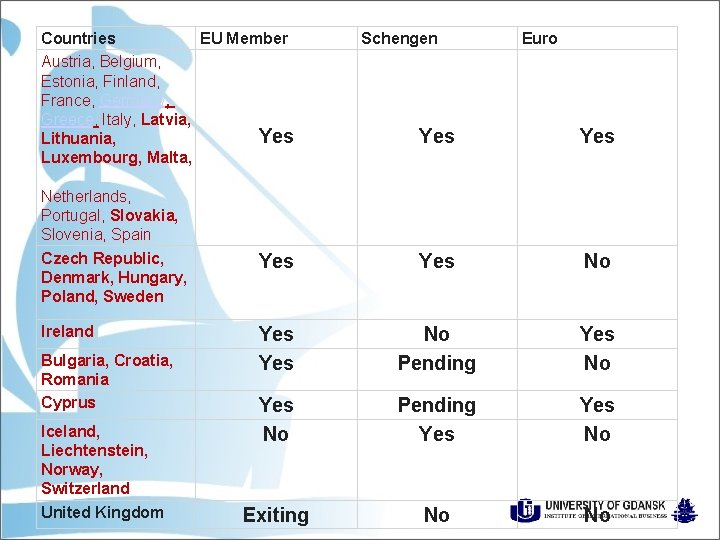
Countries EU Member Austria, Belgium, Estonia, Finland, France, Germany, Greece, Italy, Latvia, Yes Lithuania, Luxembourg, Malta, Netherlands, Portugal, Slovakia, Slovenia, Spain Czech Republic, Denmark, Hungary, Poland, Sweden Ireland Bulgaria, Croatia, Romania Cyprus Iceland, Liechtenstein, Norway, Switzerland United Kingdom Schengen Euro Yes Yes No Pending Yes No Exiting No No
PURPOSE OF THE EU? • to be more competitive in the global marketplace • at the same time, it must balance the needs of its independent fiscal and political members.

How It Is Governed? To prepare on your own
Currency • The euro – the common currency for the EU area. • It is the second most commonly held currency in the world, after the U. S. dollar. • It replaced the Italian lira, the French franc, and the German deutschmark, among others. • The value of the euro is free-floating instead of a fixed exchange rate. • As a result, foreign exchange traders determine its value each day. • The most widely-watched value is how much the euro's value is compared to the U. S. dollar. The dollar is the unofficial world currency.
The Difference Between the Eurozone and the EU • The eurozone consists of all countries that use the euro. • All EU members pledge to convert to the euro, 19 have so far: Austria, Belgium, Cyprus, Estonia, Finland, France, Germany, Greece, Ireland, Italy, Latvia, Lithuania, Luxembourg, Malta, Netherlands, Portugal, Slovakia, Slovenia, and Spain. • The eurozone was created in 2005. • The European Central Bank is the EU's central bank. • It sets monetary policy and manages bank lending rates and foreign exchange reserves. • Its target inflation rate is less than 2%.
The Schengen Area • The Schengen Area guarantees free movement to those legally residing within its boundaries. • Residents and visitors can cross borders without getting visas or showing their passports. • In total, there are 26 members of the Schengen Area. • Two EU countries, Ireland the United Kingdom, have declined the Schengen benefits. • Four non-EU countries, Iceland, Liechtenstein, Norway, and Switzerland have adopted the Schengen Agreement. • Three territories are special members of the EU and part of the Schengen Area: the Azores, Madeira, and the Canary Islands. • Three countries have open borders with the Schengen Area: Monaco, San Marino, and Vatican City.
Economy • The EU's trade structure has propelled it to become the world's secondlargest economy after China. • � In 2018, its gross domestic product was $22 trillion, while China's was $25. 3 trillion. These measurements use purchasing power parity to account for the discrepancy between each country's standard of living. • The United States was third, producing $20. 5 trillion, according to estimates by the International Monetary Fund. • But the EU's success is not evenly distributed: • Italy, Greece, and Cyprus have high levels of public and private debt, including bad bank loans • Italy also has high unemploymen • France suffers from low productivity • Germany has a large trade surplus • Many countries need reforms of their pension systems and labor markets.
News and contemporary problems facing by EU • • BREXIT IMMIGRATION CRISIS GREEK DEBT CRISIS CORONAVIRUS CRISIS!!
Exclusive competences of the EU in the following areas: • issues related to the customs union • establishing the rules of competition necessary for the functioning of the internal market • common trade policy • monetary policy in relations to member states with the Euro as the official currency • conservation of maritime biological resources under a common fisheries policy
Exclusive competences of the EU in the following areas: • entering into international agreements • coordinating economic and employment policies in EU member states
Principles regulating the functioning of the EU on the executive level: • • • principle of loyalty (solidarity) priciple of conferral principle of no discrimination principle of no restrictions principle of subsidiarity principle of proportionality
References • • A. Fornalska-Skurczyn sk, M. Grottel (co-authors), Introduction to International Trade, Gdan sk University Press 2016, ed. A. Fornalska-Skurczyn ska, M. Skurczyn ski E. Ugirashebuja, J. E. Ruhangisa, T. Ottervanger, A. Cuyvers, East African Community Law: Institutional, Substantive and Comparative EU Aspects, Chapter 9 a: The Eu Common Market: https: //www. jstor. org/stable/10. 1163/j. ctt 1 w 76 vj 2. 22? seq=1#metadata_info_tab_contents The European Union, How It Works, and Its History: https: //www. thebalance. com/what-is-the -european-union-how-it-works-and-history-3306356 Jan in ’t Veld, The economic benefits of the EU Single Market in goods and services, Journal of Policy Modeling, Volume 41, Issue 5, September–October 2019, Pages 803 -818: https: //www. sciencedirect. com/science/article/pii/S 0161893819300882
- Slides: 30