
European Territorial Scenarios and Vision 2050 ESPON ET
- Slides: 33
European Territorial Scenarios and Vision 2050 ESPON ET 2050 JUNE 2013 Dublin
ET 2050 Consortium
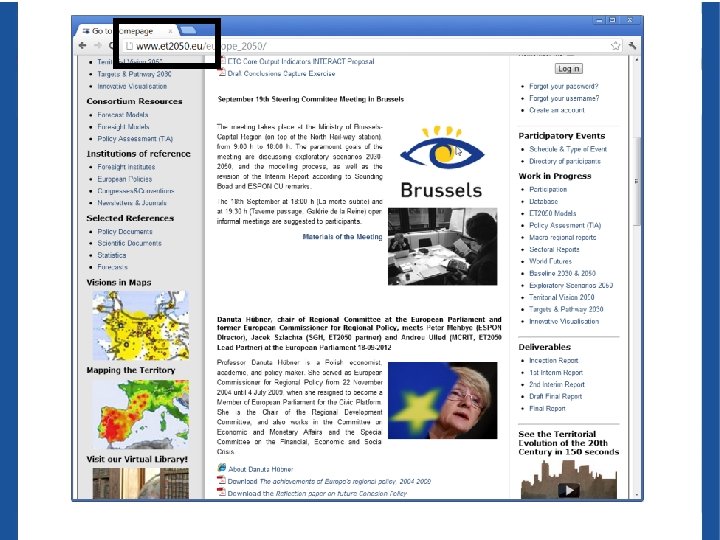
http: //www. et 2050. eu
ET 2050 Goal From Project Specifications: The ESPON Monitoring Committee, DG Regio and the ESPON Coordination Unit wish to start a territorial vision-building process that involves relevant stakeholders at European, national and regional level, having 2050 as time horizon
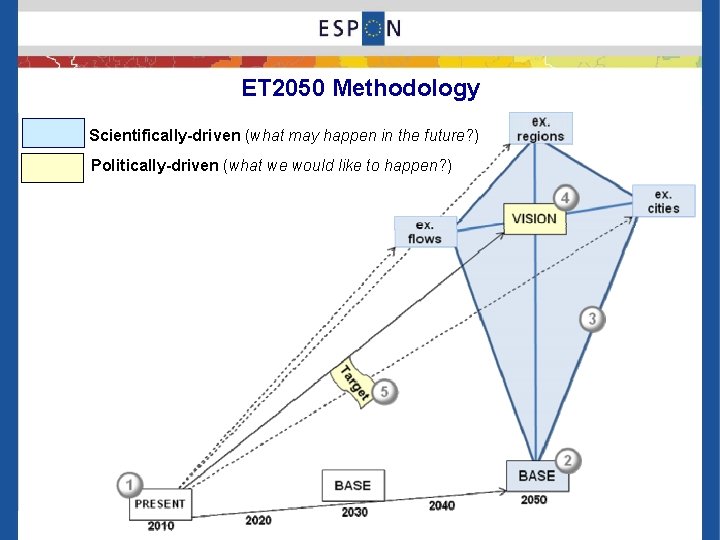
ET 2050 Methodology Scientifically-driven (what may happen in the future? ) Politically-driven (what we would like to happen? )
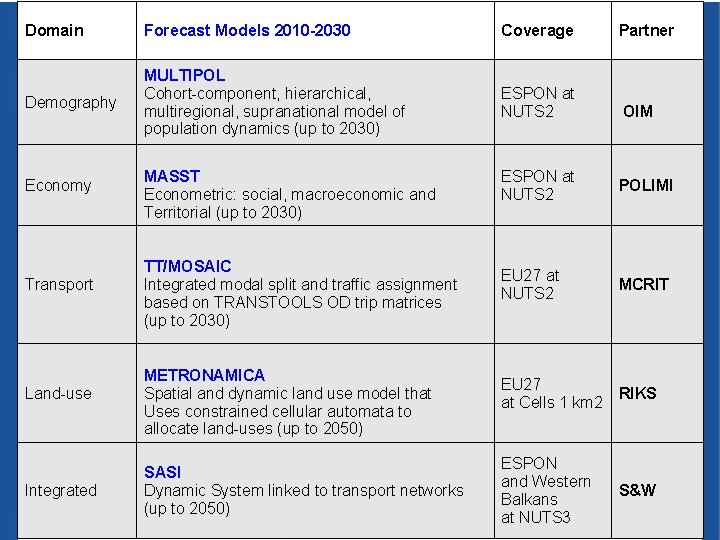
Domain Forecast Models 2010 -2030 Coverage Partner Demography MULTIPOL Cohort-component, hierarchical, multiregional, supranational model of population dynamics (up to 2030) ESPON at NUTS 2 OIM Economy Transport Land-use Integrated MASST Econometric: social, macroeconomic and Territorial (up to 2030) TT/MOSAIC Integrated modal split and traffic assignment based on TRANSTOOLS OD trip matrices (up to 2030) METRONAMICA Spatial and dynamic land use model that Uses constrained cellular automata to allocate land-uses (up to 2050) SASI Dynamic System linked to transport networks (up to 2050) ESPON at NUTS 2 POLIMI EU 27 at NUTS 2 MCRIT EU 27 at Cells 1 km 2 RIKS ESPON and Western Balkans at NUTS 3 S&W
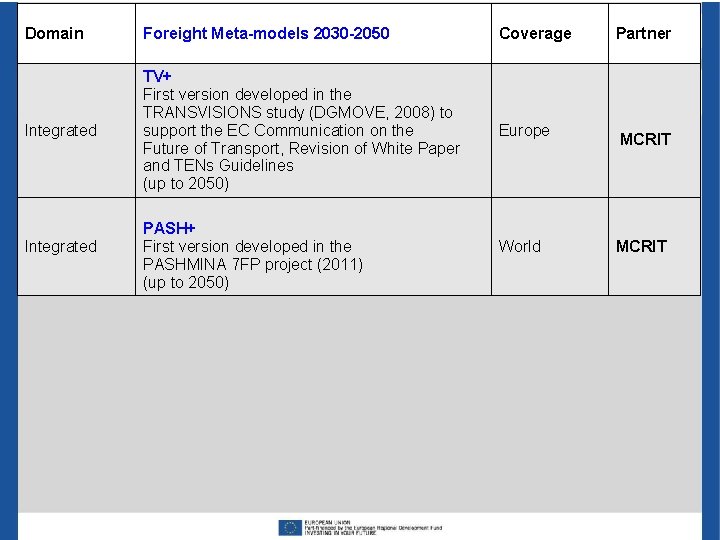
Domain Foreight Meta-models 2030 -2050 Coverage Integrated TV+ First version developed in the TRANSVISIONS study (DGMOVE, 2008) to support the EC Communication on the Future of Transport, Revision of White Paper and TENs Guidelines (up to 2050) Europe Integrated PASH+ First version developed in the PASHMINA 7 FP project (2011) (up to 2050) World Partner MCRIT
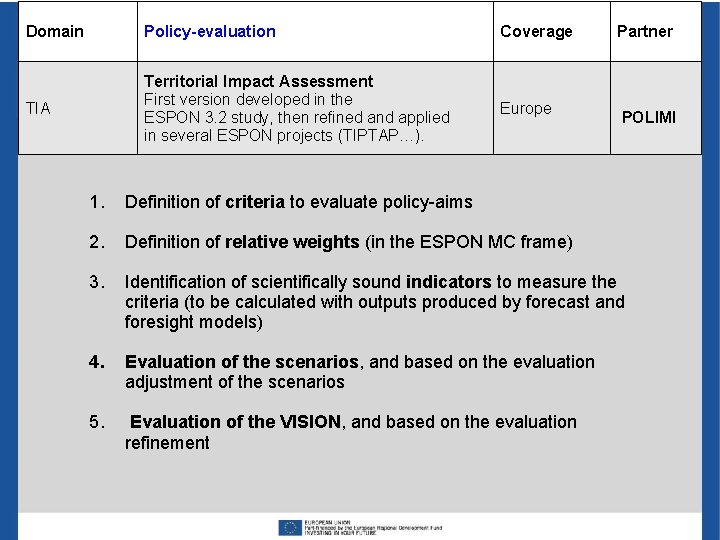
Domain Policy-evaluation Coverage TIA Territorial Impact Assessment First version developed in the ESPON 3. 2 study, then refined and applied in several ESPON projects (TIPTAP…). Europe Partner POLIMI 1. Definition of criteria to evaluate policy-aims 2. Definition of relative weights (in the ESPON MC frame) 3. Identification of scientifically sound indicators to measure the criteria (to be calculated with outputs produced by forecast and foresight models) 4. Evaluation of the scenarios, and based on the evaluation adjustment of the scenarios 5. Evaluation of the VISION, and based on the evaluation refinement
European Territorial Vision 2050 A Vision is a dream of an ideal future for European territory
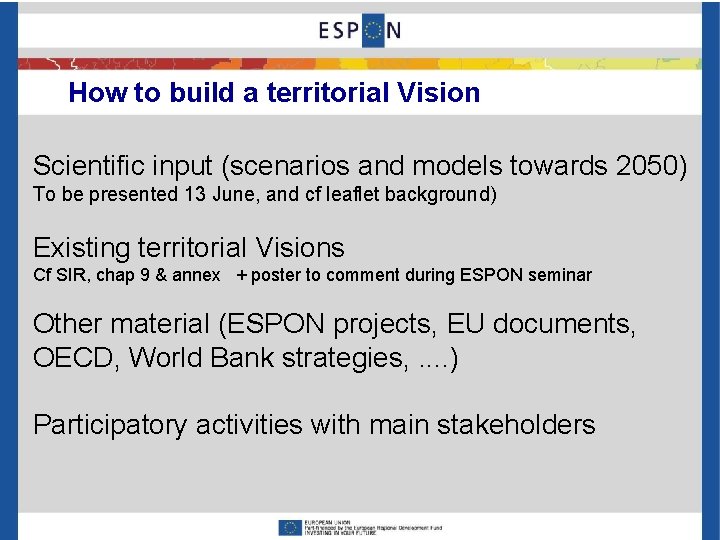
How to build a territorial Vision Scientific input (scenarios and models towards 2050) To be presented 13 June, and cf leaflet background) Existing territorial Visions Cf SIR, chap 9 & annex + poster to comment during ESPON seminar Other material (ESPON projects, EU documents, OECD, World Bank strategies, . . ) Participatory activities with main stakeholders
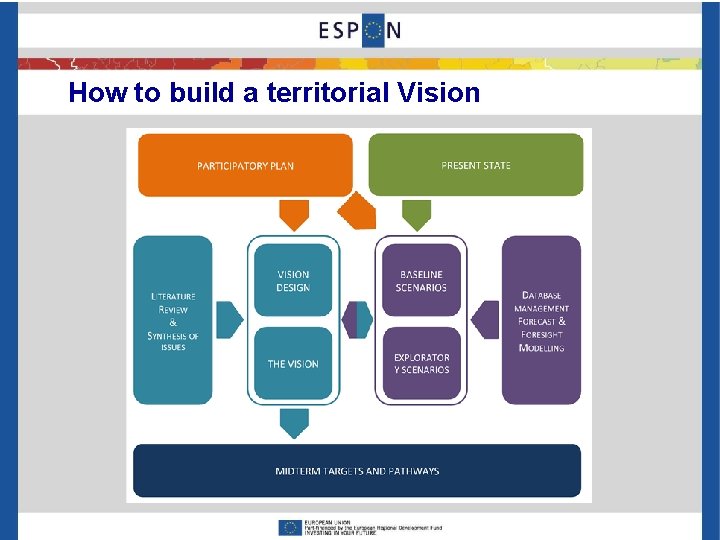
How to build a territorial Vision
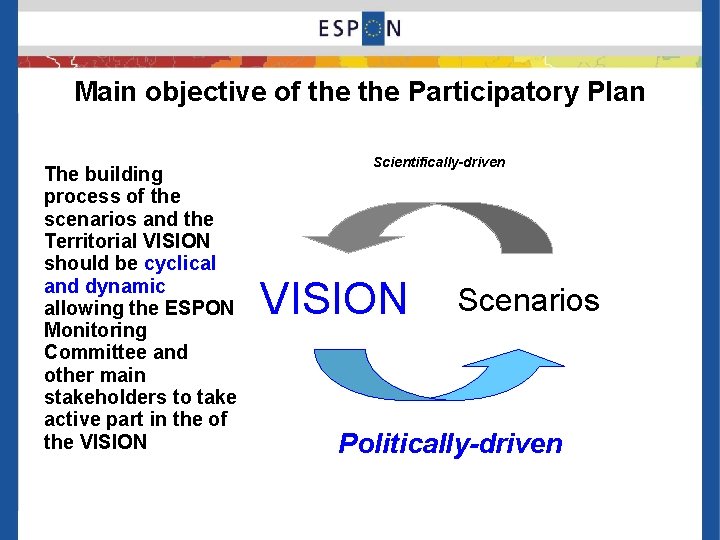
Main objective of the Participatory Plan The building process of the scenarios and the Territorial VISION should be cyclical and dynamic allowing the ESPON Monitoring Committee and other main stakeholders to take active part in the of the VISION Scientifically-driven VISION Scenarios Politically-driven
Participatory plan and activities A database: around 800 contacts , including different type of stakeholders (cf specifications); planning practitionner, European Commission, (including Sec Gen, DG CLIM, DG ECFIN and DG EMPL, as requested by the ESPON CU), Council of the EU (DG G 1 Regional Policy Team), European Parliament (REGI Commission), Committee of the Regions, ECOSOC, various other EU bodies/agencies (EEA, etc. ), public interest groups (e. g. AEBR, AER, CPMR, Eurocities, Metrex), territorial groupings (Council of the Baltic Sea States, Danube Strategy, Grande Région, Plan Bleu, INTERREG programmes, etc. ), non EU international organisations (Council of Europe, International Maritime Organisation, UNECE, UNEP, etc. ) various national planning administrations (in particular past, current and coming presidencies of the NTCCP). Group 4 includes a broad category of “scientific experts”, as well as two specific categories: ESPON project Lead Partners, and ESPON Contact Points.
Contact and consultations: Parp first phase • Spring 2012 first round consultations, +/- 50 interviews (cf FIR synthesis) • Fall 2012: second round consultations: European Commission , EESC, (cf SIR synthesis) • 2 meetings with D Huebner from REGI committe of the European Parliament, and contact with Co. R • Workshops with MC (cf FIR and SIR)
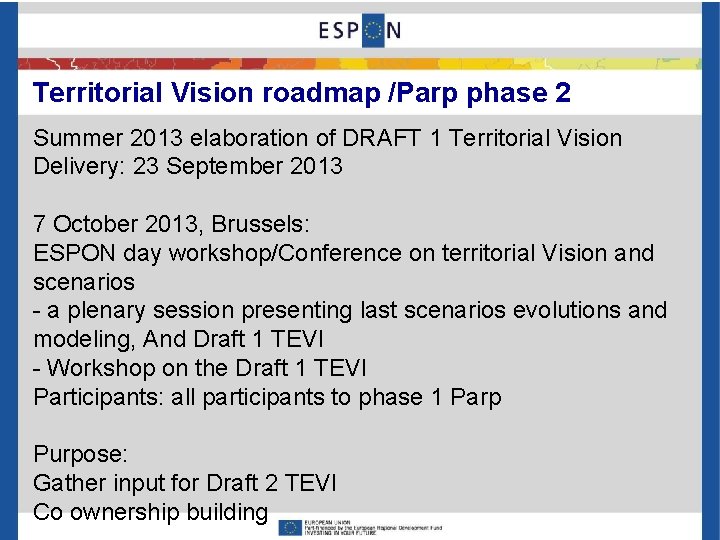
Territorial Vision roadmap /Parp phase 2 Summer 2013 elaboration of DRAFT 1 Territorial Vision Delivery: 23 September 2013 7 October 2013, Brussels: ESPON day workshop/Conference on territorial Vision and scenarios - a plenary session presenting last scenarios evolutions and modeling, And Draft 1 TEVI - Workshop on the Draft 1 TEVI Participants: all participants to phase 1 Parp Purpose: Gather input for Draft 2 TEVI Co ownership building
Territorial Vision roadmap Mid November 2013: Draft 2 TEVI December 2013: Espon seminar Lithuania MC workshop on draft 2 TEVI 28 February 2014: Draft final report, including draft 3 TEVI Spring 2014: MC workshop on Draft 3 TEVi June 2014: Final report, ESPON seminar Greece Presentation of final TEVi to MC
workshop 12 June Dublin A Vision is a dream of an ideal future for European territory Which Europe should your children and grandchildren live in?
Workshop Dublin, 12 June Two activities: Purpose: to collect your views on the desirability of key policy choices NOT about the likeliness Activity 1: ranking and selecting Anonymous individual exercise 35 minutes Activity 2: Mapping: subgroup mixed geographically 70 minutes
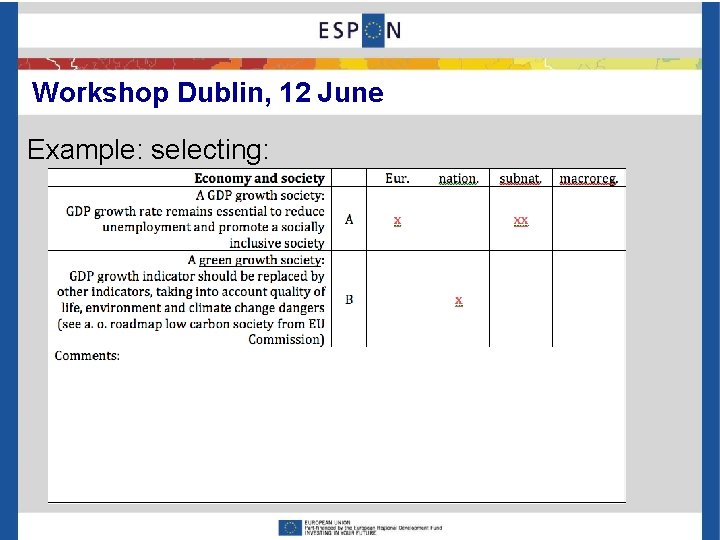
Workshop Dublin, 12 June Activity 1: individual, anonymous 11 questions 2 groups of questions 1 -6: ranking: relate to Europe as whole 7 -11: selecting: between policy choices alternatives (potentially antagonistic), A OR B , at different geographical level no A and B for the same question at the same geographical level For the same question, Possibility of A for one geographical level, and B for another
Workshop Dublin, 12 June Example: Ranking: EU Enlargement Is it desirable to enlarge the EU with new Member States (MS)? YES/Rather yes/rather not/No Comment: feel free to comment: questionnaire will be treated qualitatively, not quantitatively
Workshop Dublin, 12 June Example: selecting:
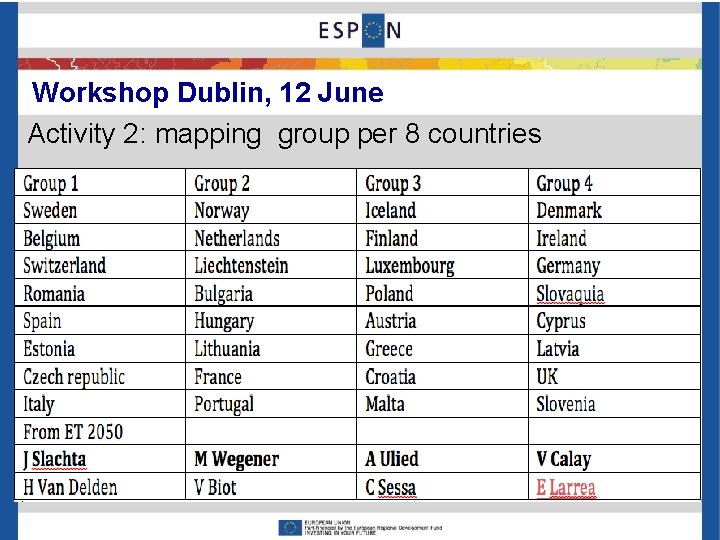
Workshop Dublin, 12 June Activity 2: mapping group per 8 countries
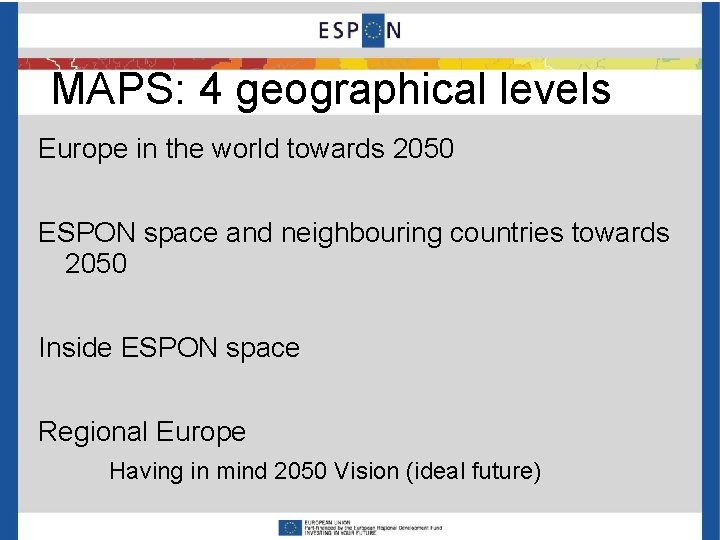
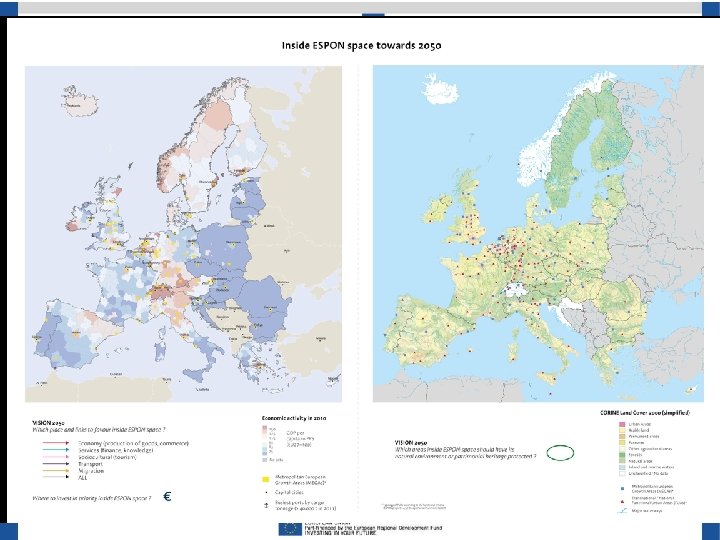
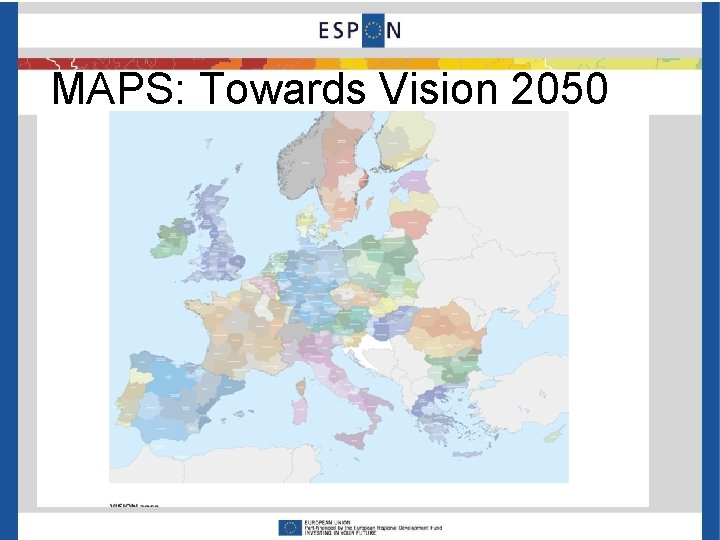
MAPS: 4 geographical levels Europe in the world towards 2050 ESPON space and neighbouring countries towards 2050 Inside ESPON space Regional Europe Having in mind 2050 Vision (ideal future)
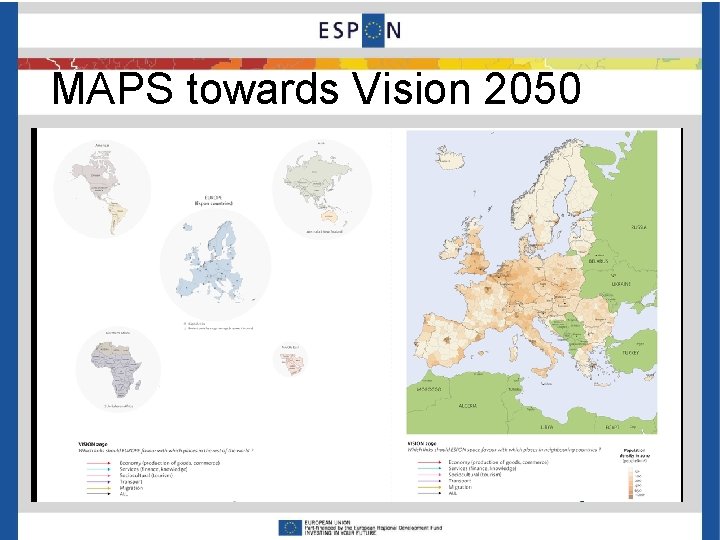
MAPS towards Vision 2050
MAPS )
MAPS: Towards Vision 2050
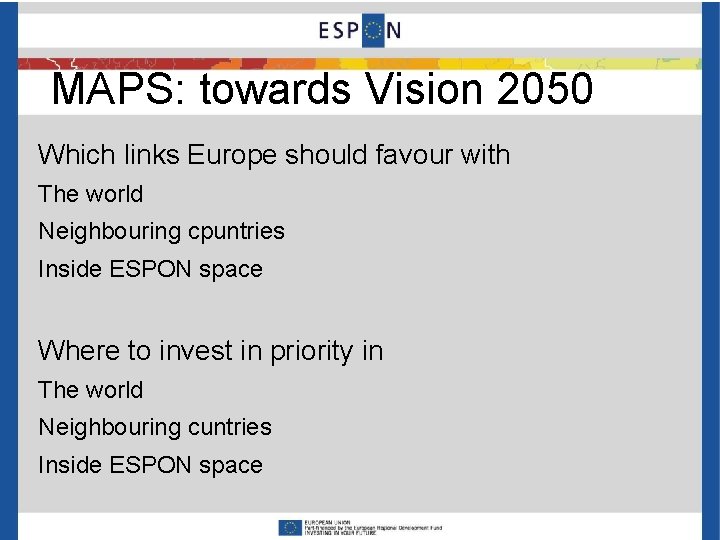
MAPS: towards Vision 2050 Which links Europe should favour with The world Neighbouring cpuntries Inside ESPON space Where to invest in priority in The world Neighbouring cuntries Inside ESPON space
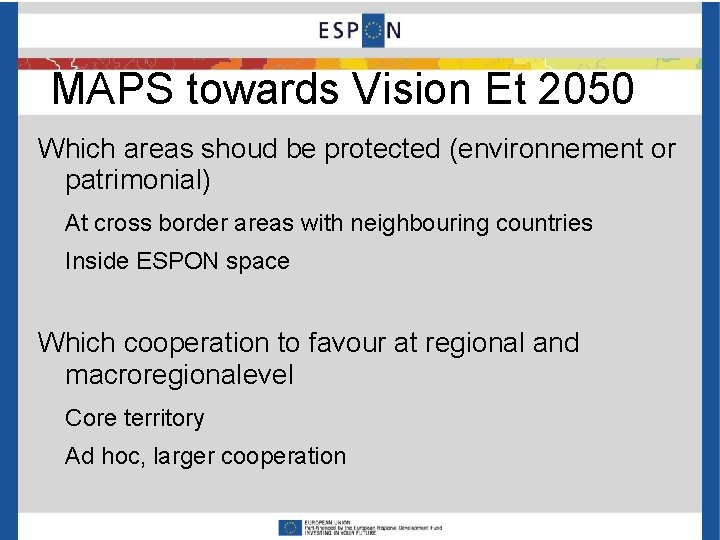
MAPS towards Vision Et 2050 Which areas shoud be protected (environnement or patrimonial) At cross border areas with neighbouring countries Inside ESPON space Which cooperation to favour at regional and macroregionalevel Core territory Ad hoc, larger cooperation
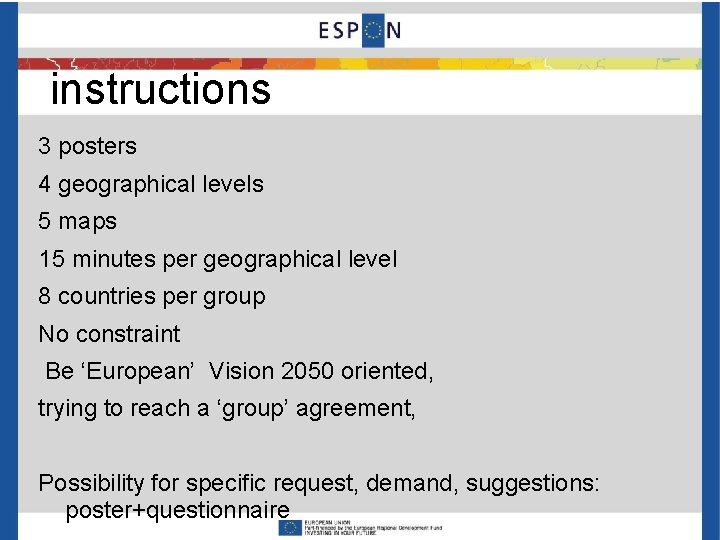
instructions 3 posters 4 geographical levels 5 maps 15 minutes per geographical level 8 countries per group No constraint Be ‘European’ Vision 2050 oriented, trying to reach a ‘group’ agreement, Possibility for specific request, demand, suggestions: poster+questionnaire
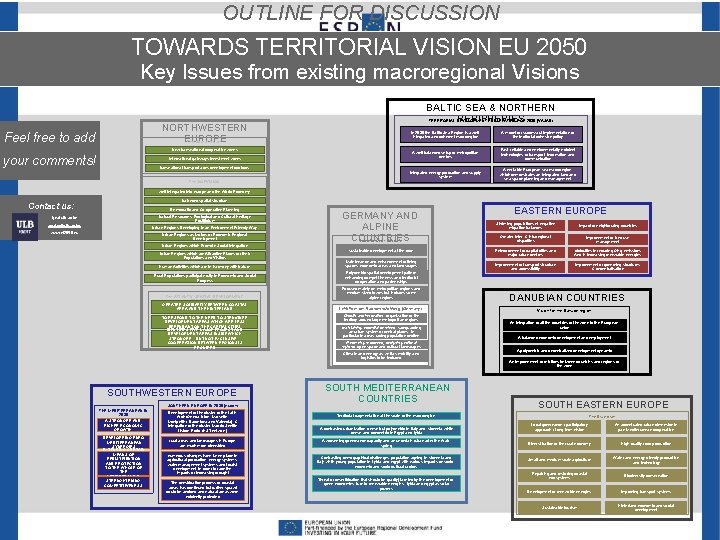
OUTLINE FOR DISCUSSION TOWARDS TERRITORIAL VISION EU 2050 Key Issues from existing macroregional Visions BALTIC SEA & NORTHERN PERIPHERIES TERRITORIAL DEVELOPMENT PERSPECTIVE FOR 2030 (VASAB) NORTHWESTERN EUROPE Feel free to add In 2030 the Baltic Sea Region is a wellintegrated and coherent macroregion A model for successful implementation of the territorial cohesion policy A well-balanced setup of metropolitan centres Fast, reliable and environmentally efficient technologies of transport, information and communication Integrated energy production and supply system A veritable European sea macroregion, which demonstrates an integrated land sea-space planning and management The Spatial Vision New transnational cooperation zones your comments! international gateways investment zones transnational transport axes development corridors The NORVISION well integrated into europe and the World Economy balanced spatial structure Contact us: Democratic and Co-operative Planning Natural Resources, Ecological and Cultural Heritage Equilibrium igeat. ulb. ac. be vcalay@ulb. ac. be Urban Regions Developing in an Environment Friendly Way www. et 2050. eu Urban Regions as Motors of Economic Regional Development Urban Regions which Promote Social Integration Urban Regions which are Attractive Places for their Populations and Visitors GERMANY AND ALPINE COUNTRIES Raumkonzept Schweiz sustainable development at the core Human Activities which are in Harmony with Nature Maintenance and enhancement of living spaces, economic areas and landscapes Rural Populations participate fully in Economic and Social Progress Polycentric spatial development pattern enhancing competitiveness and territorial cooperation and partnerships The ATLANTIC SPATIAL DEVELOPMENT PERSPECTIVE GREATER SOLIDARITY BETWEEN COASTAL AREA AND THE HINTERLAND TO RESPOND TO THE NEED TO STRUc. TURE DEVELOPMENT AREAS WHICH ARE LESS DEPENDANT ON THE CAPITAL CITIES IDENTIFIES FIVE MAJOR PROJECT AND DEVELOPMENT AREAS INSIDE WHICH STRONGER – BUT NOT EXCLUSIVE – COOPERATION BETWEEN REGIONS IS REQUIRED Focused mainly on metropolitan regions and medium sized towns but includes some alpine regions. Leitbilder Raumentwicklung (Germany) Growth and innovation: organization of the territory around large metropolitan regions Maintaining essential services: safeguarding an urban system of central places, in particular in areas facing population decline Preserving resources, designing cultural regions: open space and cultural landscapes Climate and energy as well as mobility and logistics to be included SOUTHWESTERN EUROPE SOUTHERN EUROPE IN 2030 (espon) THE MEDITERRANEAN IN 2030 A STRONGER AND RICHER ECONOMIC GROWTH DEVELOPPING EURO -MEDITERRANEAN SYNERGIES EXTENDING CERTAIN MEANS OF REDISTRIBUTION AND PROTECTION TO THE WHOLE OF THE MEDITERRANEAN STRENGHTENING COMPETITIVENESS Development of the cluster of the Latin Arch (Genoa, Nice, Marseille, Montpellier, Barcelona and Valencia) & Integration of the cluster Madrid-Seville Lisbon-Porto (HST network) rural areas and landscapes in Europe are much more diversified numerous changes have taken place in agricultural production, energy systems, water management systems and tourist development, in order to face the impacts of increasing drought The densification process of coastal areas has continued but further sprawl could be avoided and natural areas were efficiently protected SOUTH MEDITERRANEAN COUNTRIES EASTERN EUROPE Shrinking populations et negative migration balances Impact of neighbouring countries Greater inter- & intraregional disparities Improvement of land use management Reinforcement of capital cities and major urban centres difficulties in reducing GHg emissions And in increasing renewable energies Improvement of transport structure and accessibility Improvement of governing structures & decentralisation DANUBIAN COUNTRIES Vision for the Danube region An integration of all the countries of the zone to the European union A balanced economic development and employment A polycentric and decentralized development dynamic An improvement of relations between countries and regions of the zone SOUTH EASTERN EUROPE Territorial fragmentation at the scale of the macroregion A contrasted urbanization: dense but polycentric in Italy and slovenia while dense and concentric in Egypt and lybia A worsening governance capacity and an uncertain future after the Arab spring Contrasting demographical challenges: population ageing in slovenia and italy while young population in Lybia and egypt with various impacts on socioeconomic and socio-cultural factors Threat of desertification that should be (partly) tackled by the development of green economies; turn to renewable energies; lybia and egypt as solar powers The Blue plan Local governance / participatory approach / Long term vision An accentuated urban dimension in pan-Mediterranean cooperation Diversification of the rural economy High quality food production Small and medium scale agriculture Water and energy-friendly production and technology Repairing and restoring coastal ecosystems Biodiversity conservation Development of renewable energies Improving transport systems Sustainable tourism Hinterland economic and social development
“Existing Vision key issue poster (Dublin castle + questionnaire to be distributed at the end
“Too seek Europe, is to make it! Europe exists through its search for the infinit -and this is what I call adventure” Zygmunt Bauman, “An Adventure called Europe”
www. et 2050. eu IGEAT vbiot@ulb. ac. be vcalay@ulb. ac. be