
EUROPEAN SOCIETY OF CARDIOLOGY CONGRESS 2018 HighSensitive Troponin
- Slides: 25
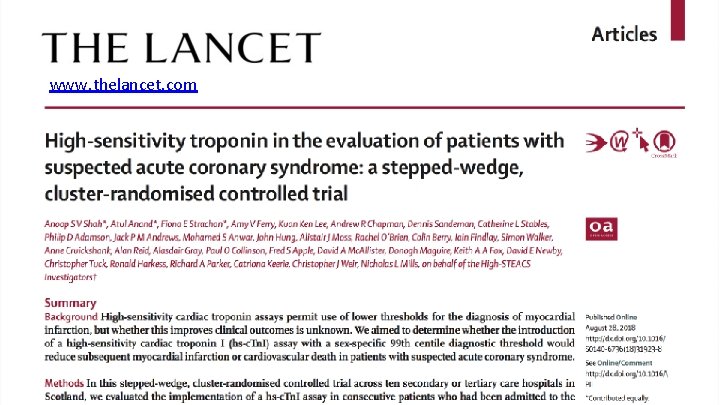
EUROPEAN SOCIETY OF CARDIOLOGY CONGRESS 2018 High-Sensitive Troponin in the Evaluation of patients with Acute Coronary Syndrome (High-STEACS): a stepped-wedge cluster-randomised controlled trial Professor Nicholas L Mills on behalf of the High-STEACS Investigators @High. STEACS #ESC 2018
Declaration of interest - Consulting/Royalties/Owner/ Stockholder of a healthcare company (I have recieved horonaria from Abbott Diagnostics, Singulex and Roche all of whom manufacture cardiac troponin assays ) -Research contracts (The High. STEACS trial is funded in full by a research charity, the British Heart Foundation, but Abbott Diagnostics provided reagent without charge to support the trial. ) ESC Congress Munich 2018 •
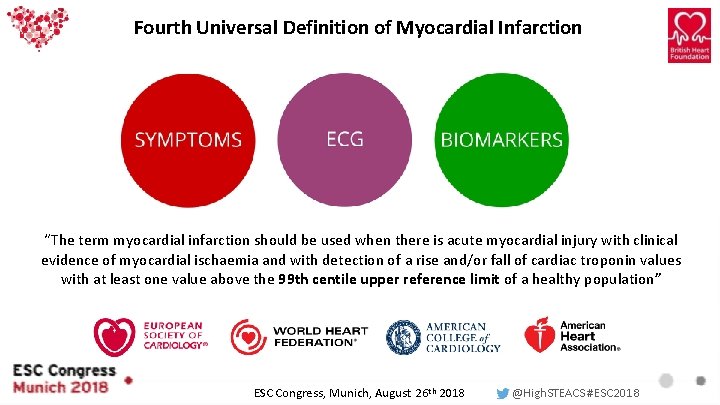
Fourth Universal Definition of Myocardial Infarction “The term myocardial infarction should be used when there is acute myocardial injury with clinical evidence of myocardial ischaemia and with detection of a rise and/or fall of cardiac troponin values with at least one value above the 99 th centile upper reference limit of a healthy population” ESC Congress, Munich, August 26 th 2018 @High. STEACS #ESC 2018
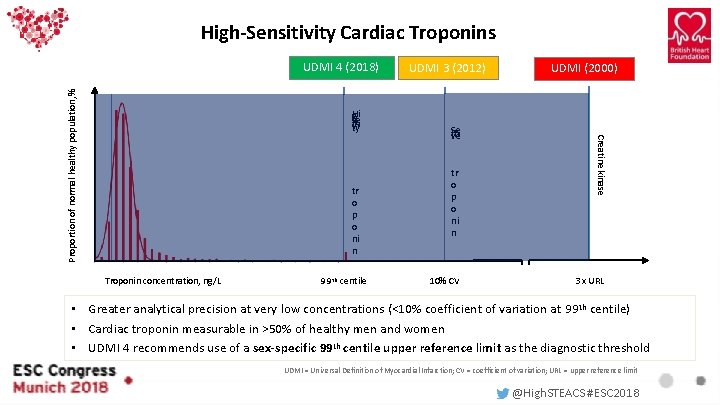
High-Sensitivity Cardiac Troponins Hi ghse ns iti vi ty tr o p o ni n Troponin concentration, ng/L 99 th centile UDMI 3 (2012) Se ns iti ve tr o p o ni n 10% CV UDMI (2000) Creatine kinase Proportion of normal healthy population, % UDMI 4 (2018) 3 x URL • Greater analytical precision at very low concentrations (<10% coefficient of variation at 99 th centile) • Cardiac troponin measurable in >50% of healthy men and women • UDMI 4 recommends use of a sex-specific 99 th centile upper reference limit as the diagnostic threshold UDMI = Universal Definition of Myocardial Infarction; CV = coefficient of variation; URL = upper reference limit @High. STEACS #ESC 2018
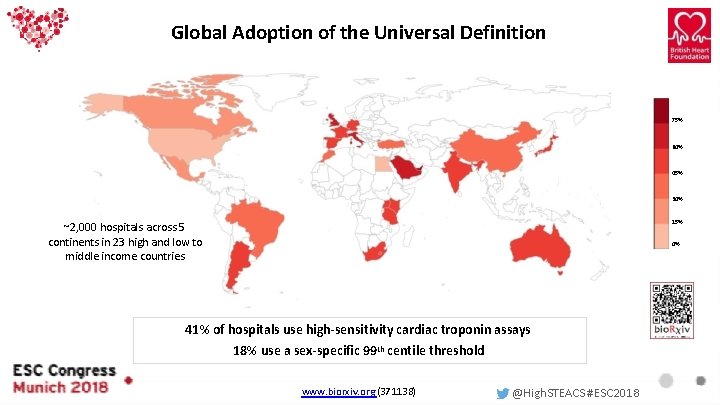
Global Adoption of the Universal Definition 75% 60% 45% 30% 15% ~2, 000 hospitals across 5 continents in 23 high and low to middle income countries 0% 41% of hospitals use high-sensitivity cardiac troponin assays 18% use a sex-specific 99 th centile threshold www. biorxiv. org (371138) @High. STEACS #ESC 2018
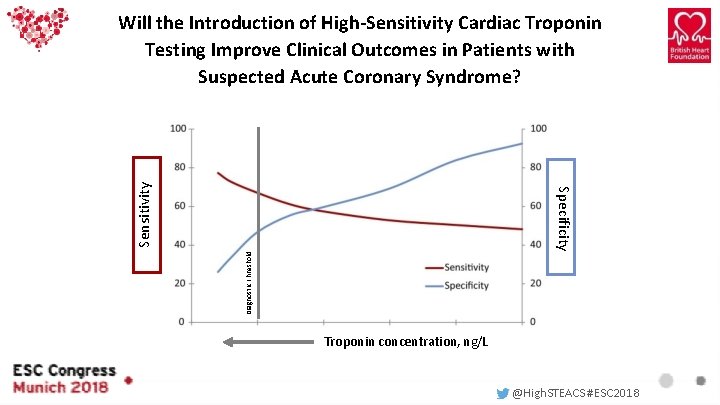
Diagnostic Threshold Specificity Sensitivity Will the Introduction of High-Sensitivity Cardiac Troponin Testing Improve Clinical Outcomes in Patients with Suspected Acute Coronary Syndrome? Troponin concentration, ng/L @High. STEACS #ESC 2018
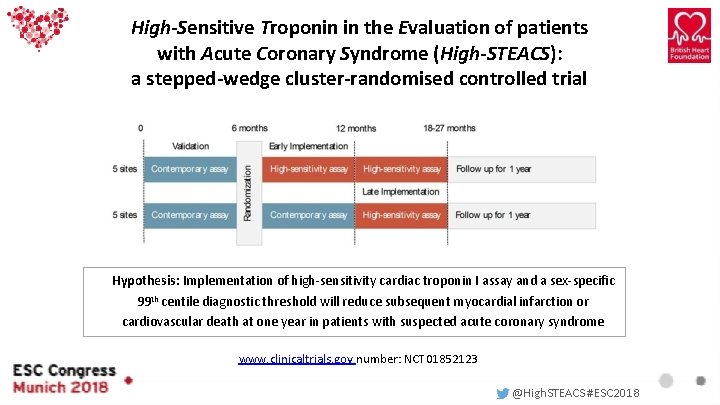
High-Sensitive Troponin in the Evaluation of patients with Acute Coronary Syndrome (High-STEACS): a stepped-wedge cluster-randomised controlled trial Hypothesis: Implementation of high-sensitivity cardiac troponin I assay and a sex-specific 99 th centile diagnostic threshold will reduce subsequent myocardial infarction or cardiovascular death at one year in patients with suspected acute coronary syndrome www. clinicaltrials. gov number: NCT 01852123 @High. STEACS #ESC 2018
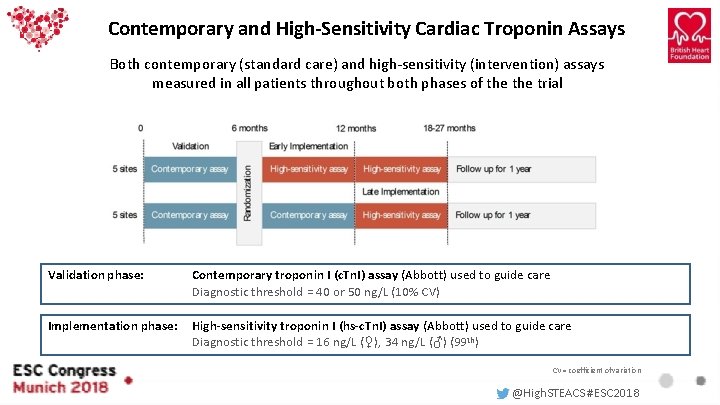
Contemporary and High-Sensitivity Cardiac Troponin Assays Both contemporary (standard care) and high-sensitivity (intervention) assays measured in all patients throughout both phases of the trial Validation phase: Contemporary troponin I (c. Tn. I) assay (Abbott) used to guide care Diagnostic threshold = 40 or 50 ng/L (10% CV) Implementation phase: High-sensitivity troponin I (hs-c. Tn. I) assay (Abbott) used to guide care Diagnostic threshold = 16 ng/L (♀), 34 ng/L (♂) (99 th) CV = coefficient of variation @High. STEACS #ESC 2018
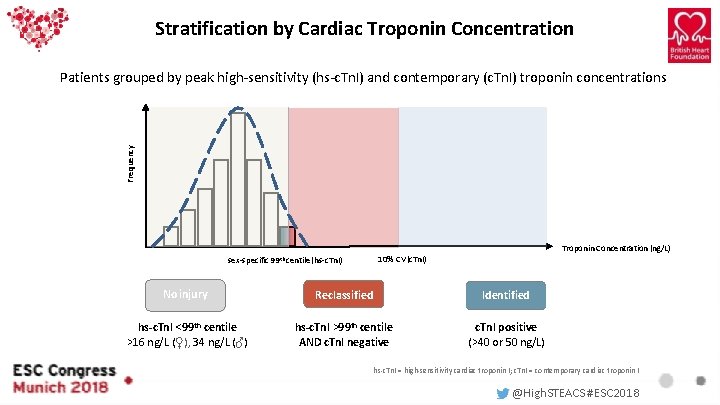
Stratification by Cardiac Troponin Concentration Frequency Patients grouped by peak high-sensitivity (hs-c. Tn. I) and contemporary (c. Tn. I) troponin concentrations Troponin Concentration (ng/L) sex-specific 99 th centile (hs-c. Tn. I) 10% CV (c. Tn. I) No injury Reclassified Identified hs-c. Tn. I <99 th centile >16 ng/L (♀), 34 ng/L (♂) hs-c. Tn. I >99 th centile AND c. Tn. I negative c. Tn. I positive (>40 or 50 ng/L) hs-c. Tn. I = high-sensitivity cardiac troponin I; c. Tn. I = contemporary cardiac troponin I @High. STEACS #ESC 2018
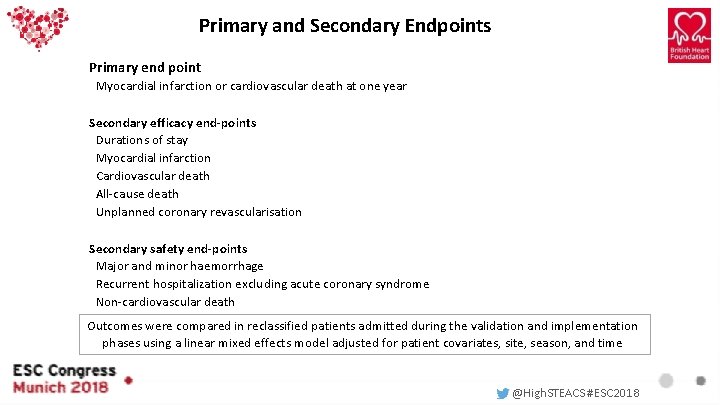
Primary and Secondary Endpoints Primary end point Myocardial infarction or cardiovascular death at one year Secondary efficacy end-points Durations of stay Myocardial infarction Cardiovascular death All-cause death Unplanned coronary revascularisation Secondary safety end-points Major and minor haemorrhage Recurrent hospitalization excluding acute coronary syndrome Non-cardiovascular death Outcomes were compared in reclassified patients admitted during the validation and implementation phases using a linear mixed effects model adjusted for patient covariates, site, season, and time @High. STEACS #ESC 2018
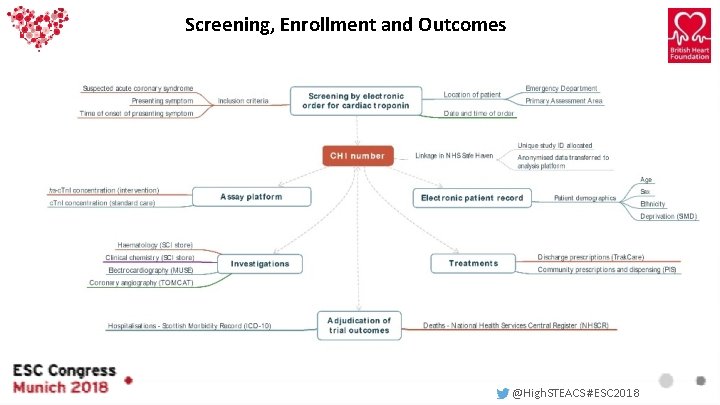
Screening, Enrollment and Outcomes @High. STEACS #ESC 2018
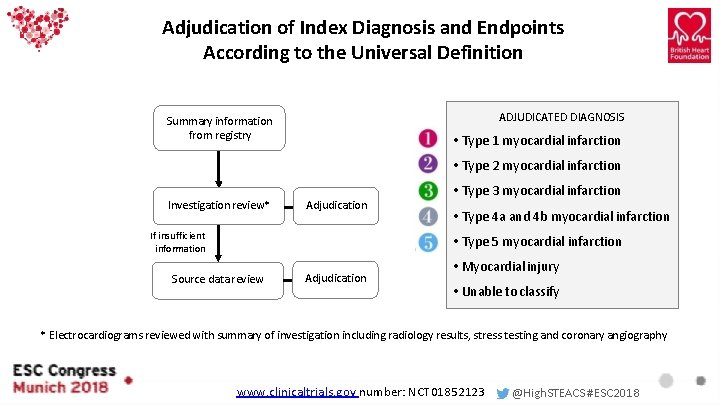
Adjudication of Index Diagnosis and Endpoints According to the Universal Definition ADJUDICATED DIAGNOSIS Summary information from registry • Type 1 myocardial infarction • Type 2 myocardial infarction Investigation review* Adjudication If insufficient information • Type 3 myocardial infarction • Type 4 a and 4 b myocardial infarction • Type 5 myocardial infarction Source data review Adjudication • Myocardial injury • Unable to classify * Electrocardiograms reviewed with summary of investigation including radiology results, stress testing and coronary angiography www. clinicaltrials. gov number: NCT 01852123 @High. STEACS #ESC 2018
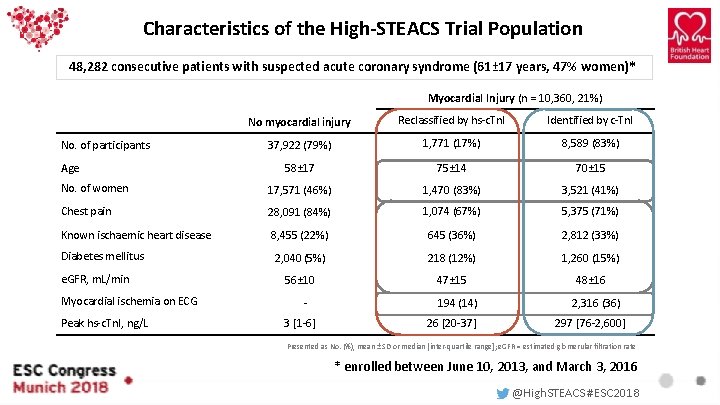
Characteristics of the High-STEACS Trial Population 48, 282 consecutive patients with suspected acute coronary syndrome (61± 17 years, 47% women)* Myocardial Injury (n = 10, 360, 21%) No myocardial injury Reclassified by hs-c. Tn. I Identified by c-Tn. I 37, 922 (79%) 1, 771 (17%) 8, 589 (83%) 58± 17 75± 14 70± 15 No. of women 17, 571 (46%) 1, 470 (83%) 3, 521 (41%) Chest pain 28, 091 (84%) 1, 074 (67%) 5, 375 (71%) Known ischaemic heart disease 8, 455 (22%) 645 (36%) 2, 812 (33%) Diabetes mellitus 2, 040 (5%) 218 (12%) 1, 260 (15%) 56± 10 47± 15 48± 16 No. of participants Age e. GFR, m. L/min Myocardial ischemia on ECG Peak hs-c. Tn. I, ng/L 3 [1 -6] 194 (14) 26 [20 -37] 2, 316 (36) 297 [76 -2, 600] Presented as No. (%), mean ± SD or median [inter-quartile range]; e. GFR = estimated glomerular filtration rate * enrolled between June 10, 2013, and March 3, 2016 @High. STEACS #ESC 2018
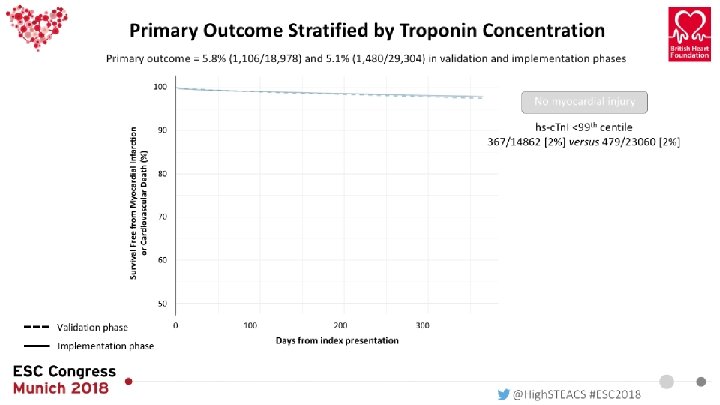
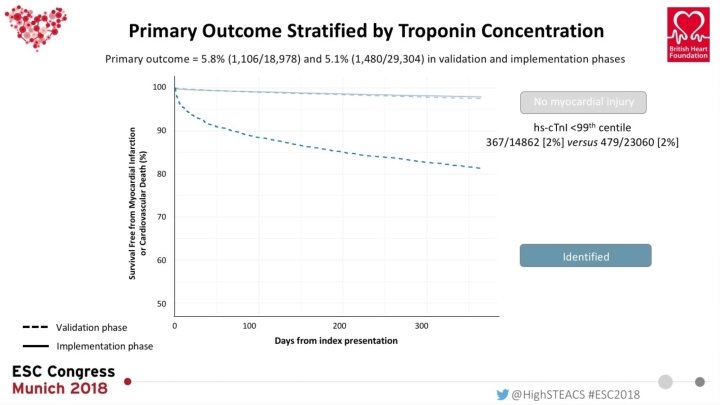
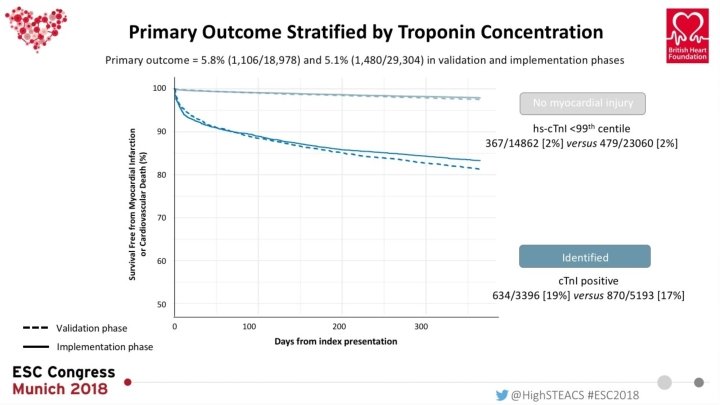
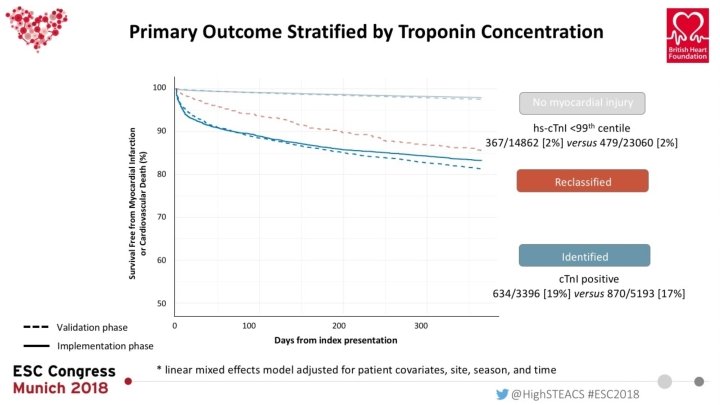
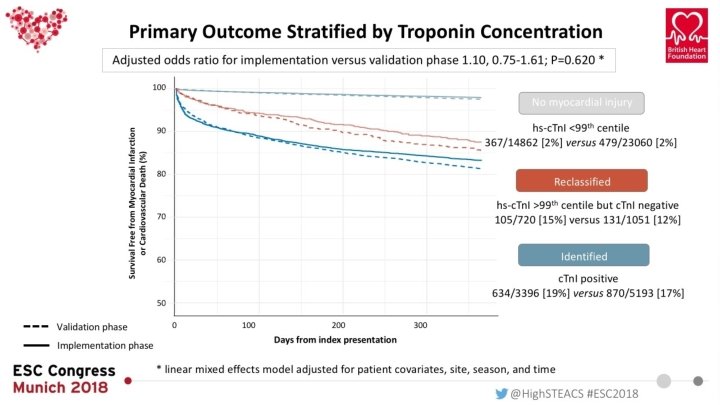
Primary Outcome Stratified by Troponin Concentration Primary outcome = 5. 8% (1, 106/18, 978) and 5. 1% (1, 480/29, 304) in validation and implementation phases Validation phase Implementation phase @High. STEACS #ESC 2018
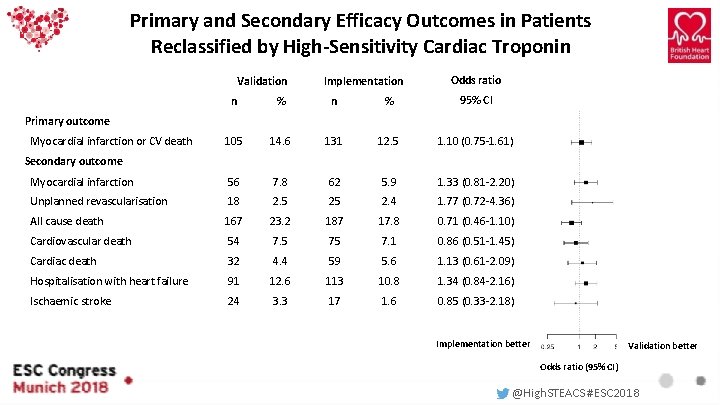
Primary and Secondary Efficacy Outcomes in Patients Reclassified by High-Sensitivity Cardiac Troponin Validation Implementation Odds ratio n % 95% CI 105 14. 6 131 12. 5 1. 10 (0. 75 -1. 61) Myocardial infarction 56 7. 8 62 5. 9 1. 33 (0. 81 -2. 20) Unplanned revascularisation 18 2. 5 25 2. 4 1. 77 (0. 72 -4. 36) All cause death 167 23. 2 187 17. 8 0. 71 (0. 46 -1. 10) Cardiovascular death 54 7. 5 75 7. 1 0. 86 (0. 51 -1. 45) Cardiac death 32 4. 4 59 5. 6 1. 13 (0. 61 -2. 09) Hospitalisation with heart failure 91 12. 6 113 10. 8 1. 34 (0. 84 -2. 16) Ischaemic stroke 24 3. 3 17 1. 6 0. 85 (0. 33 -2. 18) Primary outcome Myocardial infarction or CV death Secondary outcome Implementation better Validation better Odds ratio (95% CI) @High. STEACS #ESC 2018
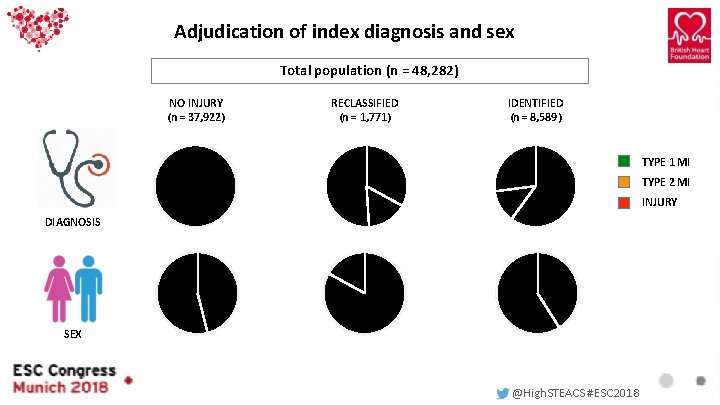
Adjudication of index diagnosis and sex Total population (n = 48, 282) NO INJURY (n = 37, 922) RECLASSIFIED (n = 1, 771) IDENTIFIED (n = 8, 589) TYPE 1 MI TYPE 2 MI INJURY DIAGNOSIS SEX @High. STEACS #ESC 2018
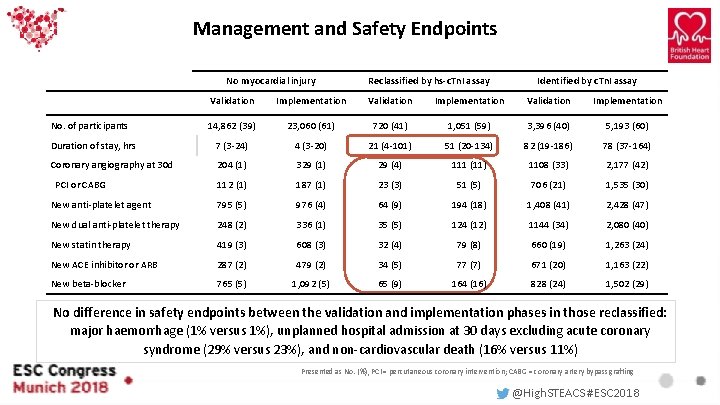
Management and Safety Endpoints No myocardial injury Reclassified by hs-c. Tn. I assay Identified by c. Tn. I assay Validation Implementation 14, 862 (39) 23, 060 (61) 720 (41) 1, 051 (59) 3, 396 (40) 5, 193 (60) Duration of stay, hrs 7 (3 -24) 4 (3 -20) 21 (4 -101) 51 (20 -134) 82 (19 -186) 78 (37 -164) Coronary angiography at 30 d 204 (1) 329 (1) 29 (4) 111 (11) 1108 (33) 2, 177 (42) 112 (1) 187 (1) 23 (3) 51 (5) 706 (21) 1, 535 (30) New anti-platelet agent 795 (5) 976 (4) 64 (9) 194 (18) 1, 408 (41) 2, 428 (47) New dual anti-platelet therapy 248 (2) 336 (1) 35 (5) 124 (12) 1144 (34) 2, 080 (40) New statin therapy 419 (3) 608 (3) 32 (4) 79 (8) 660 (19) 1, 263 (24) New ACE inhibitor or ARB 287 (2) 479 (2) 34 (5) 77 (7) 671 (20) 1, 163 (22) New beta-blocker 765 (5) 1, 092 (5) 65 (9) 164 (16) 828 (24) 1, 502 (29) No. of participants PCI or CABG No difference in safety endpoints between the validation and implementation phases in those reclassified: major haemorrhage (1% versus 1%), unplanned hospital admission at 30 days excluding acute coronary syndrome (29% versus 23%), and non-cardiovascular death (16% versus 11%) Presented as No. (%), PCI = percutaneous coronary intervention; CABG = coronary artery bypass grafting @High. STEACS #ESC 2018
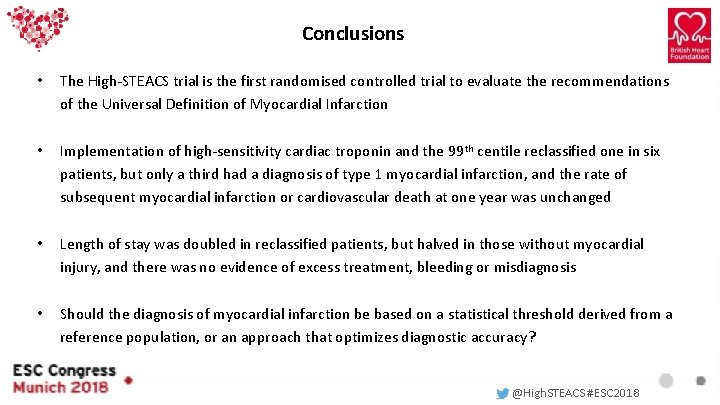
Conclusions • The High-STEACS trial is the first randomised controlled trial to evaluate the recommendations of the Universal Definition of Myocardial Infarction • Implementation of high-sensitivity cardiac troponin and the 99 th centile reclassified one in six patients, but only a third had a diagnosis of type 1 myocardial infarction, and the rate of subsequent myocardial infarction or cardiovascular death at one year was unchanged • Length of stay was doubled in reclassified patients, but halved in those without myocardial injury, and there was no evidence of excess treatment, bleeding or misdiagnosis • Should the diagnosis of myocardial infarction be based on a statistical threshold derived from a reference population, or an approach that optimizes diagnostic accuracy? @High. STEACS #ESC 2018
Acknowledgments Support British Heart Foundation Project Grants ( SP/12/10/29922 and PG/15/51/31596), BHF Butler Senior Clinical Research Fellowship ( FS/16/04/32023) Abbott Diagnostics (reagent) High-STEACS Steering Committee Edinburgh Clinical Trials Unit University of Edinburgh Professor Ian Ford (Chair) Professor Nicholas L Mills (CI) Dr Shannon Amoiles Professor Fred S Apple Professor Paul Collinson Dr Simon Walker Professor Colin Berry Professor Keith Fox Professor David Newby Professor Alasdair Gray Dr Iain Findlay Dr Anne Cruikshank Dr Donogh Maguire Dr Colin Fischbacher Professor John Norrie Professor Christopher Weir Mr Christopher Tuck (Trial Manager) Dr Catriona Keerie Mr Ronald Harkness Dr Richard Parker Dr Anoop SV Shah Dr Atul Anand Dr Fiona Strachan Ms Amy V Ferry Dr Kuan Ken Lee Dr Andrew R Chapman Dr Philip Adamson Mr Dennis Sandeman Dr Catherine L Stables Dr Jack PM Andrews Dr Mohamed S Anwar Dr John Hung Dr Alastair J Moss Ms Rachel O’Brian University of Glasgow Dr Roma Armstrong Professor Colin Berry Dr Alan Reid Dr David Mc. Allister Data Monitoring Committee Colin M Fischbacher Bernard L Croal Stephen J Leslie www. highsteacs. com @High. STEACS #ESC 2018
www. thelancet. com