
European Social Systems Assoc Prof Habil Sergiu Micoiu

European Social Systems Assoc. Prof. Habil. Sergiu Mișcoiu Babeș-Bolyai Univ. Cluj In collaboration with Prof. Patrick Mardellat IEP Lille
European Social Systems 1. Definition 2. History and Strategies 3. Types of European Social Systems Welfare States in Perspectives
1. Definition 2. History & Strategies 3. Types of ESS Welfare State: Definition The Welfare State consists of a number of programs through which governments pursue the goal of social protection against economic and social risks of life & well-being. Welfare States in Perspectives
1. Definition 2. History & Strategies 3. Types of ESS Welfare State Objectives to protect individuals and groups against economic and social risks of life and changes in society; to secure income and conditions to live a life in human dignity with fullest participation in society; to combat discrimination and inequalities; to promote social cohesion and inclusion and to avoid marginalisation; to combat poverty and extreme gaps in the distribution of wealth in society. Welfare States in Perspectives
1. Definition 2. History & Strategies 3. Types of ESS Welfare State Aims It redistributes income from the working young to the retired old, from the rich to the poor, etc. It also helps to solve many problems with risk, market failures, ethical norms, poverty and inequality, justice, etc. Welfare systems are financed on the basis of solidarity; the access for all citizens to high-quality services of general interest at reasonable prices; economic democracy through social dialogue and collective bargaining. Welfare States in Perspectives
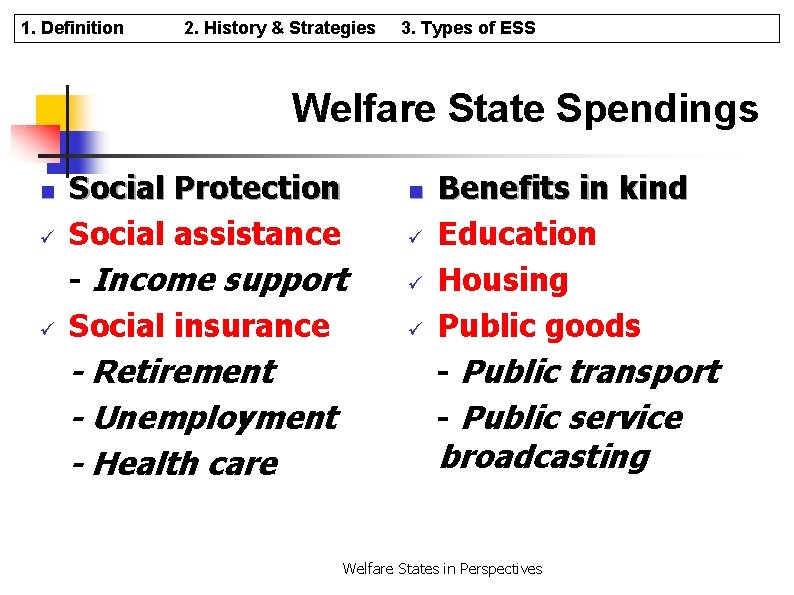
1. Definition 2. History & Strategies 3. Types of ESS Welfare State Spendings n Social Protection Social assistance - Income support Social insurance - Retirement - Unemployment - Health care n Benefits in kind Education Housing Public goods - Public transport - Public service broadcasting Welfare States in Perspectives
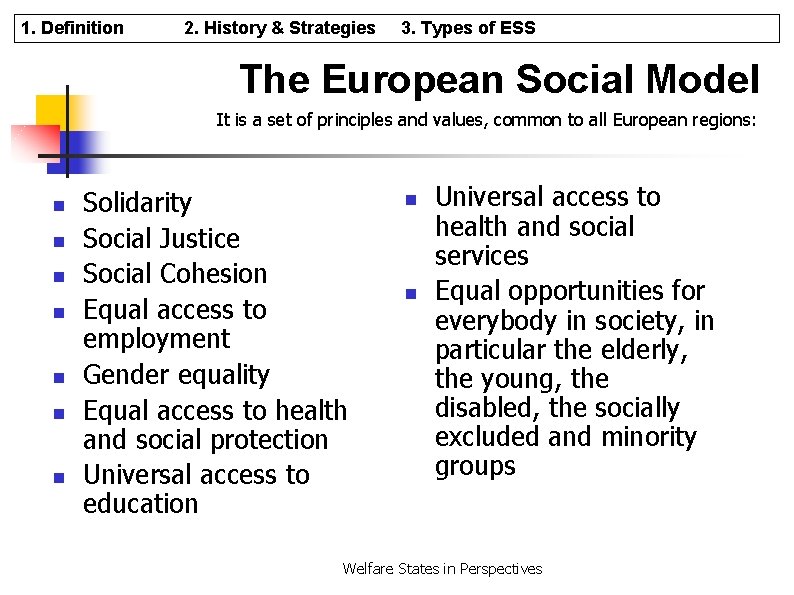
1. Definition 2. History & Strategies 3. Types of ESS The European Social Model It is a set of principles and values, common to all European regions: n n n n Solidarity Social Justice Social Cohesion Equal access to employment Gender equality Equal access to health and social protection Universal access to education n n Universal access to health and social services Equal opportunities for everybody in society, in particular the elderly, the young, the disabled, the socially excluded and minority groups Welfare States in Perspectives
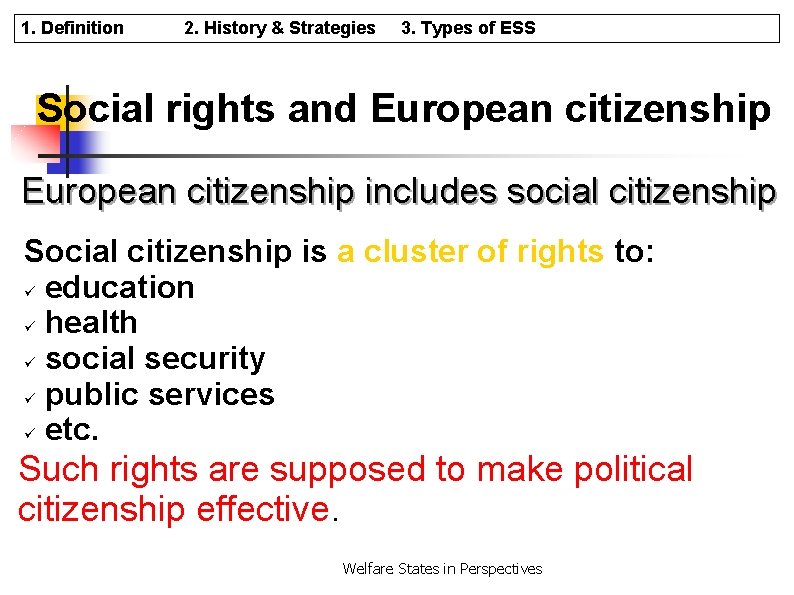
1. Definition 2. History & Strategies 3. Types of ESS Social rights and European citizenship includes social citizenship Social citizenship is a cluster of rights to: education health social security public services etc. Such rights are supposed to make political citizenship effective. Welfare States in Perspectives
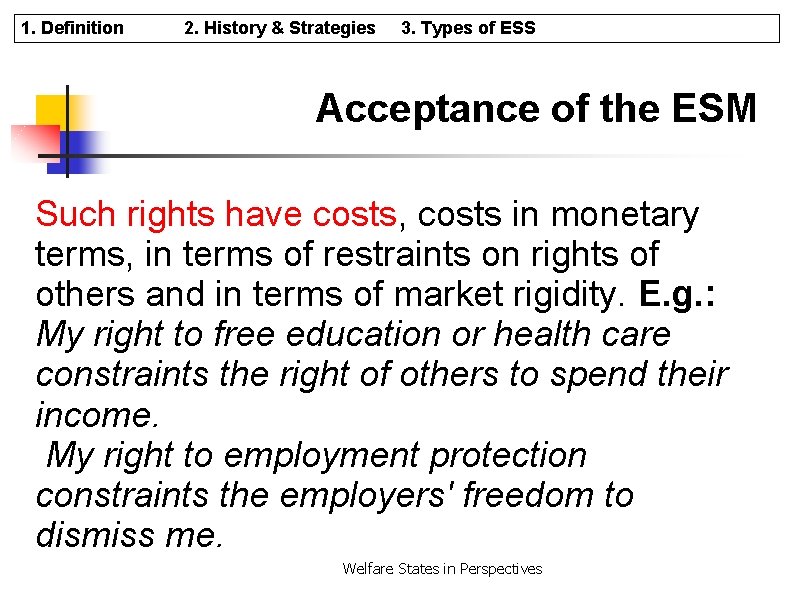
1. Definition 2. History & Strategies 3. Types of ESS Acceptance of the ESM Such rights have costs, costs in monetary terms, in terms of restraints on rights of others and in terms of market rigidity. E. g. : My right to free education or health care constraints the right of others to spend their income. My right to employment protection constraints the employers' freedom to dismiss me. Welfare States in Perspectives
1. Definition 2. History & Strategies 3. Types of ESS Acceptance of the ESM The ESM is only possible because, unlike Americans, Europeans accept the important role of the state, which means that they accept a public sphere. A public sphere is a part of society which belongs to all citizens and where things are done not for profit, but for the general good. Services are provided for the public: they are public services. Welfare States in Perspectives
1. Definition 2. History & Strategies 3. Types of ESS Acceptance of the ESM The acceptance of public services means to accept public employees. With the expansion of the Welfare state duties in the second half of the 20 th century, the number of its employees increased hugely. The counterpart of the social rights are duties: welfare rights in Europe involve the obligation to look for work. Problem is unemployment, question is: isn't unemployment caused by market rigidities? Welfare States in Perspectives
1. Definition 2. History & Strategies 3. Types of ESS Main characteristics of EU WS Relatively high level of taxes, of state activity, of redistribution & social cohesion Universal public services (health, education, housing) Comprehensive social protection: illness, old age, unemployment, maternity, etc. Extensive workers' rights and social dialogue Commitment to macroeconomic stability through monetary and fiscal policy Welfare States in Perspectives
1. Definition 2. History & Strategies 3. Types of ESS Contribution of WS to Europe ''The simplest difference between the USA and Europe is that we have welfare states, they do not'', James Wickham. The European Social Model was the success story of the post-war period. It is not expressing a sort of European essence, even if it is part of European citizenship. It has only emerged after World War II. But it now is a defining feature of Europe Welfare States in Perspectives
1. Definition 2. History & Strategies 3. Types of ESS 4. Social Expenditures Social Security Systems and the EU Europeans have high expectations in the EU, but they now become increasingly Eurosceptic Europe will exist as a social Europe, or it will not exist at all. When asked about the areas in which the EU should act, employment and social policy are frequently cited as top priority. The EU is justified if it provides for more social security, otherwise not. Welfare States in Perspectives
1. Definition 2. History & & Strategies 2. History 3. Types of ESS Historical Roots of Social Security The European Social Model as defined in the 1 st & emerged only after W W II, but its roots can be traced back to the early 16 th century. Different traditions of social security evolved in Europe from the 16 th century on, forming ideas and strategies as to how different social problems should be approached. Welfare States in Perspectives
1. Definition 2. History & & Strategies 3. Types of ESS Key References n n n Dixon, J. (1999), Social Security in Global Perspectives, Wesport, London. Esping-Andersen, G. (1990), The Three Worlds of Welfare Capitalism, Cambridge, Polity Press. Esping-Andersen, G. (1999), The Social Foundations of Post-Industrial Economies, Oxford, OUP. Ewald, F. (1986), L'Etat providence, Grasset, Paris. Ferrera, M. (1998), ''The Four Social Europe(e): between Universalism and Selectivity'' Welfare States in Perspectives
1. Definition 2. History & & Strategies 2. History 3. Types of ESS Three Social Security Traditions The Poor Law tradition The Social Insurance tradition The Welfare State tradition Welfare States in Perspectives
1. Definition 2. History & & Strategies 2. History 3. Types of ESS The Poor Law Tradition It originates from the secularization of poor relief stated in the English Poor Law Acts from 1598 and 1601 under the reign of Queen Elizabeth the 1 st. It is rooted in economic liberalism and Christian values, with respect to the principle of individual responsibility and work ethics. It distinguishes between ''deserving poor'' (=orphans, aged, disabled) and ''undeserving poor'' (=vagrants and beggars) Welfare States in Perspectives
1. Definition 2. History & & Strategies 2. History 3. Types of ESS The Social Insurance Tradition It originates in the Prussian Social Security Statutes of the 1880 s (Bismarsk), which evolved in reaction against the Poor Law tradition (criticized by the classical school: ''the poor laws may be said to create the poor which they maintain'', Malthus) It protects workers against increasing insecurtity in the course of industrialization. It is based on personal responsibility & the principle of solidarity implicit in risk pooling. Welfare States in Perspectives
1. Definition 2. History & & Strategies 2. History 3. Types of ESS The Welfare State Tradition It originates in the ideas of Lord Beveridge exposed in his reports: Social Insurance and Allied Services (1942) and Full Employment in a Free Society (1944). It is rooted in humanistic convictions that there is a common responsibility of the society as a whole for the well-being of all citizens. It is to promote social integration and progress towards an equal society with full employment by state intervention: social expenditure is seen as desirable. Welfare States in Perspectives
1. Definition 2. History & & Strategies 2. History 3. Types of ESS Three Social Security Strategies From these three social security traditions emerged three types of social security strategies in Europe that can be coined as: The Social Assistance strategy originating in the Poor law tradition The Social Insurance strategy originating in the Prussian insurance tradition The Social Allowance strategy originating in the welfare tradition Esping-Andersen 1990: 20 ff. Welfare States in Perspectives
1. Definition 2. History & & Strategies 2. History 3. Types of ESS Social Assistance Strategy The redistributive goal is to reduce poverty, that is to provide a socially acceptable minimum support. Vertical redistribution. Social assistance is targeted on individuals meeting certain criteria of neediness. Criticism: economists have argued that it can discourage labour supply because of the risk of poverty-traps and that it can increase costs of administration and surveillance. Welfare States in Perspectives
1. Definition 2. History & & Strategies 2. History 3. Types of ESS Social Insurance Strategy The redistributive goal is horizontal redistribution from workers to retired old, from childless to families with children, from healthy to the sick, etc. Benefit entitlement is dependent on and related to past contributions or earnings. The social security goal is poverty prevention. It provides a social security the market can hardly supply. Criticism: it leaves outside of the coverage the non regular full-time employees: self-employed, atypical forms of contracts, etc. Welfare States in Perspectives
1. Definition 2. History & & Strategies 2. History 3. Types of ESS Social Allowance Strategy This strategy aims at universal coverage and vertical redistribution is considered as a goal. It considers a guaranteed minimum income as a right of nationstate citizenship. Social allowances are granted according to demographic criteria such as children and age. Criticism: very expensive, today facing financial crisis; risk of inadequate levels of benefits with persistent poverty; risk of welfare-dependent underclass. Welfare States in Perspectives
1. Definition 2. History & Strategies 3. Types of ESS 3. Types ESS European Social Security Models The previously exposed strategies are idealtypes that are not to be found in the real-world. We rather find mixtures of these strategies, differing from member state to member state, according to funding, benefit levels and entitlements. These mixtures define wellfare regimes we can stylize in types of Social Models or Systems Welfare States in Perspectives
1. Definition 2. History & Strategies 3. Types of ESS 3. Types ESS Key references n n n Bertola, G. , Boeri, T. , Nicoletti, G. (Eds), (2001), Welfare and Employment in a united Europe, Cambridge, MIT Press. Esping-Andersen, G. (1990), The Three Worlds of Welfare Capitalism, Cambridge, Politiy Press. Ferrera, M. (1998), ''The Four Social Europe(e): between Universalism and Selectivity'' in Martin Rhodes and Yves Meny (Eds), The Future of European Welfare, Macmillan, London: 81 -96. Welfare States in Perspectives
1. Definition 2. History & Strategies 3. Types of ESS 3. Types ESS 4 main types of social models Scandinavian (social-democratic) Model Continental (corporatist/conservative) Model Anglo-American (liberal) Model Mediterranean (family-centered) Model Welfare States in Perspectives
1. Definition 2. History & Strategies 3. Types of ESS 3. Types ESS Scandinavian Model Based on equality, comprehensiveness, social inclusion, universality Supply of social services of high quality and affordable High employment rates, gender equality Unemployment benefits and health system financed on taxes Highly progressive taxation, low taxes for business High minimum wages, high replacement rates, generous minimum standards for pensions Cooperation between social partners Strongly dependent on homogeneity of society It is the most expensive of the four models Sweden, Denmark, Finland, (Norway) Welfare States in Perspectives
1. Definition 2. History & Strategies 3. Types of ESS 3. Types ESS Continental Model Based on the preservation of social status, tries to prevent social problems rather than solving them Income-related transfers with low minimum standards (minimum wage, pension, etc. ) Social insurance system for health, pensions, unemployment is based on contribution: levels of benefits depend on how many did individuals contribute to the system Low redistributive efforts: low wealth taxation, high taxes on labour and consumption Cooperation between social partners and coordinated wage bargaining Does not distinguish wether individuals really need social benefit: unvoluntary unemployment or voluntary unemployment? Germany, France, Belg, Netherlds, Aust. Welfare States in Perspectives
1. Definition 2. History & Strategies 3. Types of ESS 3. Types ESS Anglo-American Model Based essentially on the markets, minimal role of the State Low degree of regulation Workfare strategies instead of welfare Basic levels of social benefits, just sufficient to survive, provided to everybody who needs them Social benefits are frequently checked Public health system and publicly financed schools Does not prevent social problems, only focused on solutions Excludes poors from society, does not provide social cohesion Low social expenditure, relatively cheap United Kingdom, Ireland Welfare States in Perspectives
1. Definition 2. History & Strategies 3. Types of ESS 3. Types ESS Mediterranean Model Based on supportive family networks Low transfers Employment protection legislation is rigid High gender inequality Low participation rates for the younger and female Pension-related transfers Traits of paternalistic society remained Italy, Spain, Portugal, Greece Welfare States in Perspectives
1. Definition 2. History & Strategies 3. Types of ESS 3. Types ESS Current evolution These four types or models are slowly converging together, but there still exists four distinct social Europes. The important question is the selection of the optimal model, balanced between cost and social benefits. Welfare States in Perspectives
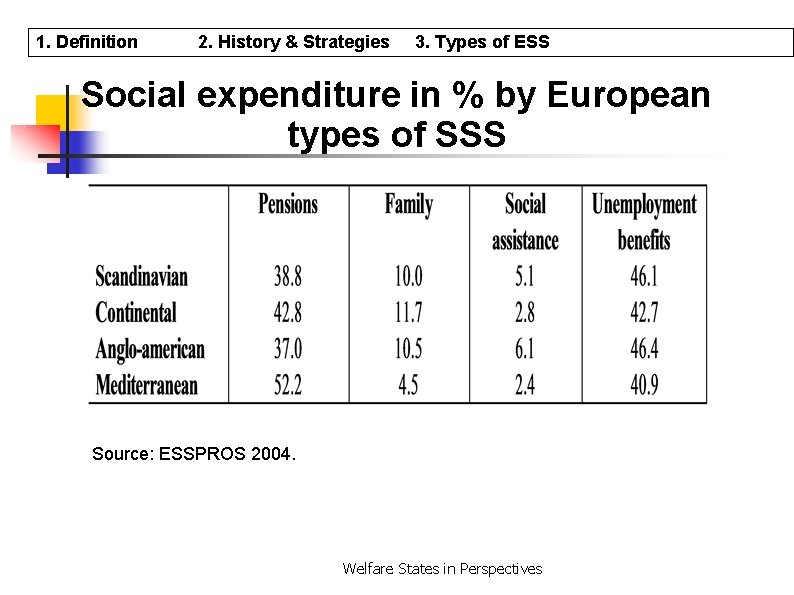
1. Definition 2. History & Strategies 3. Types of ESS Social expenditure in % by European types of SSS Source: ESSPROS 2004. Welfare States in Perspectives
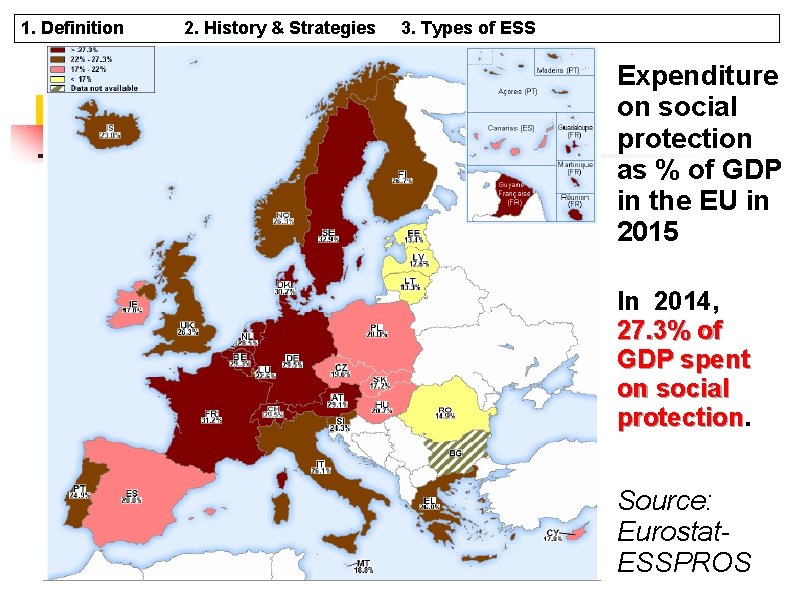
1. Definition 2. History & Strategies 3. Types of ESS Expenditure on social protection as % of GDP in the EU in 2015 In 2014, 27. 3% of GDP spent on social protection Welfare States in Perspectives Source: Eurostat. ESSPROS
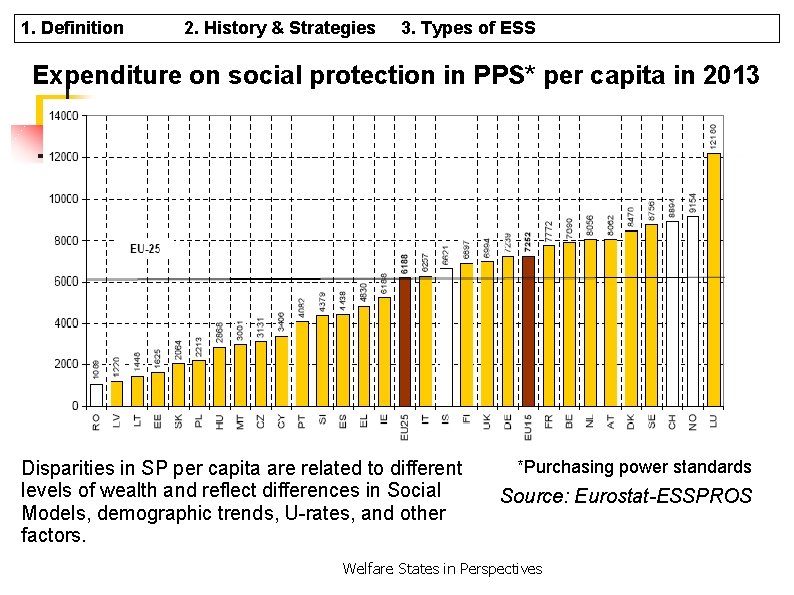
1. Definition 2. History & Strategies 3. Types of ESS Expenditure on social protection in PPS* per capita in 2013 Disparities in SP per capita are related to different levels of wealth and reflect differences in Social Models, demographic trends, U-rates, and other factors. *Purchasing power standards Source: Eurostat-ESSPROS Welfare States in Perspectives
Debate on the optimal model
- Slides: 36