
European Small Aircraft OEM Priority Objectives for CS
European Small Aircraft OEM Priority & Objectives for CS 2 Presented By A. COZZOLINO January, 23 th 2013 Bruxelles, 23 th January 2013 SAT in the CS 2
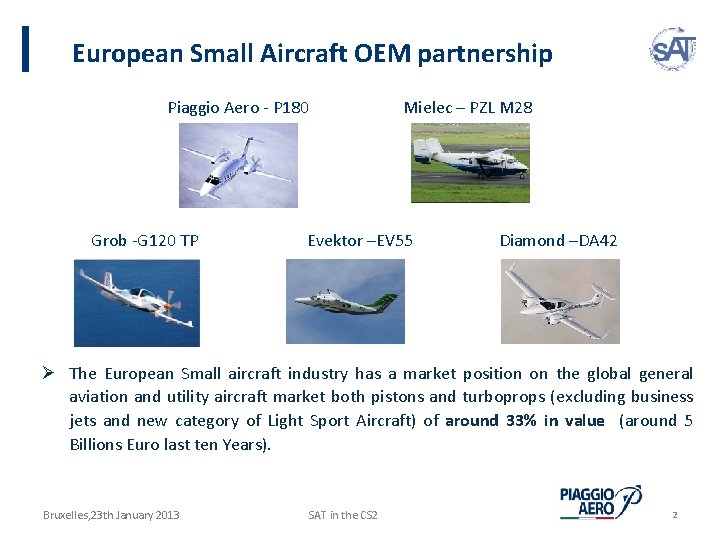
European Small Aircraft OEM partnership Piaggio Aero - P 180 Grob -G 120 TP Mielec – PZL M 28 Evektor –EV 55 Diamond –DA 42 Ø The European Small aircraft industry has a market position on the global general aviation and utility aircraft market both pistons and turboprops (excluding business jets and new category of Light Sport Aircraft) of around 33% in value (around 5 Billions Euro last ten Years). Bruxelles, 23 th January 2013 SAT in the CS 2 2
High level goals defined for small aircraft industry Ø Multimodality and passenger choice towards Flight path 2050 a. To provide accessible and affordable high speed mode of transport on European interregional network connections with low-intensity traffic b. 90% of travelers within Europe are able to complete their journey, door-to-door within 4 hours Ø Revitalization of European small aircraft industry, more competitive EU Ø More safe and more efficient small aircraft operation Ø Lower environmental impact (noise abatement, fuel efficiency, energy saving production) Bruxelles, 23 th January 2013 SAT in the CS 2 3
Small Aircraft OEM R&TD Priority (2020) ØHLO Priority Technology focus Quantitative target • Operational Cost Reduction Airframe manufacturing & maintenance cost reduction Engine acquisition & maintenance cost reduction Systems HM & More Electric 25 -30% on Total Operating Cost • Safety Improvement Systems for Pilot work load reduction 10 times fatal accident reduction • Cabin Improvement Noise, Thermal, Entertainment 80 db. A ØContributing to the ACARE Environmental Target: • Reduce CO 2 emission by 50% • Reduce NOX emission by 80% • Reduce noise perception by 50% Bruxelles, 23 th January 2013 SAT in the CS 2 4
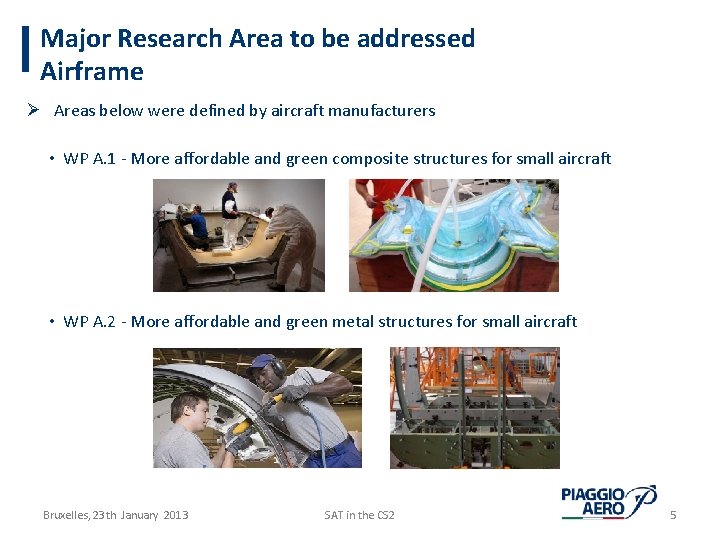
Major Research Area to be addressed Airframe Ø Areas below were defined by aircraft manufacturers • WP A. 1 - More affordable and green composite structures for small aircraft • WP A. 2 - More affordable and green metal structures for small aircraft Bruxelles, 23 th January 2013 SAT in the CS 2 5
WP A. 1 - More affordable and green composite structures for small aircraft Ø Advanced out of autoclave (OOA) technologies Ø More automation for low-volume composite production Ø Improved process stability for non-prepreg composite technologies Ø Advanced mould design and production Ø Application of hybrid (metallic/GFRP/CFRP) materials to structures Ø Application of integrated thermoplastic structural parts Ø Advanced design tool chain for OOA technologies (non handbook methods ) Bruxelles, 23 th January 2013 SAT in the CS 2 6

WP A. 1 - Airframe Integrated Structure – Composite ground demonstrator Ø Composite wing and empennage parts, hybrid float structure Ø Airframe Subassemblies demonstrating advanced production processes, production hardware (jigs/tools/moulds) and processes itself are parts of the demonstration. Decrease of DOC & IOC BY 4% Bruxelles, 23 th January 2013 SAT in the CS 2 7

WP A. 2 - More affordable and green metal structures for small aircraft Increased structure performance by means of the latest generation materials tailored for low cost application: Ø Reduction of manufacturing and assembly cost increasing the application of integral structure concept and use of automated assembly processes (i. e. the friction stir welding, integrated machined parts, alternative joining technologies) Ø New concepts of assembly jigs and tools (robotic assisted assembly in low volume production) Ø Health monitoring systems for structures maintenance reduction and failures anticipation Bruxelles, 23 th January 2013 SAT in the CS 2 8
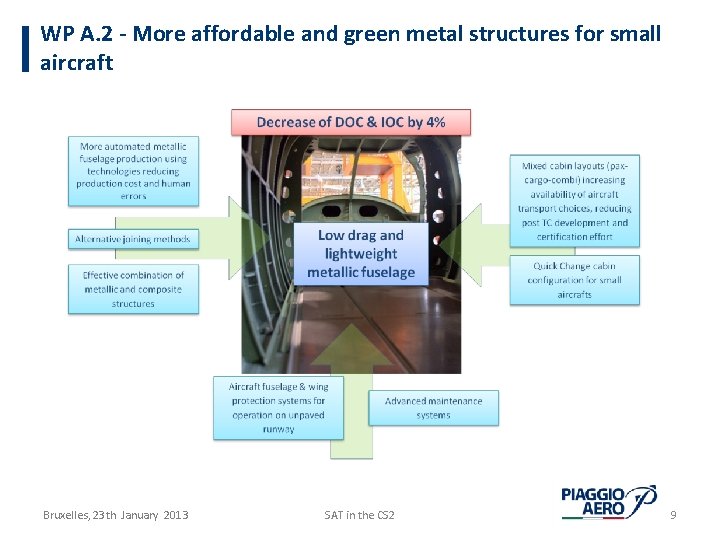
WP A. 2 - More affordable and green metal structures for small aircraft Bruxelles, 23 th January 2013 SAT in the CS 2 9
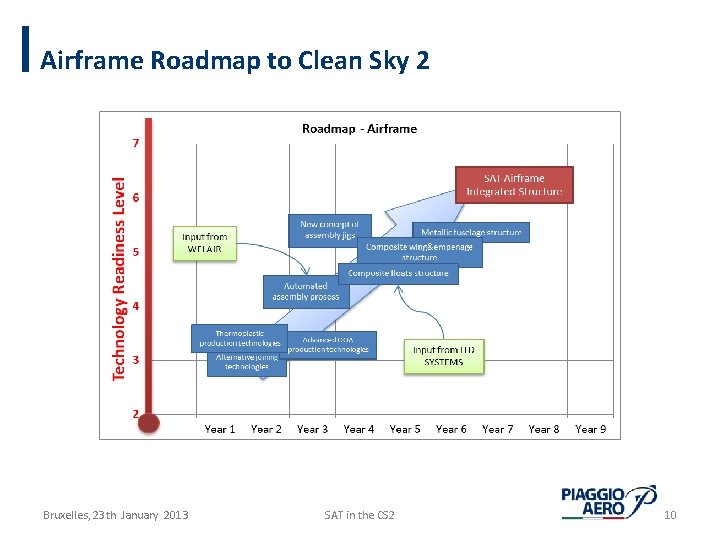
Airframe Roadmap to Clean Sky 2 Bruxelles, 23 th January 2013 SAT in the CS 2 10
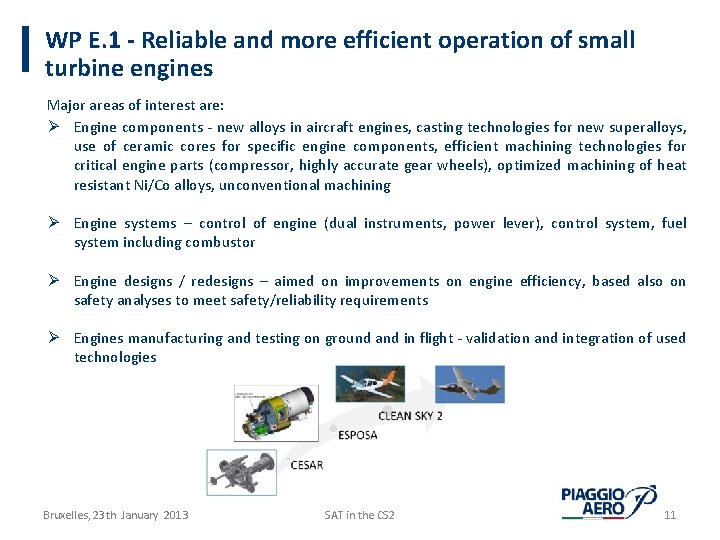
WP E. 1 - Reliable and more efficient operation of small turbine engines Major areas of interest are: Ø Engine components - new alloys in aircraft engines, casting technologies for new superalloys, use of ceramic cores for specific engine components, efficient machining technologies for critical engine parts (compressor, highly accurate gear wheels), optimized machining of heat resistant Ni/Co alloys, unconventional machining Ø Engine systems – control of engine (dual instruments, power lever), control system, fuel system including combustor Ø Engine designs / redesigns – aimed on improvements on engine efficiency, based also on safety analyses to meet safety/reliability requirements Ø Engines manufacturing and testing on ground and in flight - validation and integration of used technologies Bruxelles, 23 th January 2013 SAT in the CS 2 11
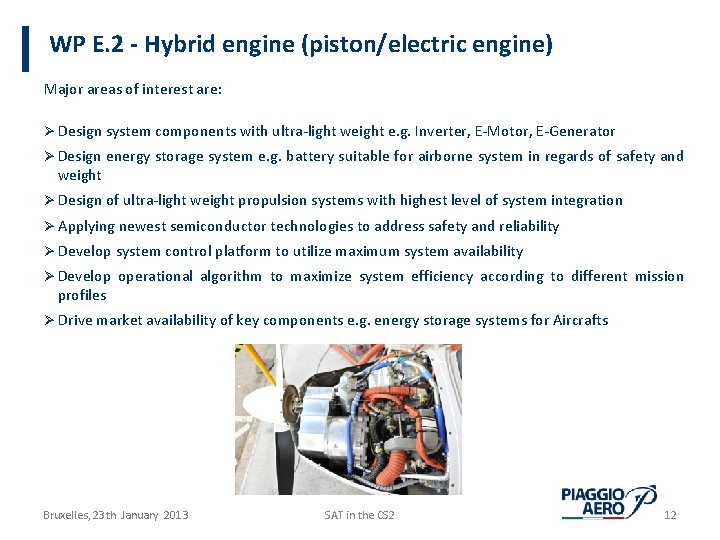
WP E. 2 - Hybrid engine (piston/electric engine) Major areas of interest are: Ø Design system components with ultra-light weight e. g. Inverter, E-Motor, E-Generator Ø Design energy storage system e. g. battery suitable for airborne system in regards of safety and weight Ø Design of ultra-light weight propulsion systems with highest level of system integration Ø Applying newest semiconductor technologies to address safety and reliability Ø Develop system control platform to utilize maximum system availability Ø Develop operational algorithm to maximize system efficiency according to different mission profiles Ø Drive market availability of key components e. g. energy storage systems for Aircrafts Bruxelles, 23 th January 2013 SAT in the CS 2 12
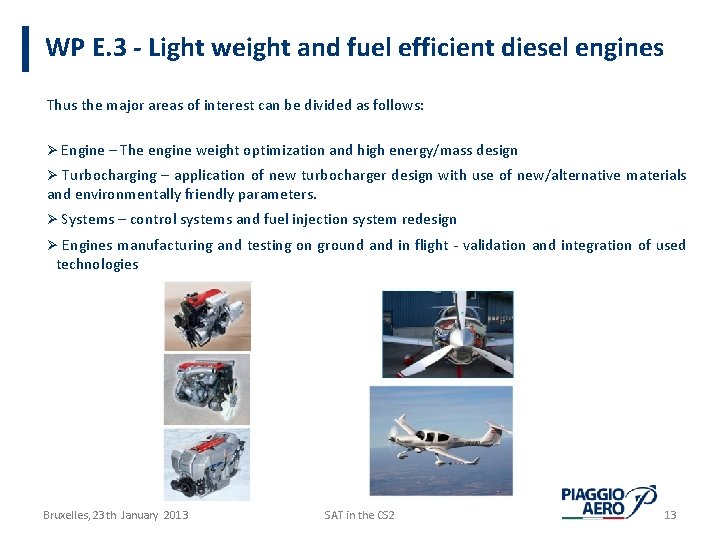
WP E. 3 - Light weight and fuel efficient diesel engines Thus the major areas of interest can be divided as follows: Ø Engine – The engine weight optimization and high energy/mass design Ø Turbocharging – application of new turbocharger design with use of new/alternative materials and environmentally friendly parameters. Ø Systems – control systems and fuel injection system redesign Ø Engines manufacturing and testing on ground and in flight - validation and integration of used technologies Bruxelles, 23 th January 2013 SAT in the CS 2 13
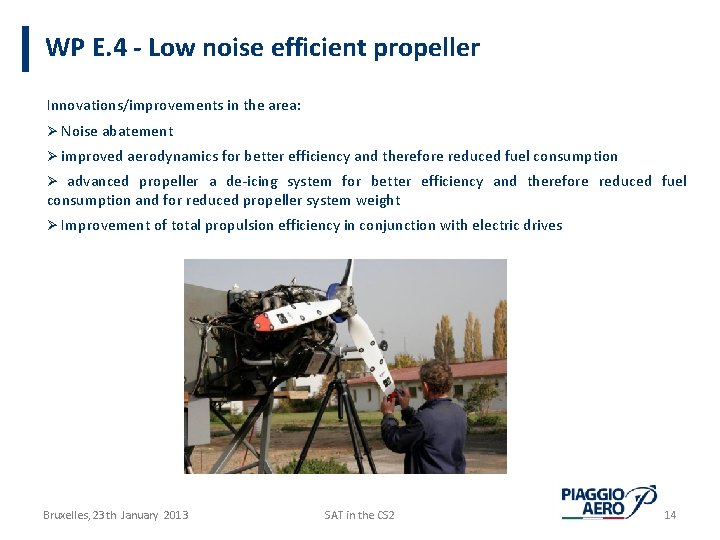
WP E. 4 - Low noise efficient propeller Innovations/improvements in the area: Ø Noise abatement Ø improved aerodynamics for better efficiency and therefore reduced fuel consumption Ø advanced propeller a de-icing system for better efficiency and therefore reduced fuel consumption and for reduced propeller system weight Ø Improvement of total propulsion efficiency in conjunction with electric drives Bruxelles, 23 th January 2013 SAT in the CS 2 14
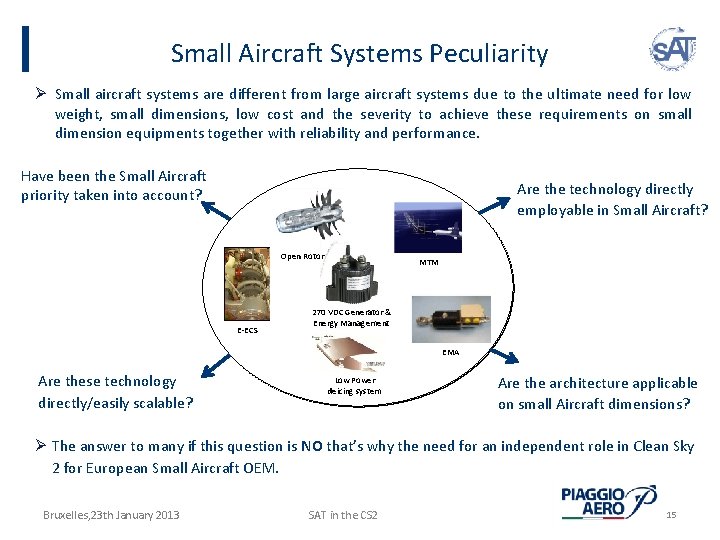
Small Aircraft Systems Peculiarity Ø Small aircraft systems are different from large aircraft systems due to the ultimate need for low weight, small dimensions, low cost and the severity to achieve these requirements on small dimension equipments together with reliability and performance. Have been the Small Aircraft priority taken into account? Are the technology directly employable in Small Aircraft? Open Rotor E-ECS MTM 270 VDC Generator & Energy Management EMA Are these technology directly/easily scalable? Low Power deicing system Are the architecture applicable on small Aircraft dimensions? Ø The answer to many if this question is NO that’s why the need for an independent role in Clean Sky 2 for European Small Aircraft OEM. Bruxelles, 23 th January 2013 SAT in the CS 2 15
Major Research Area to be addressed JTI CS 2 – ITD Systems Ø Areas below were defined by aircraft and systems manufacturers • WP S 1 - Efficient operation of small aircraft with affordable health monitoring systems • WP S 2 - More electric/electronic technologies for small aircraft • WP S 3 - Fly-by-wire architecture, modern cockpit and avionic solutions for small A/C • WP S 4 - Affordable SESAR operation, modern cockpit and avionic solutions for small A/C • WP S 5 - Comfortable and safe cabin for small aircraft Bruxelles, 12 th September 2012 SAT in the CS 2 16
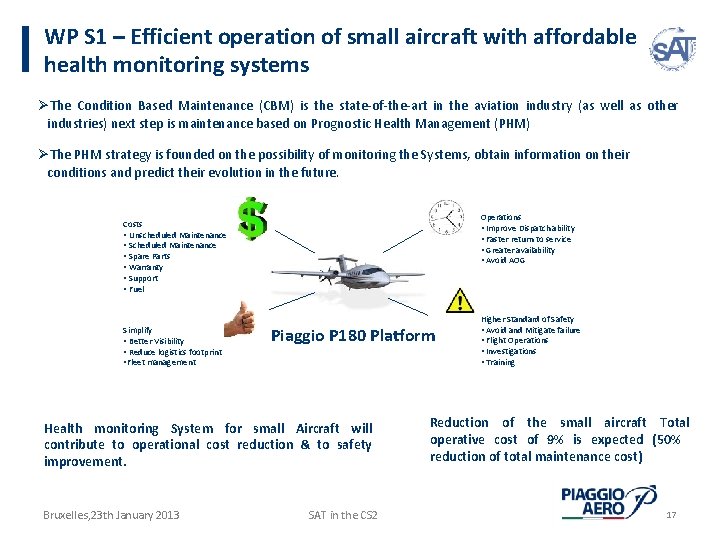
WP S 1 – Efficient operation of small aircraft with affordable health monitoring systems ØThe Condition Based Maintenance (CBM) is the state-of-the-art in the aviation industry (as well as other industries) next step is maintenance based on Prognostic Health Management (PHM) ØThe PHM strategy is founded on the possibility of monitoring the Systems, obtain information on their conditions and predict their evolution in the future. Operations • Improve Dispatch ability • Faster return to service • Greater availability • Avoid AOG Costs • Unscheduled Maintenance • Spare Parts • Warranty • Support • Fuel Simplify • Better Visibility • Reduce logistics footprint • Fleet management Piaggio P 180 Platform Health monitoring System for small Aircraft will contribute to operational cost reduction & to safety improvement. Bruxelles, 23 th January 2013 SAT in the CS 2 Higher Standard of Safety • Avoid and Mitigate failure • Flight Operations • Investigations • Training Reduction of the small aircraft Total operative cost of 9% is expected (50% reduction of total maintenance cost) 17
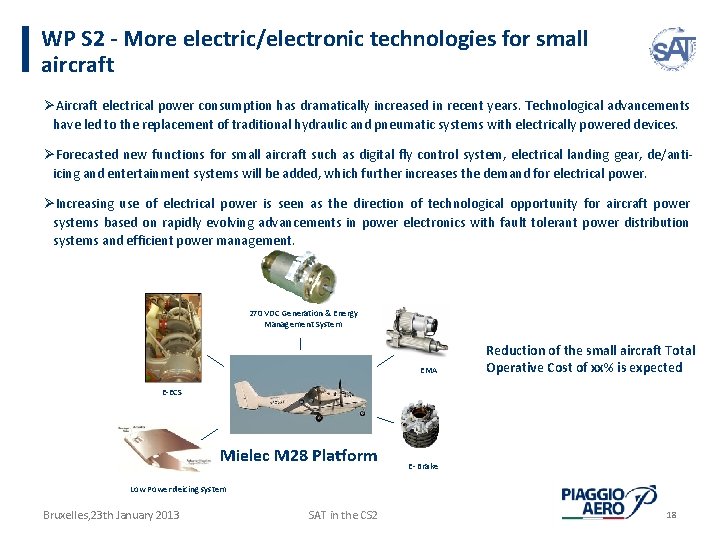
WP S 2 - More electric/electronic technologies for small aircraft ØAircraft electrical power consumption has dramatically increased in recent years. Technological advancements have led to the replacement of traditional hydraulic and pneumatic systems with electrically powered devices. ØForecasted new functions for small aircraft such as digital fly control system, electrical landing gear, de/antiicing and entertainment systems will be added, which further increases the demand for electrical power. ØIncreasing use of electrical power is seen as the direction of technological opportunity for aircraft power systems based on rapidly evolving advancements in power electronics with fault tolerant power distribution systems and efficient power management. 270 VDC Generation & Energy Management System EMA Reduction of the small aircraft Total Operative Cost of xx% is expected E-ECS Mielec M 28 Platform E- Brake Low Power deicing system Bruxelles, 23 th January 2013 SAT in the CS 2 18
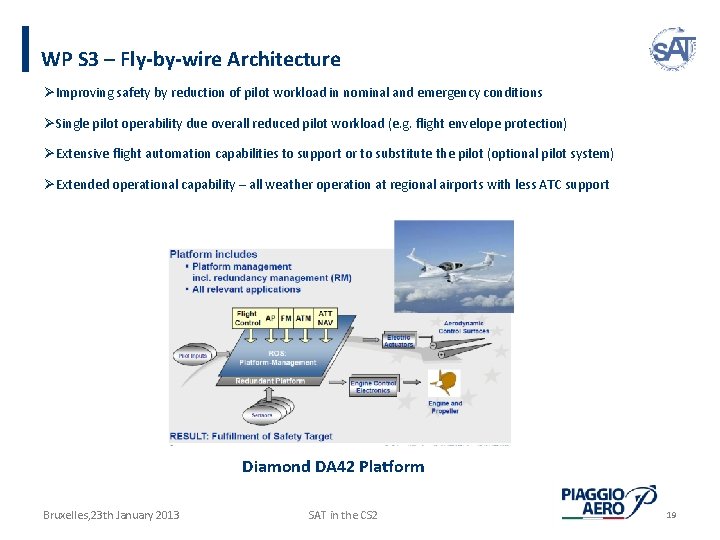
WP S 3 – Fly-by-wire Architecture ØImproving safety by reduction of pilot workload in nominal and emergency conditions ØSingle pilot operability due overall reduced pilot workload (e. g. flight envelope protection) ØExtensive flight automation capabilities to support or to substitute the pilot (optional pilot system) ØExtended operational capability – all weather operation at regional airports with less ATC support Diamond DA 42 Platform Bruxelles, 23 th January 2013 SAT in the CS 2 19
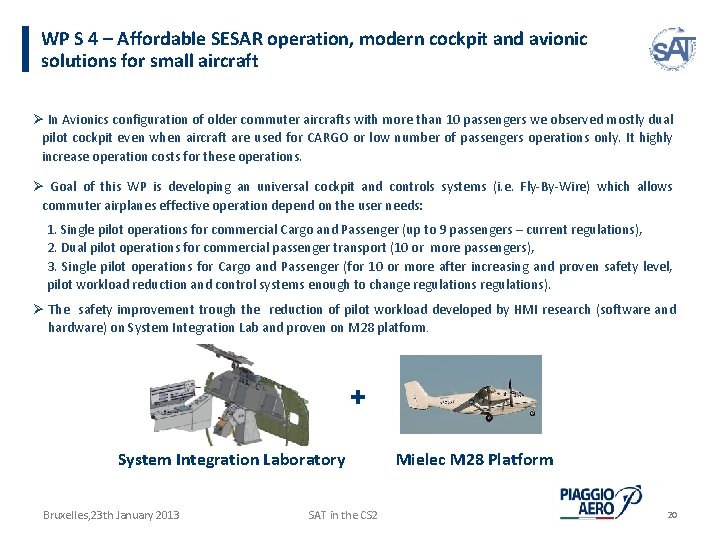
WP S 4 – Affordable SESAR operation, modern cockpit and avionic solutions for small aircraft Ø In Avionics configuration of older commuter aircrafts with more than 10 passengers we observed mostly dual pilot cockpit even when aircraft are used for CARGO or low number of passengers operations only. It highly increase operation costs for these operations. Ø Goal of this WP is developing an universal cockpit and controls systems (i. e. Fly-By-Wire) which allows commuter airplanes effective operation depend on the user needs: 1. Single pilot operations for commercial Cargo and Passenger (up to 9 passengers – current regulations), 2. Dual pilot operations for commercial passenger transport (10 or more passengers), 3. Single pilot operations for Cargo and Passenger (for 10 or more after increasing and proven safety level, pilot workload reduction and control systems enough to change regulations). Ø The safety improvement trough the reduction of pilot workload developed by HMI research (software and hardware) on System Integration Lab and proven on M 28 platform. + System Integration Laboratory Bruxelles, 23 th January 2013 SAT in the CS 2 Mielec M 28 Platform 20
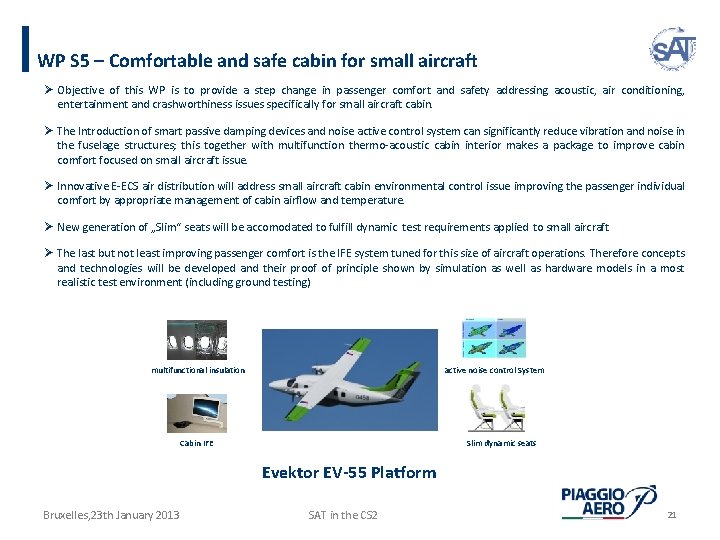
WP S 5 – Comfortable and safe cabin for small aircraft Ø Objective of this WP is to provide a step change in passenger comfort and safety addressing acoustic, air conditioning, entertainment and crashworthiness issues specifically for small aircraft cabin. Ø The Introduction of smart passive damping devices and noise active control system can significantly reduce vibration and noise in the fuselage structures; this together with multifunction thermo-acoustic cabin interior makes a package to improve cabin comfort focused on small aircraft issue. Ø Innovative E-ECS air distribution will address small aircraft cabin environmental control issue improving the passenger individual comfort by appropriate management of cabin airflow and temperature. Ø New generation of „Slim“ seats will be accomodated to fulfill dynamic test requirements applied to small aircraft Ø The last but not least improving passenger comfort is the IFE system tuned for this size of aircraft operations. Therefore concepts and technologies will be developed and their proof of principle shown by simulation as well as hardware models in a most realistic test environment (including ground testing) multifunctional insulation active noise control System Slim dynamic seats Cabin IFE Evektor EV-55 Platform Bruxelles, 23 th January 2013 SAT in the CS 2 21
- Slides: 21