
European Seventh Framework Programme FP 7 Samantha Mc
- Slides: 18
European Seventh Framework Programme (FP 7) Samantha Mc. Gregor NCP for FP 7 SSH (Theme 8) Stephanie Remola NCP for FP 7 SIS
What is FP 7? • 7 th Framework Programme for Research and Technological Development • 2007 – 2013 • Budget of over € 50 billion • Two main strategic objectives: • to strengthen the scientific and technological base of European industry; • to encourage international competitiveness while promoting research that supports EU policies.
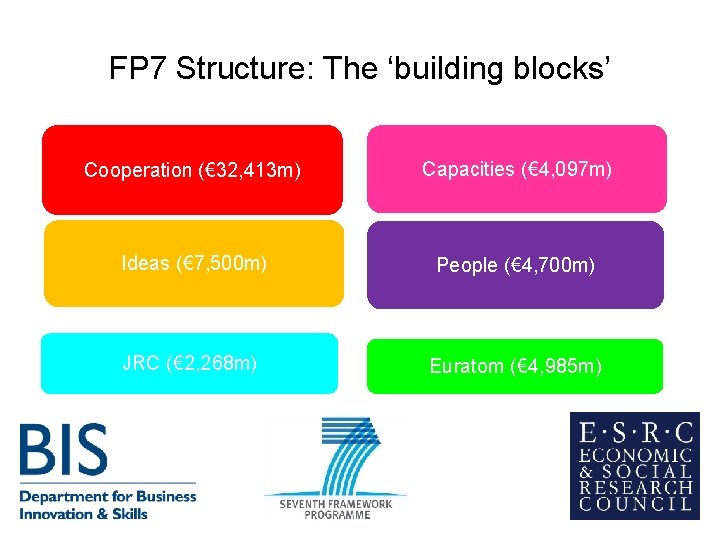
FP 7 Structure: The ‘building blocks’ Cooperation (€ 32, 413 m) Capacities (€ 4, 097 m) Ideas (€ 7, 500 m) People (€ 4, 700 m) JRC (€ 2, 268 m) Euratom (€ 4, 985 m)
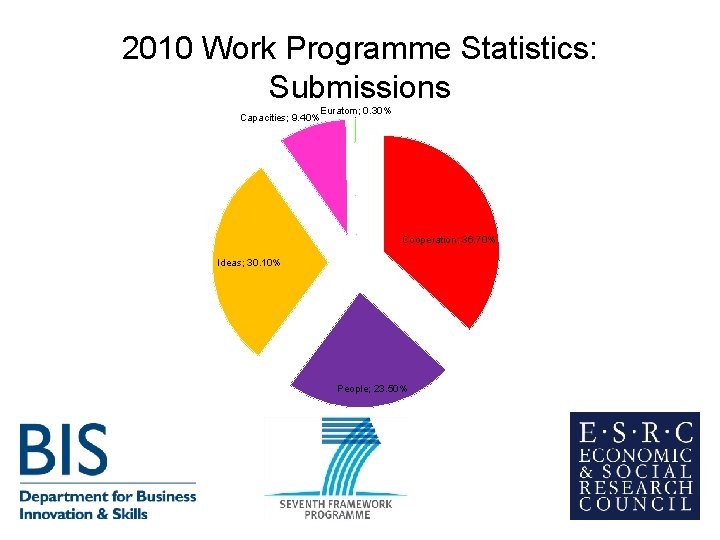
2010 Work Programme Statistics: Submissions Euratom; 0. 30% Capacities; 9. 40% Cooperation; 36. 70% Ideas; 30. 10% People; 23. 50%
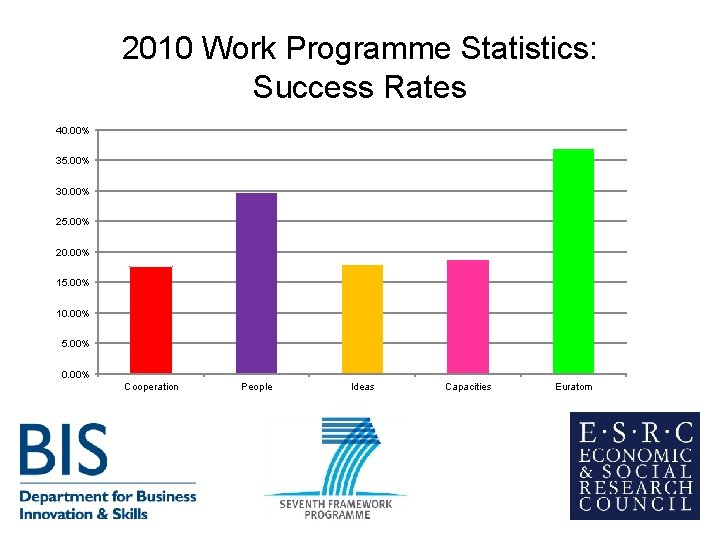
2010 Work Programme Statistics: Success Rates 40. 00% 35. 00% 30. 00% 25. 00% 20. 00% 15. 00% 10. 00% 5. 00% 0. 00% Cooperation People Ideas Capacities Euratom
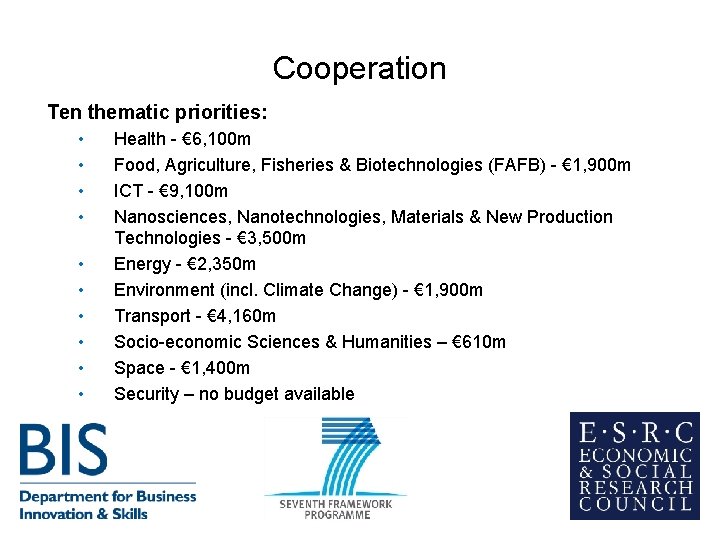
Cooperation Ten thematic priorities: • • • Health - € 6, 100 m Food, Agriculture, Fisheries & Biotechnologies (FAFB) - € 1, 900 m ICT - € 9, 100 m Nanosciences, Nanotechnologies, Materials & New Production Technologies - € 3, 500 m Energy - € 2, 350 m Environment (incl. Climate Change) - € 1, 900 m Transport - € 4, 160 m Socio-economic Sciences & Humanities – € 610 m Space - € 1, 400 m Security – no budget available
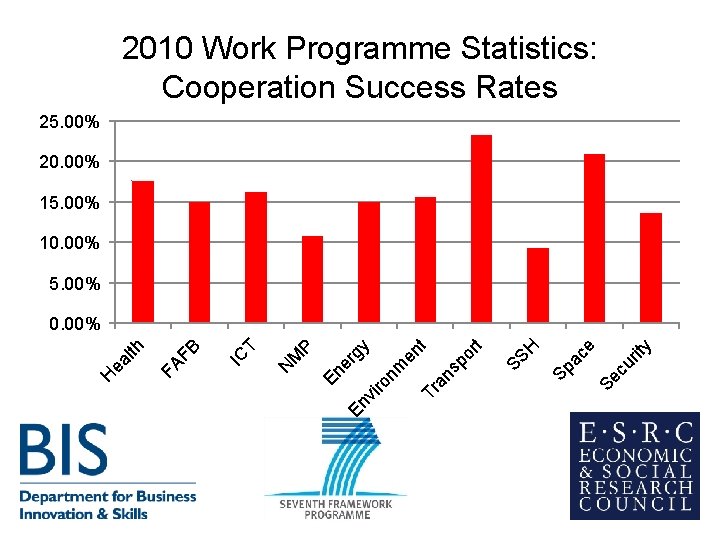
2010 Work Programme Statistics: Cooperation Success Rates 25. 00% 20. 00% 15. 00% 10. 00% 5. 00% y Se cu rit ce Sp a SS H er En gy vi ro nm en t Tr an sp or t En P M N T IC FB FA H ea lth 0. 00%
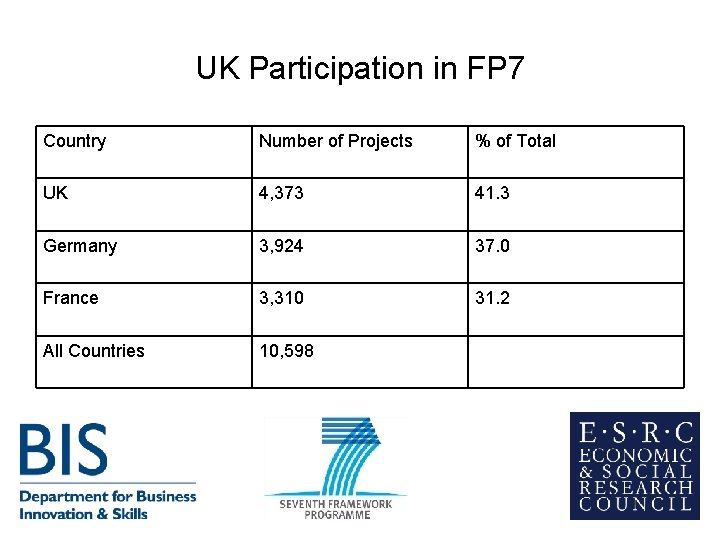
UK Participation in FP 7 Country Number of Projects % of Total UK 4, 373 41. 3 Germany 3, 924 37. 0 France 3, 310 31. 2 All Countries 10, 598
FP 7 Finance: Key Principles • Co-financing: reimbursement of direct, indirect and third-party costs (%/lump sums/flat rates) • No profit • No commercial activities • Different project types/funding schemes • EC principle of eligible and non-eligible costs • Use your institution’s accounting processes
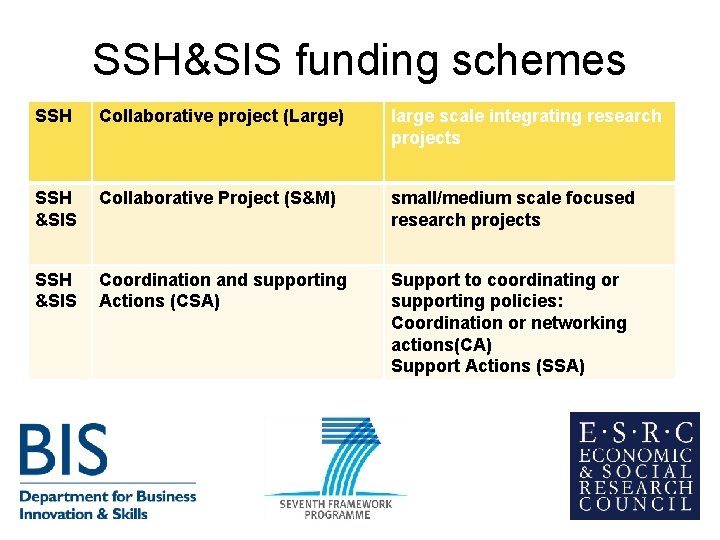
SSH&SIS funding schemes SSH Collaborative project (Large) large scale integrating research projects SSH &SIS Collaborative Project (S&M) small/medium scale focused research projects SSH &SIS Coordination and supporting Actions (CSA) Support to coordinating or supporting policies: Coordination or networking actions(CA) Support Actions (SSA)
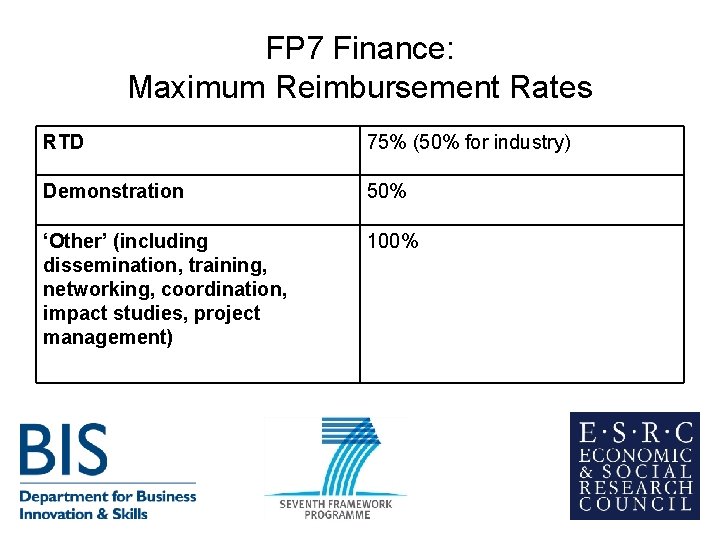
FP 7 Finance: Maximum Reimbursement Rates RTD 75% (50% for industry) Demonstration 50% ‘Other’ (including dissemination, training, networking, coordination, impact studies, project management) 100%
Identifying Project Partners: Who do I need in my consortium? • Partners must be well-matched to activities outlined in proposal • Appropriate balance of sectors i. e. academia, industry, civil society, user groups etc. • Consideration of the impact of the project • Consideration of EU added-value • In line with European Commission recommendations where applicable • Don’t recruit project partners for the sake of appearance – this will be obvious!
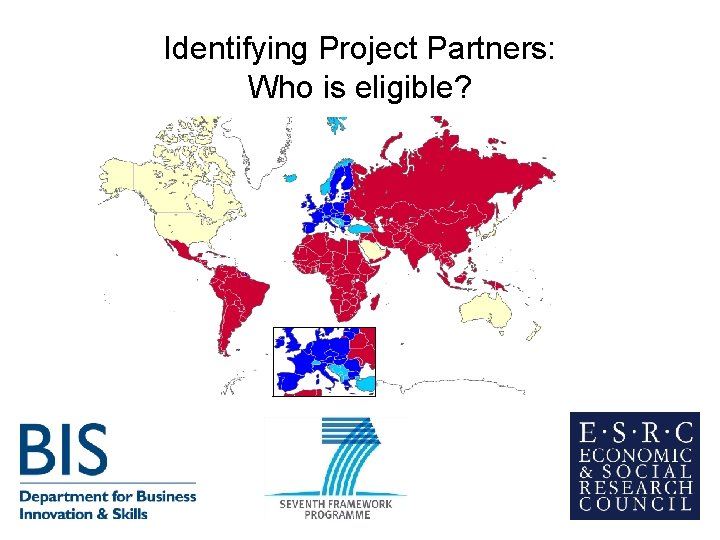
Identifying Project Partners: Who is eligible? • EU-27: Austria, Belgium, Bulgaria, Cyprus, Czech Republic, Denmark, Estonia, Finland, France, Germany, Greece, Hungary, Italy, Latvia, Lithuania, Luxembourg, Malta, the Netherlands, Poland, Portugal, Republic of Ireland, Romania, Slovakia, Slovenia, Spain, Sweden, the UK • FP 7 Associated countries: Albania, Bosnia and Herzegovina, Croatia, FYR Macedonia, Iceland, Israel, Liechtenstein, Montenegro, Norway, Serbia, Switzerland, Turkey • International Cooperation Partner Countries (SICA only)
Identifying Project Partners: Who is eligible?
Identifying Project Partners: What can I do? • Use your NCP (me!) • Complete a partner search form here: http: //www. net 4 society. eu/public/pss (SSH) • Join the net 4 society Research Directory (SSH) • http: //tinyurl. com/32 udzlf (SIS) • CORDIS website – past projects • UKRO representative • Utilise existing contacts
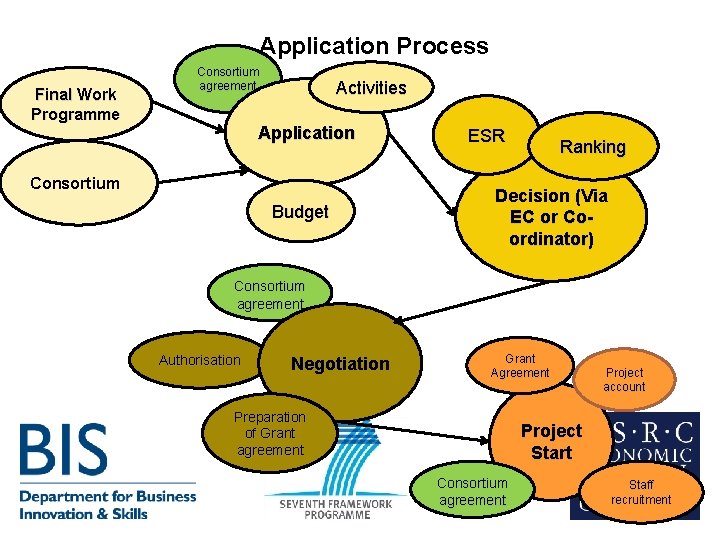
Application Process Final Work Programme Consortium agreement Activities Application Consortium Budget ESR Ranking Decision (Via EC or Coordinator) Consortium agreement Authorisation Negotiation Grant Agreement Preparation of Grant agreement Project account Project Start Consortium agreement Staff recruitment
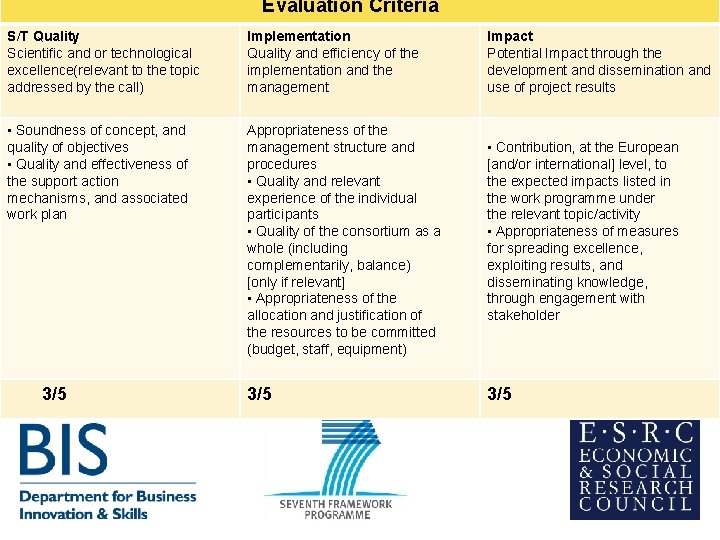
Evaluation Criteria S/T Quality Scientific and or technological excellence(relevant to the topic addressed by the call) Implementation Quality and efficiency of the implementation and the management • Soundness of concept, and quality of objectives • Quality and effectiveness of the support action mechanisms, and associated work plan Appropriateness of the management structure and procedures • Quality and relevant experience of the individual participants • Quality of the consortium as a whole (including complementarily, balance) [only if relevant] • Appropriateness of the allocation and justification of the resources to be committed (budget, staff, equipment) 3/5 Impact Potential Impact through the development and dissemination and use of project results • Contribution, at the European [and/or international] level, to the expected impacts listed in the work programme under the relevant topic/activity • Appropriateness of measures for spreading excellence, exploiting results, and disseminating knowledge, through engagement with stakeholder 3/5
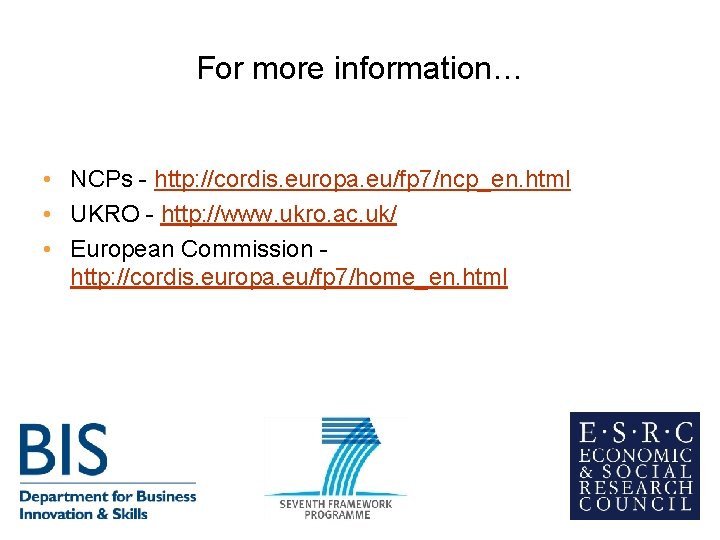
For more information… • NCPs - http: //cordis. europa. eu/fp 7/ncp_en. html • UKRO - http: //www. ukro. ac. uk/ • European Commission http: //cordis. europa. eu/fp 7/home_en. html