
EUROPEAN SCOUT REGION ORGANIZATIONAL DEVELOPMENT CORE GROUP Academy
- Slides: 18
EUROPEAN SCOUT REGION ORGANIZATIONAL DEVELOPMENT CORE GROUP Academy Session 2011, Paris October 30 th and 31 st 2011 1
Putting strategy into action “Strategy is the direction and scope of an organisation over the long-term: which achieves advantage for the organisation through its configuration of resources within a challenging environment, to meet the needs of markets and to fulfill expectations of different target groups. ” 2
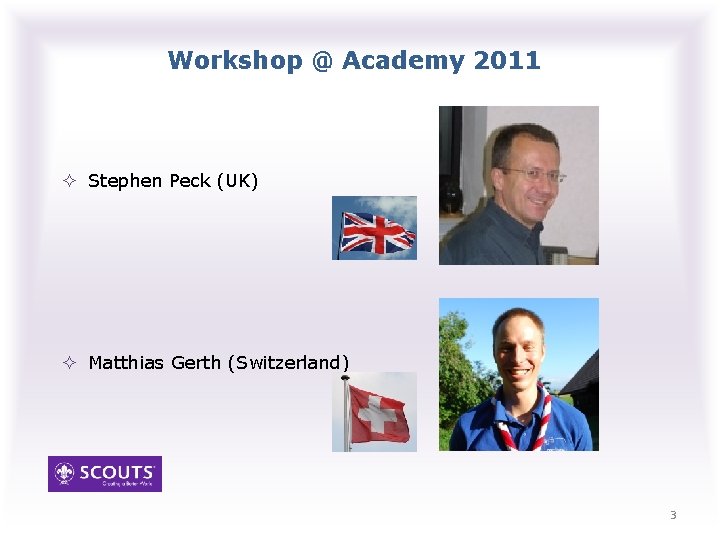
Workshop @ Academy 2011 Stephen Peck (UK) Matthias Gerth (Switzerland) 3
Intro Language(s)? Who are you? (Name, NSO, function, motivation) What do you expect? use the post-its What is needed before you develop strategies and actions? Write one example each of a successful and an unsuccessful strategy or change implementation from your NSO Change management, organisational behaviour, project management 4
Managing change Why change things? Why it‘s hard in Scouting and Guiding People resist change, not organisations Why it goes wrong Plan to succeed Dealing with resistance Embedding the change in the culture 5
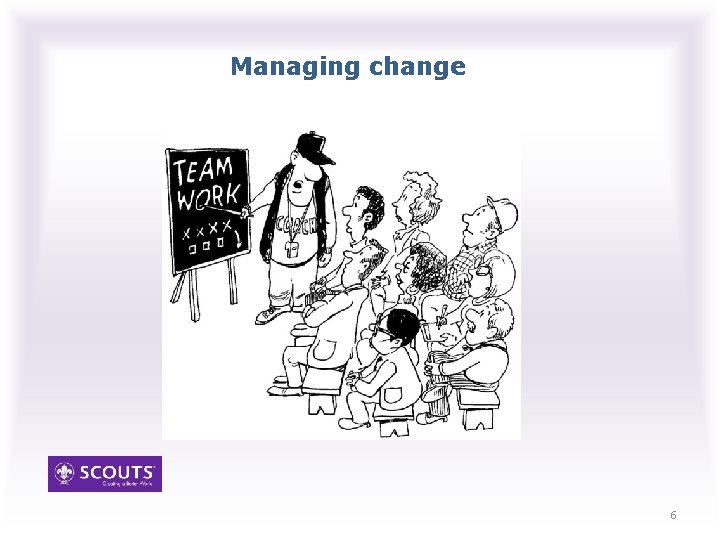
Managing change 6
Organisational culture Learning Organization (LO) “The LO concept was developed to help organisations cope with the rapid acceleration in the pace of change – a challenge also facing every NSO. Additionally, the LO approach is one that encourages Members to be involved and contribute to the NSO’s development. Member involvement is a growing expectation at all levels and the LO approach will help us to meet that expectation. ” 7
Organisational culture Key organisational behaviours Involve and consult our membership at all levels whenever possible Flatten organisational structures Share information and store it in an accessible way so that everyone can see the whole picture and can therefore contribute to discussions Encourage learning and personal development…this is what we should be doing in Scouting anyway! Regular external stimulus for the organisation's thinking and development Adopt a holistic approach to strategy 8
Organisational culture Key organisational behaviours 9
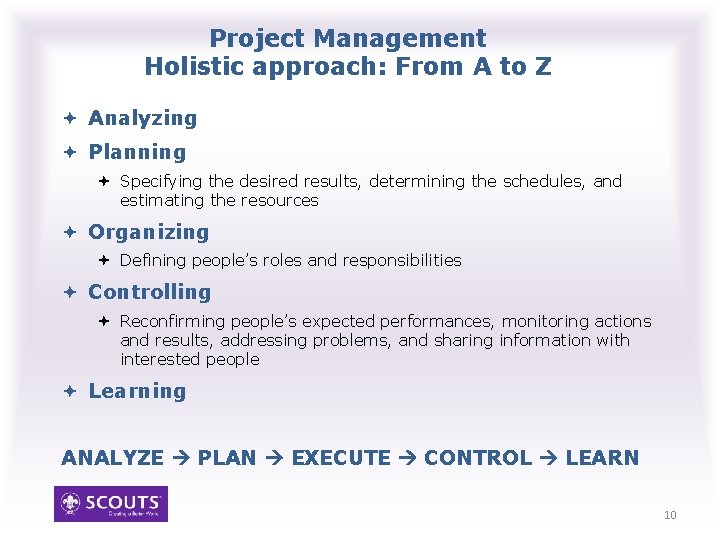
Project Management Holistic approach: From A to Z Analyzing Planning Specifying the desired results, determining the schedules, and estimating the resources Organizing Defining people’s roles and responsibilities Controlling Reconfirming people’s expected performances, monitoring actions and results, addressing problems, and sharing information with interested people Learning ANALYZE PLAN EXECUTE CONTROL LEARN 10
Project Management Holistic approach: From A to Z 11
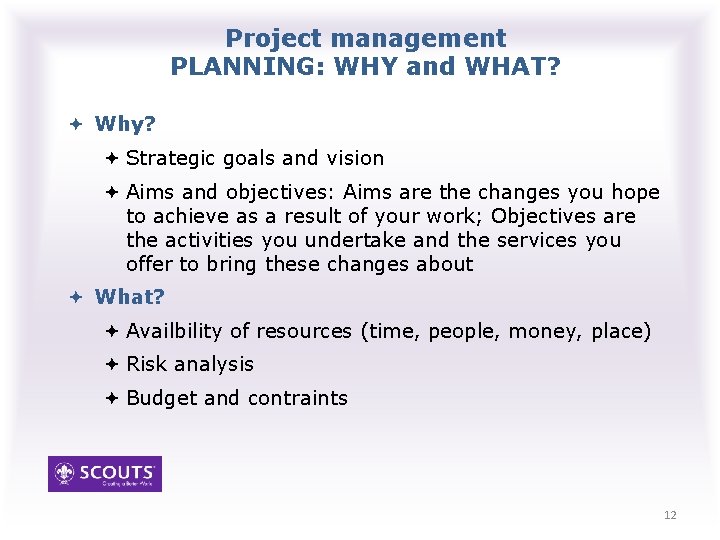
Project management PLANNING: WHY and WHAT? Why? Strategic goals and vision Aims and objectives: Aims are the changes you hope to achieve as a result of your work; Objectives are the activities you undertake and the services you offer to bring these changes about What? Availbility of resources (time, people, money, place) Risk analysis Budget and contraints 12
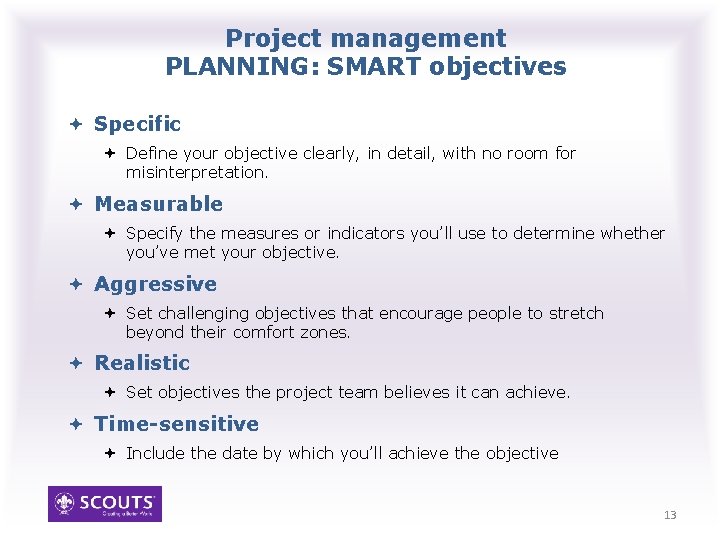
Project management PLANNING: SMART objectives Specific Define your objective clearly, in detail, with no room for misinterpretation. Measurable Specify the measures or indicators you’ll use to determine whether you’ve met your objective. Aggressive Set challenging objectives that encourage people to stretch beyond their comfort zones. Realistic Set objectives the project team believes it can achieve. Time-sensitive Include the date by which you’ll achieve the objective 13
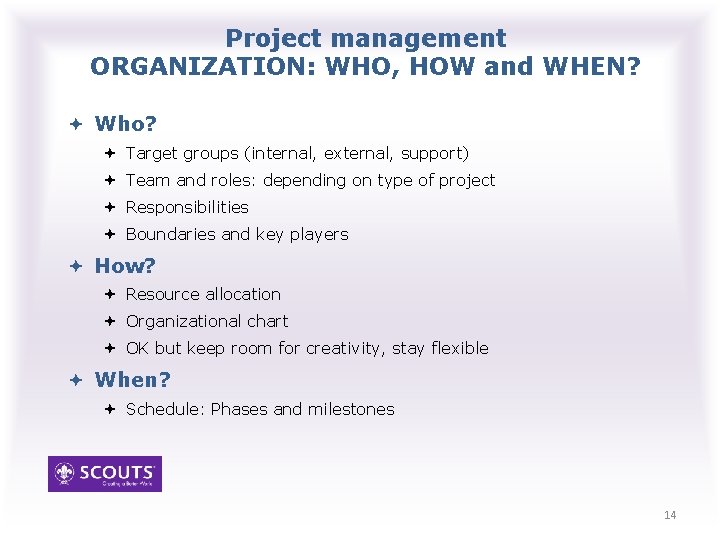
Project management ORGANIZATION: WHO, HOW and WHEN? Who? Target groups (internal, external, support) Team and roles: depending on type of project Responsibilities Boundaries and key players How? Resource allocation Organizational chart OK but keep room for creativity, stay flexible When? Schedule: Phases and milestones 14
Project management CONTROLLING Tracking progress Regular reporting Evaluation Lessons learned 15
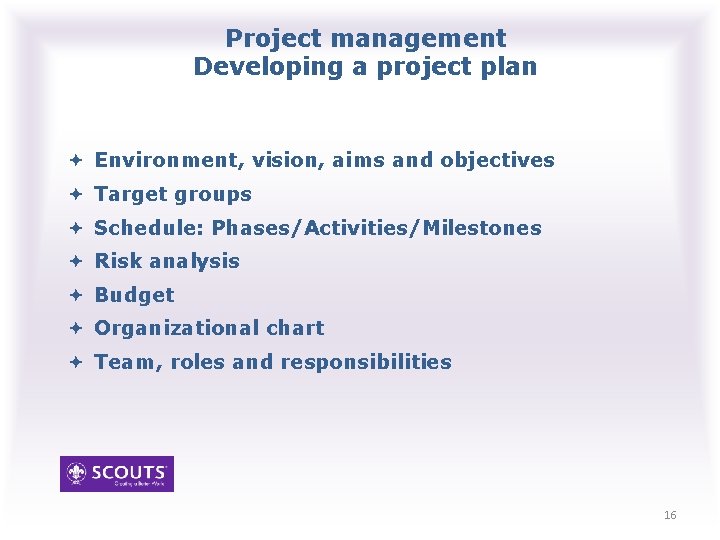
Project management Developing a project plan Environment, vision, aims and objectives Target groups Schedule: Phases/Activities/Milestones Risk analysis Budget Organizational chart Team, roles and responsibilities 16
Summary 17
Support for your organization The Organisational Development Core Group Tailored support: Consulting, workshops, etc. The library of documents OD seminar, February 11 -12, 2012; Gilwell Park Q&A 18