
European Reference Networks ERN What Why Where and

- Slides: 18
European Reference Networks (ERN) What, Why, Where and how do we face the future ? “Scottish Parliament, Implications of BREXIT Peter A Mossey, University of Dundee 5 th February 2019
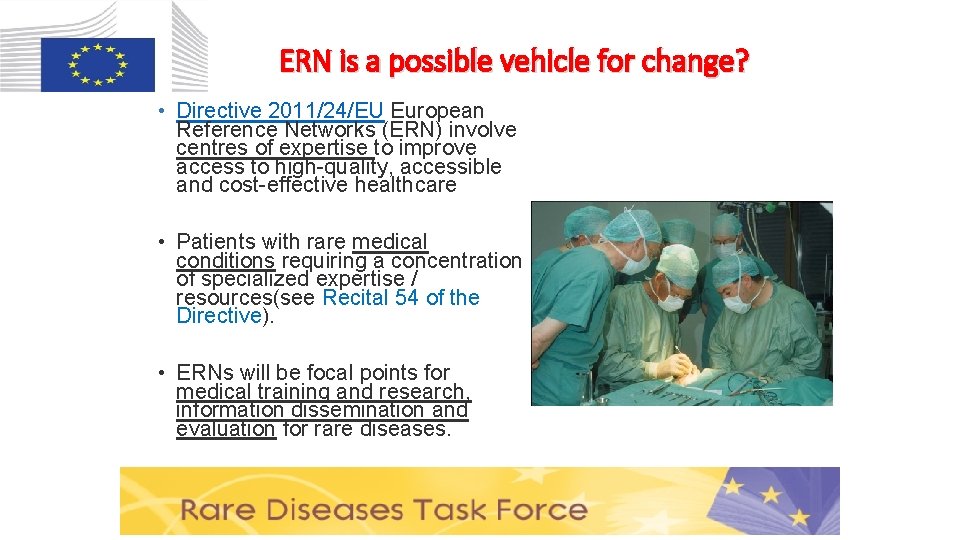
ERN is a possible vehicle for change? • Directive 2011/24/EU European Reference Networks (ERN) involve centres of expertise to improve access to high-quality, accessible and cost-effective healthcare • Patients with rare medical conditions requiring a concentration of specialized expertise / resources(see Recital 54 of the Directive). • ERNs will be focal points for medical training and research, information dissemination and evaluation for rare diseases.
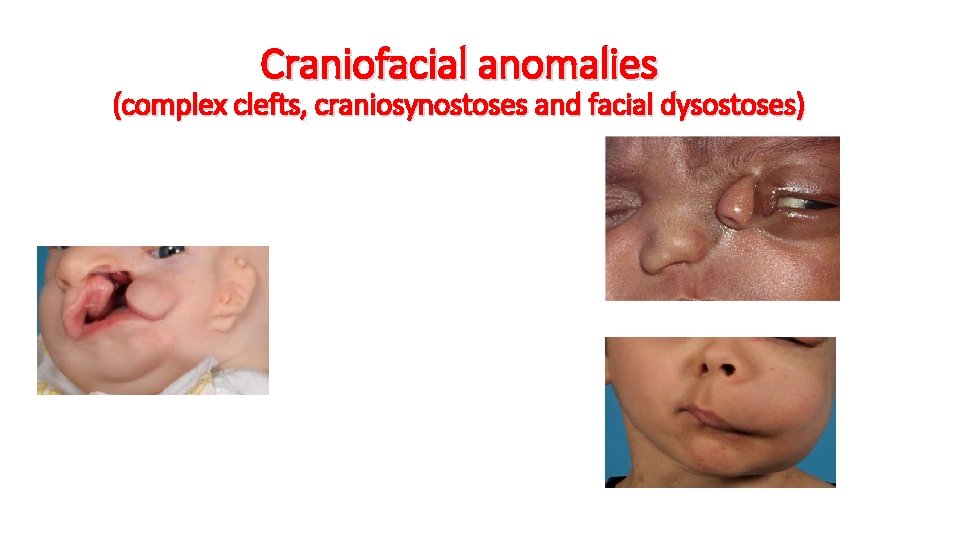
Craniofacial anomalies (complex clefts, craniosynostoses and facial dysostoses)
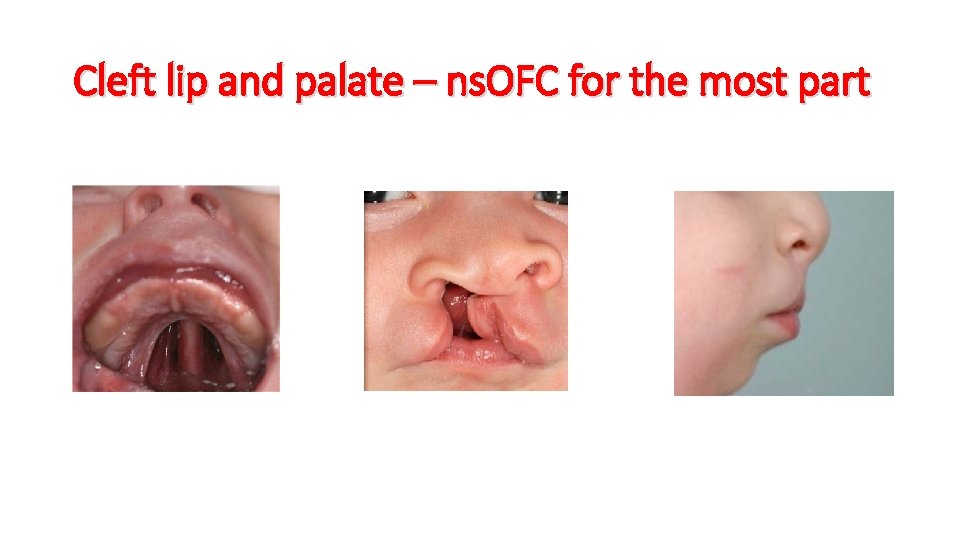
Cleft lip and palate – ns. OFC for the most part
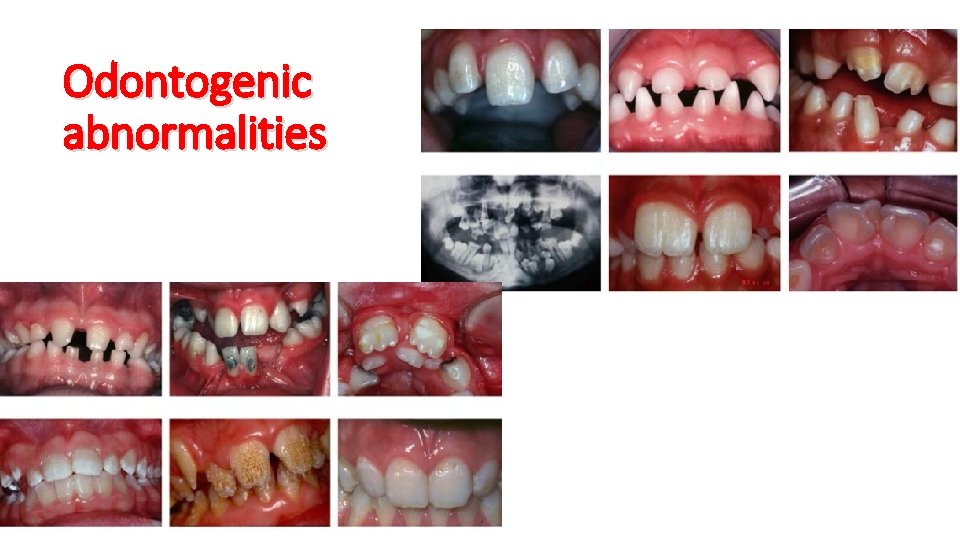
Odontogenic abnormalities
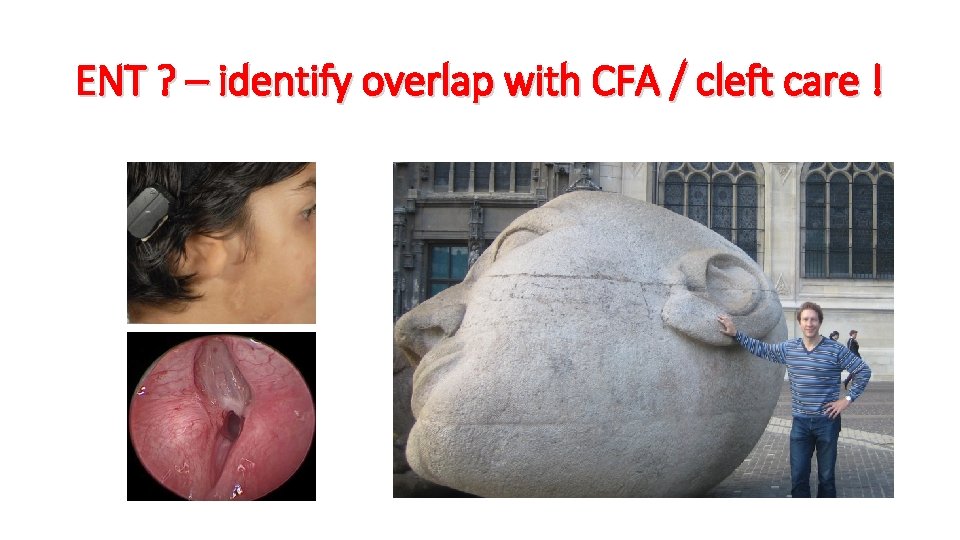
ENT ? – identify overlap with CFA / cleft care !
EU Parliament 9 th October 2012
Research in the ERNs • Tremendous potential within the ERN and RD is a theme in H 2020 • Track record: many aspects of EU research in rare diseases world leading • Innovation part of but goes well beyond “standards of care” • Basic science, innovation and evidence base are all part of quality of care • Will be the concern of each discipline, but also needs interdisciplinary focus
ERNs are the potential solution ? • ERNs are a mechanism of cooperation between healthcare providers of highly specialised services all over Europe • Healthcare providers are expected to collaborate amongst themselves in a dedicated field of expertise in order to establish and sustain these Networks. • The Members of a network will work in accordance with the legislation of their Member State • Funding will be required to unlock this potential
ERN “CRANIO” mission: • 1. To establish and manage a steady referral network for patients with craniofacial anomalies; cleft lip/palate; odontologic anomalies; and ENT disorders throughout Europe; • 2. To improve the quality of care by enhancing diagnosis, treatment and follow-up of the patients with rare craniofacial anomalies and ENT disorders; • 3. To minimize any deviations from our operational standards and to create best practices through suitable quality improvement initiatives, while monitoring their effectiveness using measures and indicators; • 4. To stimulate innovation through multicentre research projects on (genetic) causes, pathophysiology, and associated problems, and introduction of e. Health. • 5. To support the continuous learning and development of all our members by providing high quality educational and training opportunities to medical, nursing and other healthcare professionals; • 6. To disseminate gained knowledge throughout Europe and outside, making it available to all stakeholders;
Standards of care: next steps • Available clinical guidelines in all CRANIO phenotypes and all disciplines - significant task, so where do we start ? • No need to re-invent the wheel when we may already have Formula One – well refined, high tech, tried and tested !! • Which ones are “accepted” and by whom – professional bodies and societies, PAGs, governments ? • Scope ? – have we defined this – what do we mean by standards of care in the ERN context ? • Which are standards common to all CRANIO phenotypes / disciplines, and which will be discipline specific ?
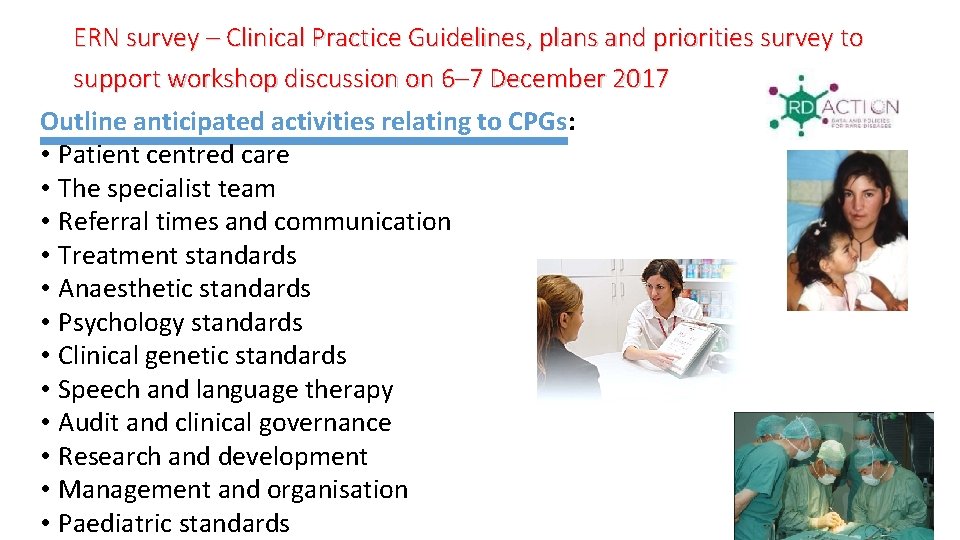
ERN survey – Clinical Practice Guidelines, plans and priorities survey to support workshop discussion on 6– 7 December 2017 Outline anticipated activities relating to CPGs: • Patient centred care • The specialist team • Referral times and communication • Treatment standards • Anaesthetic standards • Psychology standards • Clinical genetic standards • Speech and language therapy • Audit and clinical governance • Research and development • Management and organisation • Paediatric standards
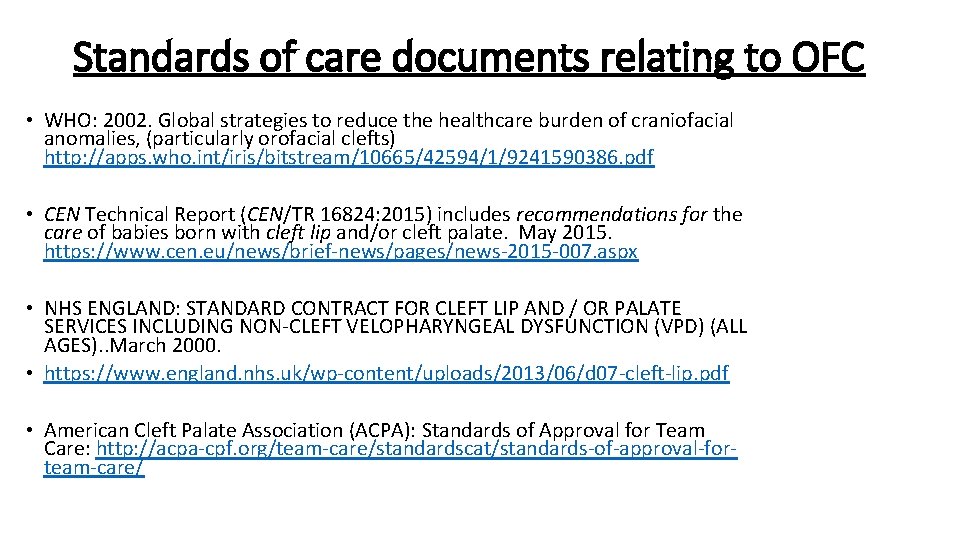
Standards of care documents relating to OFC • WHO: 2002. Global strategies to reduce the healthcare burden of craniofacial anomalies, (particularly orofacial clefts) http: //apps. who. int/iris/bitstream/10665/42594/1/9241590386. pdf • CEN Technical Report (CEN/TR 16824: 2015) includes recommendations for the care of babies born with cleft lip and/or cleft palate. May 2015. https: //www. cen. eu/news/brief-news/pages/news-2015 -007. aspx • NHS ENGLAND: STANDARD CONTRACT FOR CLEFT LIP AND / OR PALATE SERVICES INCLUDING NON-CLEFT VELOPHARYNGEAL DYSFUNCTION (VPD) (ALL AGES). . March 2000. • https: //www. england. nhs. uk/wp-content/uploads/2013/06/d 07 -cleft-lip. pdf • American Cleft Palate Association (ACPA): Standards of Approval for Team Care: http: //acpa-cpf. org/team-care/standardscat/standards-of-approval-forteam-care/
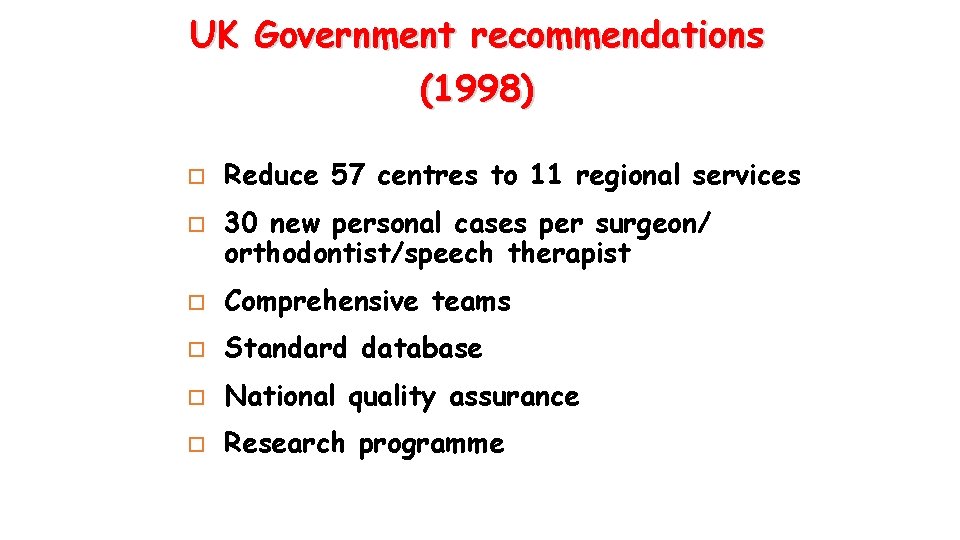
UK Government recommendations (1998) o o Reduce 57 centres to 11 regional services 30 new personal cases per surgeon/ orthodontist/speech therapist o Comprehensive teams o Standard database o National quality assurance o Research programme
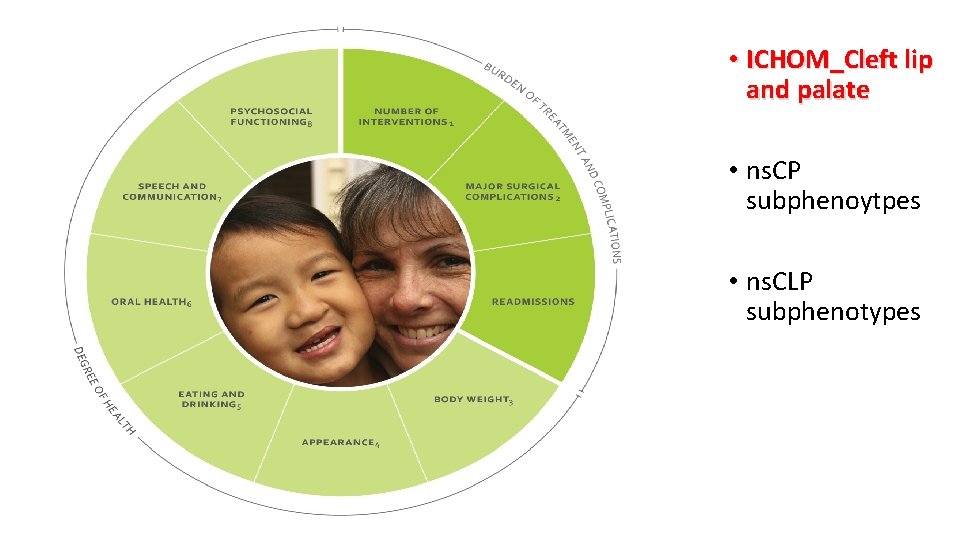
• ICHOM_Cleft lip and palate • ns. CP subphenoytpes • ns. CLP subphenotypes
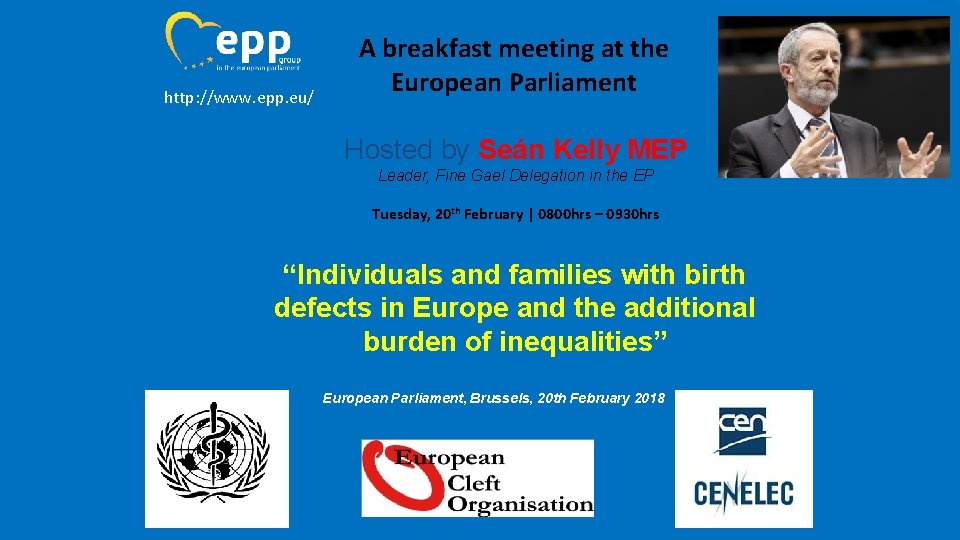
http: //www. epp. eu/ A breakfast meeting at the European Parliament Hosted by Seán Kelly MEP Leader, Fine Gael Delegation in the EP Tuesday, 20 th February | 0800 hrs – 0930 hrs “Individuals and families with birth defects in Europe and the additional burden of inequalities” European Parliament, Brussels, 20 th February 2018
Consumers, Health, Agriculture and Food Executive Agency • La Commissione Europea, attraverso The Consumers, Health, Agriculture and Food Executive Agency (Chafea), ha pubblicato il secondo bando 2018 del Programma europeo Salute 2014 -2020. • • In particolare, la call "Implementation of best practices to promote health and prevent non-communicable diseases and to reduce health inequalities" mira a implementare buone pratiche già testate in un paese europeo in altri paesi membri dell'Unione europea; in particolare, due sono le buone pratica identificate (tra cui una italiana) che corrispondono anche ai topic della call: • Topic 1: Transferring the Swedish Physical Activity on Prescription Initiative to other countries • Topic 2: Transferring the Italian CARDIO 50 programme to other countries • La scadenza per inviare le proposte progettuali è fissata per tutti i topic al 13 settembre 2018.
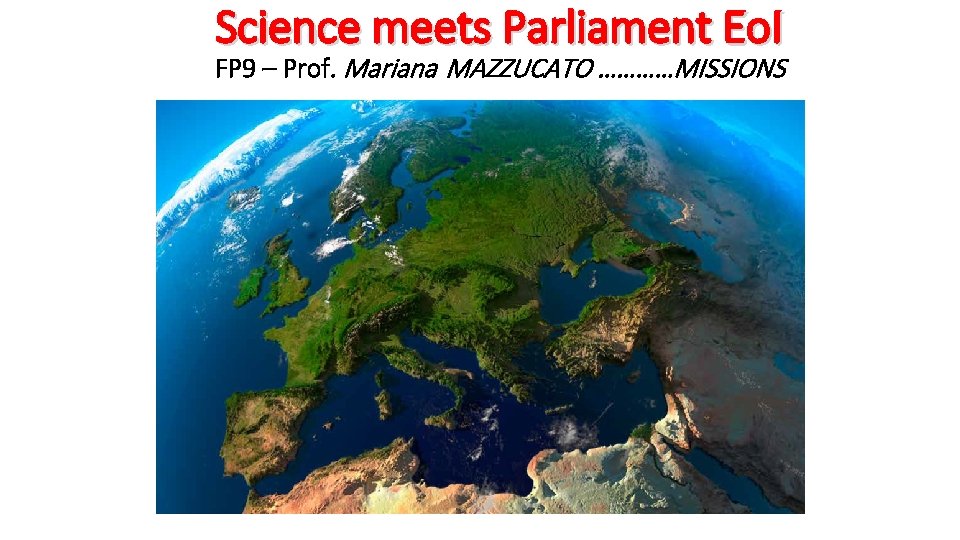
Science meets Parliament Eo. I FP 9 – Prof. Mariana MAZZUCATO …………MISSIONS