
European Project Erasmus Strategic Partnership 2015 ROUND TABLE
European Project Erasmus+ / Strategic Partnership / 2015 ROUND TABLE FOR TEACHERS FRIDAY , 24 MARCH 2017 GREECE “NON FORMAL SOCIAL TEACHING STRATEGIES ” 4 th HIGH SCHOOL OF HERAKLEION CRETE GREECE 1
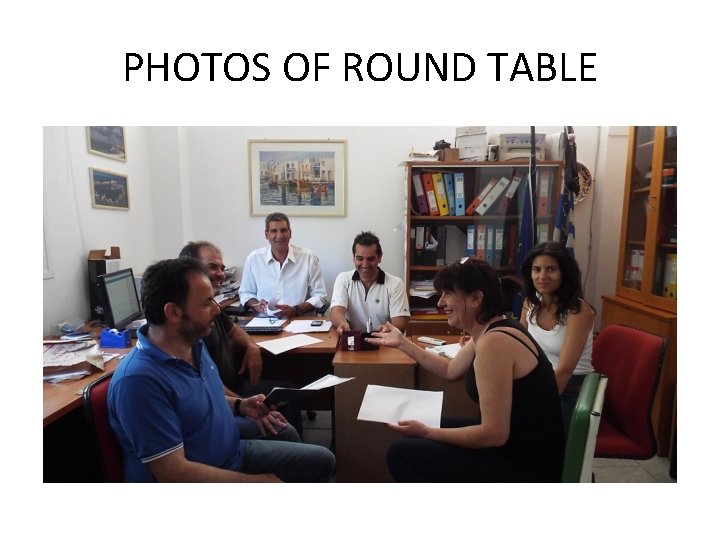
PHOTOS OF ROUND TABLE

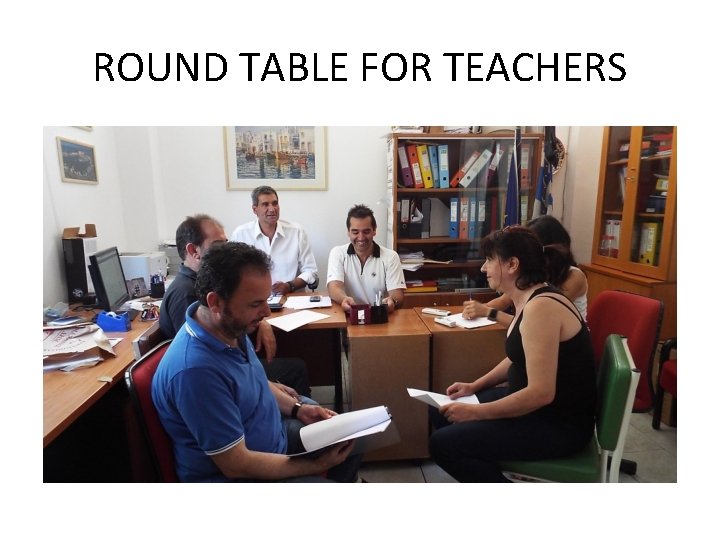
ROUND TABLE FOR TEACHERS
ROUND TABLE FOR TEACHERS
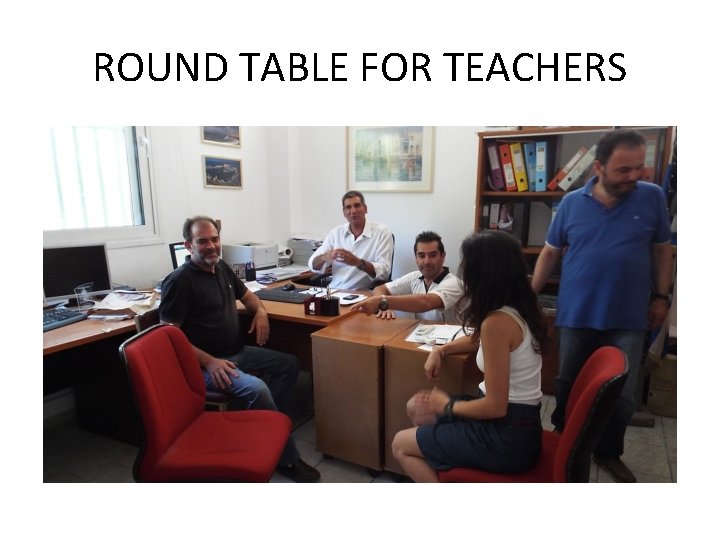
ROUND TABLE FOR TEACHERS
LIST OF ATTENTANCE : AGAPIS STYLIANOS: HEADMASTER MEMBER OF ERASMUS TEAM ELENI PATIRAKI : COORDINATOR MEMBER OF ERASMUS TEAM CHARALAMPOS KATSIDIS: DEPUTY HEADMASTER MEMBER OF ERASMUS TEAM • EMMANOUIL PITAROKOILIS : MEMBER OF ERASMUS TEAM • POLYMNIA LAKIOTAKI : MEMBER OF ERASMUS TEAM • SPIROS PONTIKAKIS : MEMBER OF ERASMUS TEAM • •
ROUND TABLE FOR TEACHERS SHORT PRESENTATION • • Issue of discussion : Why non-formal education and informal learning is so difficult to be accepted in our high school and why our students need frontistiria. Frontistiria are private schools whose attendance by the Greek students has become a necessity in order for them to be able to achieve high grades and succeed in their exams in school. It seems like teachers in our educational system don’t work with students but they just get into the classrooms for nothing. Our ministry of Education doesn’t accept from teachers to change the way of teaching. They ignore our efforts and they just tell us to teach the book they sent to us in the formal way. There can be heard and seen lots of facts that show people's disappointment by the Greek Education System. Many people claim that Greek schools' role does little to help them make use of their abilities in life. We try to teach with non-formal and informal teaching strategies but we have many difficulties because of the law educational system in our country.
Discussion about teaching strategies • Formal learning: learning typically provided by an education or training institution, structured (in terms of learning objectives, learning time or learning support) and leading to certification. Formal learning is intentional from the learner’s perspective. • Informal learning: learning resulting from daily life activities related to work, family or leisure. It is not structured (in terms of learning objectives, learning time or learning support) and typically does not lead to certification. Informal learning may be intentional but in most cases it is not-intentional
ROUND TABLE FOR TEACHERS NEW IDEAS • Non formal and informal teaching strategies in our school. • We decided to continue with the following activities in the classrooms: • Teambuilding • In the non-formal education it’s very important that the group operate optimal. For that, Teambuilding activities are very useful to let the participants let knowing each other, and build a positive team dynamics. Name game • You play name games at the beginning of the project to get to know each other and learn people names. You should also some more name games at different stages of the project to help people remember everyone.
NEW IDEAS IN NONFORMAL TEACHING STRATEGIES • Trust games • Trust is the most important ingredient for a good team spirit. There for, you can intervent some exercises which will improve the trust feeling between participants. • Information Games • These are activities that help you create or extract pieces of information from the participants. For example different work in groups giving different topics for groups to discuss their experience and knowledge and create a presentation. • Collage • Used in art therapy. The team has to make collage out of magazines and newspapers about some certain subject. The work style depends on the group. Some groups will have a discussion about the subject before they decided what the collage will illustrate. Some groups will start with looking for interesting images and then linking them together.
ROUND TABLE FOR TEACHERS discussion issue • Besides the non-formal educating program there a lot of activities we could do in our spare time. Like sharing dinners and doing entertainment activities with each other. This is called the informal education which, is very important for the group process because here the participants learn to know, and to communicate with each other in a informal way. Some see informal education as the learning that goes on in daily life. As teachers , for example, we may well encourage our students to talk about things that have happened in their lives so that they can handle their feelings and to think about what to do next. •
Round table • Others may view informal education as the learning projects that we undertake for ourselves. We may take up fishing, for example, and then start reading around the subject, buying magazines and searching out other anglers. • Informal education can be all of these things. However, here we focus on informal education as a spontaneous process of helping people to learn. It works through conversation, and the exploration and enlargement of experience. It’s purpose, we suggest, is to cultivate communities, associations and relationships that make for human flourishing.
We agree that… • Informal education is the wise, respectful and spontaneous process of cultivating learning. It works through conversation, and the exploration and enlargement of experience. we can see that whether we are parents or educators, we teach. When we are engaged in learning projects we teach ourselves. In all of these roles we are also likely to talk and join in activities with others (children, young people and adults). Some of the time we work with a clear objective in mind – perhaps linked to some broader plan e. g. around the development of reading. At other times we may go with the flow – adding to the conversation when it seems right or picking up on an interest. • These ways of working all entail learning – but informal education tends to be unpredictable – we do not know where it might lead – and spontaneous. •
Conversation Issue : as educators, have to catch the moment where we can say or do something to deepen people’s thinking or to put themselves in touch with their feelings • Informal education, we argue, is driven by conversation and being with others. It develops through spending time with people – sharing in their lives – and listening and talking. Catherine Blyth has described conversation as ‘the spontaneous business of making connections’. It involves connecting with both ideas and other people. When we join in conversation it is often difficult to predict where it will lead. As such it can be a very powerful experience – ‘conversation changes the way you see the world, and even changes the world’. • As well as talking and listening to others, we also have conversations with ourselves. We can watch ourselves as we go about our lives, as we talk and think. People ‘have, as it were, two internal voices, so they can both create new ideas and look at them, criticize and admire’. • When we put conversation at the centre of education something very important happens. It is the exchanges and the thoughts they provoke that leads us – not some predetermined curriculum or plan For the most part, we do not have lesson plans to follow; we respond to situations, to experiences.
CONCLUSION Although we have nice ideas for informal teaching, we know that our students have no spare time after school because of the private lessons they have to attend in private schools for learning English, German or French language or prepare theirselves in exams for Maths, ancient Greek, history and social sciences
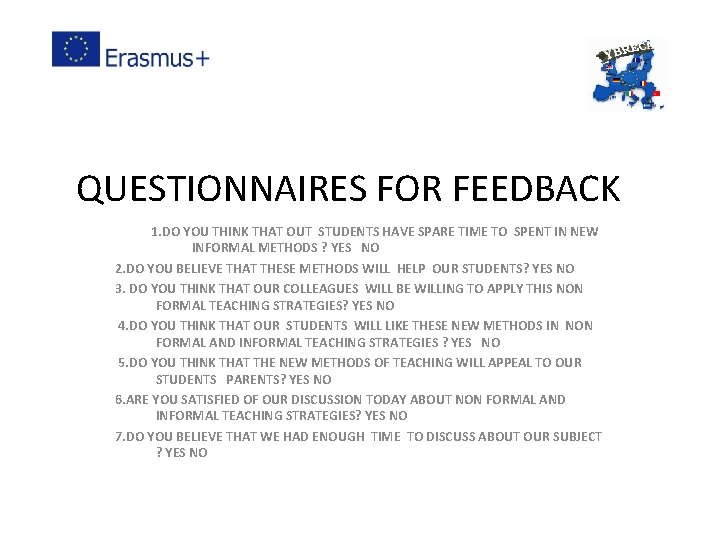
QUESTIONNAIRES FOR FEEDBACK 1. DO YOU THINK THAT OUT STUDENTS HAVE SPARE TIME TO SPENT IN NEW INFORMAL METHODS ? YES NO 2. DO YOU BELIEVE THAT THESE METHODS WILL HELP OUR STUDENTS? YES NO 3. DO YOU THINK THAT OUR COLLEAGUES WILL BE WILLING TO APPLY THIS NON FORMAL TEACHING STRATEGIES? YES NO 4. DO YOU THINK THAT OUR STUDENTS WILL LIKE THESE NEW METHODS IN NON FORMAL AND INFORMAL TEACHING STRATEGIES ? YES NO 5. DO YOU THINK THAT THE NEW METHODS OF TEACHING WILL APPEAL TO OUR STUDENTS PARENTS? YES NO 6. ARE YOU SATISFIED OF OUR DISCUSSION TODAY ABOUT NON FORMAL AND INFORMAL TEACHING STRATEGIES? YES NO 7. DO YOU BELIEVE THAT WE HAD ENOUGH TIME TO DISCUSS ABOUT OUR SUBJECT ? YES NO
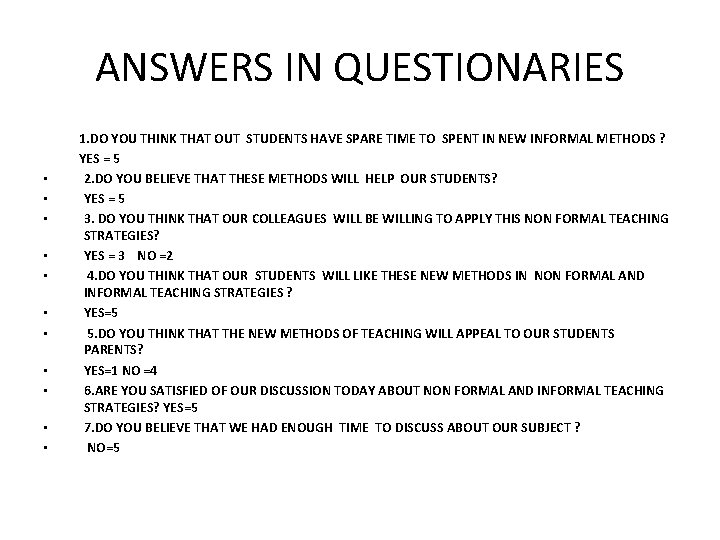
ANSWERS IN QUESTIONARIES • • • 1. DO YOU THINK THAT OUT STUDENTS HAVE SPARE TIME TO SPENT IN NEW INFORMAL METHODS ? YES = 5 2. DO YOU BELIEVE THAT THESE METHODS WILL HELP OUR STUDENTS? YES = 5 3. DO YOU THINK THAT OUR COLLEAGUES WILL BE WILLING TO APPLY THIS NON FORMAL TEACHING STRATEGIES? YES = 3 NO =2 4. DO YOU THINK THAT OUR STUDENTS WILL LIKE THESE NEW METHODS IN NON FORMAL AND INFORMAL TEACHING STRATEGIES ? YES=5 5. DO YOU THINK THAT THE NEW METHODS OF TEACHING WILL APPEAL TO OUR STUDENTS PARENTS? YES=1 NO =4 6. ARE YOU SATISFIED OF OUR DISCUSSION TODAY ABOUT NON FORMAL AND INFORMAL TEACHING STRATEGIES? YES=5 7. DO YOU BELIEVE THAT WE HAD ENOUGH TIME TO DISCUSS ABOUT OUR SUBJECT ? NO=5
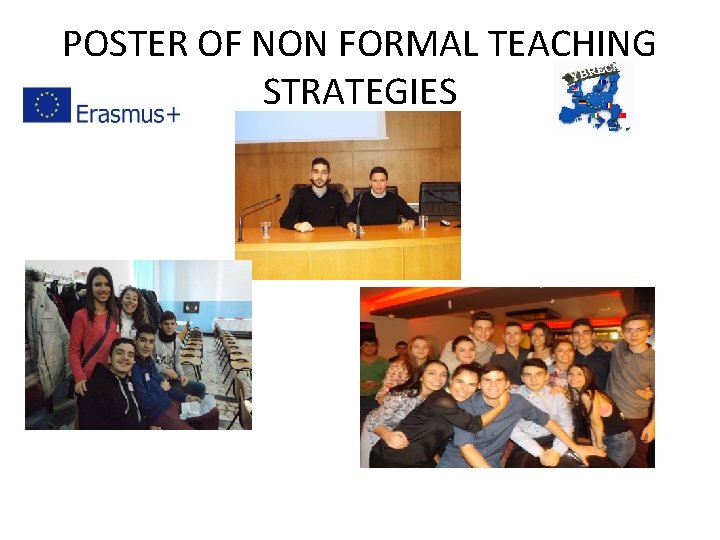
POSTER OF NON FORMAL TEACHING STRATEGIES
PRESS ANNOUNCEMENT • INVITATION • DEAR PARENTS OF OUR STUDENTS , WE -THE TEACHERS OF 4 TH GEL OF HERAKLEION - HAVE DECIDED TO CONTINUE TEACHING OF NEW METHODS OF NON FORMAL TEACHING IN OUR SCHOOL PROGRAMME DUE TO OUR ERASMUS + EUROPEAN PROGRAMME. WE ASK FOR YOUR ASSISTANTANCE TO APPLY OUR PROJECT ON YOUR CHILDREN. WE BELIEVE THAT OUR STUDENTS WILL BE INSPIRED TO HAVE A BETTER PERFORMANCE IN SCHOOL DUE TO NEW METHODS. WE INVITE YOU IN OUR SCHOOL ON MONDAY 27 OF MARCH AT 14. 00 IN OUR AMPHITHEATRON TO DISCUSS ABOUT THAT SUBJECTS. • • AGAPIS STYLIANOS HEADMASTER OF 4 TH GEL OF HERAKLEION ERASMUS + TEAM OF TEACHERS HERAKLEION 24 -03 -2017
LEAFLET • DEAR STUDENTS AND PARENTS, WE DESIDED TO CONTINUE TEACHING NEW METHODS OF OUR SUBJECTS. THE NEW METHODS OF TEACHING IS ABOUT GOING OUTDOORS WITH OUR STUDENTS TO LEARN IN A MORE PRACTICAL WAY ABOUT THE SUBJECTS WE ARE TEACHING IN SCHOOL. WE BELIEVE THAT THIS NEW METHOD WITH INSPIRE ALL OF US TO SHOW THE BEST SIDE OF OURSELVES AND WILL INCREASE OUR EDUCATIONAL AND INTELLECTUAL LEVEL. • AGAPIS STYLIANOS : HEADMASTER OF THE SCHOOL • ERASMUS + TEAM OF TEACHERS
- Slides: 20