
European Network for Biodiversity Information Why ENBI ENBI
European Network for Biodiversity Information
Why ENBI ?
ENBI major objectives • European (EU/EC) contribution to GBIF. • Open regional network of biodiversity information centers and projects. • Interaction with EU/CHM, EEA, EIONET, and EPBRS. (Memorandum of Understanding with the European Environment Agency).
What will ENBI do? • • • ENBI is a network, not a single research project. Obtain a picture of the future challenges and opportunities. Identify current and planned activities, as well as gaps. Agree on priorities and on options for future cooperation. Define and implement a number of feasibility and pilot projects. • Interact with related information domains. • ENBI will (presently) not act as the European GBIF node. • Promote the continuity of ENBI.
Work plan • The establishment of a strong Europe-wide biodiversity information network. • Common approaches for the maintenance and enhancement of biodiversity databases. • Integration and interoperability of large-scale distributed database sites. • Mechanisms to support the development of e-services and products.
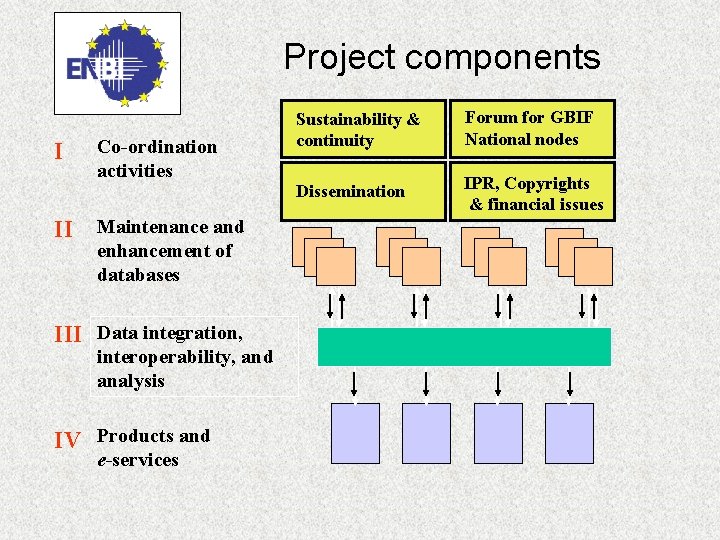
Project components I Co-ordination activities II Maintenance and enhancement of databases III Data integration, interoperability, and analysis IV Products and e-services Sustainability & continuity Forum for GBIF National nodes Dissemination IPR, Copyrights & financial issues

Current Scope of ENBI 36 months, starting 1 January 2003 65 institutes, representing 24 countries. - GBIF national nodes - Co-ordinators of relevant EU projects - Other stakeholders 13 work packages accommodated in 4 clusters.
Cluster I Co-ordinating activities. - Network co-ordination - Co-ordination with GBIF - Strategies for sustainability and continuity of European activities ENBI Forums & Inventory of state-of-art. Dissemination. IPR, copyrights & business issues.
Cluster II Maintenance, enhancement and presentation of bio-diversity databases. Co-operation of pan-European checklist and ‘Species bank’ database projects. Co-operation of pan-European databases on biological collections and specimens. Observational survey data.
Cluster III Data integration, interoperability and analysis. Data management in large distributed biodiversity database systems. Interoperability and common access. Generic analysis tools and data mining.
Cluster IV Products and e-services. Multi-lingual access. Information services on European biodiversity data. Making non-European biodiversity data in European repositories globally available.
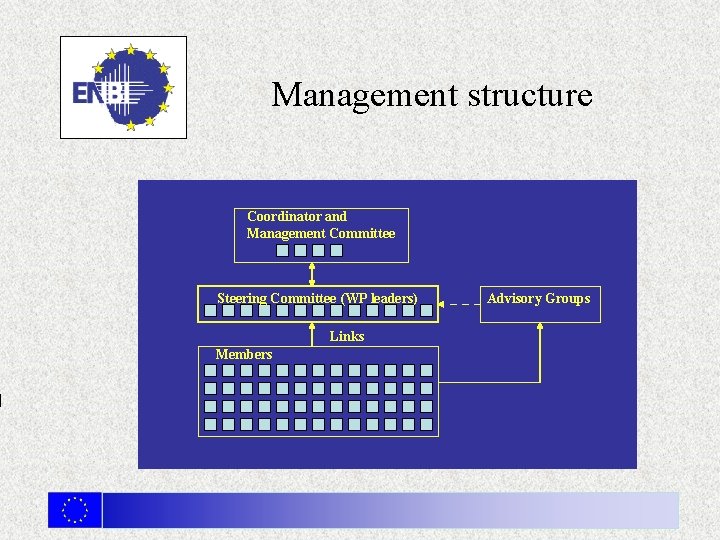
Management structure Coordinator and Management Committee Steering Committee (WP leaders) Links Members Advisory Groups
Interaction with GBIF • ENBI members will promote that more European countries will sign the GBIF Memorandum of Understanding. • Transparency between the two communities of GBIF and ENBI to avoid duplication of effort or competing models. • Option that ENBI will represent the European Commission in NODES (GBIF national nodes committee). • Joint activities and sharing of budgets in common activities. • Exchange experiences and compare models and activities with other regional networks (such as IABIN).
Looking ahead • 6 FP (ERA) initiatives – Integrated project ‘European Virtual Biodiversity Laboratory’ – Integrated project ‘Assembling the Tree of Life’ – Network of Excellence ‘Biodiversity databases’ • ERANET – Promote related national activities – Multinational cooperation • 7 th Framework Programme
http: //www. enbi. info/ Contact: ENBI@SCIENCE. UVA. NL The ENBI Coordinators: Wouter Los & Cees Hof University of Amsterdam P. O. Box 94766 1090 GT Amsterdam The Netherlands
- Slides: 15