
European marriage patterns in perspective Hajnal 1966 u
- Slides: 19
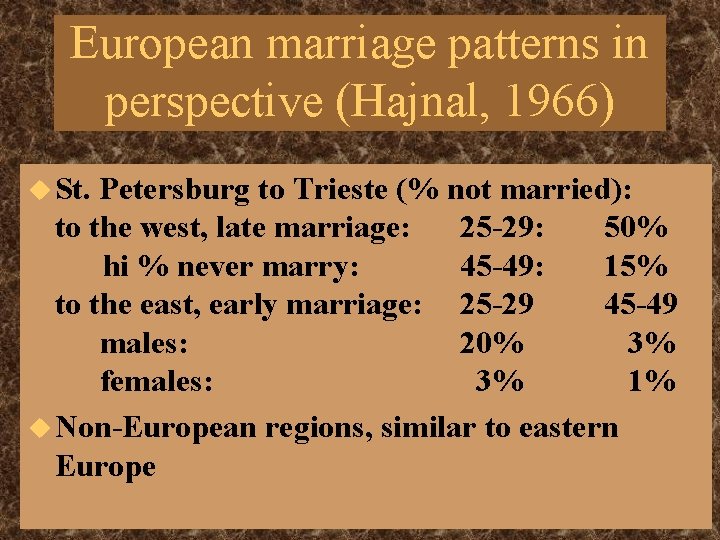
European marriage patterns in perspective (Hajnal, 1966) u St. Petersburg to Trieste (% not married): to the west, late marriage: 25 -29: 50% hi % never marry: 45 -49: 15% to the east, early marriage: 25 -29 45 -49 males: 20% 3% females: 3% 1% u Non-European regions, similar to eastern Europe
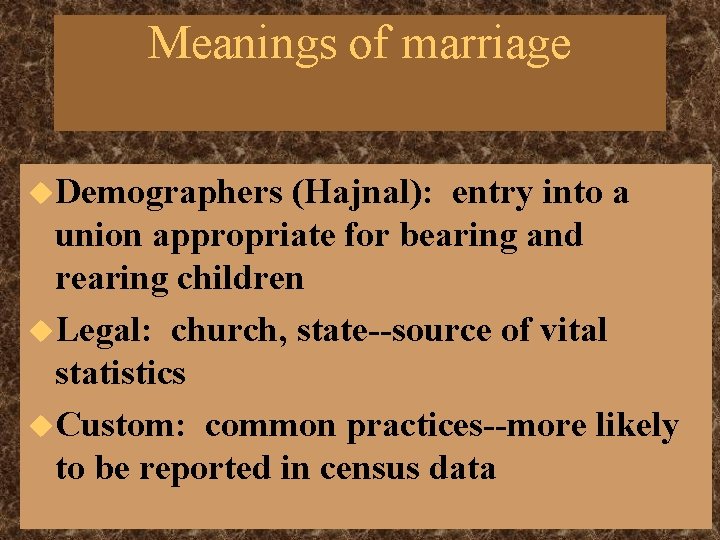
Meanings of marriage u. Demographers (Hajnal): entry into a union appropriate for bearing and rearing children u. Legal: church, state--source of vital statistics u. Custom: common practices--more likely to be reported in census data
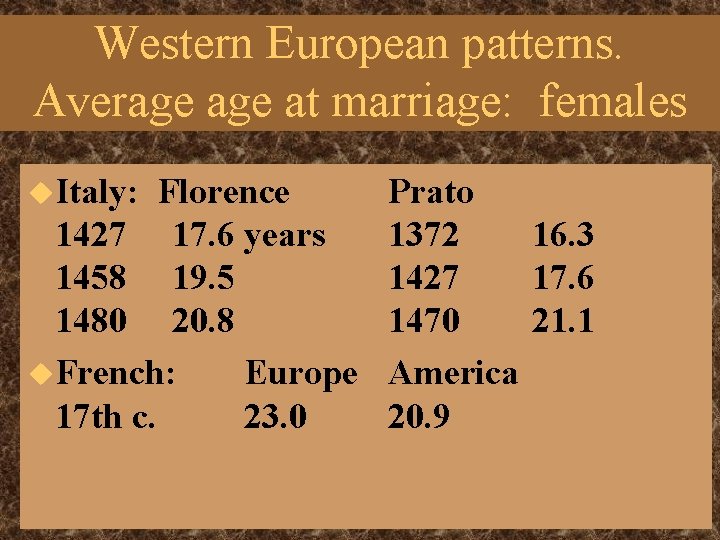
Western European patterns. Average at marriage: females u. Italy: Florence 1427 17. 6 years 1458 19. 5 1480 20. 8 u. French: Europe 17 th c. 23. 0 Prato 1372 16. 3 1427 17. 6 1470 21. 1 America 20. 9
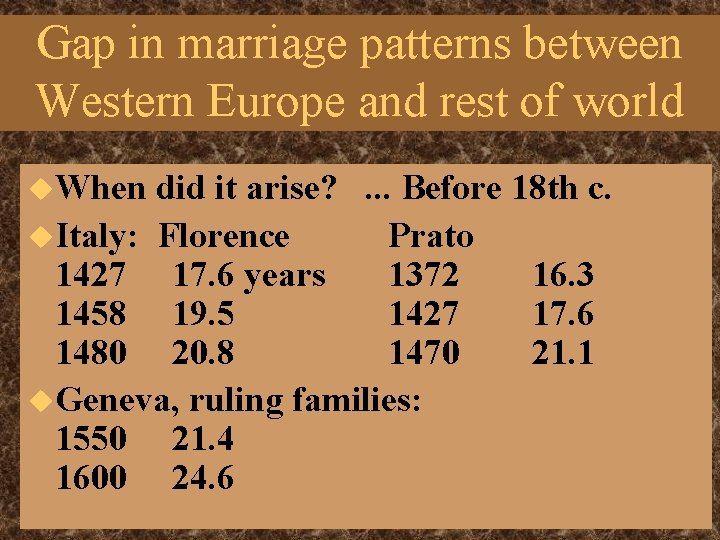
Gap in marriage patterns between Western Europe and rest of world u. When did it arise? . . . Before 18 th c. u. Italy: Florence Prato 1427 17. 6 years 1372 16. 3 1458 19. 5 1427 17. 6 1480 20. 8 1470 21. 1 u. Geneva, ruling families: 1550 21. 4 1600 24. 6
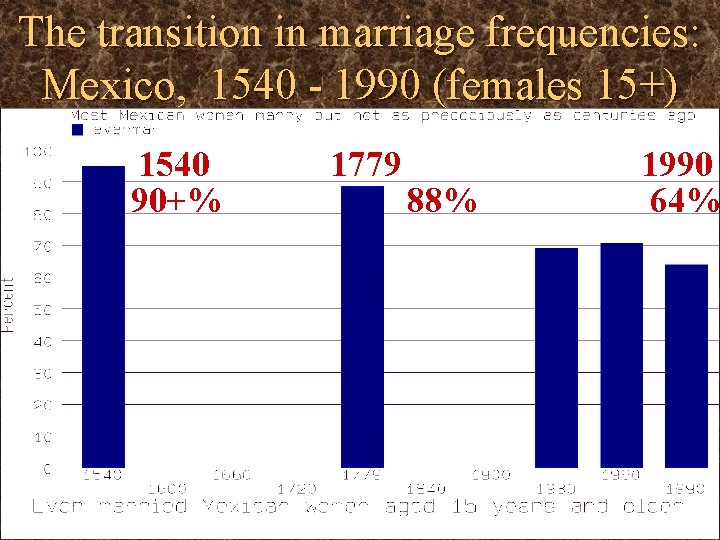
The transition in marriage frequencies: Mexico, 1540 - 1990 (females 15+) 1540 90+% 1779 88% 1990 64%
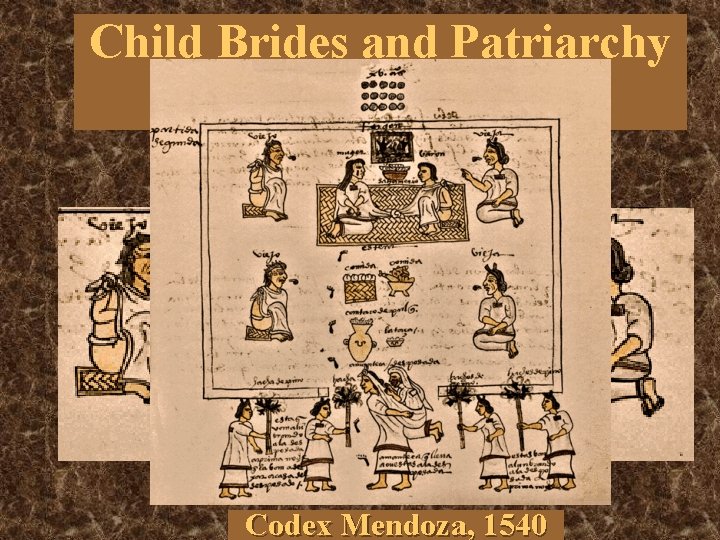
Child Brides and Patriarchy in Ancient Mexico Codex Mendoza, 1540
Age at marriage among the Aztecs, questions: u. Before the conquest, did the Nahuas marry at relatively older ages (25 years for females according to many historians)? u. A different black legend: After the conquest did Spanish overlords and priests force Indians to marry at young ages (to increase taxes and parish dues)?
Marriageways of the nahuas: What did marriage mean? Texts: “they took one another, ” “they joined together, ” “he acquired a woman, ” “his woman, ” etc. Four characteristics of all marital unions in this document (800 pairs, only 1 Christian) u 1. joint residence of man and woman u 2. permancence of union, until death u 3. children (or explanation of why none) u 4. marriage necessary to attain adulthood
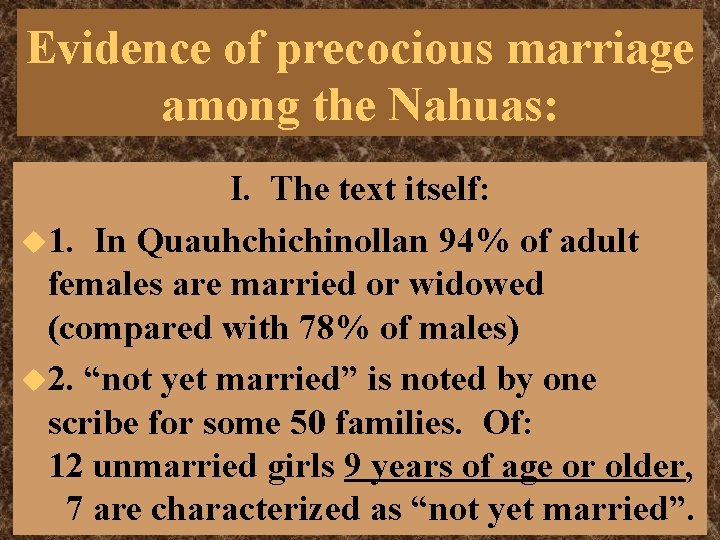
Evidence of precocious marriage among the Nahuas: I. The text itself: u 1. In Quauhchichinollan 94% of adult females are married or widowed (compared with 78% of males) u 2. “not yet married” is noted by one scribe for some 50 families. Of: 12 unmarried girls 9 years of age or older, 7 are characterized as “not yet married”.
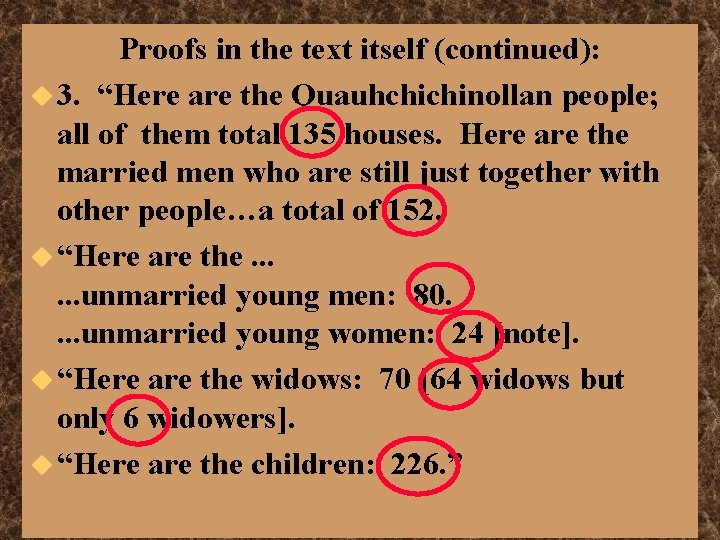
Proofs in the text itself (continued): u 3. “Here are the Quauhchichinollan people; all of them total 135 houses. Here are the married men who are still just together with other people…a total of 152. u “Here are the. . . unmarried young men: 80. . unmarried young women: 24 [note]. u “Here are the widows: 70 [64 widows but only 6 widowers]. u “Here are the children: 226. ”
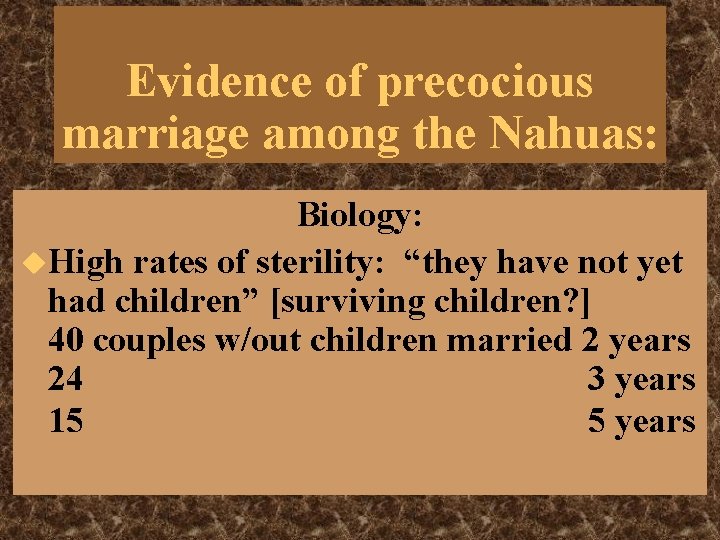
Evidence of precocious marriage among the Nahuas: Biology: u. High rates of sterility: “they have not yet had children” [surviving children? ] 40 couples w/out children married 2 years 24 3 years 15 5 years
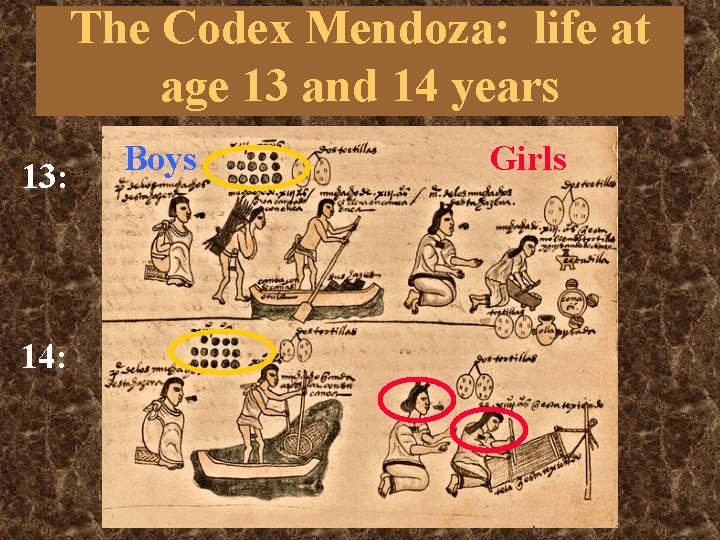
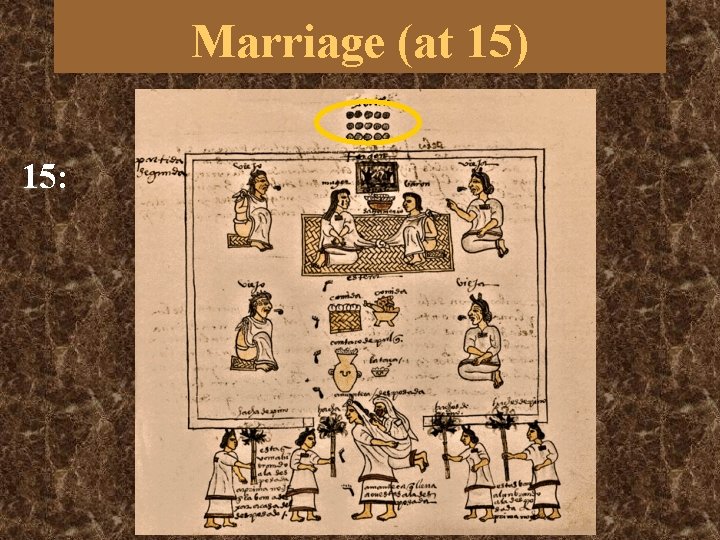
Other evidence of precocious marriage among the Nahua u. The Codex Mendoza (1540) shows the life stages of boys and girls: marriage is celebrated at age 15 (and not at 18, 20 or 25 as often stated by historians):
The Codex Mendoza: life at age 13 and 14 years 13: 14: Boys Girls
Marriage (at 15) 15:
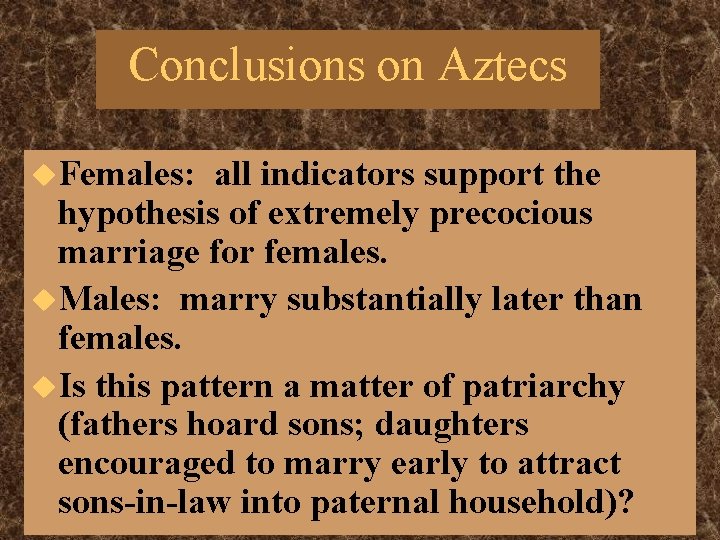
Conclusions on Aztecs u. Females: all indicators support the hypothesis of extremely precocious marriage for females. u. Males: marry substantially later than females. u. Is this pattern a matter of patriarchy (fathers hoard sons; daughters encouraged to marry early to attract sons-in-law into paternal household)?
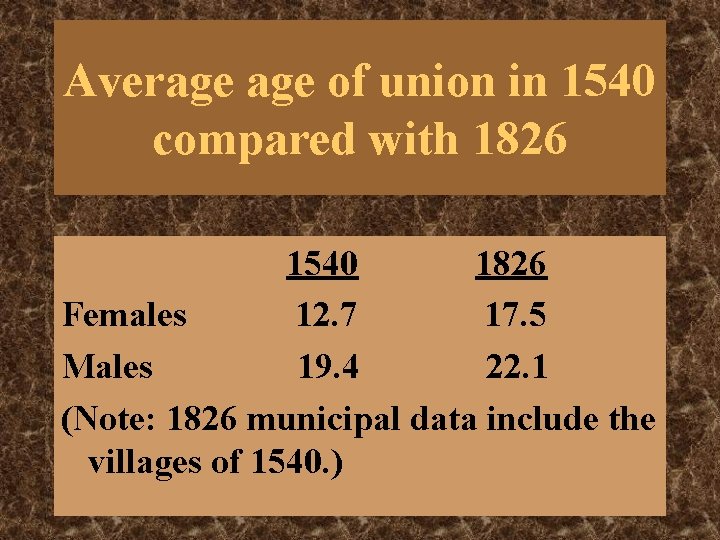
Average of union in 1540 compared with 1826 1540 1826 Females 12. 7 17. 5 Males 19. 4 22. 1 (Note: 1826 municipal data include the villages of 1540. )
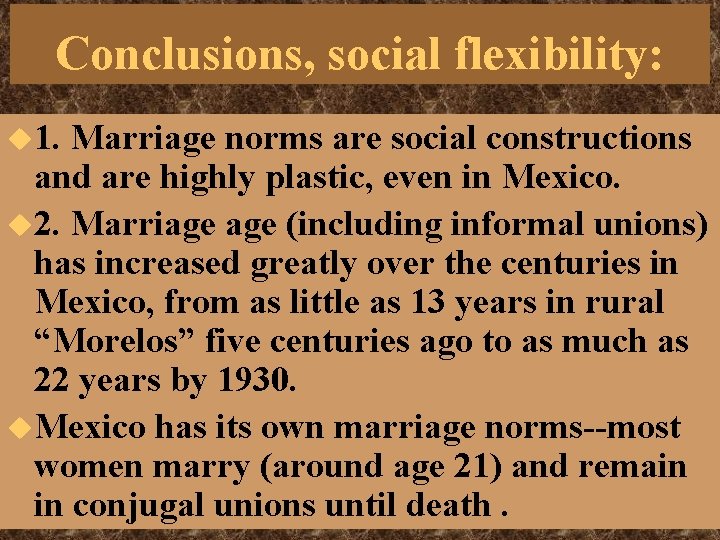
Conclusions, social flexibility: u 1. Marriage norms are social constructions and are highly plastic, even in Mexico. u 2. Marriage (including informal unions) has increased greatly over the centuries in Mexico, from as little as 13 years in rural “Morelos” five centuries ago to as much as 22 years by 1930. u. Mexico has its own marriage norms--most women marry (around age 21) and remain in conjugal unions until death.
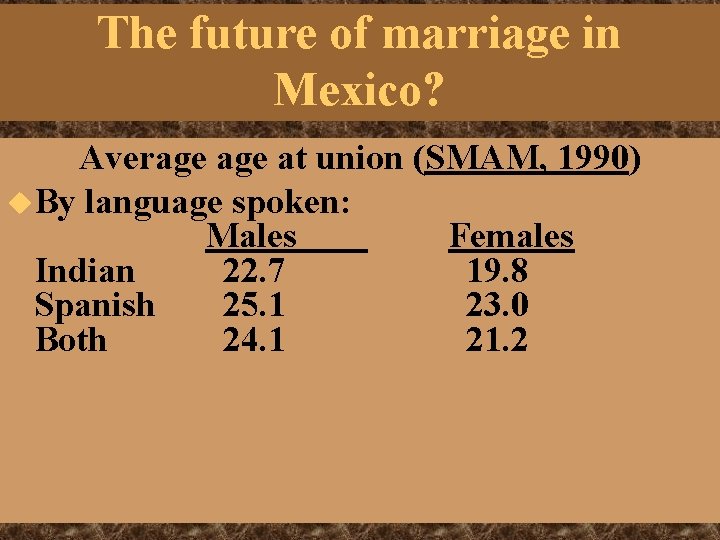
The future of marriage in Mexico? Average at union (SMAM, 1990) u. By language spoken: Males Females Indian 22. 7 19. 8 Spanish 25. 1 23. 0 Both 24. 1 21. 2
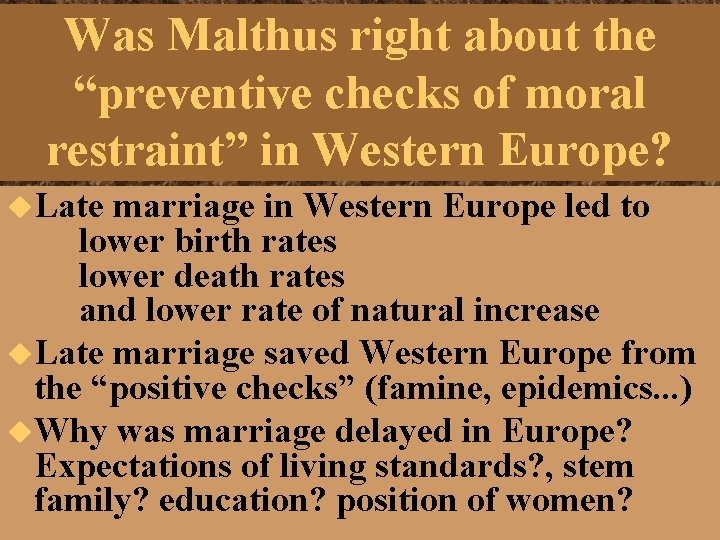
Was Malthus right about the “preventive checks of moral restraint” in Western Europe? u. Late marriage in Western Europe led to lower birth rates lower death rates and lower rate of natural increase u. Late marriage saved Western Europe from the “positive checks” (famine, epidemics. . . ) u. Why was marriage delayed in Europe? Expectations of living standards? , stem family? education? position of women?