
European Institute of Public Administration Institut europen dadministration

European Institute of Public Administration - Institut européen d’administration publique Multi-level governance – Fostering participation in practice Gracia Vara Arribas g. vara-arribas@eipa-ecr. com learning and development - consultancy - research © EIPA 2011
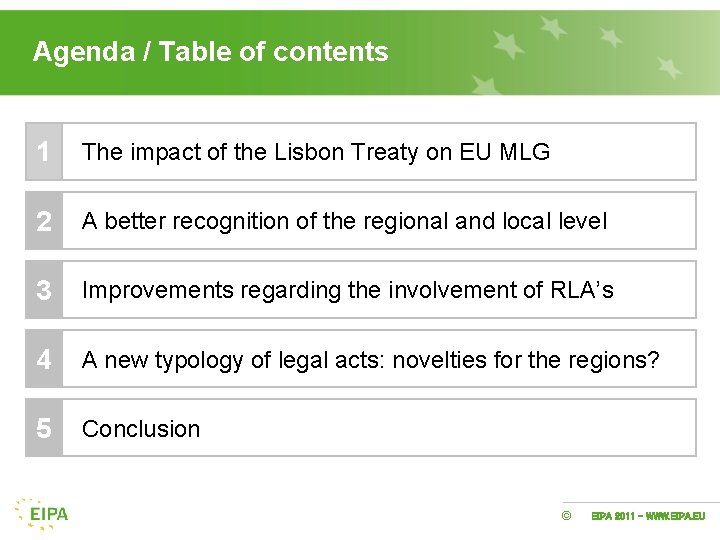
Agenda / Table of contents 1 The impact of the Lisbon Treaty on EU MLG 2 A better recognition of the regional and local level 3 Improvements regarding the involvement of RLA’s 4 A new typology of legal acts: novelties for the regions? 5 Conclusion © EIPA 2011 - WWW. EIPA. EU
1. The impact of the Lisbon Treaty on the EU multi-level governance system § The entry into force of the Treaty of Lisbon (TL), in december 2009, has opened up a new cycle of governance preserving most of the key points of the dead Treaty establishing a Constitution for Europe. § Many concrete novelties ensure that EU governance is evolving towards more advanced multi-level forms improving the standing of regions and cities in the European Union’s political system. Constitutive Value – Catalytic Value © EIPA 2011 - WWW. EIPA. EU
Towards a real MLG? § Treaty of Lisbon = opportunity § Result of almost 10 years of treaty reform § Consolidated framework for many years to come § Focus on policy delivery § Treaty now needs to be used to its full potential © EIPA 2011 - WWW. EIPA. EU
2. A better recognition of local and regional authorities § Respect for minorities and protection of linguistic and cultural diversity § Respect for local and regional self-government § Recognition of the specificity of certain areas and regions § Greater account taken of the role of regional and local authorities with regard to services of general interests (SGIs) § Taking into account of the regional and local dimensions with regard to climate change, energy and civil protection; § Clearer delimitation of competences within the EU § Possibility to increase or reduce the EU competences § Representative democracy & partipatory democracy © EIPA 2011 - WWW. EIPA. EU
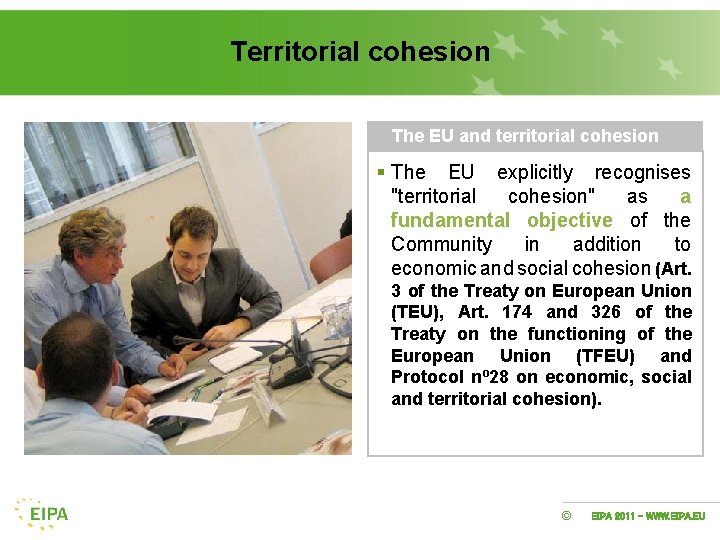
Territorial cohesion The EU and territorial cohesion § The EU explicitly recognises "territorial cohesion" as a fundamental objective of the Community in addition to economic and social cohesion (Art. 3 of the Treaty on European Union (TEU), Art. 174 and 326 of the Treaty on the functioning of the European Union (TFEU) and Protocol nº 28 on economic, social and territorial cohesion). © EIPA 2011 - WWW. EIPA. EU
Phase 3: § The Committee of the Regions has to be consulted in new areas. § New areas under the Ordinary Procedure § More qualified Majority voting. - In 2014 the double majority system Phase 3 © EIPA 2011 - WWW. EIPA. EU

3. Improvements regarding the involvement of RLA’s EU legislative process during the ordinary legislative procedure Pre-legislative phase: European Commission evaluates policy options and prepares legislative proposal Phase 1 Transposition & Implementation of EU legislation The EU institutions start discussing legislative proposal Phase 2 European Commission adopts legislative proposal Phase 3 Phase 4 Phase 5 European Parliament and Council adopt EU legislation © EIPA 2011 - WWW. EIPA. EU
Phase 1: à The Commission, when it motivates its proposals, may include an impact analysis with a regional and local levels, particularly in financial terms. à The regional and local actions have to be planned or taken into account during the stakeholder consultation Phase 1 © EIPA 2011 - WWW. EIPA. EU
Phase 2: § The subsidiarity Early Warning system § The entering into force of the Lisbon Treaty boosts the role of the representative body of regional and local authorities, the Committe of the Regions (Co. R) consolidating its powers from different ways. Phase 2 © EIPA 2011 - WWW. EIPA. EU
Phase 4: § The Co. R can go to Court in cases of breach of the subsidiarity principle Phase 4 © EIPA 2011 - WWW. EIPA. EU
The strengthening of the Co. R’s institutional role § With the Lisbon Treaty, the Co. R obtains the right to bring legal actions before the Court of Justice of the Europan Union, in two different cases : à to protect the Co. R’s own institutional prerogative ; à to request the annulment of EU legislative acts that it considers being in breach of the principle of subsidiarity. © EIPA 2011 - WWW. EIPA. EU
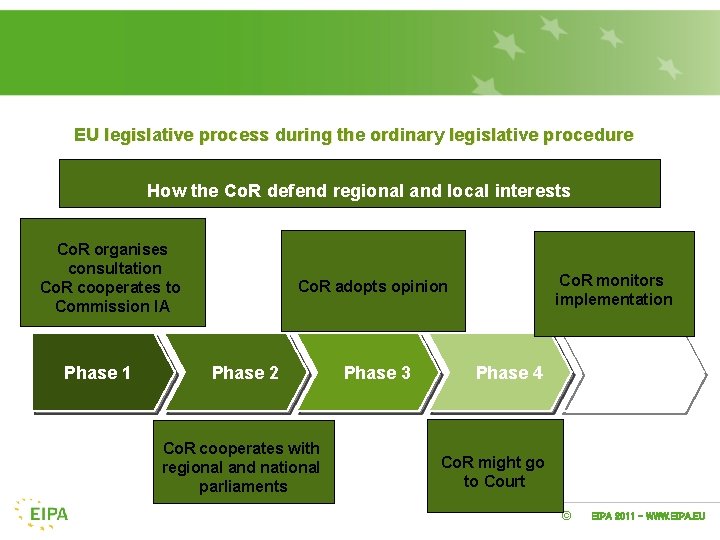
EU legislative process during the ordinary legislative procedure How the Co. R defend regional and local interests Pre-legislative phase: Co. R organises European Commission consultation evaluates policy Co. R cooperates to options and prepares Commission IA legislative proposal Phase 1 Transposition & Implementation Co. R monitors of EU implementation legislation The EU institutions Co. R discussing adopts opinion start legislative proposal Phase 2 European Commission Co. R cooperates adopts legislativewith regional and national proposal parliaments Phase 3 Phase 4 Phase 5 European Parliament Co. R mightand go Council adopt to Court EU legislation © EIPA 2011 - WWW. EIPA. EU
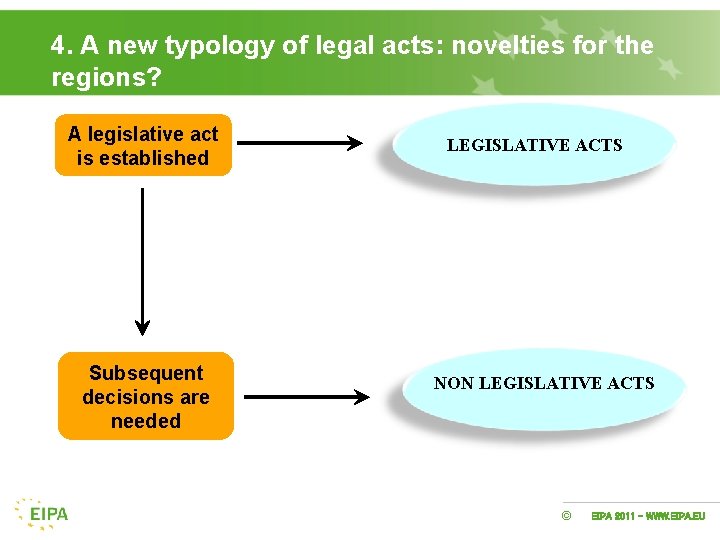
4. A new typology of legal acts: novelties for the regions? A legislative act is established Subsequent decisions are needed LEGISLATIVE ACTS NON LEGISLATIVE ACTS © EIPA 2011 - WWW. EIPA. EU
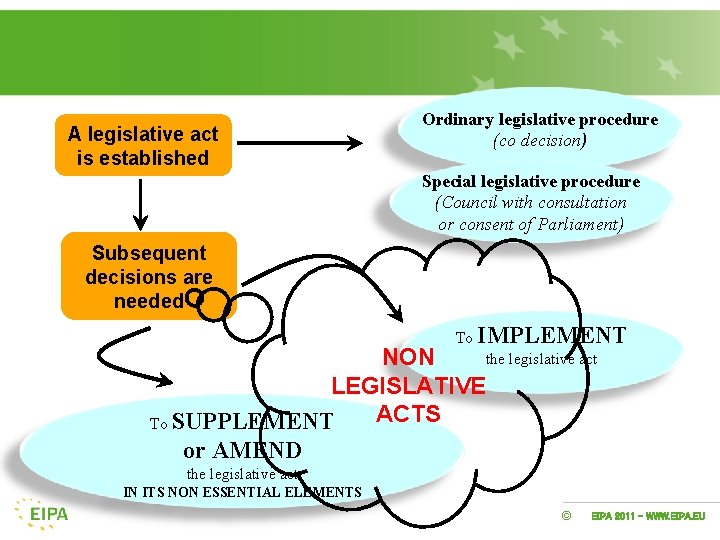
A legislative act is established Ordinary legislative procedure (co decision) Special legislative procedure (Council with consultation or consent of Parliament) Subsequent decisions are needed To IMPLEMENT the legislative act NON LEGISLATIVE ACTS To SUPPLEMENT or AMEND the legislative act IN ITS NON ESSENTIAL ELEMENTS © EIPA 2011 - WWW. EIPA. EU
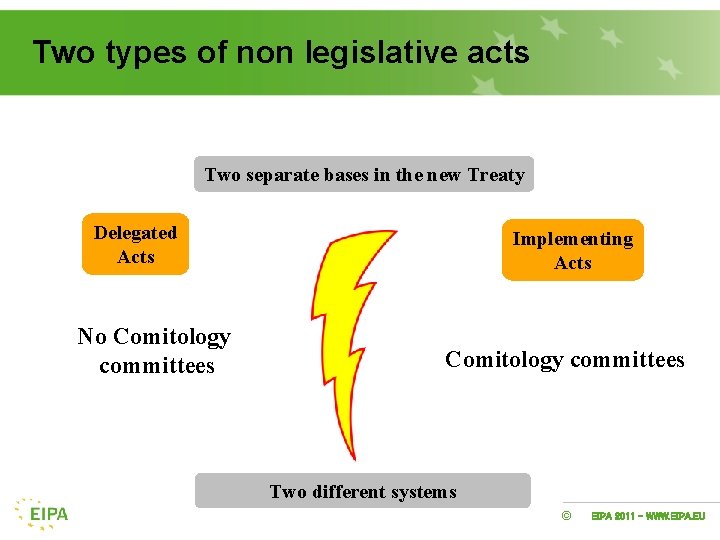
Two types of non legislative acts Two separate bases in the new Treaty Delegated Acts No Comitology committees Implementing Acts Comitology committees Two different systems © EIPA 2011 - WWW. EIPA. EU
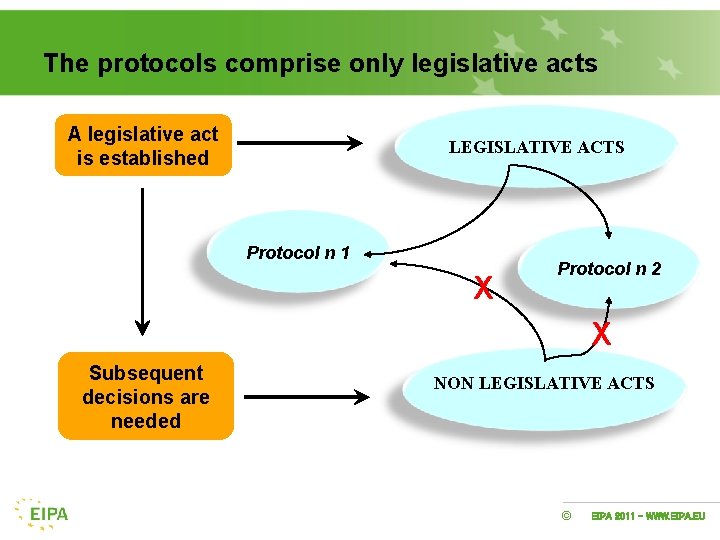
The protocols comprise only legislative acts A legislative act is established LEGISLATIVE ACTS Protocol n 1 X Protocol n 2 X Subsequent decisions are needed NON LEGISLATIVE ACTS © EIPA 2011 - WWW. EIPA. EU
5. Conclusion § The LT consolidates the EU multi-level governance system giving more weight to LRAs and their representative, the Co. R. § The Treaty offers many new possibilities that need to be backed by political willingness at all levels. the Co. R’s White Paper on multi-level governance § In order to exploit the LT potentials, it is essential to establish a real MLG culture within the MS, its regions and the European level. © EIPA 2011 - WWW. EIPA. EU
Thanks § Gracia Vara § www. eipa. eu © EIPA 2011 - WWW. EIPA. EU
- Slides: 19