
European Fiscal Board Assessment of EU fiscal rules

European Fiscal Board Assessment of EU fiscal rules with a focus on the six and two-pack legislation Prof. Niels THYGESEN Chair of the European Fiscal Board Workshop on on "How could the Stability and Growth Pact be simplified? " European Parliament, Brussels, 11 December 2019
Scope of EFB analysis Main objectives of fiscal rules: Have EU fiscal rules. . . − ensured the long-term sustainability of public finances? − allowed counter-cyclical economic stabilisation? − improved the quality of public finances? 2
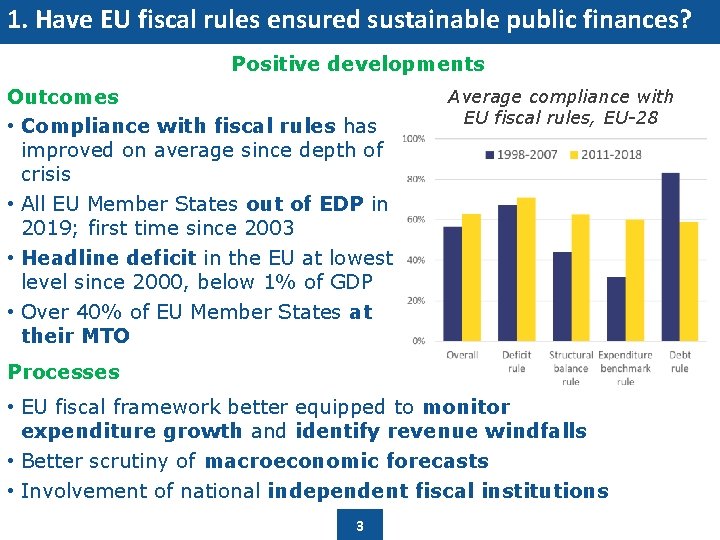
1. Have EU fiscal rules ensured sustainable public finances? Positive developments Outcomes • Compliance with fiscal rules has improved on average since depth of crisis • All EU Member States out of EDP in 2019; first time since 2003 • Headline deficit in the EU at lowest level since 2000, below 1% of GDP • Over 40% of EU Member States at their MTO Average compliance with EU fiscal rules, EU-28 Processes • EU fiscal framework better equipped to monitor expenditure growth and identify revenue windfalls • Better scrutiny of macroeconomic forecasts • Involvement of national independent fiscal institutions 3
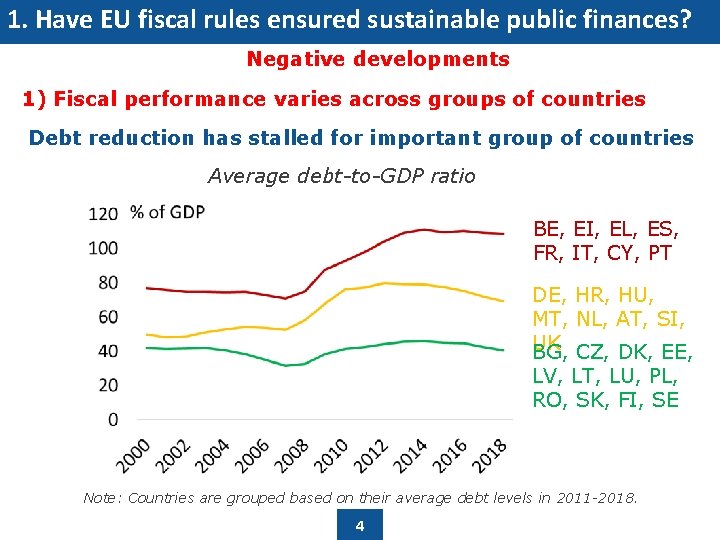
1. Have EU fiscal rules ensured sustainable public finances? Negative developments 1) Fiscal performance varies across groups of countries Debt reduction has stalled for important group of countries Average debt-to-GDP ratio BE, EI, EL, ES, FR, IT, CY, PT DE, HR, HU, MT, NL, AT, SI, UK CZ, DK, EE, BG, LV, LT, LU, PL, RO, SK, FI, SE Note: Countries are grouped based on their average debt levels in 2011 -2018. 4
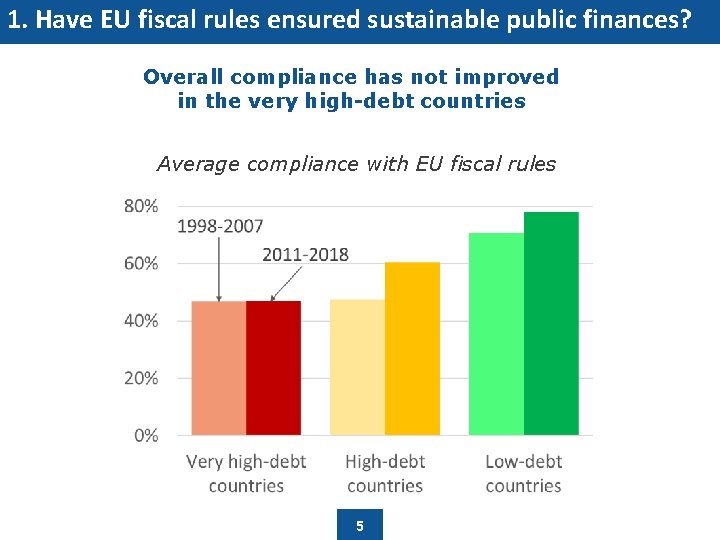
1. Have EU fiscal rules ensured sustainable public finances? Overall compliance has not improved in the very high-debt countries Average compliance with EU fiscal rules 5
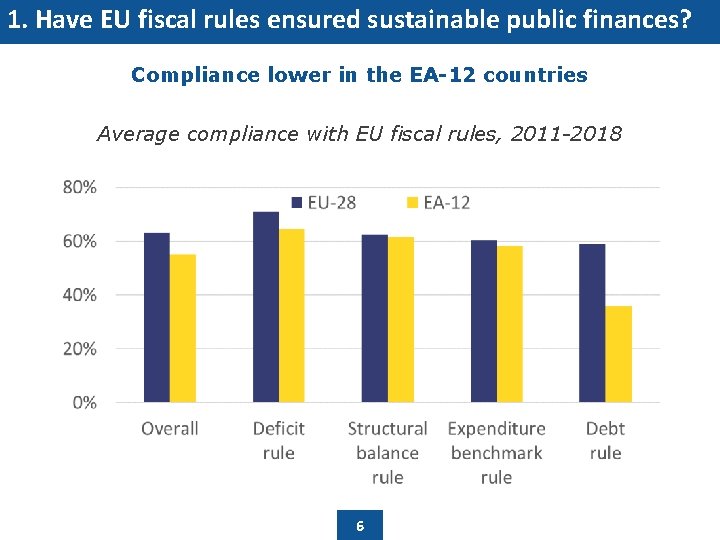
1. Have EU fiscal rules ensured sustainable public finances? Compliance lower in the EA-12 countries Average compliance with EU fiscal rules, 2011 -2018 6
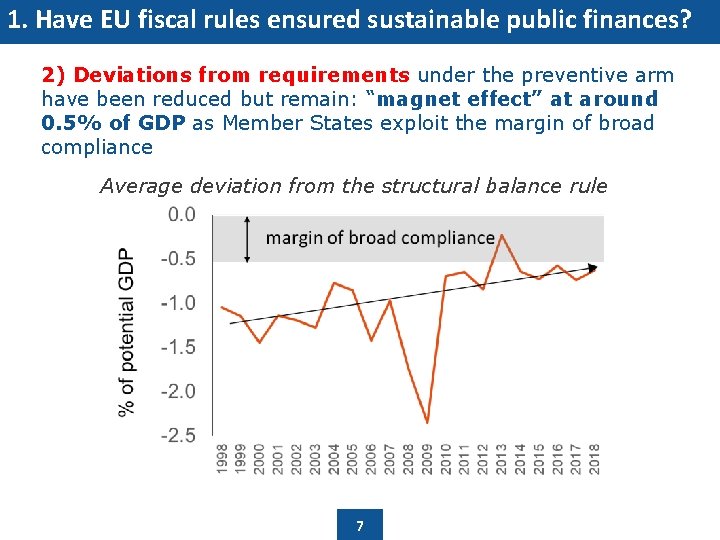
1. Have EU fiscal rules ensured sustainable public finances? 2) Deviations from requirements under the preventive arm have been reduced but remain: “magnet effect” at around 0. 5% of GDP as Member States exploit the margin of broad compliance Average deviation from the structural balance rule 7
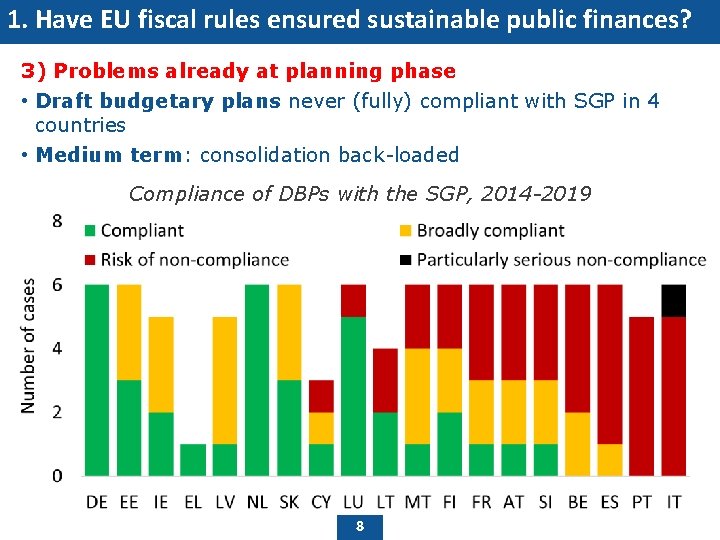
1. Have EU fiscal rules ensured sustainable public finances? 3) Problems already at planning phase • Draft budgetary plans never (fully) compliant with SGP in 4 countries • Medium term: consolidation back-loaded Compliance of DBPs with the SGP, 2014 -2019 8
1. Have EU fiscal rules ensured sustainable public finances? 4) Multiple indicators weaken implementation • Preventive arm: cherry-picking between change in structural balance and expenditure benchmark • Corrective arm: strategy of meeting the nominal deficit target during the recovery thanks to higher revenue, rather than delivering the (more demanding) required structural effort • Debt criterion superseded by compliance with the preventive arm (use of low nominal growth as relevant factor) 9
1. Have EU fiscal rules ensured sustainable public finances? 5) Governance issues • Fiscal surveillance increasingly bilateral and less reliant on pressure by peers • Sanctions prove difficult to enforce: contrary to expectations, RQMV has not helped imposing sanctions, because it has led the Commission to internalise the political consequences of its proposals 10
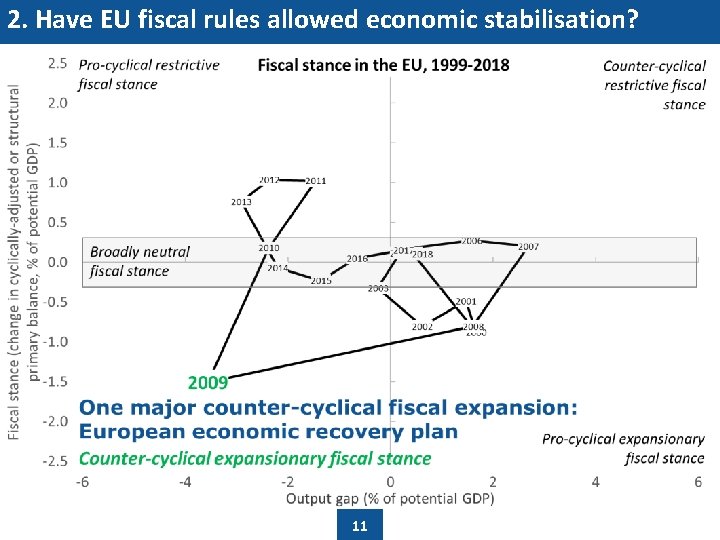
2. Have EU fiscal rules allowed economic stabilisation? 11
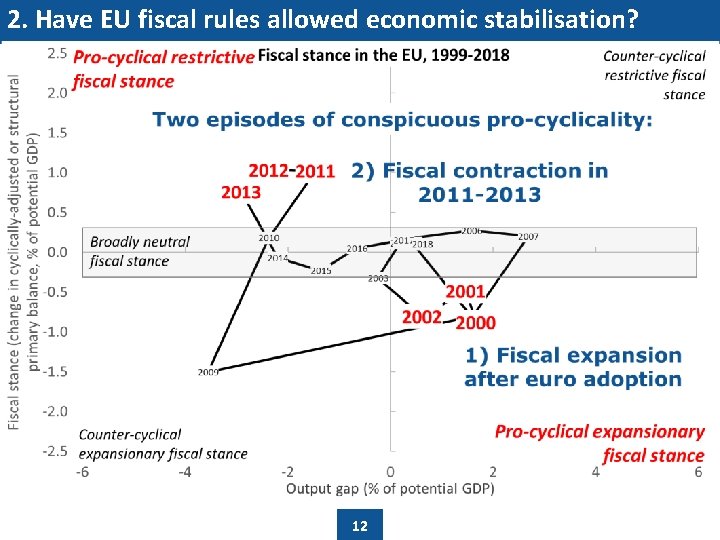
2. Have EU fiscal rules allowed economic stabilisation? 12
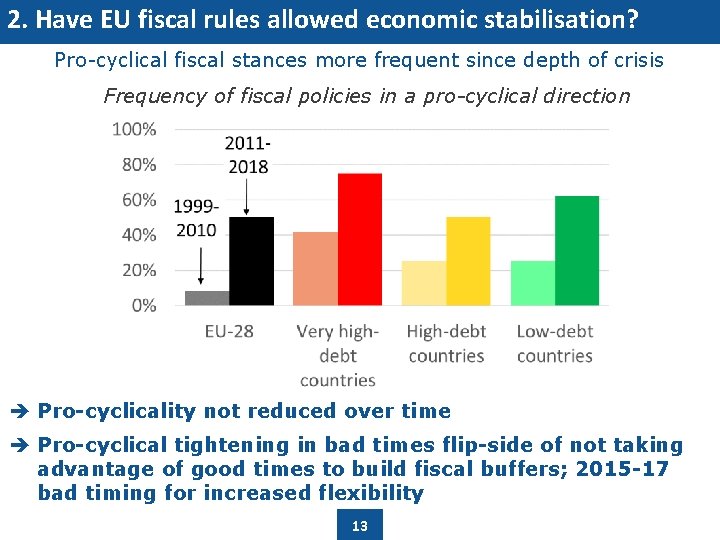
2. Have EU fiscal rules allowed economic stabilisation? Pro-cyclical fiscal stances more frequent since depth of crisis Frequency of fiscal policies in a pro-cyclical direction è Pro-cyclicality not reduced over time è Pro-cyclical tightening in bad times flip-side of not taking advantage of good times to build fiscal buffers; 2015 -17 bad timing for increased flexibility 13
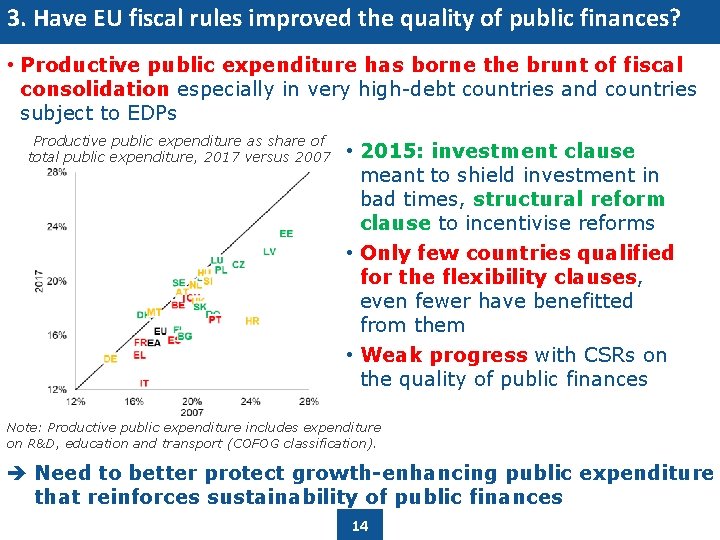
3. Have EU fiscal rules improved the quality of public finances? • Productive public expenditure has borne the brunt of fiscal consolidation especially in very high-debt countries and countries subject to EDPs Productive public expenditure as share of total public expenditure, 2017 versus 2007 • 2015: investment clause meant to shield investment in bad times, structural reform clause to incentivise reforms • Only few countries qualified for the flexibility clauses, even fewer have benefitted from them • Weak progress with CSRs on the quality of public finances Note: Productive public expenditure includes expenditure on R&D, education and transport (COFOG classification). è Need to better protect growth-enhancing public expenditure that reinforces sustainability of public finances 14
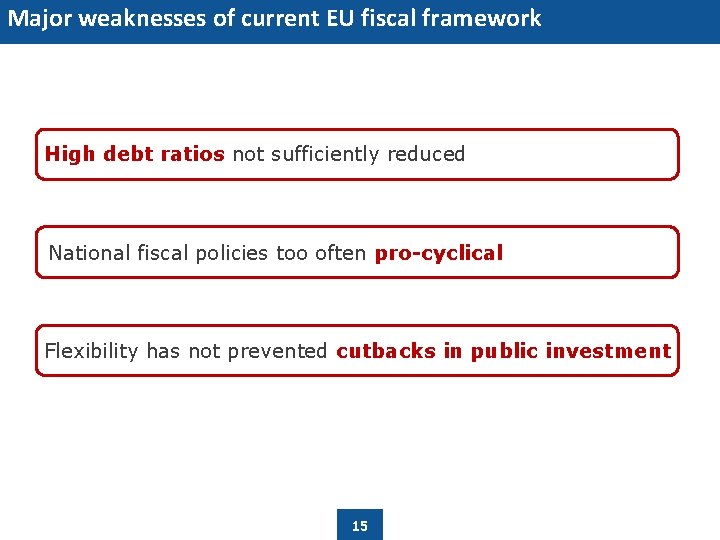
Major weaknesses of current EU fiscal framework High debt ratios not sufficiently reduced National fiscal policies too often pro-cyclical Flexibility has not prevented cutbacks in public investment 15
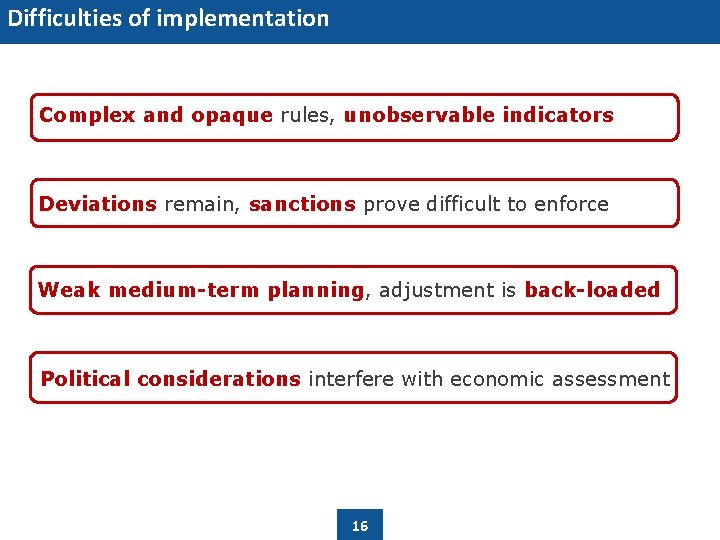
Difficulties of implementation Complex and opaque rules, unobservable indicators Deviations remain, sanctions prove difficult to enforce Weak medium-term planning, adjustment is back-loaded Political considerations interfere with economic assessment 16
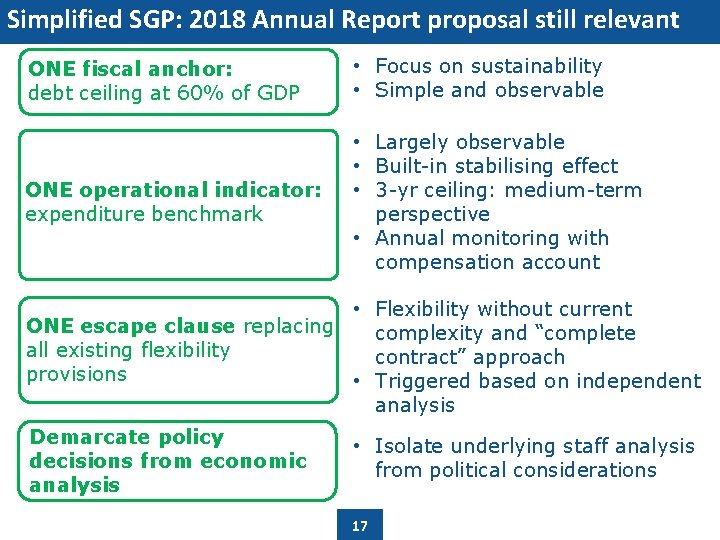
Simplified SGP: 2018 Annual Report proposal still relevant ONE fiscal anchor: debt ceiling at 60% of GDP • Focus on sustainability • Simple and observable ONE operational indicator: expenditure benchmark • Largely observable • Built-in stabilising effect • 3 -yr ceiling: medium-term perspective • Annual monitoring with compensation account • Flexibility without current ONE escape clause replacing complexity and “complete all existing flexibility contract” approach provisions • Triggered based on independent analysis Demarcate policy decisions from economic analysis • Isolate underlying staff analysis from political considerations 17
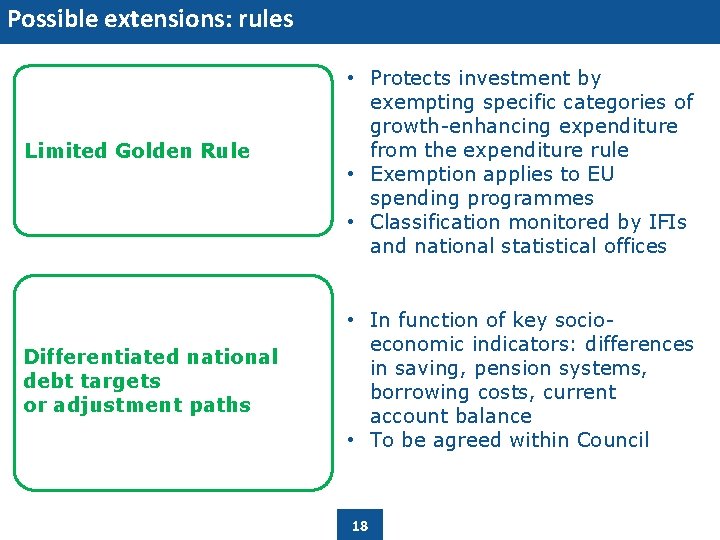
Possible extensions: rules Limited Golden Rule Differentiated national debt targets or adjustment paths • Protects investment by exempting specific categories of growth-enhancing expenditure from the expenditure rule • Exemption applies to EU spending programmes • Classification monitored by IFIs and national statistical offices • In function of key socioeconomic indicators: differences in saving, pension systems, borrowing costs, current account balance • To be agreed within Council 18
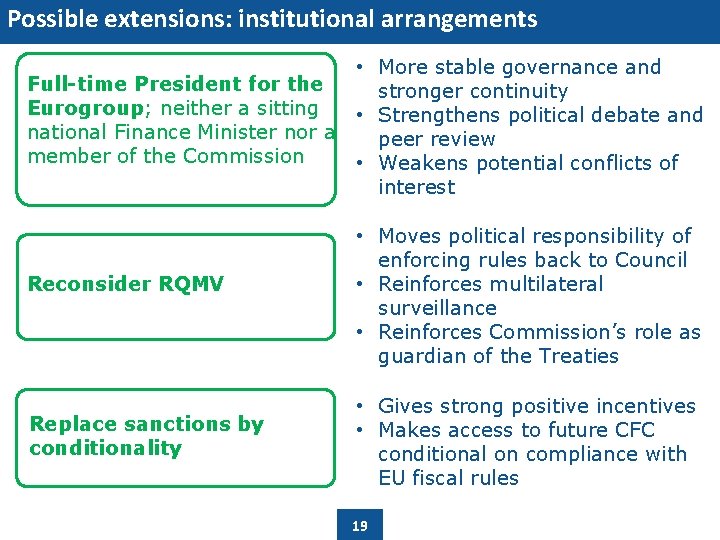
Possible extensions: institutional arrangements • More stable governance and Full-time President for the stronger continuity Eurogroup; neither a sitting • Strengthens political debate and national Finance Minister nor a peer review member of the Commission • Weakens potential conflicts of interest Reconsider RQMV Replace sanctions by conditionality • Moves political responsibility of enforcing rules back to Council • Reinforces multilateral surveillance • Reinforces Commission’s role as guardian of the Treaties • Gives strong positive incentives • Makes access to future CFC conditional on compliance with EU fiscal rules 19

Thank you for your attention

Background slides
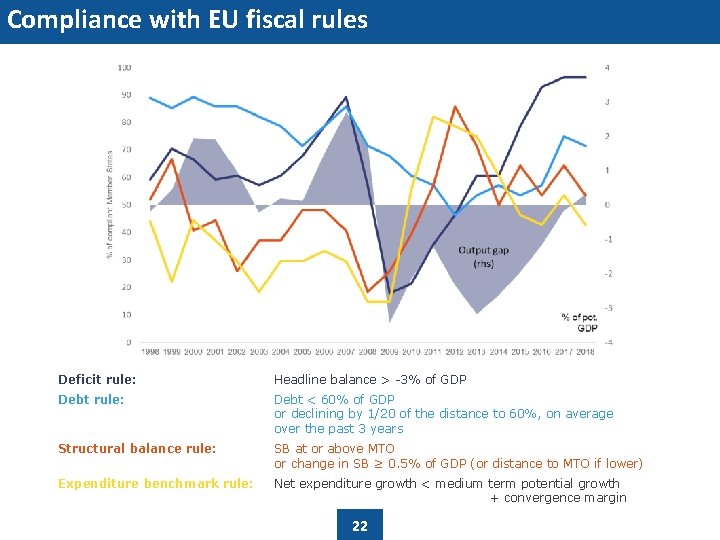
Compliance with EU fiscal rules Deficit rule: Headline balance > -3% of GDP Debt rule: Debt < 60% of GDP or declining by 1/20 of the distance to 60%, on average over the past 3 years Structural balance rule: SB at or above MTO or change in SB ≥ 0. 5% of GDP (or distance to MTO if lower) Expenditure benchmark rule: Net expenditure growth < medium term potential growth + convergence margin 22
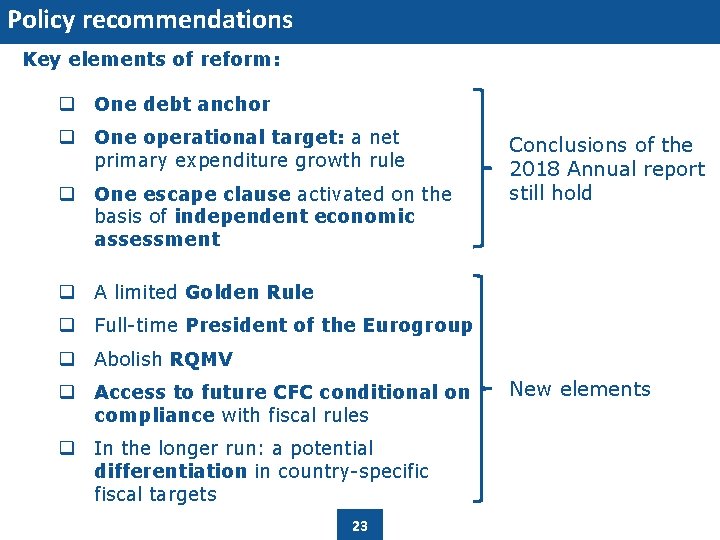
Policy recommendations Key elements of reform: q One debt anchor q One operational target: a net primary expenditure growth rule q One escape clause activated on the basis of independent economic assessment Conclusions of the 2018 Annual report still hold q A limited Golden Rule q Full-time President of the Eurogroup q Abolish RQMV q Access to future CFC conditional on compliance with fiscal rules q In the longer run: a potential differentiation in country-specific fiscal targets 23 New elements
- Slides: 23