
European Exploration Why Who What Where When Gold
- Slides: 24
European Exploration Why? Who? What? Where? When?
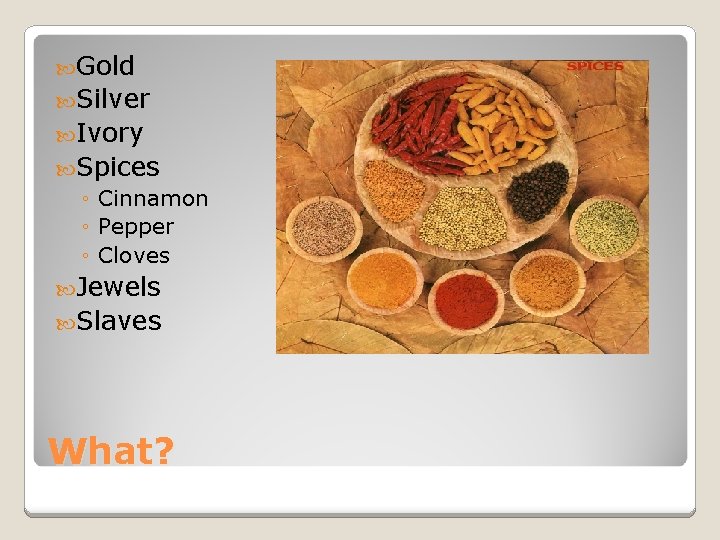
Gold Silver Ivory Spices ◦ Cinnamon ◦ Pepper ◦ Cloves Jewels Slaves What?
Seek Greater Wealth ◦ Merchants and traders wanted to expand the already profitable business of trading new luxuries. ◦ Also, European merchants/kings wish to rid of the Italian middleman. Crusades/Reformation Spread of Christianity ◦ Crusades left feeling of hostility towards Muslims, so they felt the need to continue fighting and to convert non-Muslims. ◦ “God, glory, and gold” Why?
New Technology ◦ Needed new technology to make discovery possible ◦ Caravel triangular sail allowed ships to sail against the wind ◦ The astrolabe and the compass (both came from the Muslims and the east) Renaissance and peoples. Why? curiosity about other lands
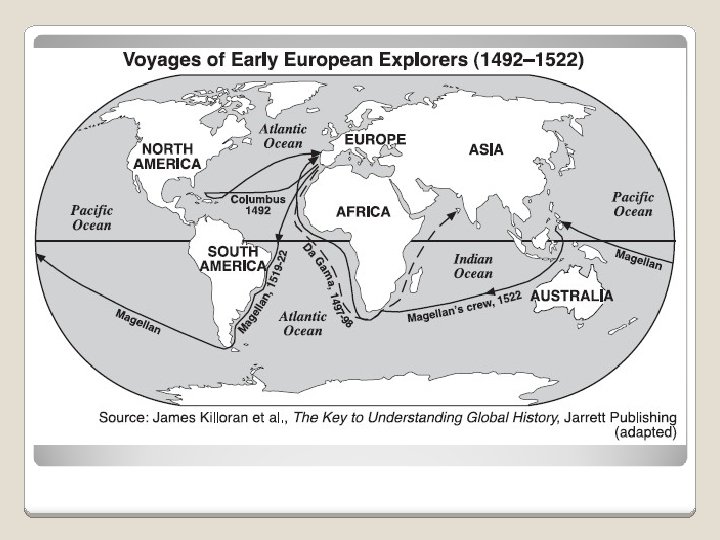
Portugal ◦ Prince Henry strong government support ◦ 1419 created his own navigational school ◦ Died in 1460, but by then, Portugal had established a series of trading posts along the shores of Africa. Pepper, cinnamon, cloves, gold, silver, jewels, and slaves. Later, wished to find a sea route to Asia. ◦ Dias made it around the tip of Africa but ultimately failed. Gave room to Vasco de Gama who reached the coast of India. Who?
Spain ◦ Good ole Chris Columbus wanted to have his extreme trip around the Atlantic to be funded ◦ Spain needed to find a route to beat Portugal. ◦ So in 1492 Columbus sailed the ocean blue. Sought a different route to India by sailing West across Atlantic ◦ He miscalculated where he had landed (Bahamas not India) ◦ His voyage started European colonization of the Americas Conquistadors ◦ Conquered Native American land ◦ Native Americans could do little to stop them Europeans had superior weapons, recruited resentful Native Americans and introduced new disease Who?
Netherlands ◦ Owned largest fleet of ships in the world ◦ Set up many successful trading posts in Asia ◦ Set up trading posts along the Hudson river, where major activities were fur trading ◦ Colonized several Caribbean islands ◦ Broke down the Portuguese influence on Philippines ◦ The Dutch East India Company outmuscled the English East India Company Minted their own money, make treaties, and even raise their own armies. Who?
England ◦ Set up trading posts in Asia ◦ Set up colonies on east cost of North America where major economic activity was tobacco growing. Virginia and North Carolina area France ◦ Focused mainly on North America ◦ Main activity was fur trading ◦ They did not colonize North American territories like England ◦ Colonized several Caribbean islands Who?
European Disagreements ◦ Treaty of Tordesillas Line of Demarcation Between Portugal and Spain to claim new land, eastern lands to Portugal, western to Spain Treaty didn’t apply to other countries so they ignored it Problems Already
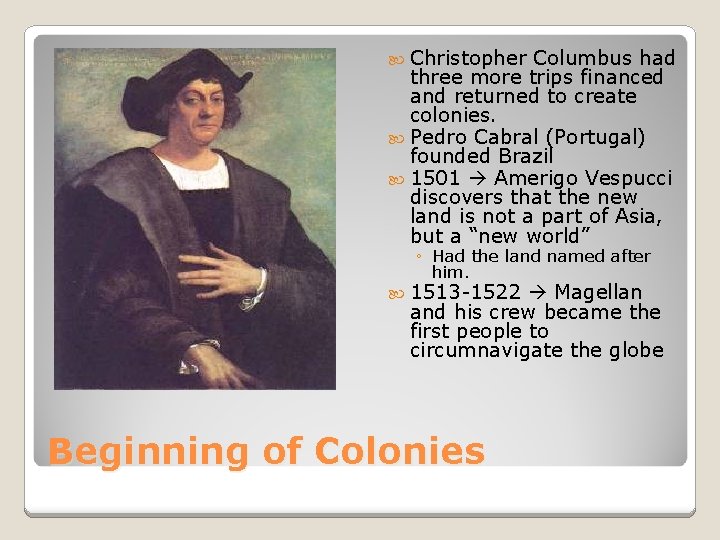
Christopher Columbus had three more trips financed and returned to create colonies. Pedro Cabral (Portugal) founded Brazil 1501 Amerigo Vespucci discovers that the new land is not a part of Asia, but a “new world” ◦ Had the land named after him. 1513 -1522 Magellan and his crew became the first people to circumnavigate the globe Beginning of Colonies
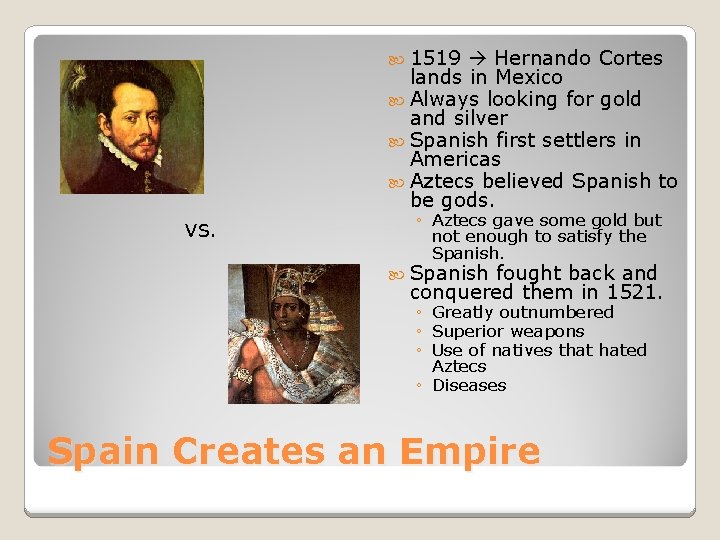
1519 Hernando Cortes lands in Mexico Always looking for gold and silver Spanish first settlers in Americas Aztecs believed Spanish to be gods. VS. ◦ Aztecs gave some gold but not enough to satisfy the Spanish fought back and conquered them in 1521. ◦ Greatly outnumbered ◦ Superior weapons ◦ Use of natives that hated Aztecs ◦ Diseases Spain Creates an Empire
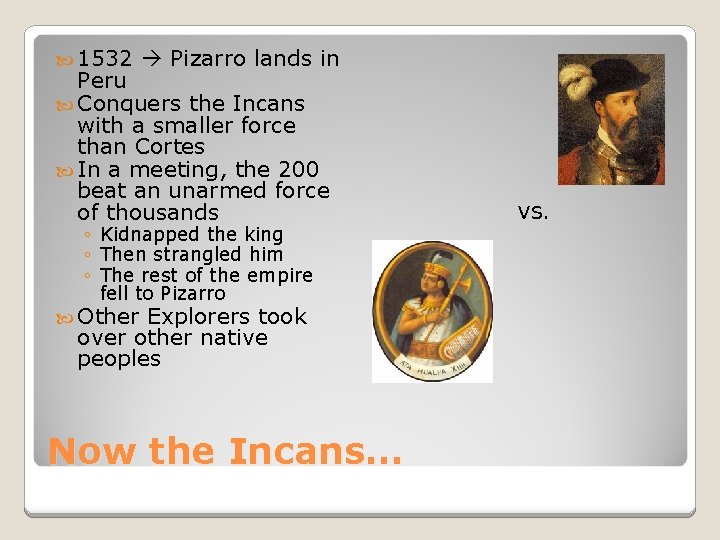
1532 Pizarro lands in Peru Conquers the Incans with a smaller force than Cortes In a meeting, the 200 beat an unarmed force of thousands ◦ Kidnapped the king ◦ Then strangled him ◦ The rest of the empire fell to Pizarro Other Explorers took over other native peoples Now the Incans… VS.
Spanish settlers in America peninsulares (mostly men) ◦ Married native women to create large mestizo population. Although the Spanish married the natives, they oppressed them. The Reconquista Encomienda Europeans had authority from rulers to run natives land ◦ Early system of slave labor ◦ Harsh treatment of natives Usually overworked and abused often
Spanish priests worked to spread Christianity but they pushed for better treatment of the Native Americans. ◦ Criticized the pattern of labor under the encomienda system. ◦ Bartolome de Las Casas suggested the better treatment of natives and the use of Africans (later changed his mind) ◦ Encomienda system was abolished in 1542. ◦ Between 1510 to 1610, native population in Mexico was reduced from 25 million to 1 million. Opposition to Spanish Rule
New France Canada ◦ ALL ABOUT FUR!!!! and Louisiana New England Jamestown, VA & Massachusetts Bay Colony (Pilgrims, aka Puritans) New Netherland Hudson Bay, Hudson River, Hudson Strait ◦ Trading Posts not permanent settlement New France/England/Netherlands
Working relationship with the French and Dutch Strained relationship with the English ◦ WHY? English wished to populate colonies, which meant moving the Natives out Misunderstanding with religions ◦ King Philip’s War Again, the backbreaker to the natives was the various European diseases. ◦ Led to shortage of labor which is why they began to go after the Africans in both North and South America. Native American Reaction
As the native labor in the America began to die out, the Europeans had to begin looking elsewhere ◦ That place was Africa. ◦ 3 major reasons why Africans: 1. Immunities to European diseases. 2. Experience in farming 3. Strangers to America nowhere to hide Spain and Portugal lead the way in terms of importing slaves ◦ Portugal was #1, by late 1800’s over 3. 6 million Africans were transported to Brazil The Atlantic Slave Trade
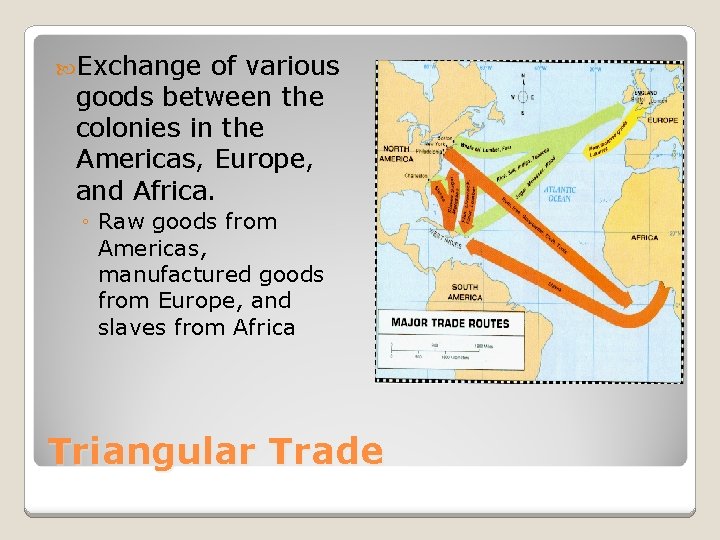
Exchange of various goods between the colonies in the Americas, Europe, and Africa. ◦ Raw goods from Americas, manufactured goods from Europe, and slaves from Africa Triangular Trade
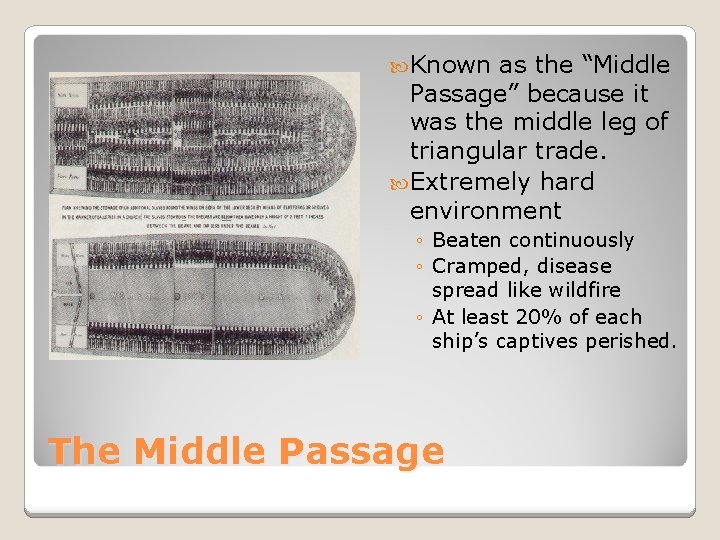
Known as the “Middle Passage” because it was the middle leg of triangular trade. Extremely hard environment ◦ Beaten continuously ◦ Cramped, disease spread like wildfire ◦ At least 20% of each ship’s captives perished. The Middle Passage
In Africa: ◦ Numerous cultures and tribes lost generations of their youth. ◦ Families torn apart that split culture ◦ Introduced guns that can still be seen in effect today. In America: ◦ Greatly influenced to the economic and cultural development of the Americas. ◦ Helped stabilize colonies that would not have survived w/o their labor ◦ Also helped continue the population growth of the Americas by marrying natives and creating a large mixed -race population Impact of Slave Trade
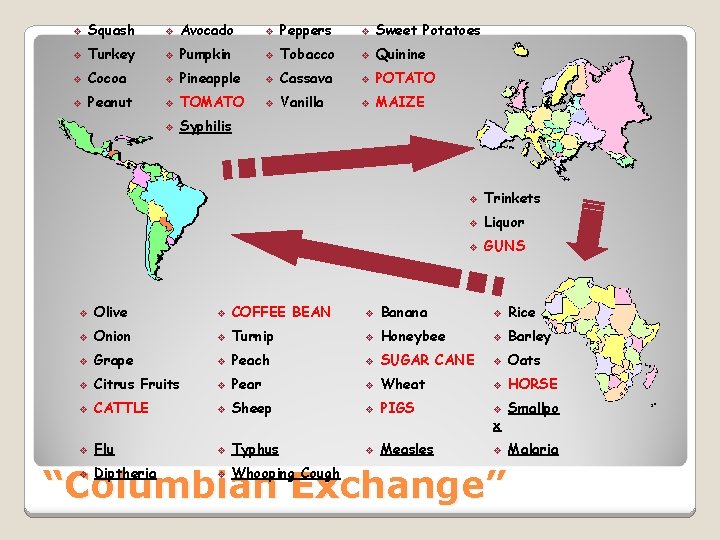
Global transfer of foods, plants, and animals during the colonization of the Americas ◦ Perhaps the most important item to travel from the Americas to the rest of the world were the potatoes and corn Traffic across the Atlantic flowed both ways ◦ Europeans introduced livestock animals into the Americas (horse, cattle, pigs) ◦ Food and slaves and disease also came from Africa to the America “Columbian Exchange”
v Squash v Avocado v Peppers v Sweet Potatoes v Turkey v Pumpkin v Tobacco v Quinine v Cocoa v Pineapple v Cassava v POTATO v Peanut v TOMATO v Vanilla v MAIZE v Syphilis v Trinkets v Liquor v GUNS v Olive v COFFEE BEAN v Banana v Rice v Onion v Turnip v Honeybee v Barley v Grape v Peach v SUGAR CANE v Oats v Citrus Fruits v Pear v Wheat v HORSE v CATTLE v Sheep v PIGS v Smallpo v Flu v Typhus v Measles v Malaria x “Columbian Exchange” v Diptheria v Whooping Cough
Beginnings of Capitalism ◦ Economic system based on private ownership and the investment of wealth for profit. ◦ No longer the government more privatized Joint-stock companies ◦ A business in which investors pool their wealth for a common purpose, then share the profits. Growth of Mercantilism ◦ Country’s power depended mainly on its wealth. ◦ Nation could increase wealth in two ways Obtain as much gold and silver as possible Establish a favorable balance of trade sold more goods than it bought ◦ Ultimate goal was self-sufficiency Effects of “Columbian Exchange”