
European Economic Integration 110451 0992 2014 III EUs

- Slides: 46
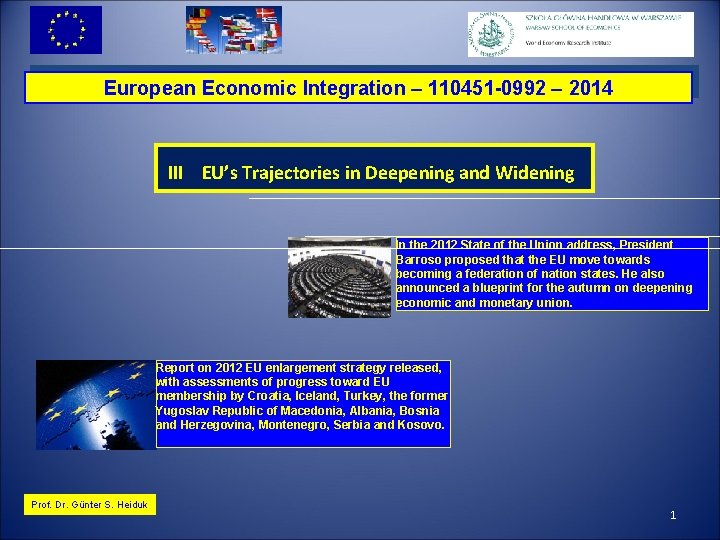
European Economic Integration – 110451 -0992 – 2014 III EU’s Trajectories in Deepening and Widening In the 2012 State of the Union address, President Barroso proposed that the EU move towards becoming a federation of nation states. He also announced a blueprint for the autumn on deepening economic and monetary union. Report on 2012 EU enlargement strategy released, with assessments of progress toward EU membership by Croatia, Iceland, Turkey, the former Yugoslav Republic of Macedonia, Albania, Bosnia and Herzegovina, Montenegro, Serbia and Kosovo. Prof. Dr. Günter S. Heiduk 1
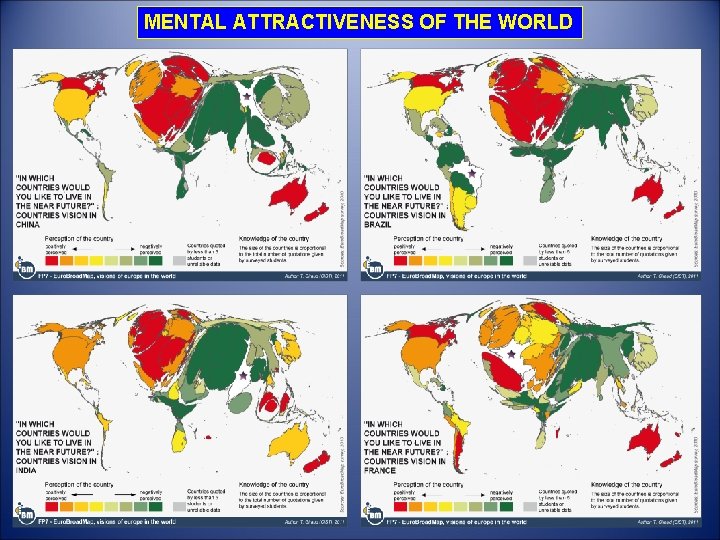
Euro. Broad. Map – Visions of Europe in the World The Euro. Broad. Map project aims to produce a non-Eurocentric vision of Europe in the world. Until now, two large scale surveys have been set up. The first one focused on 9350 students in 43 cities of 18 countries in the world chosen to allow interesting comparisons. It aims to check the variation of the perception of Europe in the world as a homogeneous population (students between 20 and 25 years old) has been surveyed. The survey has been done in EU countries, Eastern and Southern neighboring countries and remote countries. The second survey focused on migrants in an anthropological perspective. It aims to check the variation of the perception of Europe in space and time among a particular population. The survey conducted on students already shows interesting results on Europe perception even if the analysis of the maps is still in progress. For example, we have noticed very huge differences in the question where students are invited to associate 5 words to Europe with EU student using an economic and institutional vocabulary and other students having a balanced point of view with reference to luxury, well being, development level but also domination and racism. But whatever the words used Europe appear as one of the most attractive place of the world for the students. http: //cordis. europa. eu/documents/documentlibrary/116651581 EN 6. pdf
MENTAL ATTRACTIVENESS OF THE WORLD
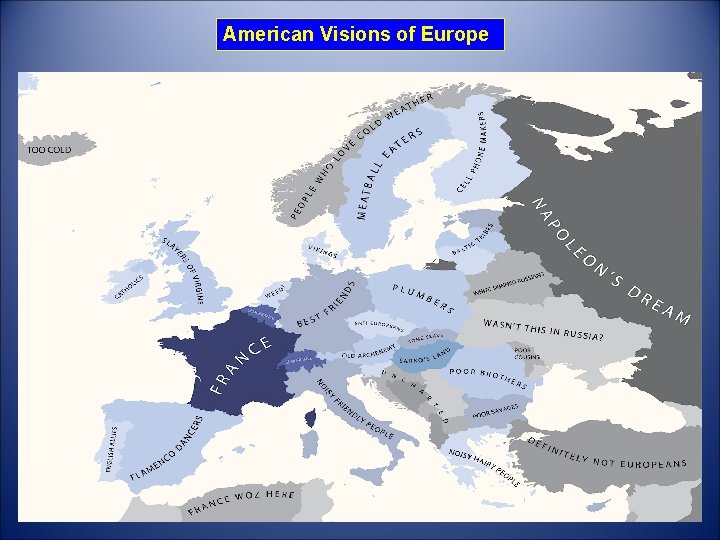
American Visions of Europe 5
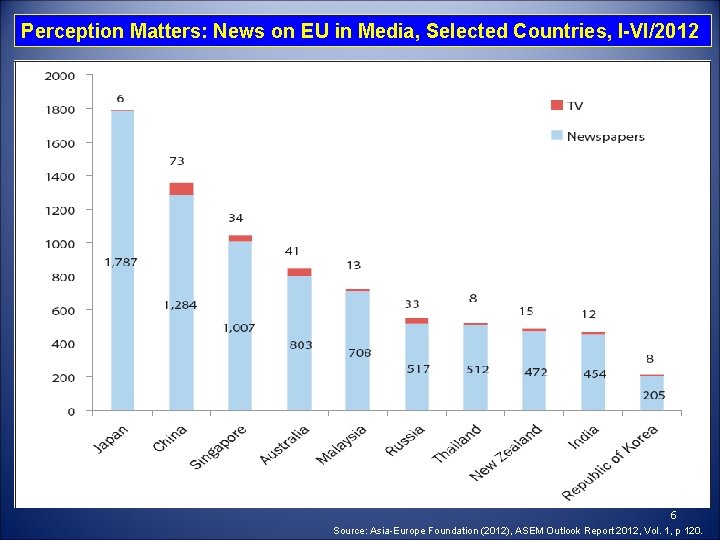
Perception Matters: News on EU in Media, Selected Countries, I-VI/2012 6 Source: Asia-Europe Foundation (2012), ASEM Outlook Report 2012, Vol. 1, p 120.
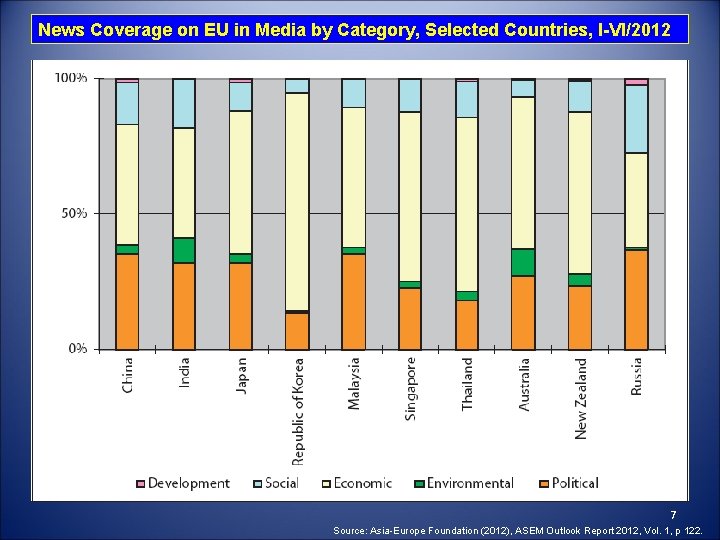
News Coverage on EU in Media by Category, Selected Countries, I-VI/2012 7 Source: Asia-Europe Foundation (2012), ASEM Outlook Report 2012, Vol. 1, p 122.
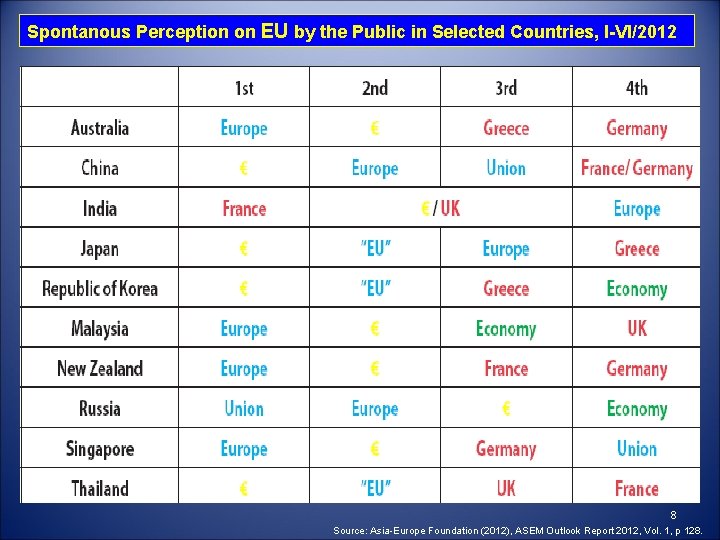
Spontanous Perception on EU by the Public in Selected Countries, I-VI/2012 8 Source: Asia-Europe Foundation (2012), ASEM Outlook Report 2012, Vol. 1, p 128.
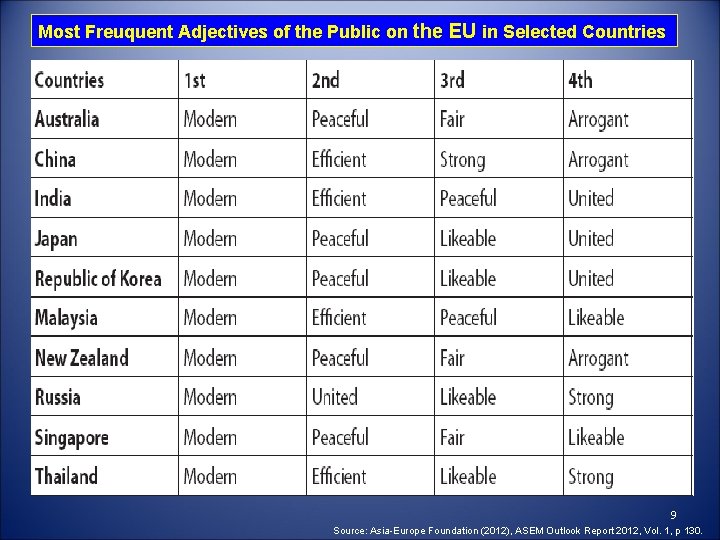
Most Freuquent Adjectives of the Public on the EU in Selected Countries 9 Source: Asia-Europe Foundation (2012), ASEM Outlook Report 2012, Vol. 1, p 130.
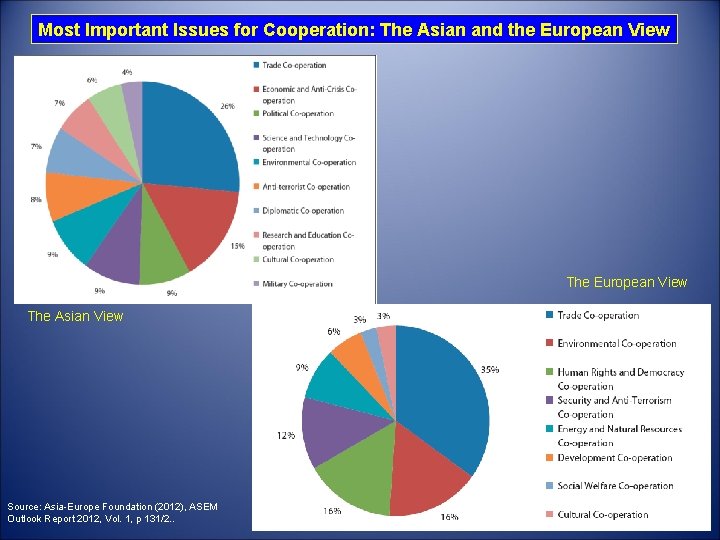
Most Important Issues for Cooperation: The Asian and the European View The Asian View Source: Asia-Europe Foundation (2012), ASEM Outlook Report 2012, Vol. 1, p 131/2. . 10
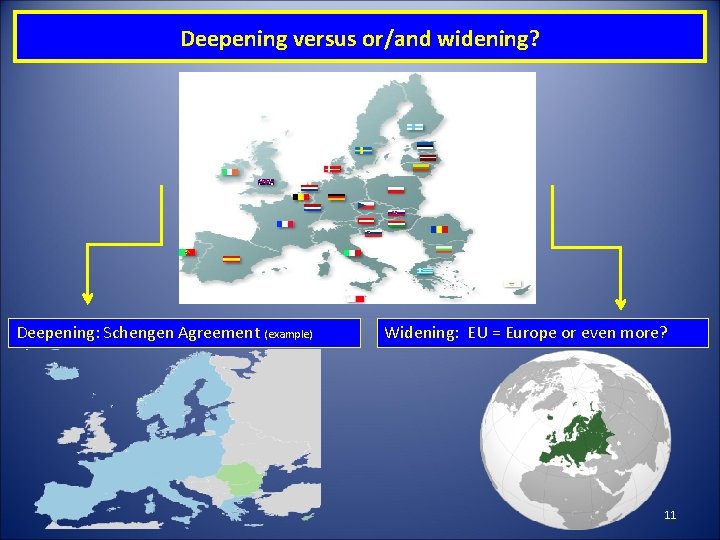
Deepening versus or/and widening? Deepening: Schengen Agreement (example) Widening: EU = Europe or even more? 11
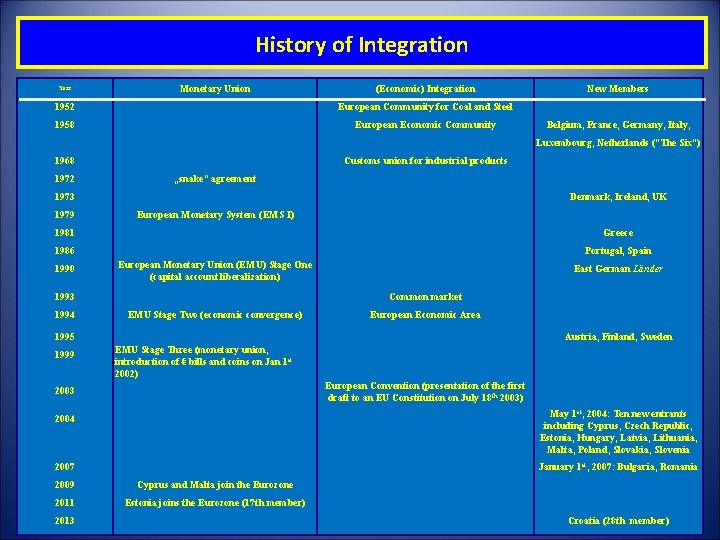
History of Integration Year Monetary Union (Economic) Integration 1952 European Community for Coal and Steel 1958 European Economic Community New Members Belgium, France, Germany, Italy, Luxembourg, Netherlands (“The Six”) 1968 1972 Customs union for industrial products „snake“ agreement 1973 1979 Denmark, Ireland, UK European Monetary System (EMS I) 1981 Greece 1986 1990 Portugal, Spain European Monetary Union (EMU) Stage One (capital account liberalization) 1993 1994 East German Länder Common market EMU Stage Two (economic convergence) European Economic Area 1995 1999 Austria, Finland, Sweden EMU Stage Three (monetary union, introduction of € bills and coins on Jan 1 st 2002) European Convention (presentation of the first draft to an EU Constitution on July 18 th 2003) 2003 2004 May 1 st, 2004: Ten new entrants including Cyprus, Czech Republic, Estonia, Hungary, Latvia, Lithuania, Malta, Poland, Slovakia, Slovenia 2007 January 1 st, 2007: Bulgaria, Romania 2009 Cyprus and Malta join the Eurozone 2011 Estonia joins the Eurozone (17 th member) 2013 12 Croatia (28 th member)
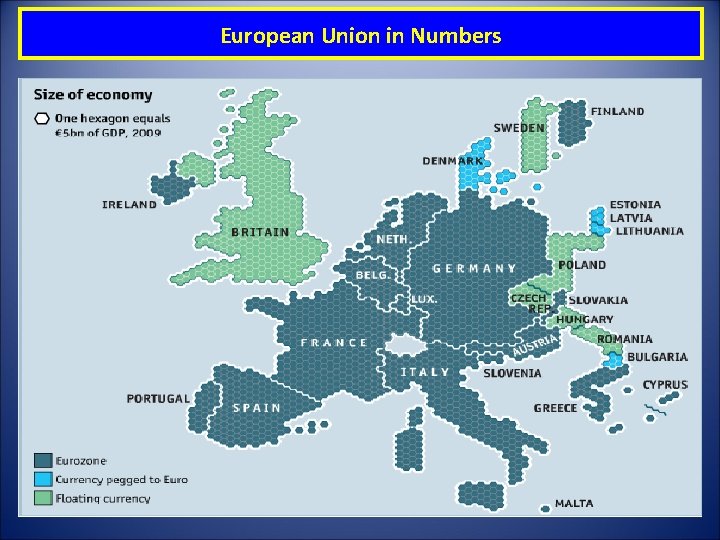
European Union in Numbers
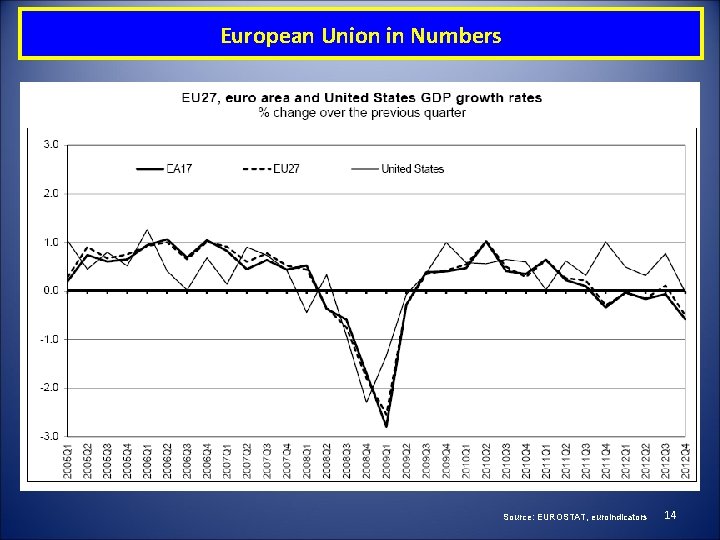
European Union in Numbers Source: EUROSTAT, euroindicators 14
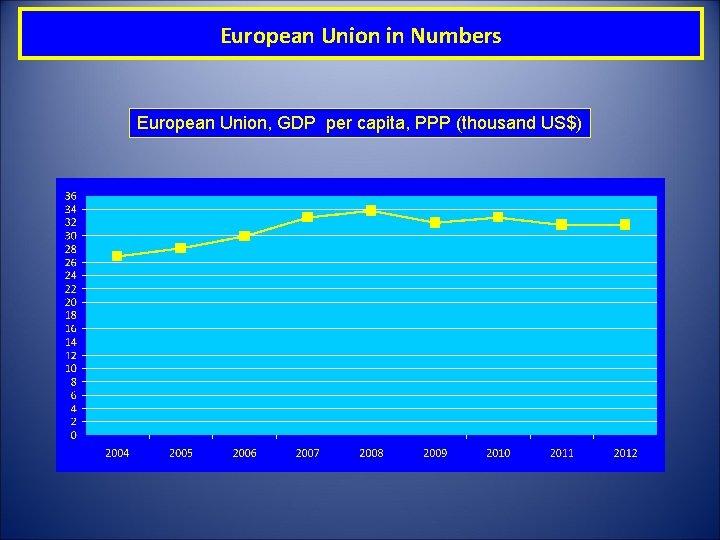
European Union in Numbers European Union, GDP per capita, PPP (thousand US$)
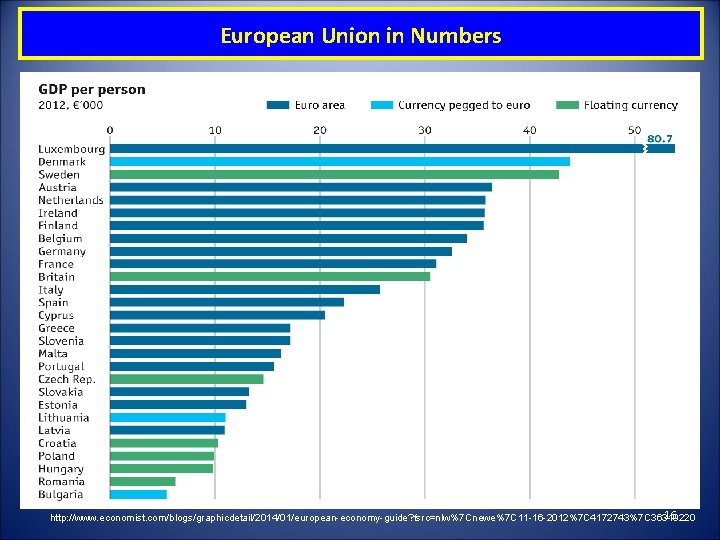
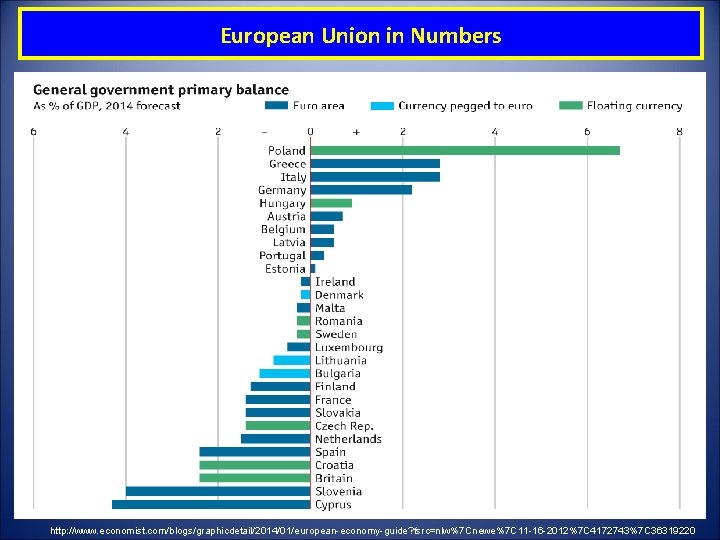
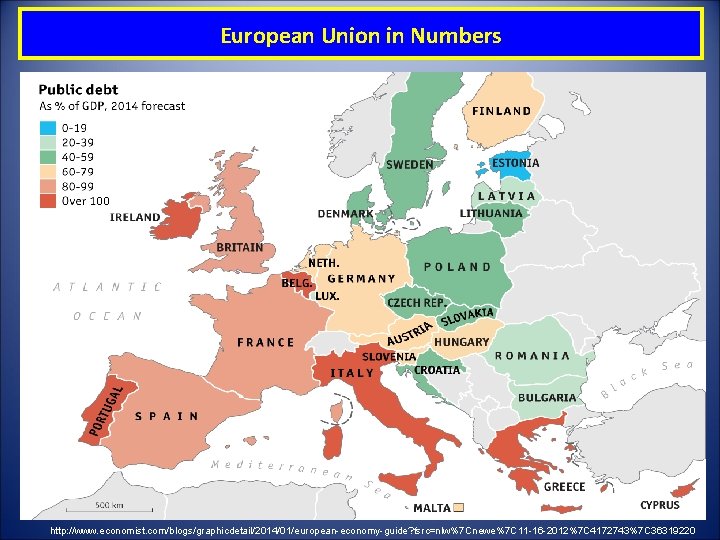
European Union in Numbers 16 http: //www. economist. com/blogs/graphicdetail/2014/01/european-economy-guide? fsrc=nlw%7 Cnewe%7 C 11 -16 -2012%7 C 4172743%7 C 36319220
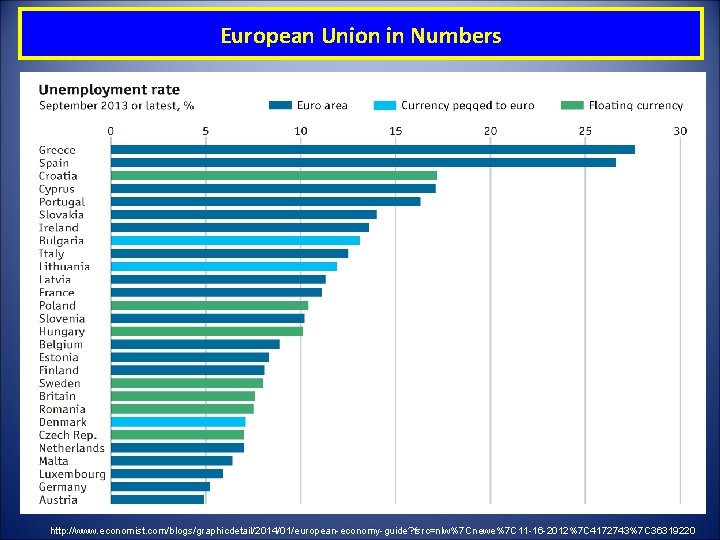
European Union in Numbers http: //www. economist. com/blogs/graphicdetail/2014/01/european-economy-guide? fsrc=nlw%7 Cnewe%7 C 11 -16 -2012%7 C 4172743%7 C 36319220
European Union in Numbers http: //www. economist. com/blogs/graphicdetail/2014/01/european-economy-guide? fsrc=nlw%7 Cnewe%7 C 11 -16 -2012%7 C 4172743%7 C 36319220
European Union in Numbers Government Debt-GDP Ratio for Selected Countries, 2007 -2011 http: //www. economist. com/blogs/graphicdetail/2014/01/european-economy-guide? fsrc=nlw%7 Cnewe%7 C 11 -16 -2012%7 C 4172743%7 C 36319220
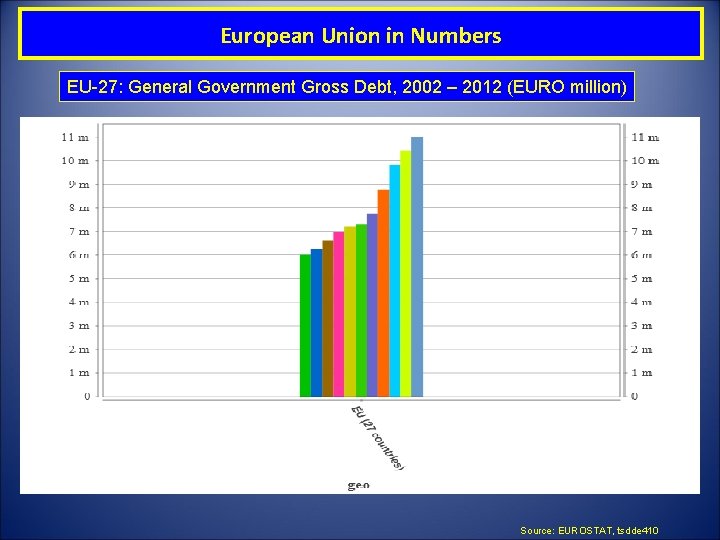
European Union in Numbers EU-27: General Government Gross Debt, 2002 – 2012 (EURO million) Source: EUROSTAT, tsdde 410
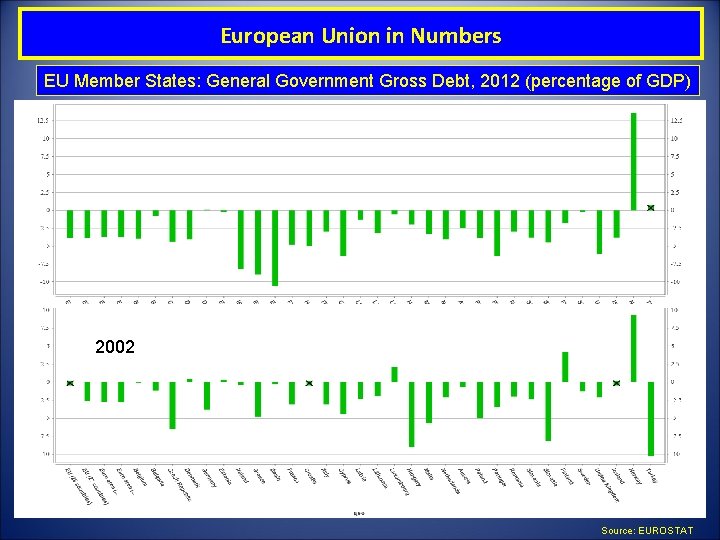
European Union in Numbers EU Member States: General Government Gross Debt, 2012 (percentage of GDP) 2002 Source: EUROSTAT
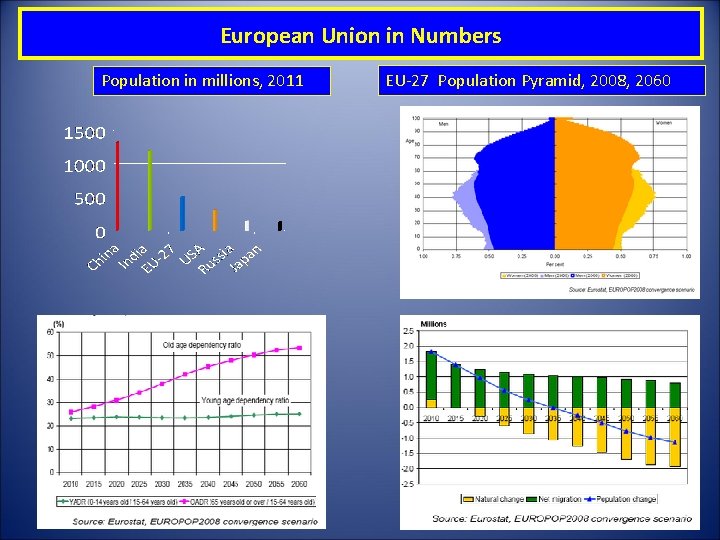
European Union in Numbers Population in millions, 2011 EU-27 Population Pyramid, 2008, 2060 22
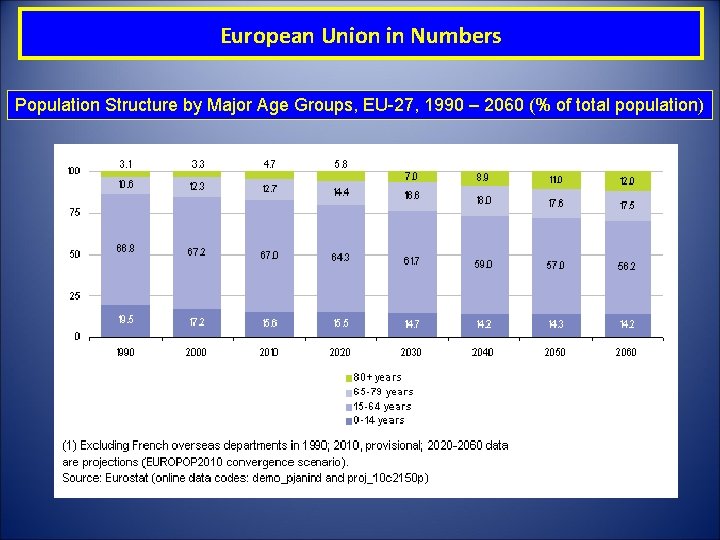
European Union in Numbers Population Structure by Major Age Groups, EU-27, 1990 – 2060 (% of total population)
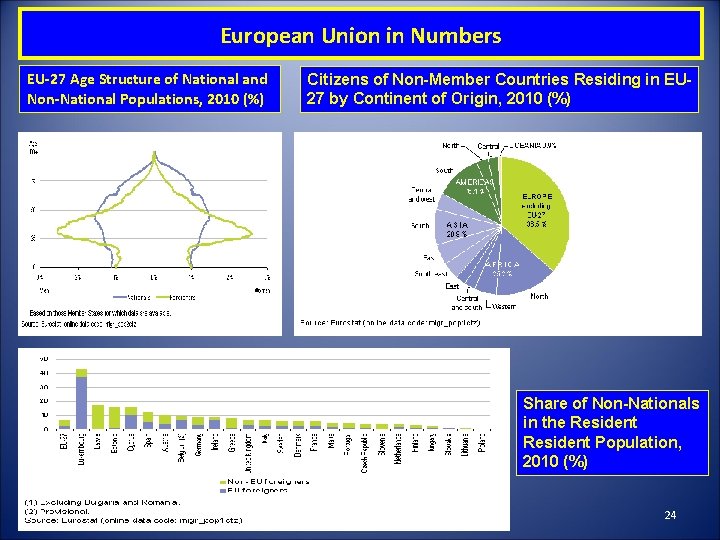
European Union in Numbers EU-27 Age Structure of National and Non-National Populations, 2010 (%) Citizens of Non-Member Countries Residing in EU 27 by Continent of Origin, 2010 (%) Share of Non-Nationals in the Resident Population, 2010 (%) 24
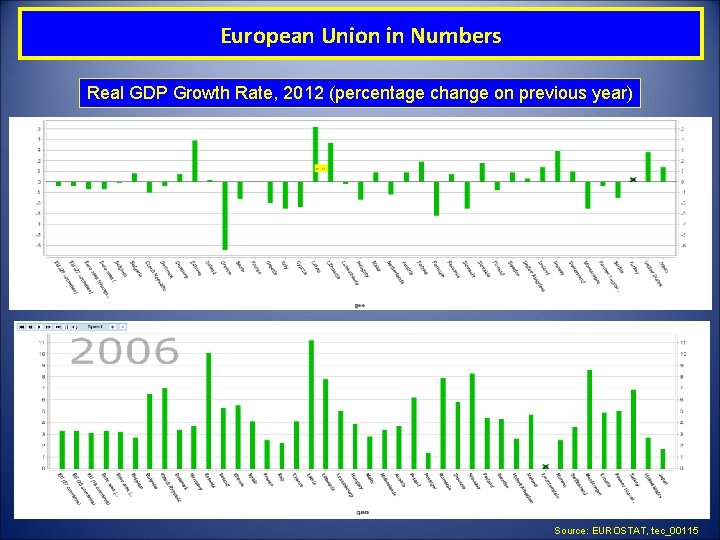
European Union in Numbers Real GDP Growth Rate, 2012 (percentage change on previous year) Source: EUROSTAT, tec_00115
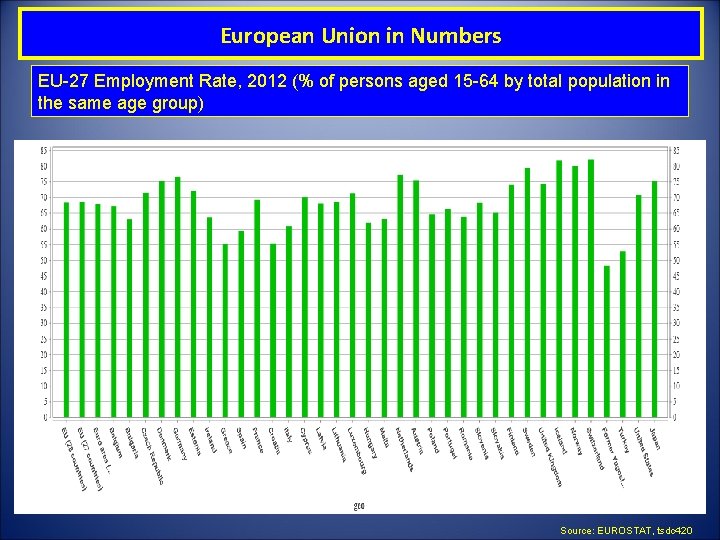
European Union in Numbers EU-27 Employment Rate, 2012 (% of persons aged 15 -64 by total population in the same age group) Source: EUROSTAT, tsdc 420
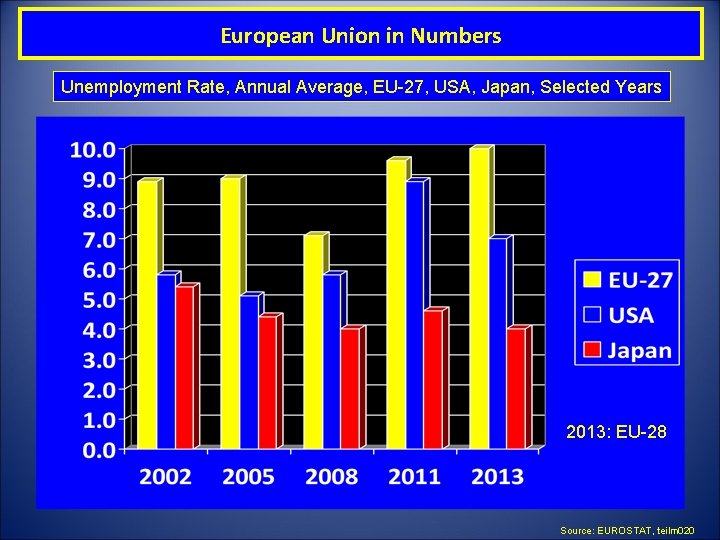
European Union in Numbers Unemployment Rate, Annual Average, EU-27, USA, Japan, Selected Years 2013: EU-28 Source: EUROSTAT, teilm 020
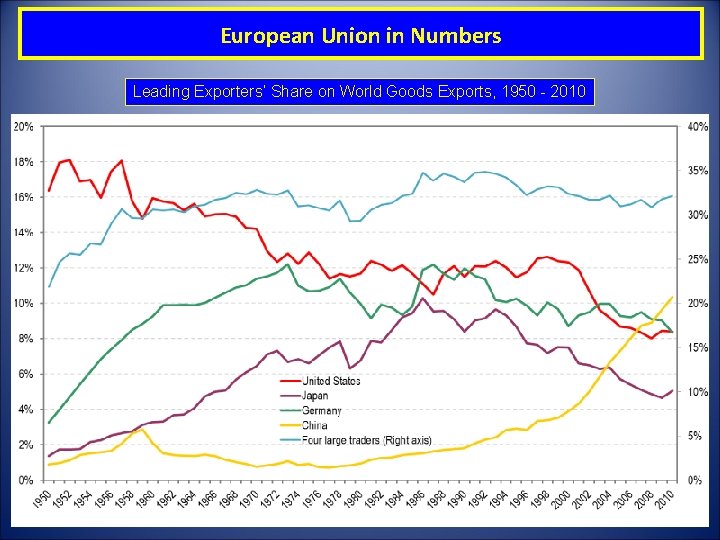
European Union in Numbers Leading Exporters‘ Share on World Goods Exports, 1950 - 2010
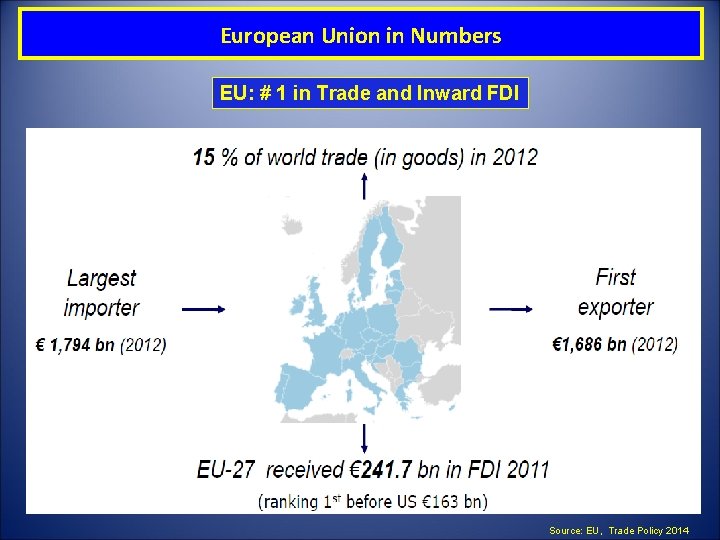
European Union in Numbers EU: # 1 in Trade and Inward FDI Source: EU, Trade Policy 2014
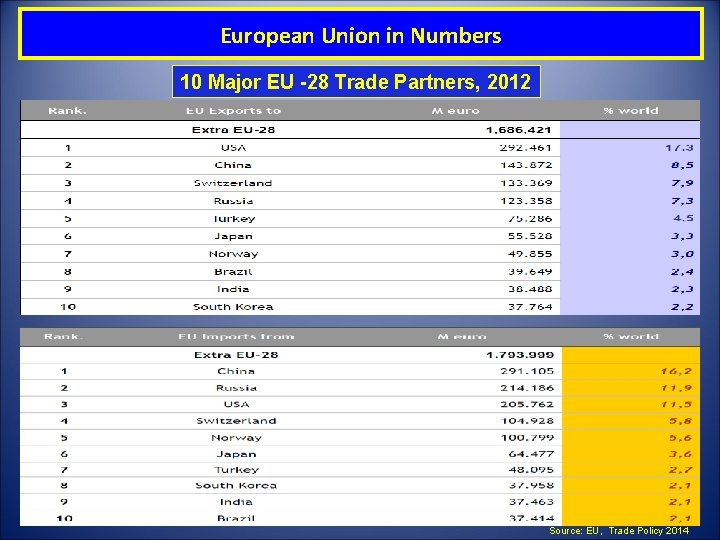
European Union in Numbers 10 Major EU -28 Trade Partners, 2012 30 Source: EU, Trade Policy 2014
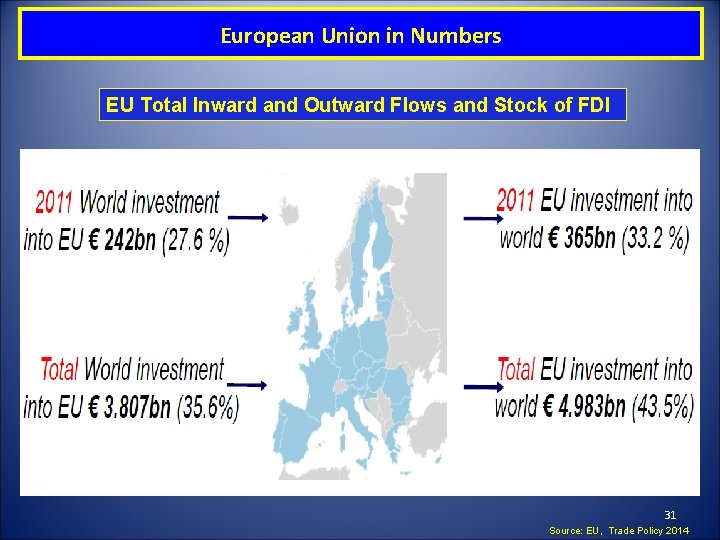
European Union in Numbers EU Total Inward and Outward Flows and Stock of FDI 31 Source: EU, Trade Policy 2014
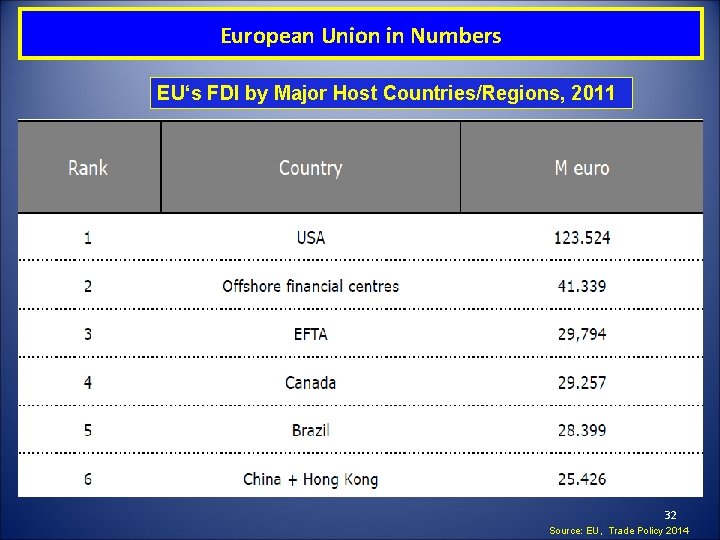
European Union in Numbers EU‘s FDI by Major Host Countries/Regions, 2011 32 Source: EU, Trade Policy 2014
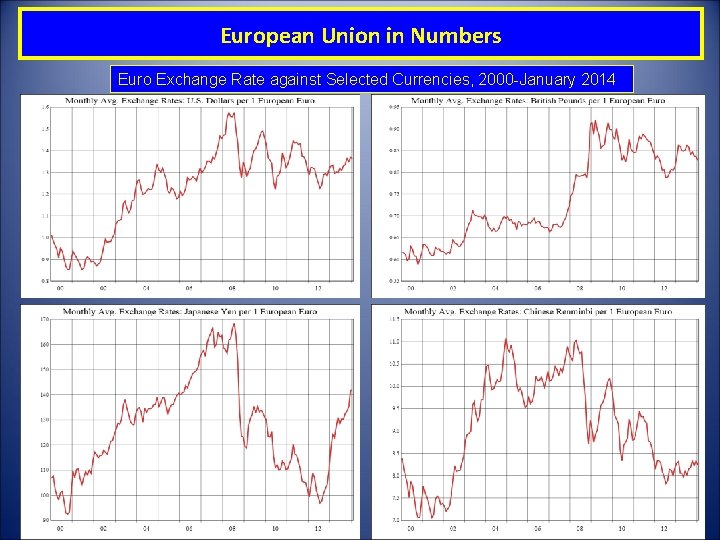
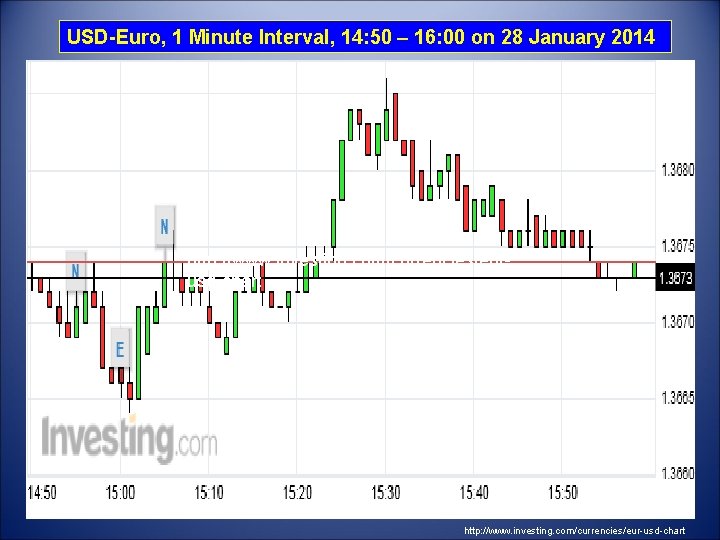
European Union in Numbers Euro Exchange Rate against Selected Currencies, 2000 -January 2014
USD-Euro, 1 Minute Interval, 14: 50 – 16: 00 on 28 January 2014 http: //www. investing. com/currencies/eurusd-chart http: //www. investing. com/currencies/eur-usd-chart
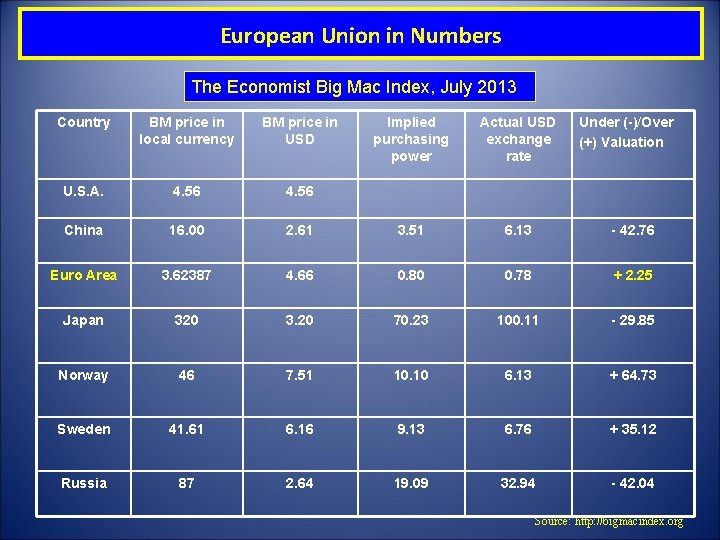
European Union in Numbers The Economist Big Mac Index, July 2013 Country BM price in local currency BM price in USD Implied purchasing power Actual USD exchange rate U. S. A. 4. 56 China 16. 00 Euro Area Under (-)/Over (+) Valuation 2. 61 3. 51 6. 13 - 42. 76 3. 62387 4. 66 0. 80 0. 78 + 2. 25 Japan 320 3. 20 70. 23 100. 11 - 29. 85 Norway 46 7. 51 10. 10 6. 13 + 64. 73 Sweden 41. 61 6. 16 9. 13 6. 76 + 35. 12 Russia 87 2. 64 19. 09 32. 94 - 42. 04 Source: http: //bigmacindex. org
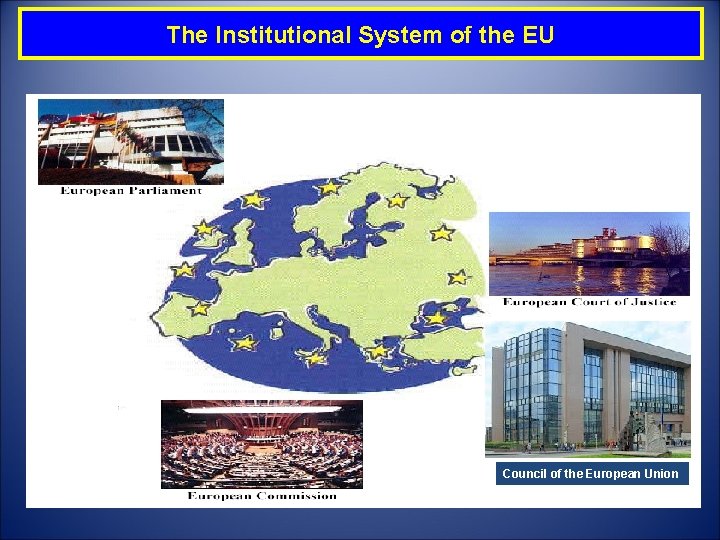
The Institutional System of the EU Council of the European Union
The Institutional System of the EU The EU is run by five institutions, each playing a specific role: European Parliament Council of the Union European Commission Court of Justice Court of Auditors (elected by the people of the Member States); (composed of the governments of the Member States); (driving force and executive body); (compliance with the law); (sound and lawful management of the EU budget). Five further bodies are part of the institutional system: European Economic and Social Committee (expresses the opinions of organised civil society on economic and social issues); Committee of the Regions (expresses the opinions of regional and local authorities on regional policy, environment, and education); European Ombudsman (deals with complaints from citizens concerning misadministration by an EU institution or body); European Investment Bank (contributes to EU objectives by financing public and private long-term investments); European Central Bank (responsible for monetary policy and foreign exchange operations).
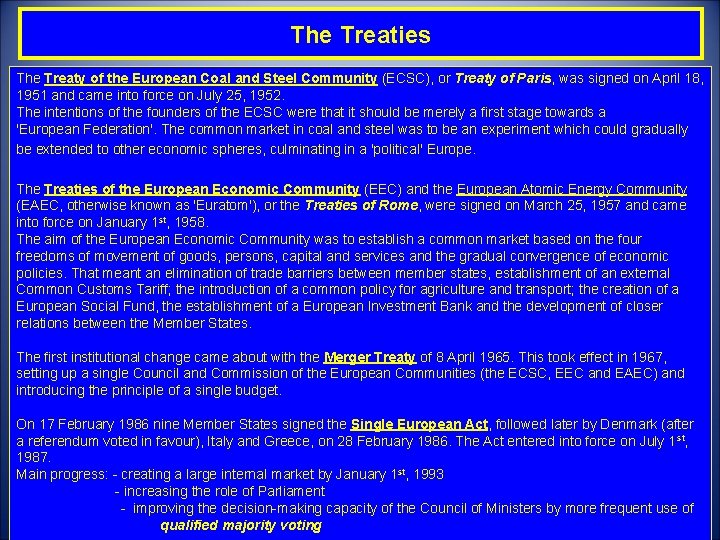
The Treaties The Treaty of the European Coal and Steel Community (ECSC), or Treaty of Paris, was signed on April 18, 1951 and came into force on July 25, 1952. The intentions of the founders of the ECSC were that it should be merely a first stage towards a 'European Federation'. The common market in coal and steel was to be an experiment which could gradually be extended to other economic spheres, culminating in a 'political' Europe. The Treaties of the European Economic Community (EEC) and the European Atomic Energy Community (EAEC, otherwise known as 'Euratom'), or the Treaties of Rome, were signed on March 25, 1957 and came into force on January 1 st, 1958. The aim of the European Economic Community was to establish a common market based on the four freedoms of movement of goods, persons, capital and services and the gradual convergence of economic policies. That meant an elimination of trade barriers between member states, establishment of an external Common Customs Tariff; the introduction of a common policy for agriculture and transport; the creation of a European Social Fund, the establishment of a European Investment Bank and the development of closer relations between the Member States. The first institutional change came about with the Merger Treaty of 8 April 1965. This took effect in 1967, setting up a single Council and Commission of the European Communities (the ECSC, EEC and EAEC) and introducing the principle of a single budget. On 17 February 1986 nine Member States signed the Single European Act, followed later by Denmark (after a referendum voted in favour), Italy and Greece, on 28 February 1986. The Act entered into force on July 1 st, 1987. Main progress: - creating a large internal market by January 1 st, 1993 - increasing the role of Parliament - improving the decision-making capacity of the Council of Ministers by more frequent use of qualified majority voting
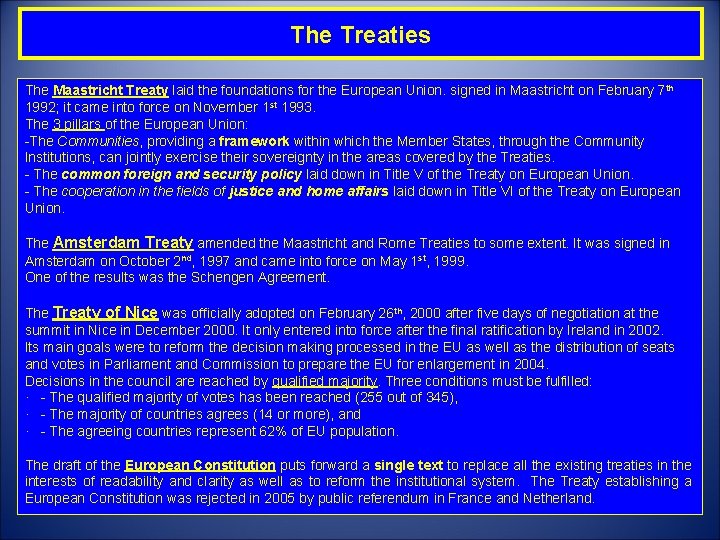
The Treaties The Maastricht Treaty laid the foundations for the European Union. signed in Maastricht on February 7 th 1992; it came into force on November 1 st 1993. The 3 pillars of the European Union: -The Communities, providing a framework within which the Member States, through the Community Institutions, can jointly exercise their sovereignty in the areas covered by the Treaties. - The common foreign and security policy laid down in Title V of the Treaty on European Union. - The cooperation in the fields of justice and home affairs laid down in Title VI of the Treaty on European Union. The Amsterdam Treaty amended the Maastricht and Rome Treaties to some extent. It was signed in Amsterdam on October 2 nd, 1997 and came into force on May 1 st, 1999. One of the results was the Schengen Agreement. The Treaty of Nice was officially adopted on February 26 th, 2000 after five days of negotiation at the summit in Nice in December 2000. It only entered into force after the final ratification by Ireland in 2002. Its main goals were to reform the decision making processed in the EU as well as the distribution of seats and votes in Parliament and Commission to prepare the EU for enlargement in 2004. Decisions in the council are reached by qualified majority. Three conditions must be fulfilled: · - The qualified majority of votes has been reached (255 out of 345), · - The majority of countries agrees (14 or more), and · - The agreeing countries represent 62% of EU population. The draft of the European Constitution puts forward a single text to replace all the existing treaties in the interests of readability and clarity as well as to reform the institutional system. The Treaty establishing a European Constitution was rejected in 2005 by public referendum in France and Netherland.
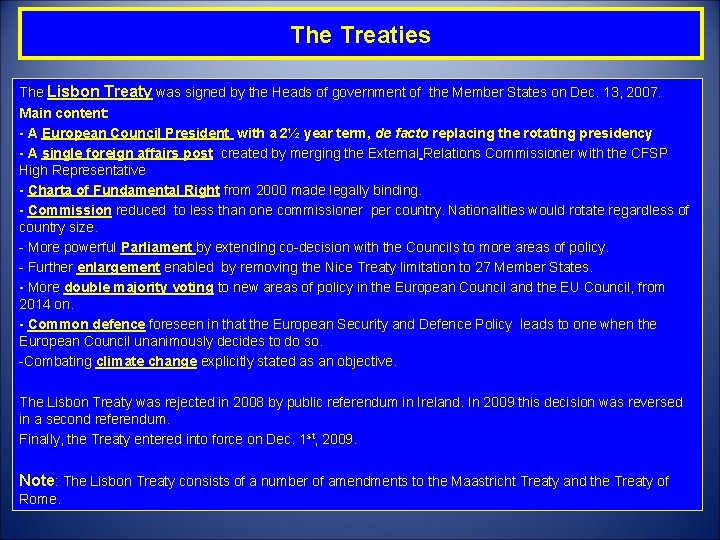
The Treaties The Lisbon Treaty was signed by the Heads of government of the Member States on Dec. 13, 2007. Main content: - A European Council President with a 2½ year term, de facto replacing the rotating presidency - A single foreign affairs post created by merging the External Relations Commissioner with the CFSP High Representative - Charta of Fundamental Right from 2000 made legally binding. - Commission reduced to less than one commissioner per country. Nationalities would rotate regardless of country size. - More powerful Parliament by extending co-decision with the Councils to more areas of policy. - Further enlargement enabled by removing the Nice Treaty limitation to 27 Member States. - More double majority voting to new areas of policy in the European Council and the EU Council, from 2014 on. - Common defence foreseen in that the European Security and Defence Policy leads to one when the European Council unanimously decides to do so. -Combating climate change explicitly stated as an objective. The Lisbon Treaty was rejected in 2008 by public referendum in Ireland. In 2009 this decision was reversed in a second referendum. Finally, the Treaty entered into force on Dec. 1 st, 2009. Note: The Lisbon Treaty consists of a number of amendments to the Maastricht Treaty and the Treaty of Rome.
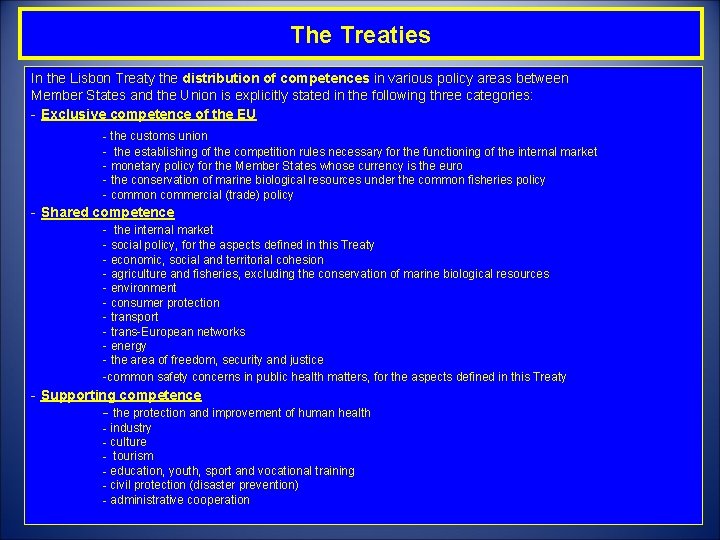
The Treaties In the Lisbon Treaty the distribution of competences in various policy areas between Member States and the Union is explicitly stated in the following three categories: - Exclusive competence of the EU - the customs union - the establishing of the competition rules necessary for the functioning of the internal market - monetary policy for the Member States whose currency is the euro - the conservation of marine biological resources under the common fisheries policy - common commercial (trade) policy - Shared competence - the internal market - social policy, for the aspects defined in this Treaty - economic, social and territorial cohesion - agriculture and fisheries, excluding the conservation of marine biological resources - environment - consumer protection - transport - trans-European networks - energy - the area of freedom, security and justice -common safety concerns in public health matters, for the aspects defined in this Treaty - Supporting competence - the protection and improvement of human health - industry - culture - tourism - education, youth, sport and vocational training - civil protection (disaster prevention) - administrative cooperation
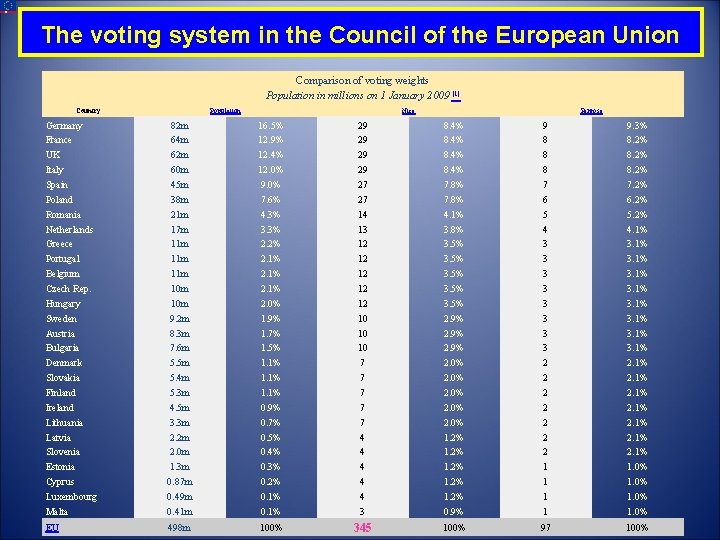
The voting system in the Council of the European Union Comparison of voting weights Population in millions on 1 January 2009 [1] Country Population Nice Penrose Germany France UK Italy Spain Poland Romania Netherlands Greece Portugal Belgium Czech Rep. Hungary Sweden Austria Bulgaria Denmark Slovakia Finland Ireland Lithuania Latvia Slovenia Estonia Cyprus Luxembourg Malta 82 m 64 m 62 m 60 m 45 m 38 m 21 m 17 m 11 m 11 m 10 m 9. 2 m 8. 3 m 7. 6 m 5. 5 m 5. 4 m 5. 3 m 4. 5 m 3. 3 m 2. 2 m 2. 0 m 1. 3 m 0. 87 m 0. 49 m 0. 41 m 16. 5% 12. 9% 12. 4% 12. 0% 9. 0% 7. 6% 4. 3% 3. 3% 2. 2% 2. 1% 2. 0% 1. 9% 1. 7% 1. 5% 1. 1% 0. 9% 0. 7% 0. 5% 0. 4% 0. 3% 0. 2% 0. 1% 29 29 27 27 14 13 12 12 12 10 10 10 7 7 7 4 4 4 3 8. 4% 7. 8% 4. 1% 3. 8% 3. 5% 2. 9% 2. 0% 1. 2% 0. 9% 9 8 8 8 7 6 5 4 3 3 3 3 2 2 2 2 1 1 9. 3% 8. 2% 7. 2% 6. 2% 5. 2% 4. 1% 3. 1% 2. 1% 1. 0% EU 498 m 100% 345 100% 97 100%
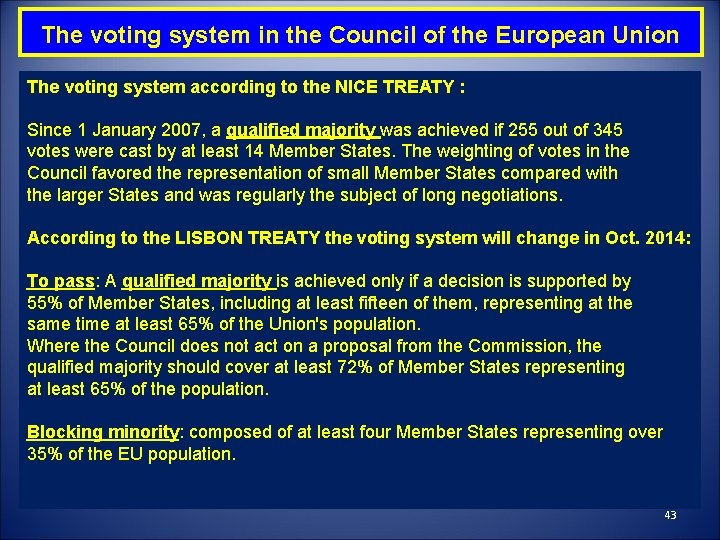
The voting system in the Council of the European Union The voting system according to the NICE TREATY : Since 1 January 2007, a qualified majority was achieved if 255 out of 345 votes were cast by at least 14 Member States. The weighting of votes in the Council favored the representation of small Member States compared with the larger States and was regularly the subject of long negotiations. According to the LISBON TREATY the voting system will change in Oct. 2014: To pass: A qualified majority is achieved only if a decision is supported by 55% of Member States, including at least fifteen of them, representing at the same time at least 65% of the Union's population. Where the Council does not act on a proposal from the Commission, the qualified majority should cover at least 72% of Member States representing at least 65% of the population. Blocking minority: composed of at least four Member States representing over 35% of the EU population. 43
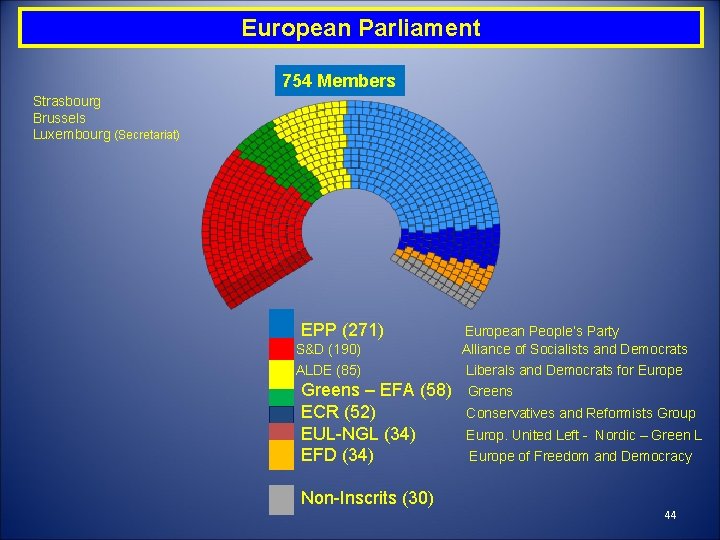
European Parliament 754 Members Strasbourg Brussels Luxembourg (Secretariat) EPP (271) S&D (190) ALDE (85) Greens – EFA (58) ECR (52) EUL-NGL (34) EFD (34) Non-Inscrits (30) European People’s Party Alliance of Socialists and Democrats Liberals and Democrats for Europe Greens Conservatives and Reformists Group Europ. United Left - Nordic – Green L Europe of Freedom and Democracy 44
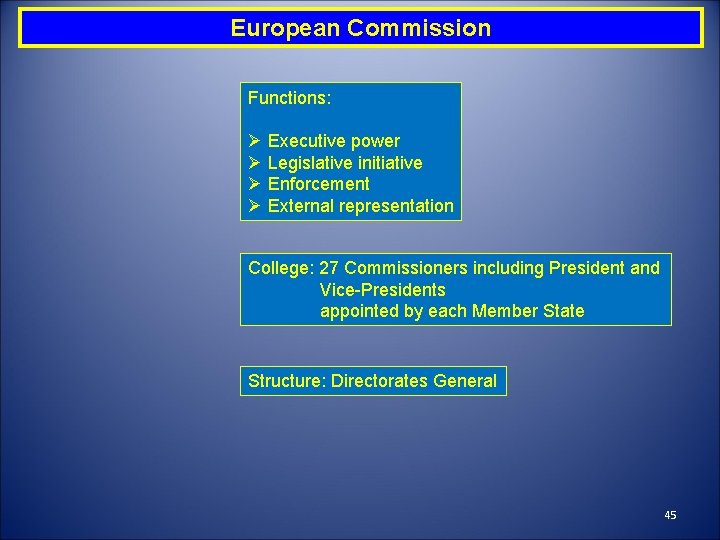
European Commission Functions: Ø Executive power Ø Legislative initiative Ø Enforcement Ø External representation College: 27 Commissioners including President and Vice-Presidents appointed by each Member State Structure: Directorates General 45
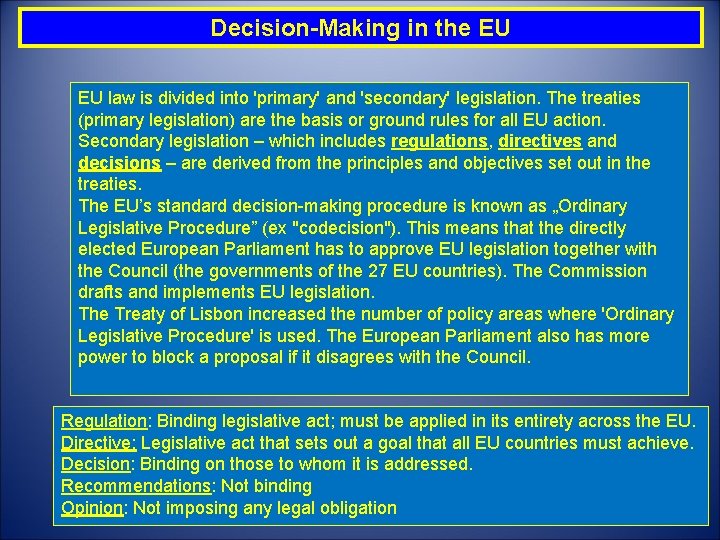
Decision-Making in the EU EU law is divided into 'primary' and 'secondary' legislation. The treaties (primary legislation) are the basis or ground rules for all EU action. Secondary legislation – which includes regulations, directives and decisions – are derived from the principles and objectives set out in the treaties. The EU’s standard decision-making procedure is known as „Ordinary Legislative Procedure” (ex "codecision"). This means that the directly elected European Parliament has to approve EU legislation together with the Council (the governments of the 27 EU countries). The Commission drafts and implements EU legislation. The Treaty of Lisbon increased the number of policy areas where 'Ordinary Legislative Procedure' is used. The European Parliament also has more power to block a proposal if it disagrees with the Council. Regulation: Binding legislative act; must be applied in its entirety across the EU. Directive: Legislative act that sets out a goal that all EU countries must achieve. Decision: Binding on those to whom it is addressed. Recommendations: Not binding Opinion: Not imposing any legal obligation 46