
European Commission Enterprise and Industry Directorate General Information
- Slides: 33
European Commission Enterprise and Industry Directorate General Information Meeting on the Call for proposals “ERASMUS for young entrepreneurs” European Commission Enterprise and Industry Directorate-General Unit E 1 – Entrepreneurship Brussels, 23 June 2008 These slides are for illustration only and do not take precedence over the official call text published on the Commission’s website
Part 1 Objectives, applicants, geographical coverage, activities 2
What is the overall objective? To set up a European mobility scheme “to facilitate exchange of experiences, learning and networking for nascent EU entrepreneurs through periods spent at companies of experienced entrepreneurs in other EU Member States. ” 3
What is the specific objective? Fostering • entrepreneurship • internationalisation • competitiveness of start-up entrepreneurs and newly established SMEs in the EU 4
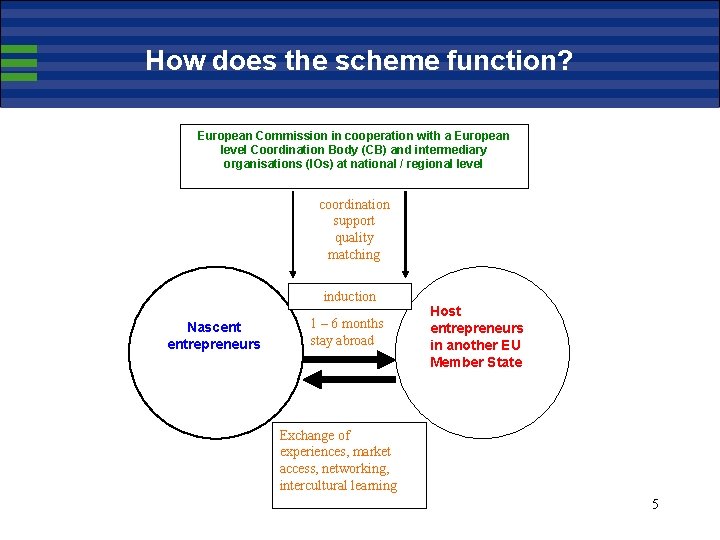
How does the scheme function? European Commission in cooperation with a European level Coordination Body (CB) and intermediary organisations (IOs) at national / regional level coordination support quality matching induction Nascent entrepreneurs 1 – 6 months stay abroad Host entrepreneurs in another EU Member State Exchange of experiences, market access, networking, intercultural learning 5
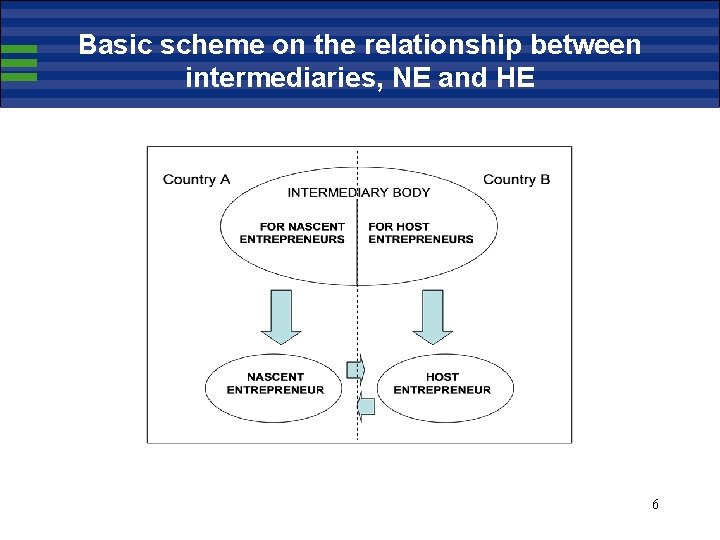
Basic scheme on the relationship between intermediaries, NE and HE 6
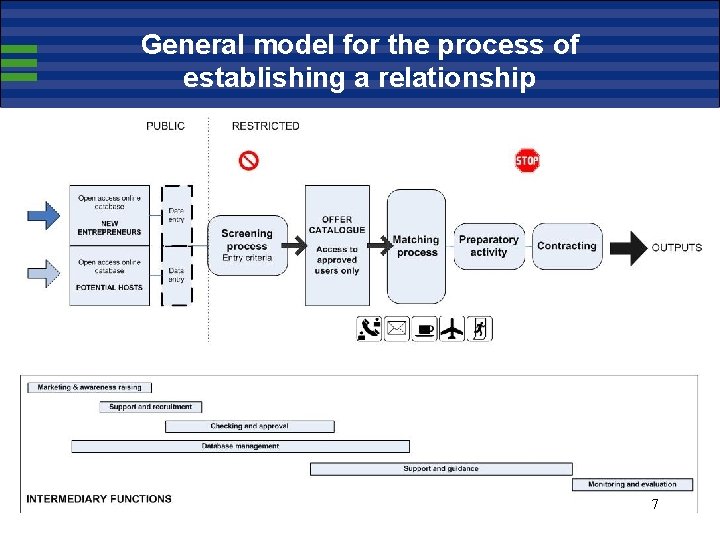
General model for the process of establishing a relationship 7
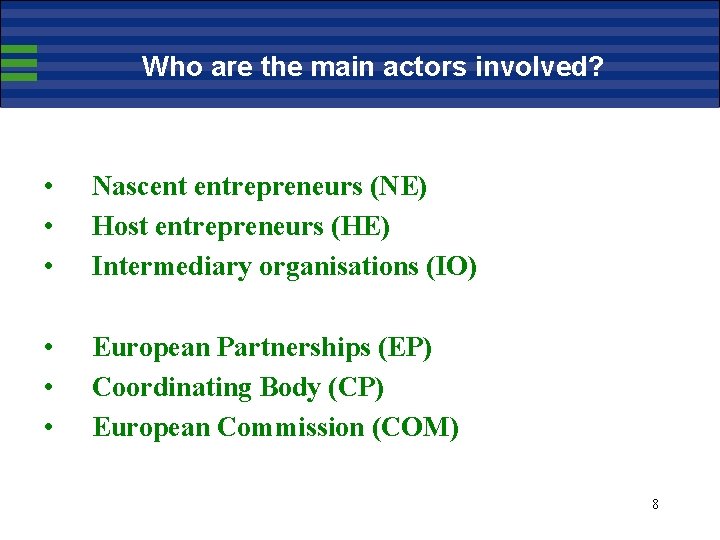
Who are the main actors involved? • • • Nascent entrepreneurs (NE) Host entrepreneurs (HE) Intermediary organisations (IO) • • • European Partnerships (EP) Coordinating Body (CP) European Commission (COM) 8
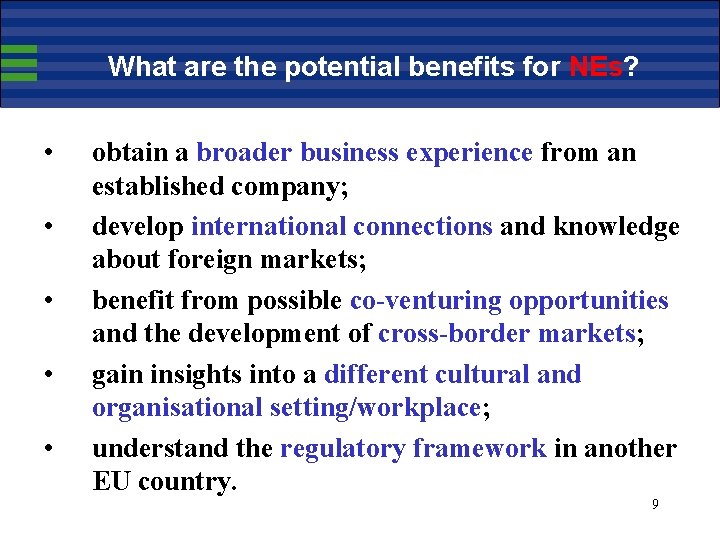
What are the potential benefits for NEs? • • • obtain a broader business experience from an established company; develop international connections and knowledge about foreign markets; benefit from possible co-venturing opportunities and the development of cross-border markets; gain insights into a different cultural and organisational setting/workplace; understand the regulatory framework in another EU country. 9
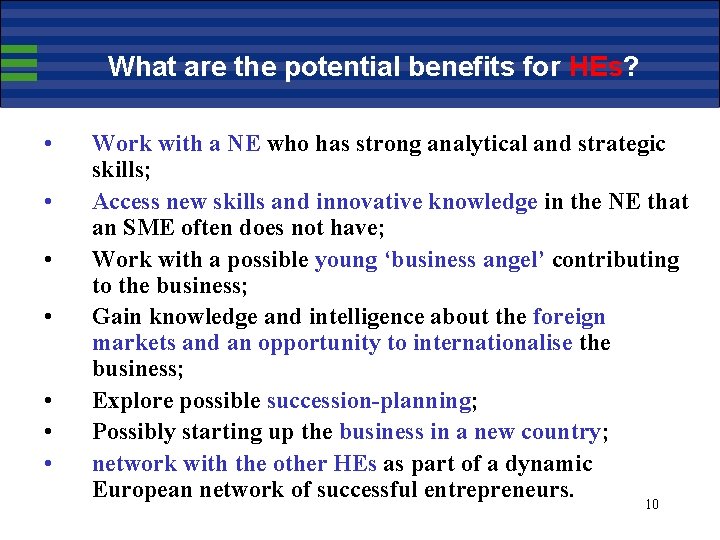
What are the potential benefits for HEs? • • Work with a NE who has strong analytical and strategic skills; Access new skills and innovative knowledge in the NE that an SME often does not have; Work with a possible young ‘business angel’ contributing to the business; Gain knowledge and intelligence about the foreign markets and an opportunity to internationalise the business; Explore possible succession-planning; Possibly starting up the business in a new country; network with the other HEs as part of a dynamic European network of successful entrepreneurs. 10
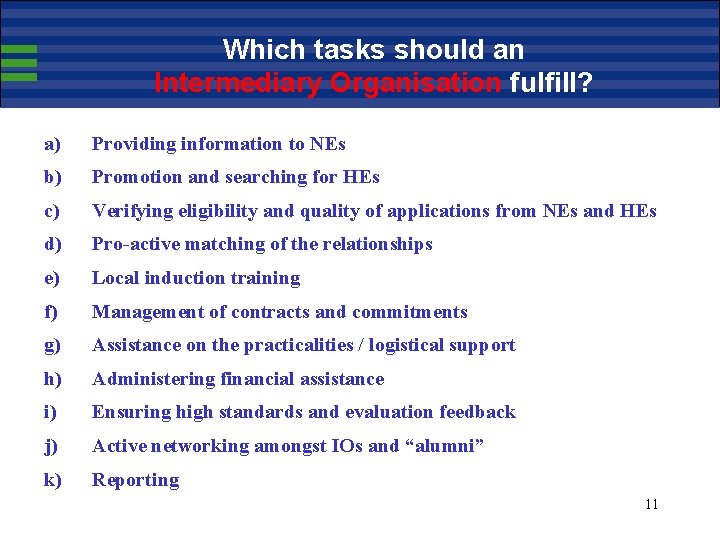
Which tasks should an Intermediary Organisation fulfill? a) Providing information to NEs b) Promotion and searching for HEs c) Verifying eligibility and quality of applications from NEs and HEs d) Pro-active matching of the relationships e) Local induction training f) Management of contracts and commitments g) Assistance on the practicalities / logistical support h) Administering financial assistance i) Ensuring high standards and evaluation feedback j) Active networking amongst IOs and “alumni” k) Reporting 11
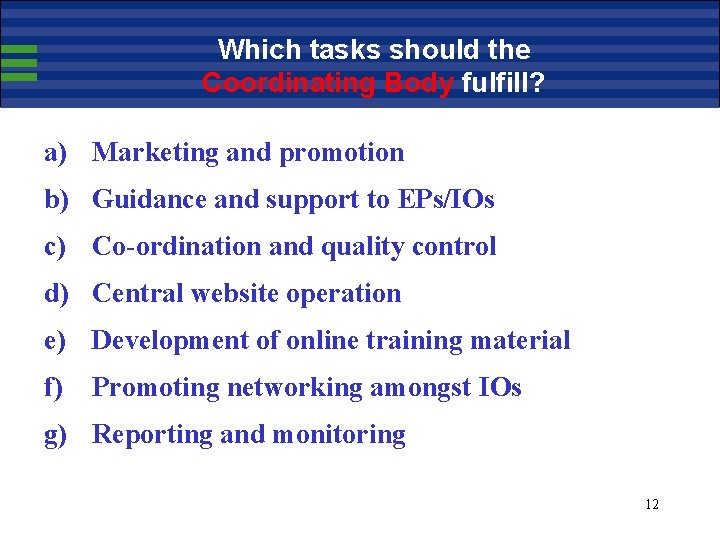
Which tasks should the Coordinating Body fulfill? a) Marketing and promotion b) Guidance and support to EPs/IOs c) Co-ordination and quality control d) Central website operation e) Development of online training material f) Promoting networking amongst IOs g) Reporting and monitoring 12
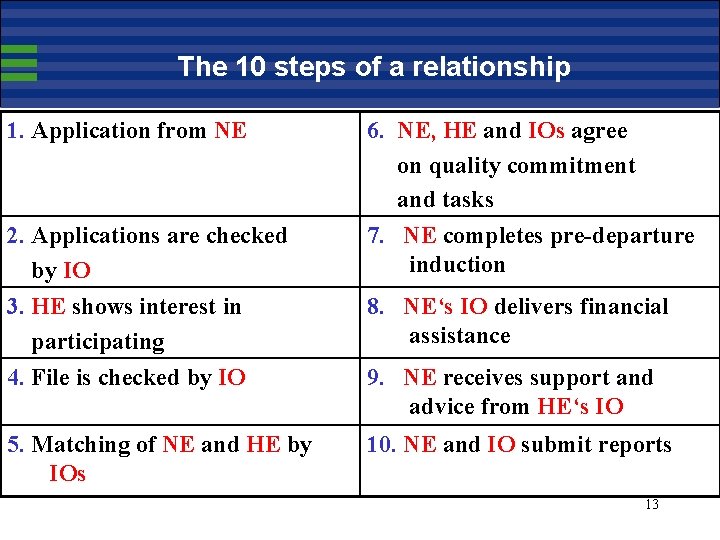
The 10 steps of a relationship 1. Application from NE 2. Applications are checked by IO 6. NE, HE and IOs agree on quality commitment and tasks 7. NE completes pre-departure induction 3. HE shows interest in participating 4. File is checked by IO 8. NE‘s IO delivers financial assistance 5. Matching of NE and HE by IOs 10. NE and IO submit reports 9. NE receives support and advice from HE‘s IO 13
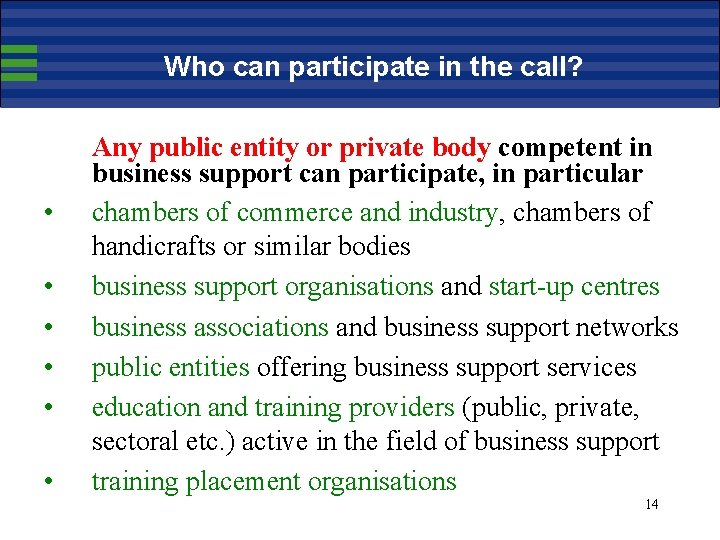
Who can participate in the call? • • • Any public entity or private body competent in business support can participate, in particular chambers of commerce and industry, chambers of handicrafts or similar bodies business support organisations and start-up centres business associations and business support networks public entities offering business support services education and training providers (public, private, sectoral etc. ) active in the field of business support training placement organisations 14
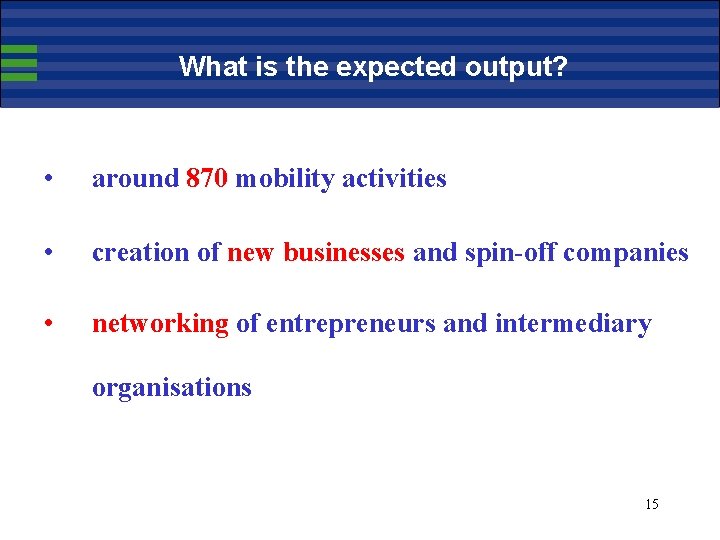
What is the expected output? • around 870 mobility activities • creation of new businesses and spin-off companies • networking of entrepreneurs and intermediary organisations 15
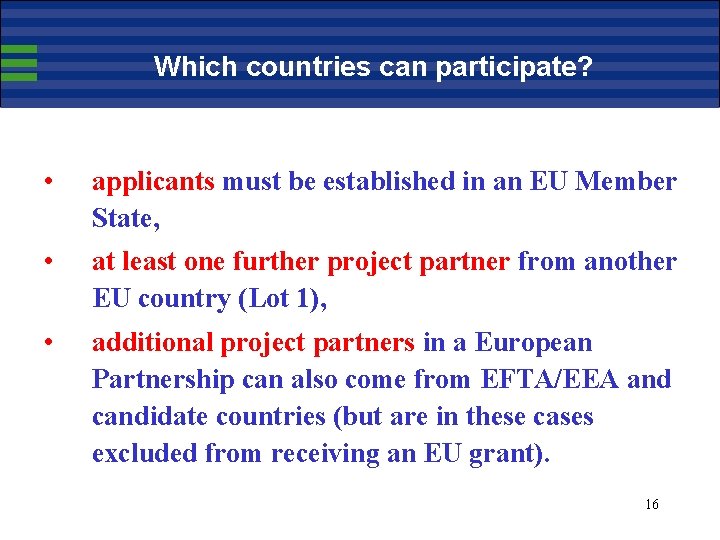
Which countries can participate? • applicants must be established in an EU Member State, • at least one further project partner from another EU country (Lot 1), • additional project partners in a European Partnership can also come from EFTA/EEA and candidate countries (but are in these cases excluded from receiving an EU grant). 16
Which activities will be supported? • Lot 1: European partnerships enhancing the mobility of nascent entrepreneurs • Lot 2: coordination, support and networking at European level linked to the action mentioned in lot 1 17
Which basic conditions must be fulfilled? • Lot 1: European partnerships – at least 2 entities from 2 different EU member states – certain regional coverage (NUTS) – cooperation with other partnerships • Lot 2: coordination, support and networking – no partners – coordination at European level – cooperation with partnerships and Commission 18
What is the project duration? • Lot 1: The maximum duration of projects is 18 months (i. e. until June 2010). • Lot 2: The maximum duration of the project is 22 months (i. e. until October 2010) 19
What are the main deliverables of a European partnership? • 30 -50 successfully matched relationships between nascent entrepreneurs and host entrepreneurs (of which 50% with other partnerships) • services linked to these relationships (promotion, information, induction, advice, contracts, logistical support etc. ) • quality control, evaluation, reporting and active networking 20
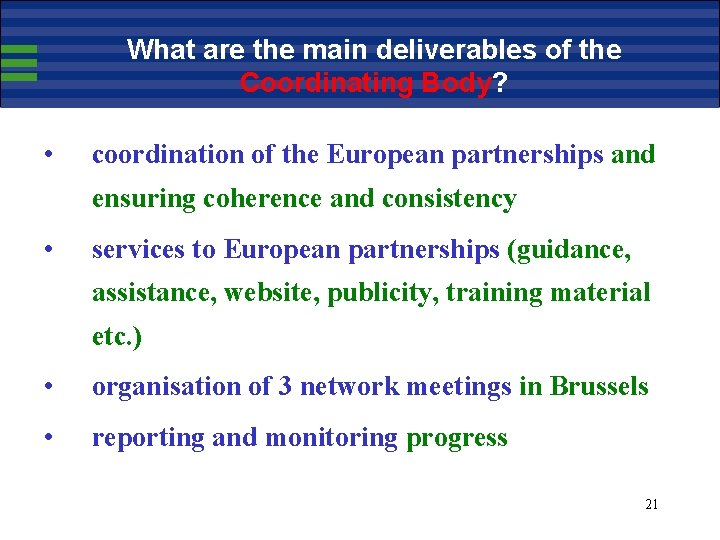
What are the main deliverables of the Coordinating Body? • coordination of the European partnerships and ensuring coherence and consistency • services to European partnerships (guidance, assistance, website, publicity, training material etc. ) • organisation of 3 network meetings in Brussels • reporting and monitoring progress 21
Part 2 Budget, payments, timing 22
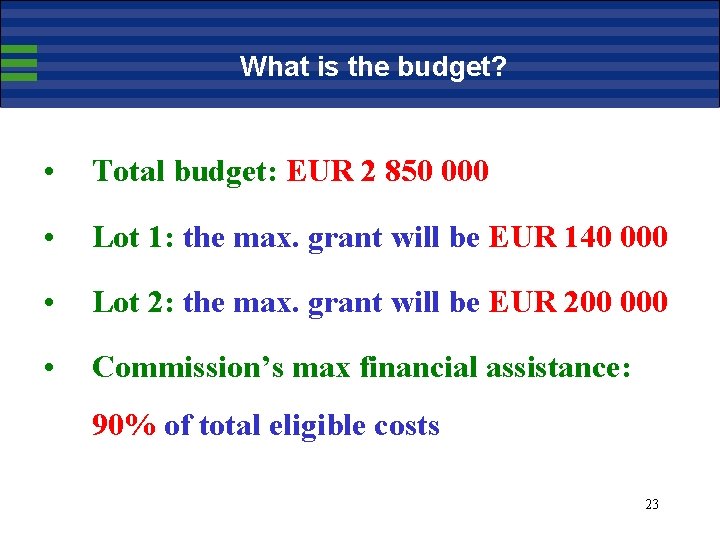
What is the budget? • Total budget: EUR 2 850 000 • Lot 1: the max. grant will be EUR 140 000 • Lot 2: the max. grant will be EUR 200 000 • Commission’s max financial assistance: 90% of total eligible costs 23
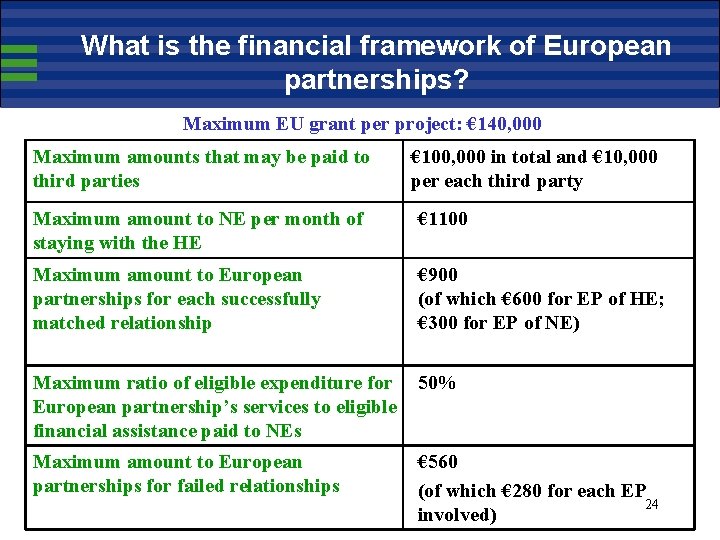
What is the financial framework of European partnerships? Maximum EU grant per project: € 140, 000 Maximum amounts that may be paid to third parties € 100, 000 in total and € 10, 000 per each third party Maximum amount to NE per month of staying with the HE € 1100 Maximum amount to European partnerships for each successfully matched relationship € 900 (of which € 600 for EP of HE; € 300 for EP of NE) Maximum ratio of eligible expenditure for European partnership’s services to eligible financial assistance paid to NEs 50% Maximum amount to European partnerships for failed relationships € 560 (of which € 280 for each EP 24 involved)
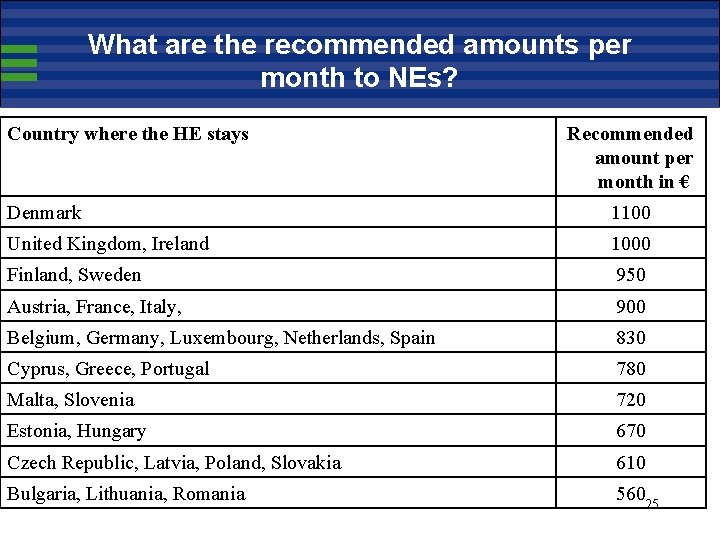
What are the recommended amounts per month to NEs? Country where the HE stays Recommended amount per month in € Denmark 1100 United Kingdom, Ireland 1000 Finland, Sweden 950 Austria, France, Italy, 900 Belgium, Germany, Luxembourg, Netherlands, Spain 830 Cyprus, Greece, Portugal 780 Malta, Slovenia 720 Estonia, Hungary 670 Czech Republic, Latvia, Poland, Slovakia 610 Bulgaria, Lithuania, Romania 56025
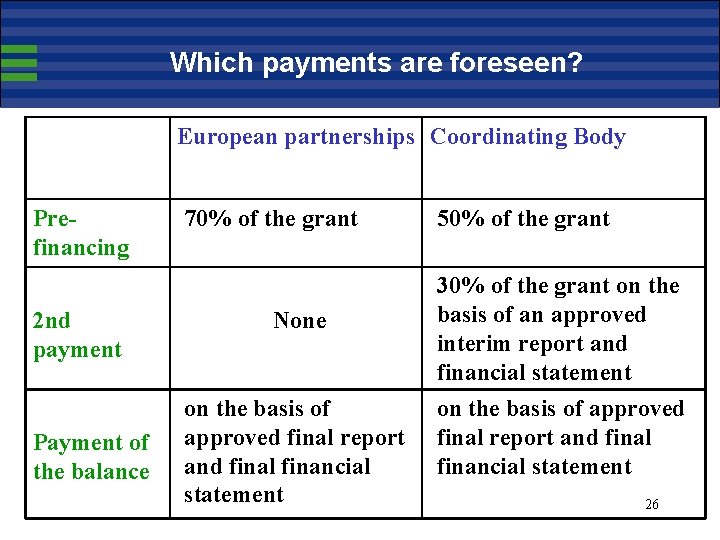
Which payments are foreseen? European partnerships Coordinating Body Prefinancing 2 nd payment Payment of the balance 70% of the grant None on the basis of approved final report and final financial statement 50% of the grant 30% of the grant on the basis of an approved interim report and financial statement on the basis of approved final report and final financial statement 26
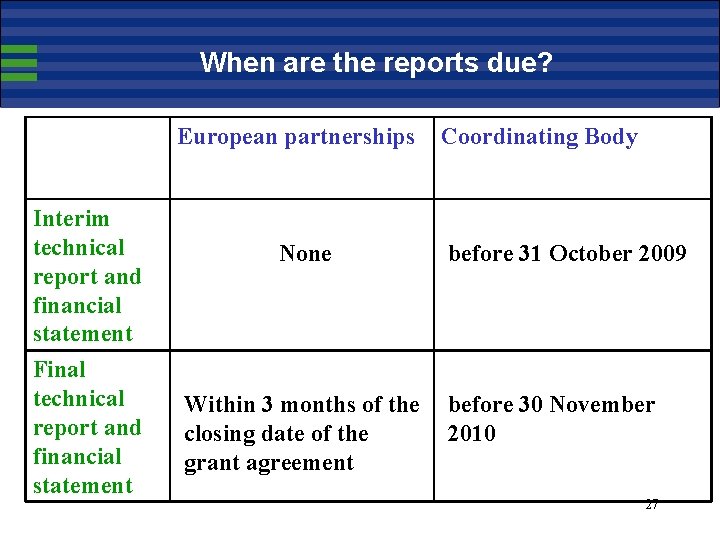
When are the reports due? European partnerships Interim technical report and financial statement Final technical report and financial statement None Within 3 months of the closing date of the grant agreement Coordinating Body before 31 October 2009 before 30 November 2010 27
Part 3 Eligibility, selection, award criteria 28
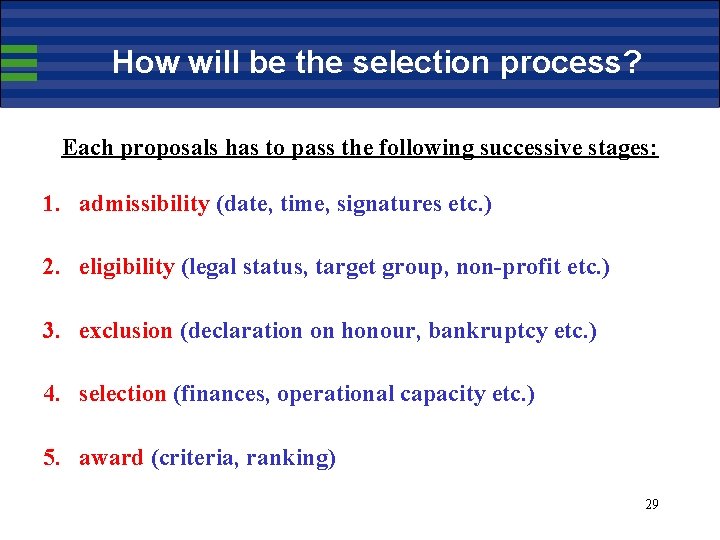
How will be the selection process? Each proposals has to pass the following successive stages: 1. admissibility (date, time, signatures etc. ) 2. eligibility (legal status, target group, non-profit etc. ) 3. exclusion (declaration on honour, bankruptcy etc. ) 4. selection (finances, operational capacity etc. ) 5. award (criteria, ranking) 29
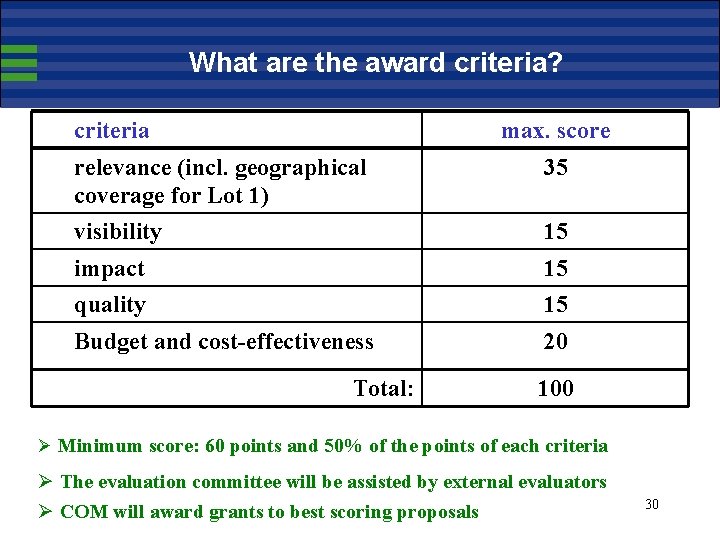
What are the award criteria? criteria max. score relevance (incl. geographical coverage for Lot 1) 35 visibility 15 impact 15 quality 15 Budget and cost-effectiveness 20 Total: 100 Ø Minimum score: 60 points and 50% of the points of each criteria Ø The evaluation committee will be assisted by external evaluators Ø COM will award grants to best scoring proposals 30
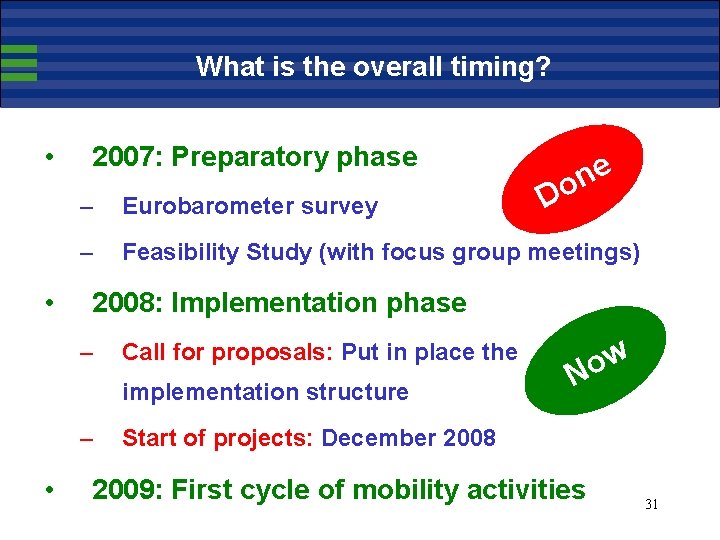
What is the overall timing? • • 2007: Preparatory phase D – Eurobarometer survey – Feasibility Study (with focus group meetings) 2008: Implementation phase – Call for proposals: Put in place the implementation structure – • e n o w o N Start of projects: December 2008 2009: First cycle of mobility activities 31
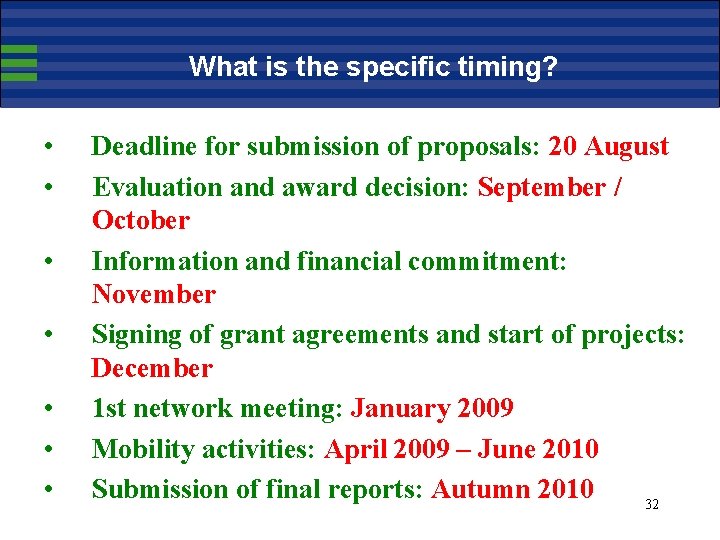
What is the specific timing? • • Deadline for submission of proposals: 20 August Evaluation and award decision: September / October Information and financial commitment: November Signing of grant agreements and start of projects: December 1 st network meeting: January 2009 Mobility activities: April 2009 – June 2010 Submission of final reports: Autumn 2010 32
Where can I find more information? The full text of the call for proposals: http: //ec. europa. eu/enterprise/funding/index. htm Contact: European Commission, DG Enterprise and Industry Entrepreneurship (Unit E. 1), B-1049 Brussels e-mail: entr-entrepreneurship@ec. europa. eu European Commission Enterprise and Industry Directorate General 33