
European Commission Energy labelling Jonathan Claridge European Commission
European Commission Energy labelling Jonathan Claridge European Commission 21 October 2003 n° 1
European Commission Energy Labelling Energy labelling of products - policy objectives Support sustainable development through: - increasing security of energy supply by reducing energy consumption - curbing energy demand without affecting economic growth - protecting the environment (lower CO² emissions) n° 2
European Commission Energy Labelling of Domestic Appliances n° 3
European Commission Energy Labelling of Domestic Appliances Legislation Framework Directive (92/75/EEC) Implementing directives l refrigerators & freezers (94/2/EC) l washing machines (95/12/EC) l tumble driers (95/13/EC) l dishwashers (97/17/EC) l lamps (98/11/EC) l air-conditioners (2002/31/EC) l electric ovens (2002/40/EC) l rev. refrigerators & freezers (2003/66/EC) n° 4
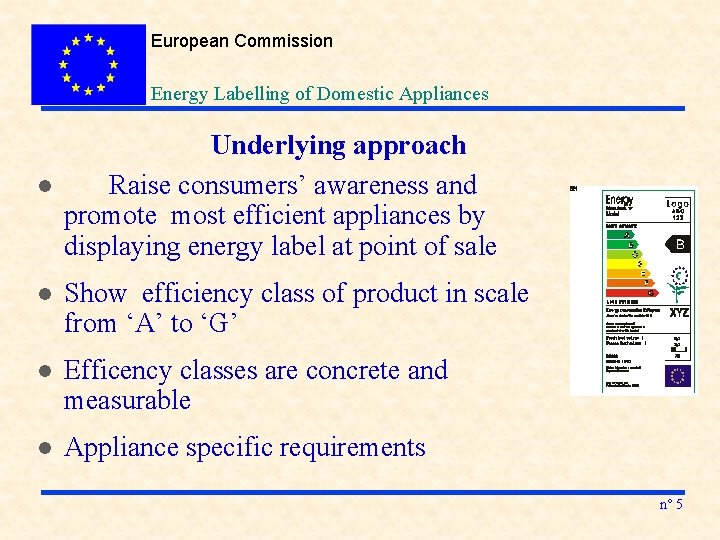
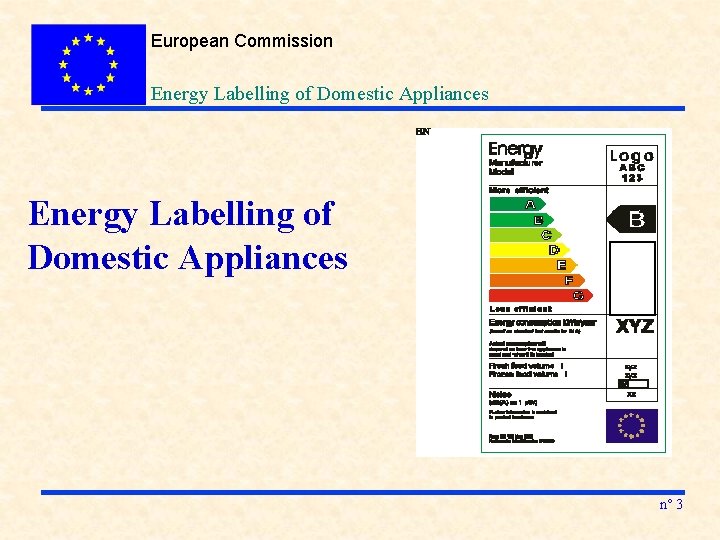
European Commission Energy Labelling of Domestic Appliances l Underlying approach Raise consumers’ awareness and promote most efficient appliances by displaying energy label at point of sale l Show efficiency class of product in scale from ‘A’ to ‘G’ l Efficency classes are concrete and measurable l Appliance specific requirements n° 5
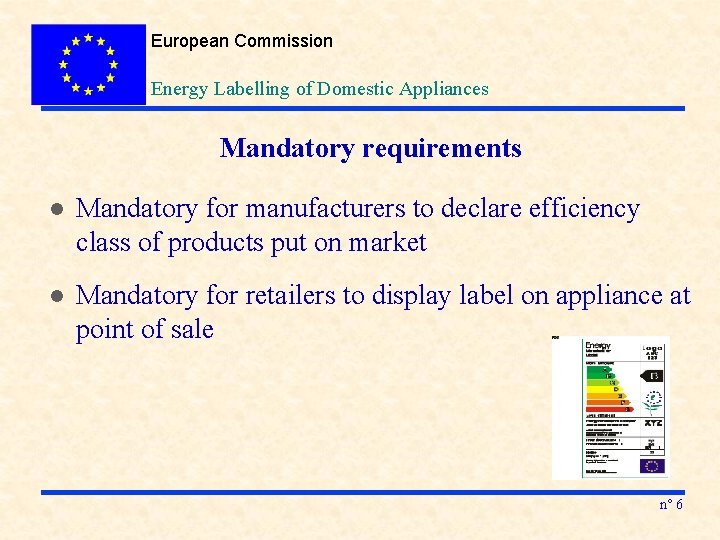
European Commission Energy Labelling of Domestic Appliances Mandatory requirements l Mandatory for manufacturers to declare efficiency class of products put on market l Mandatory for retailers to display label on appliance at point of sale n° 6
European Commission Energy Labelling of Domestic Appliances Conditions for selecting products l Represent significant proportion of energy demand at European level l Present overriding proportion of energy consumption at use l Scope for improvement - product has large spread of energy efficiencies for equivalent function performance n° 7
European Commission Energy Labelling of Domestic Appliances Transparency and consultation · · · Timely and extensive consultation of stakeholders, including from 3 rd countries TBT notification Exploring development of internet consultations (“Better Regulation” initiative) n° 8
European Commission Energy Labelling of Domestic Appliances International standards and equivalence l International standards used as basis for regulations except when inappropriate or ineffective l If equivalent rules, can access EU market. n° 9
European Commission Energy Labelling of Domestic Appliances Conformity assessment and enforcement l Manufacturers’ self-declaration of conformity l Enforcement through market surveillance and product liability laws n° 10
European Commission Energy Labelling of Domestic Appliances Market access l Mandatory requirements - impact on trade. l Creation niche markets, lower barriers to entry. . . l EC imports from many countries (Turkey, Poland, Indonesia, US, …) n° 11
European Commission Energy Labelling of Domestic Appliances EC imports, 2002 Air conditioners Refrigerators and freezers World € 2472 m World € 1973 m China Japan Thailand Czech Rep € 488 m € 475 m € 366 m € 292 m US Turkey South Korea Hungary € 329 m € 268 m € 256 m € 212 m n° 12
European Commission Energy Labelling of Domestic Appliances Developing countries l European Commission ready to respond to requests (e. g. ASEAN seminars) l Technical assistance programmes - European Community TBT related technical assistance to developing countries (G/TBT/W/228) n° 13
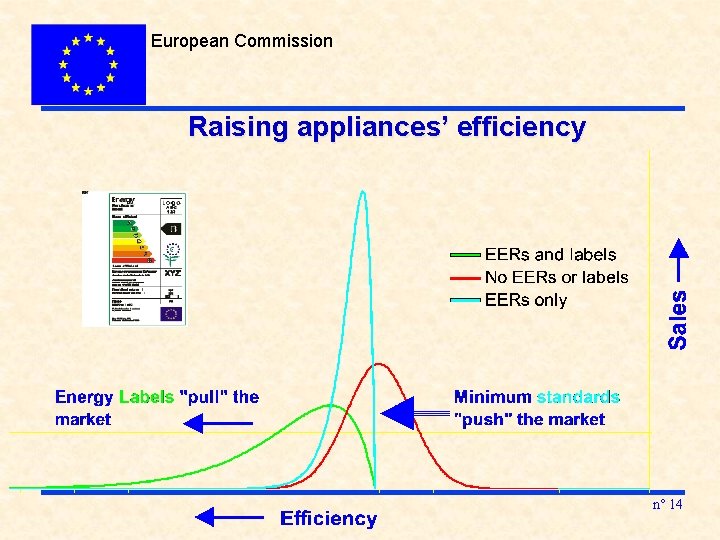
European Commission Raising appliances’ efficiency n° 14
European Commission Energy Star Labelling Programme for Office Equipment n° 15
European Commission Energy Star Labelling Overview l International Agreement between the EU and the US Associated Partners (Japan, Australia, Korea, Canada) l Covers office equipment (copiers, fax machines, computers, monitors, printers, scanners. . . ) l Defines concrete and measurable efficiency criteria n° 16
European Commission Energy Star Labelling Voluntary requirement l Voluntary scheme for manufacturers l Products meeting energy efficiency requirements have right to display Energy Star logo n° 17
European Commission Energy Star Labelling Transparency and consultation l Energy efficiency requirements are set by US EPA & European Commission l Timely and extensive consultation of stakeholders, including 3 rd country interests (EC Energy Star Board composed of the EU Member States, industry, consumers, NGOs. Public enquiry in US. . . ). n° 18
European Commission Energy Star Labelling Market access and developing countries l International agreement facilitates market access l One registration, accepted everywhere. l EC ready to respond to requests from developing countries n° 19
- Slides: 19