
European Commission Directorate General Economic and Financial Affairs
- Slides: 20
European Commission Directorate General Economic and Financial Affairs Using BCS data for tracking q-o-q GDP growth Andreas Reuter Business and consumer surveys and short-term forecast (ECFIN A 4. 2)
Outline 1. Introduction: the Economic Sentiment Indicator (ESI) 2. Relative weaknesses of the Economic Sentiment Indicator (ESI) 3. Refresher on ESI Construction Method 4. Improving the ESI's tracking performance of q-o-q GDP growth § step a: re-constructing the ESI based on "best-performing" survey questions § step b: an ESI with amplified changes 2
1. Introduction: the Economic Sentiment Indicator (ESI) Purpose of the ESI: § summarising developments in all 5 sectors covered by DG ECFIN's Business and Consumer Surveys (BCS): § industry § retail trade § consumers § services § construction § tracking GDP growth at Member State, EU and euro-area level Added value: § § timeliness (complementing delayed quantitative statistics) high frequency 3
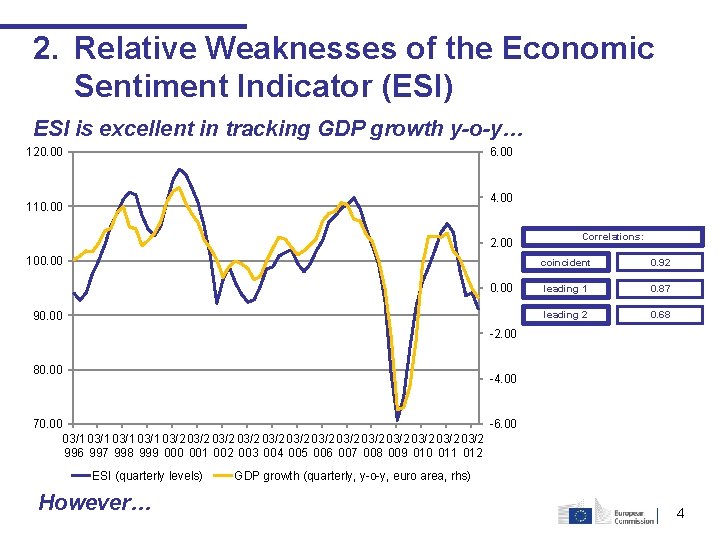
2. Relative Weaknesses of the Economic Sentiment Indicator (ESI) ESI is excellent in tracking GDP growth y-o-y… 120. 00 6. 00 4. 00 110. 00 2. 00 100. 00 90. 00 Correlations: coincident 0. 92 leading 1 0. 87 leading 2 0. 68 -2. 00 80. 00 -4. 00 70. 00 -6. 00 03/1 03/2 03/2 03/2 03/2 996 997 998 999 000 001 002 003 004 005 006 007 008 009 010 011 012 ESI (quarterly levels) However… GDP growth (quarterly, y-o-y, euro area, rhs) 4
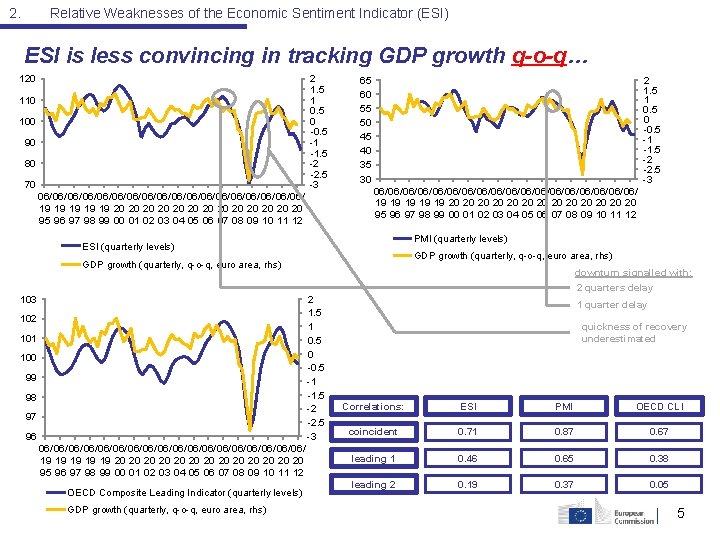
2. Relative Weaknesses of the Economic Sentiment Indicator (ESI) ESI is less convincing in tracking GDP growth q-o-q… 120 2 1. 5 1 0. 5 0 -0. 5 -1 -1. 5 -2 -2. 5 -3 110 100 90 80 70 06/ 06/ 06/ 06/ 06/ 19 19 19 20 20 20 20 95 96 97 98 99 00 01 02 03 04 05 06 07 08 09 10 11 12 65 60 55 50 45 40 35 30 2 1. 5 1 0. 5 0 -0. 5 -1 -1. 5 -2 -2. 5 -3 06/ 06/ 06/ 06/ 06/ 19 19 19 20 20 20 20 95 96 97 98 99 00 01 02 03 04 05 06 07 08 09 10 11 12 PMI (quarterly levels) ESI (quarterly levels) GDP growth (quarterly, q-o-q, euro area, rhs) 103 downturn signalled with: 2 quarters delay 2 1. 5 1 0. 5 0 -0. 5 -1 -1. 5 -2 -2. 5 -3 102 101 100 99 98 97 96 06/ 06/ 06/ 06/ 06/ 19 19 19 20 20 20 20 95 96 97 98 99 00 01 02 03 04 05 06 07 08 09 10 11 12 OECD Composite Leading Indicator (quarterly levels) GDP growth (quarterly, q-o-q, euro area, rhs) 1 quarter delay quickness of recovery underestimated Correlations: ESI PMI OECD CLI coincident 0. 71 0. 87 0. 67 leading 1 0. 46 0. 65 0. 38 leading 2 0. 19 0. 37 0. 05 5
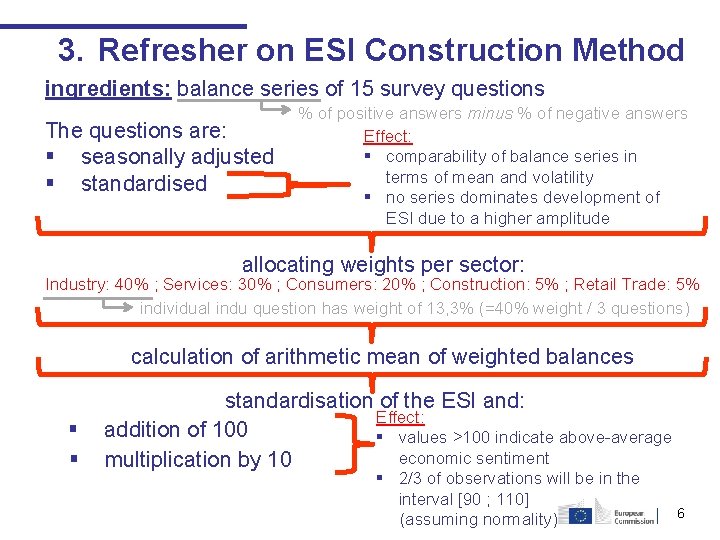
3. Refresher on ESI Construction Method ingredients: balance series of 15 survey questions The questions are: § seasonally adjusted § standardised % of positive answers minus % of negative answers Effect: § comparability of balance series in terms of mean and volatility § no series dominates development of ESI due to a higher amplitude allocating weights per sector: Industry: 40% ; Services: 30% ; Consumers: 20% ; Construction: 5% ; Retail Trade: 5% individual indu question has weight of 13, 3% (=40% weight / 3 questions) calculation of arithmetic mean of weighted balances § § standardisation of the ESI and: Effect: addition of 100 § values >100 indicate above-average economic sentiment multiplication by 10 § 2/3 of observations will be in the interval [90 ; 110] (assuming normality) 6
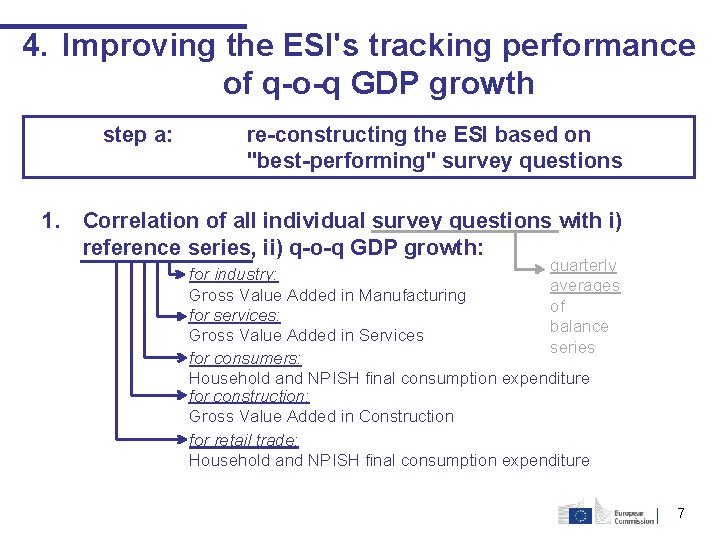
4. Improving the ESI's tracking performance of q-o-q GDP growth step a: re-constructing the ESI based on "best-performing" survey questions 1. Correlation of all individual survey questions with i) reference series, ii) q-o-q GDP growth: quarterly for industry: averages Gross Value Added in Manufacturing of for services: balance Gross Value Added in Services series for consumers: Household and NPISH final consumption expenditure for construction: Gross Value Added in Construction for retail trade: Household and NPISH final consumption expenditure 7
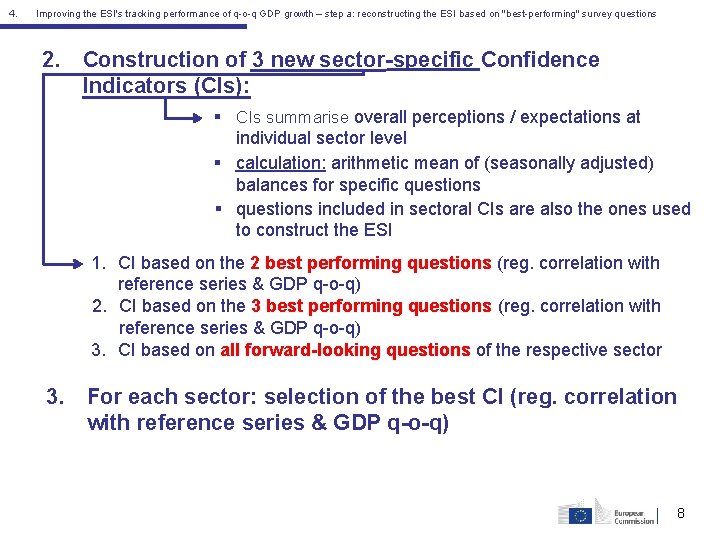
4. Improving the ESI's tracking performance of q-o-q GDP growth – step a: reconstructing the ESI based on "best-performing" survey questions 2. Construction of 3 new sector-specific Confidence Indicators (CIs): § CIs summarise overall perceptions / expectations at individual sector level § calculation: arithmetic mean of (seasonally adjusted) balances for specific questions § questions included in sectoral CIs are also the ones used to construct the ESI 1. CI based on the 2 best performing questions (reg. correlation with reference series & GDP q-o-q) 2. CI based on the 3 best performing questions (reg. correlation with reference series & GDP q-o-q) 3. CI based on all forward-looking questions of the respective sector 3. For each sector: selection of the best CI (reg. correlation with reference series & GDP q-o-q) 8
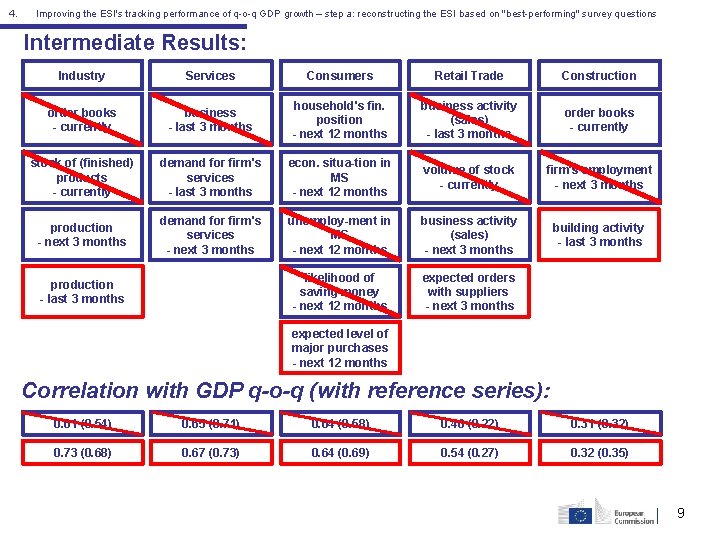
4. Improving the ESI's tracking performance of q-o-q GDP growth – step a: reconstructing the ESI based on "best-performing" survey questions Intermediate Results: Industry Services Consumers Retail Trade Construction order books - currently business - last 3 months household's fin. position - next 12 months business activity (sales) - last 3 months order books - currently stock of (finished) products - currently demand for firm's services - last 3 months econ. situa-tion in MS - next 12 months volume of stock - currently firm's employment - next 3 months production - next 3 months demand for firm's services - next 3 months unemploy-ment in MS - next 12 months business activity (sales) - next 3 months building activity - last 3 months likelihood of saving money - next 12 months expected orders with suppliers - next 3 months production - last 3 months expected level of major purchases - next 12 months Correlation with GDP q-o-q (with reference series): 0. 61 (0. 54) 0. 65 (0. 71) 0. 64 (0. 58) 0. 46 (0. 22) 0. 31 (0. 32) 0. 73 (0. 68) 0. 67 (0. 73) 0. 64 (0. 69) 0. 54 (0. 27) 0. 32 (0. 35) 9
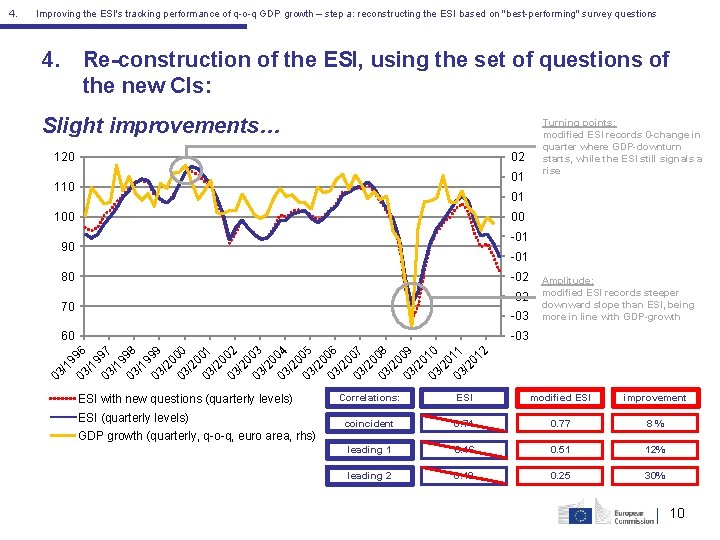
Improving the ESI's tracking performance of q-o-q GDP growth – step a: reconstructing the ESI based on "best-performing" survey questions 4. Re-construction of the ESI, using the set of questions of the new CIs: Slight improvements… 120 02 01 110 Turning points: modified ESI records 0 -change in quarter where GDP-downturn starts, while the ESI still signals a rise 01 100 00 -01 90 -01 80 -02 70 -03 Amplitude: modified ESI records steeper downward slope than ESI, being more in line with GDP-growth -03 /1 9 03 96 /1 9 03 97 /1 9 03 98 /1 9 03 99 /2 0 03 00 /2 0 03 01 /2 0 03 02 /2 0 03 03 /2 0 03 04 /2 0 03 05 /2 0 03 06 /2 0 03 07 /2 0 03 08 /2 0 03 09 /2 0 03 10 /2 0 03 11 /2 01 2 60 03 4. ESI with new questions (quarterly levels) ESI (quarterly levels) Correlations: ESI modified ESI improvement coincident 0. 71 0. 77 8% leading 1 0. 46 0. 51 12% leading 2 0. 19 0. 25 30% GDP growth (quarterly, q-o-q, euro area, rhs) 10
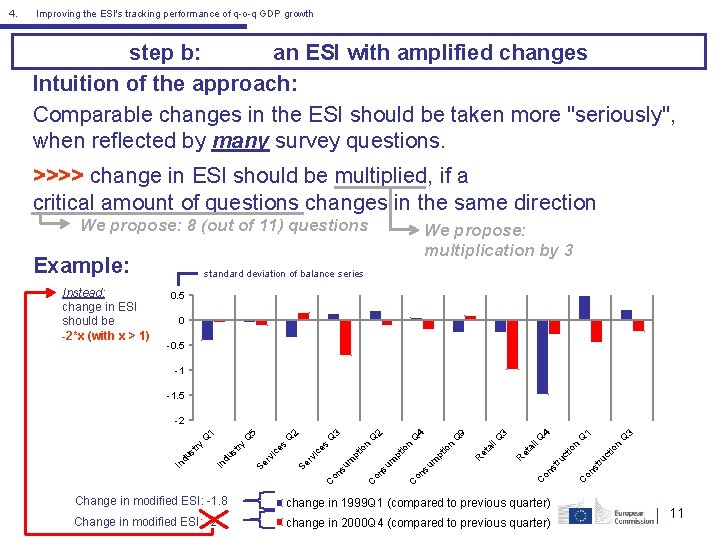
Improving the ESI's tracking performance of q-o-q GDP growth step b: an ESI with amplified changes Intuition of the approach: Comparable changes in the ESI should be taken more "seriously", when reflected by many survey questions. >>>> change in ESI should be multiplied, if a critical amount of questions changes in the same direction We propose: 8 (out of 11) questions Example: Instead: change in ESI should be -2*x (with x > 1) We propose: multiplication by 3 standard deviation of balance series 0. 5 0 -0. 5 -1 -1. 5 change in 1999 Q 1 (compared to previous quarter) Change in modified ESI: -2 change in 2000 Q 4 (compared to previous quarter) 3 n ct io st ru C on ct io st ru Change in modified ESI: -1. 8 Q 1 Q n l. Q ai R et ai l. Q 4 3 9 R et C on su m pt io n Q 4 n m pt su on C su on io m pt vi c C Q 2 Q 3 es Q Se r es vi c Se r Q 2 5 Q ry st du In du st ry Q 1 -2 In 4. 11
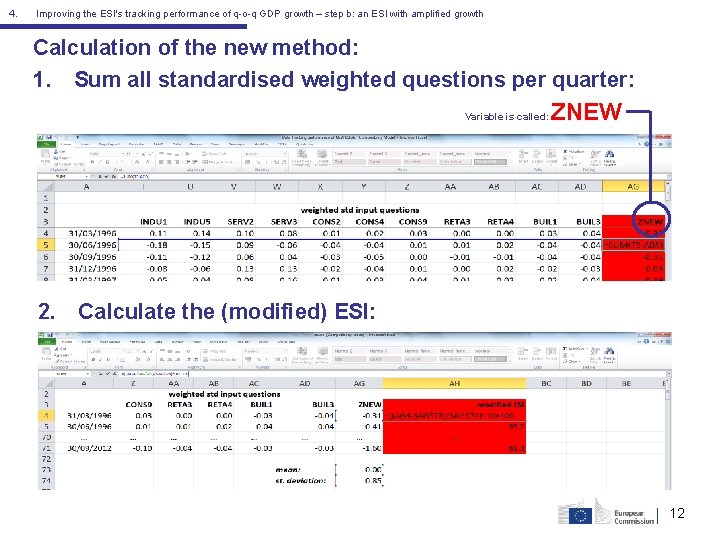
4. Improving the ESI's tracking performance of q-o-q GDP growth – step b: an ESI with amplified growth Calculation of the new method: 1. Sum all standardised weighted questions per quarter: Variable is called: ZNEW 2. Calculate the (modified) ESI: 12
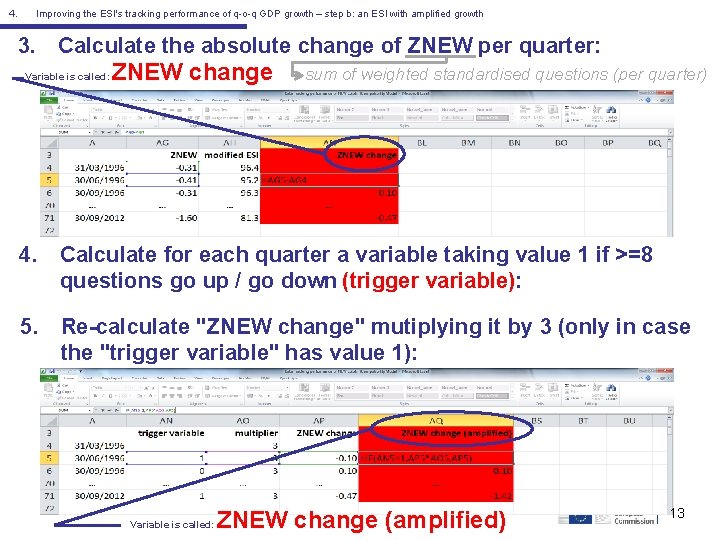
4. Improving the ESI's tracking performance of q-o-q GDP growth – step b: an ESI with amplified growth 3. Calculate the absolute change of ZNEW per quarter: Variable is called: ZNEW change sum of weighted standardised questions (per quarter) 4. Calculate for each quarter a variable taking value 1 if >=8 questions go up / go down (trigger variable): 5. Re-calculate "ZNEW change" mutiplying it by 3 (only in case the "trigger variable" has value 1): Variable is called: ZNEW change (amplified) 13
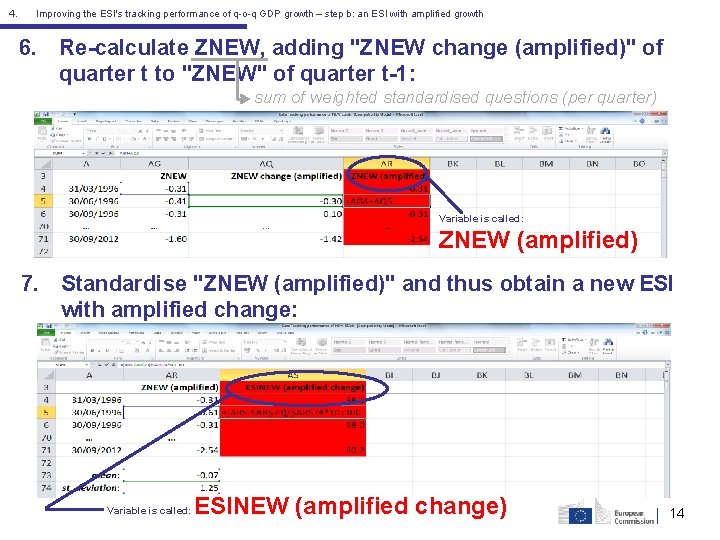
4. Improving the ESI's tracking performance of q-o-q GDP growth – step b: an ESI with amplified growth 6. Re-calculate ZNEW, adding "ZNEW change (amplified)" of quarter t to "ZNEW" of quarter t-1: sum of weighted standardised questions (per quarter) Variable is called: ZNEW (amplified) 7. Standardise "ZNEW (amplified)" and thus obtain a new ESI with amplified change: Variable is called: ESINEW (amplified change) 14
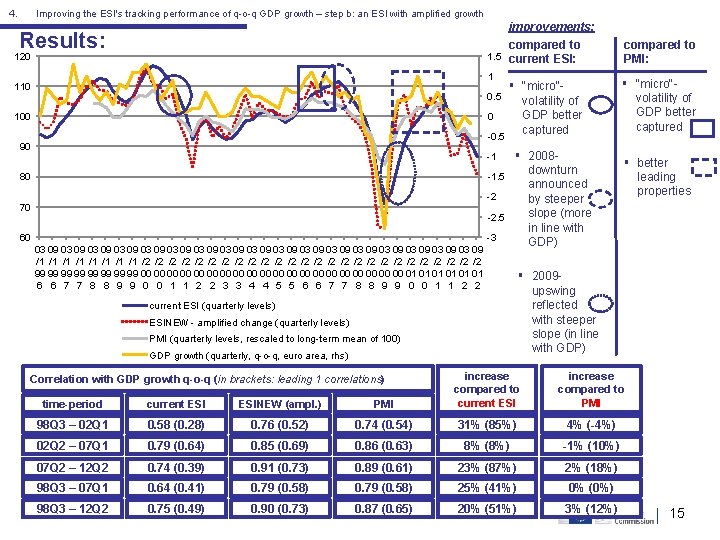
4. Improving the ESI's tracking performance of q-o-q GDP growth – step b: an ESI with amplified growth improvements: compared to 1. 5 current ESI: Results: 120 1 110 0. 5 100 0 -0. 5 90 § "micro"volatility of GDP better captured -1 80 -1. 5 -2 70 -2. 5 60 -3 03 09 03 09 03 09 03 09 03 09 /1 /1 /2 /2 /2 /2 /2 /2 /2 99 99 00 00 00 00 00 01 01 01 6 6 7 7 8 8 9 9 0 0 1 1 2 2 3 3 4 4 5 5 6 6 7 7 8 8 9 9 0 0 1 1 2 2 § 2008 downturn announced by steeper slope (more in line with GDP) current ESI (quarterly levels) ESINEW - amplified change (quarterly levels) PMI (quarterly levels, rescaled to long-term mean of 100) GDP growth (quarterly, q-o-q, euro area, rhs) § "micro"volatility of GDP better captured § better leading properties § 2009 upswing reflected with steeper slope (in line with GDP) time-period current ESINEW (ampl. ) PMI increase compared to current ESI 98 Q 3 – 02 Q 1 0. 58 (0. 28) 0. 76 (0. 52) 0. 74 (0. 54) 31% (85%) 4% (-4%) 02 Q 2 – 07 Q 1 0. 79 (0. 64) 0. 85 (0. 69) 0. 86 (0. 63) 8% (8%) -1% (10%) 07 Q 2 – 12 Q 2 0. 74 (0. 39) 0. 91 (0. 73) 0. 89 (0. 61) 23% (87%) 2% (18%) 98 Q 3 – 07 Q 1 0. 64 (0. 41) 0. 79 (0. 58) 25% (41%) 0% (0%) 98 Q 3 – 12 Q 2 0. 75 (0. 49) 0. 90 (0. 73) 0. 87 (0. 65) 20% (51%) 3% (12%) Correlation with GDP growth q-o-q (in brackets: leading 1 correlations) compared to PMI: increase compared to PMI 15
Conclusion: § BCS data can be used to construct indicator tracking q-o-q GDP growth satisfactorily § key of the approach: consider not only the (average) values of the balance series, but also the amount of series moving up/down § approach is still in its infancy and needs further testing 16
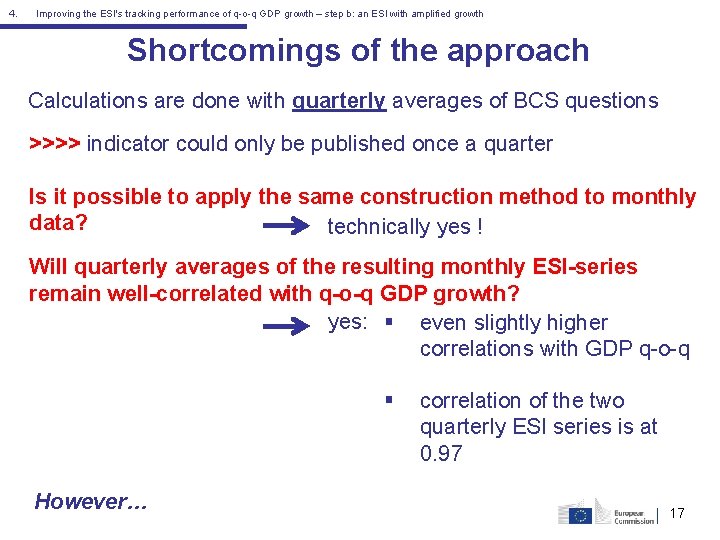
4. Improving the ESI's tracking performance of q-o-q GDP growth – step b: an ESI with amplified growth Shortcomings of the approach Calculations are done with quarterly averages of BCS questions >>>> indicator could only be published once a quarter Is it possible to apply the same construction method to monthly data? technically yes ! Will quarterly averages of the resulting monthly ESI-series remain well-correlated with q-o-q GDP growth? yes: § even slightly higher correlations with GDP q-o-q § However… correlation of the two quarterly ESI series is at 0. 97 17
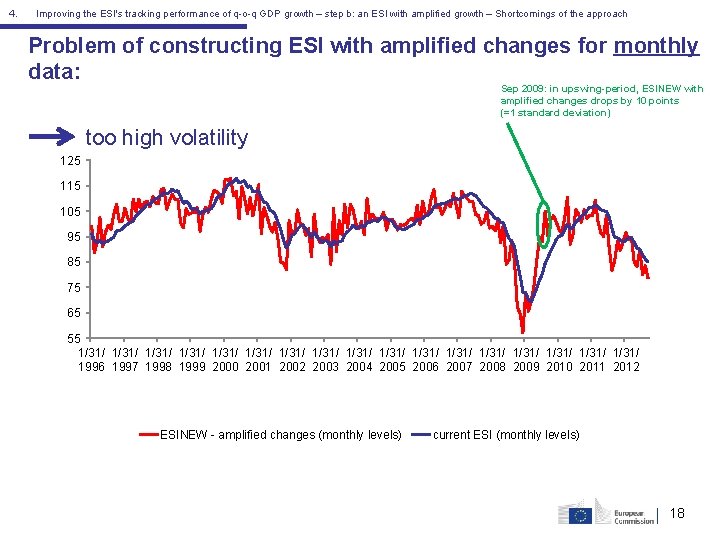
4. Improving the ESI's tracking performance of q-o-q GDP growth – step b: an ESI with amplified growth – Shortcomings of the approach Problem of constructing ESI with amplified changes for monthly data: Sep 2009: in upswing-period, ESINEW with amplified changes drops by 10 points (=1 standard deviation) too high volatility 125 115 105 95 85 75 65 55 1/31/ 1/31/ 1/31/ 1/31/ 1/31/ 1996 1997 1998 1999 2000 2001 2002 2003 2004 2005 2006 2007 2008 2009 2010 2011 2012 ESINEW - amplified changes (monthly levels) current ESI (monthly levels) 18
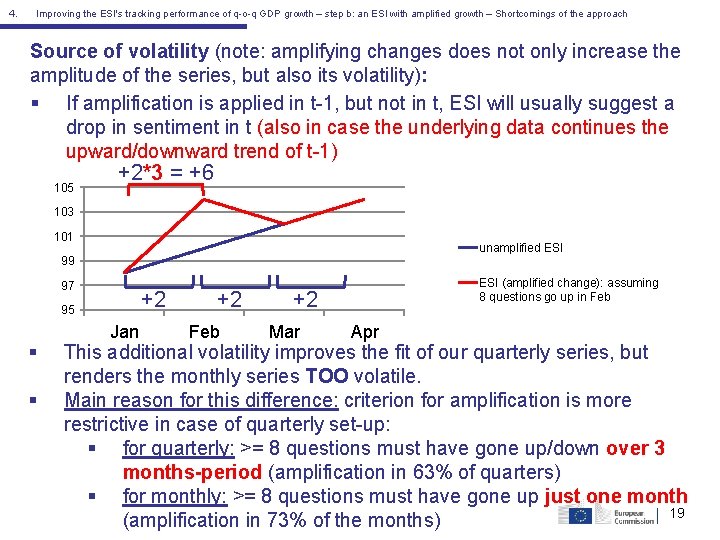
4. Improving the ESI's tracking performance of q-o-q GDP growth – step b: an ESI with amplified growth – Shortcomings of the approach Source of volatility (note: amplifying changes does not only increase the amplitude of the series, but also its volatility): § If amplification is applied in t-1, but not in t, ESI will usually suggest a drop in sentiment in t (also in case the underlying data continues the upward/downward trend of t-1) 105 +2*3 = +6 103 101 unamplified ESI 99 97 +2 95 § § Jan +2 Feb ESI (amplified change): assuming 8 questions go up in Feb +2 Mar Apr This additional volatility improves the fit of our quarterly series, but renders the monthly series TOO volatile. Main reason for this difference: criterion for amplification is more restrictive in case of quarterly set-up: § for quarterly: >= 8 questions must have gone up/down over 3 months-period (amplification in 63% of quarters) § for monthly: >= 8 questions must have gone up just one month 19 (amplification in 73% of the months)
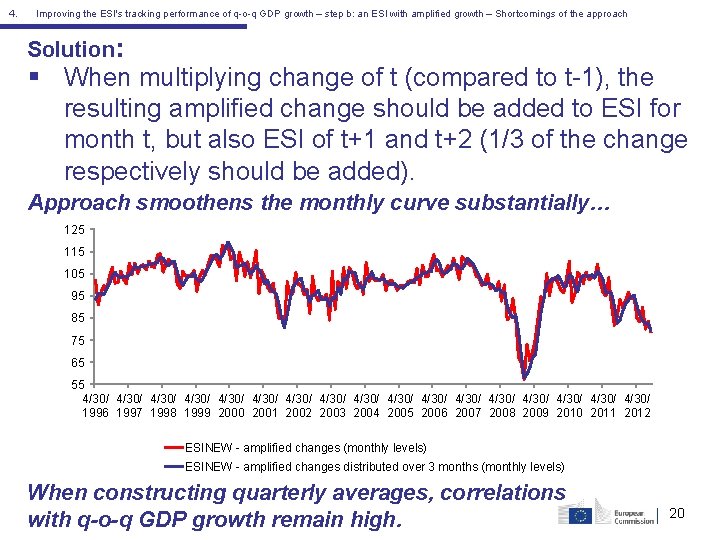
4. Improving the ESI's tracking performance of q-o-q GDP growth – step b: an ESI with amplified growth – Shortcomings of the approach Solution: § When multiplying change of t (compared to t-1), the resulting amplified change should be added to ESI for month t, but also ESI of t+1 and t+2 (1/3 of the change respectively should be added). Approach smoothens the monthly curve substantially… 125 115 105 95 85 75 65 55 4/30/ 4/30/ 4/30/ 4/30/ 4/30/ 1996 1997 1998 1999 2000 2001 2002 2003 2004 2005 2006 2007 2008 2009 2010 2011 2012 ESINEW - amplified changes (monthly levels) ESINEW - amplified changes distributed over 3 months (monthly levels) When constructing quarterly averages, correlations with q-o-q GDP growth remain high. 20