
European Colonies in the Americas 1756 Early Colonial
- Slides: 17
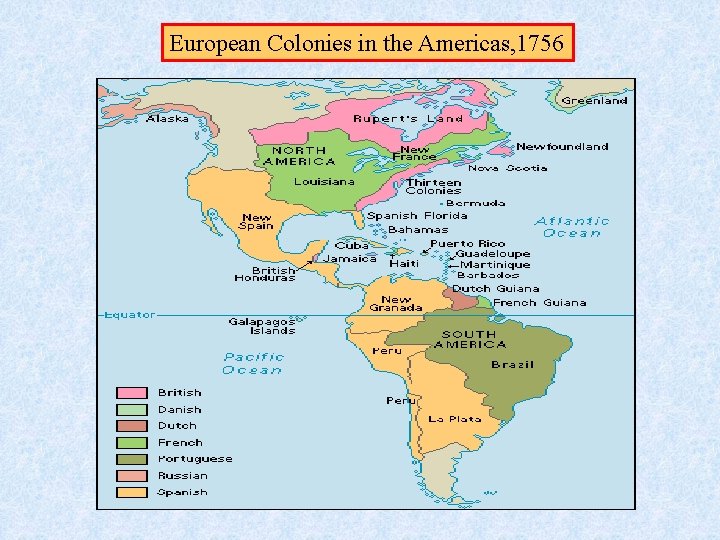
European Colonies in the Americas, 1756
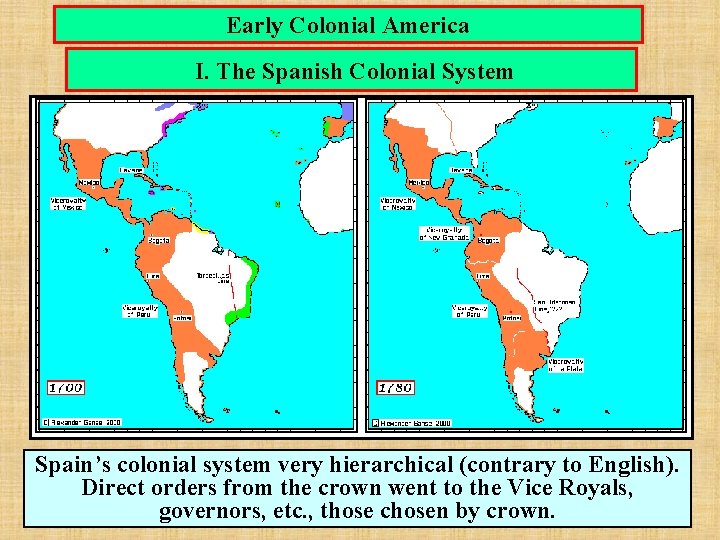
Early Colonial America I. The Spanish Colonial System Spain’s colonial system very hierarchical (contrary to English). Direct orders from the crown went to the Vice Royals, governors, etc. , those chosen by crown.
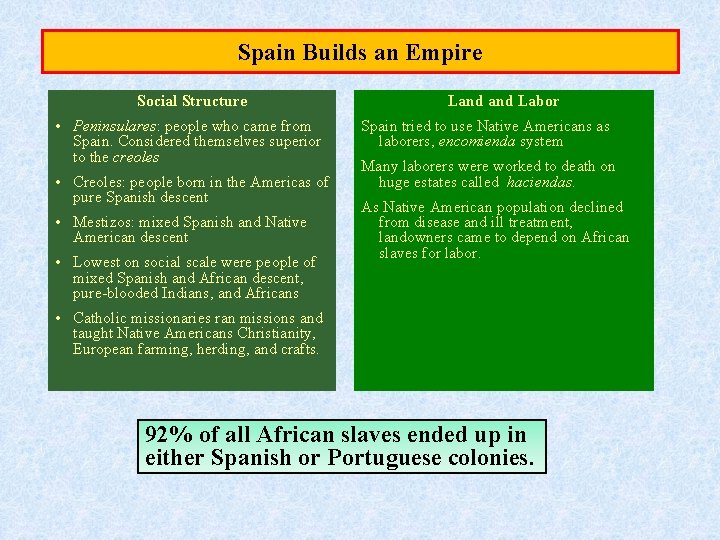
Spain Builds an Empire Social Structure • Peninsulares: people who came from Spain. Considered themselves superior to the creoles • Creoles: people born in the Americas of pure Spanish descent • Mestizos: mixed Spanish and Native American descent • Lowest on social scale were people of mixed Spanish and African descent, pure-blooded Indians, and Africans Land Labor Spain tried to use Native Americans as laborers, encomienda system Many laborers were worked to death on huge estates called haciendas. As Native American population declined from disease and ill treatment, landowners came to depend on African slaves for labor. • Catholic missionaries ran missions and taught Native Americans Christianity, European farming, herding, and crafts. 92% of all African slaves ended up in either Spanish or Portuguese colonies.
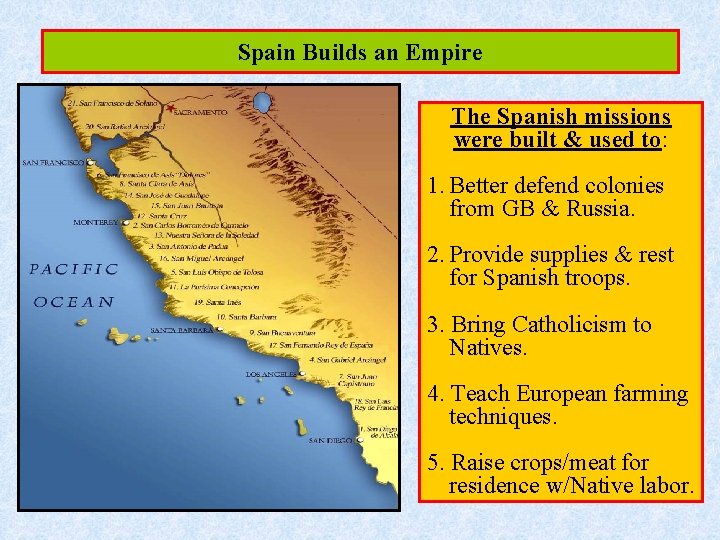
Spain Builds an Empire The Spanish missions were built & used to: 1. Better defend colonies from GB & Russia. 2. Provide supplies & rest for Spanish troops. 3. Bring Catholicism to Natives. 4. Teach European farming techniques. 5. Raise crops/meat for residence w/Native labor.
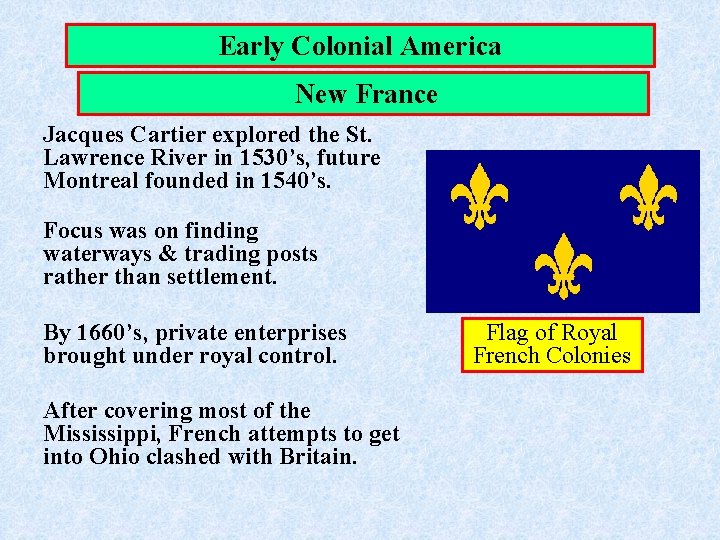
Early Colonial America New France Jacques Cartier explored the St. Lawrence River in 1530’s, future Montreal founded in 1540’s. Focus was on finding waterways & trading posts rather than settlement. By 1660’s, private enterprises brought under royal control. After covering most of the Mississippi, French attempts to get into Ohio clashed with Britain. Flag of Royal French Colonies
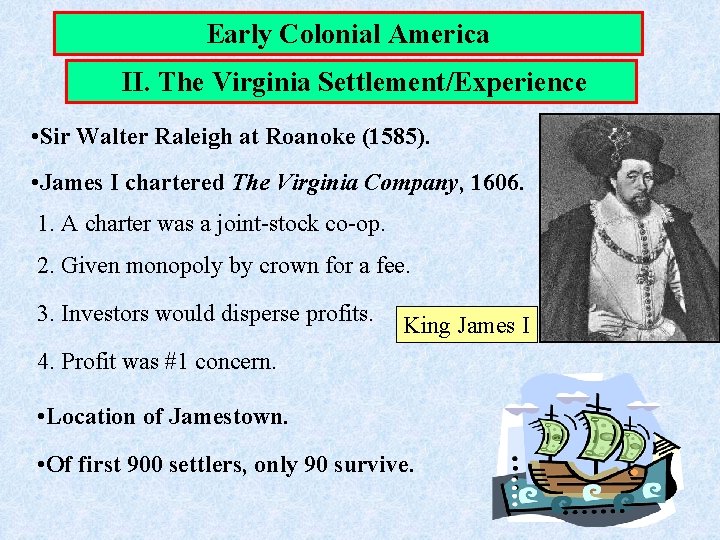
Early Colonial America II. The Virginia Settlement/Experience • Sir Walter Raleigh at Roanoke (1585). • James I chartered The Virginia Company, 1606. 1. A charter was a joint-stock co-op. 2. Given monopoly by crown for a fee. 3. Investors would disperse profits. King James I 4. Profit was #1 concern. • Location of Jamestown. • Of first 900 settlers, only 90 survive.
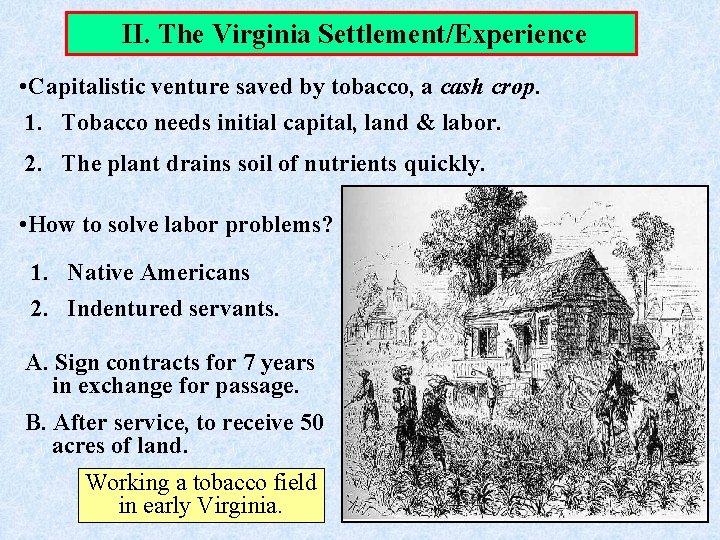
II. The Virginia Settlement/Experience • Capitalistic venture saved by tobacco, a cash crop. 1. Tobacco needs initial capital, land & labor. 2. The plant drains soil of nutrients quickly. • How to solve labor problems? 1. Native Americans 2. Indentured servants. A. Sign contracts for 7 years in exchange for passage. B. After service, to receive 50 acres of land. Working a tobacco field in early Virginia.
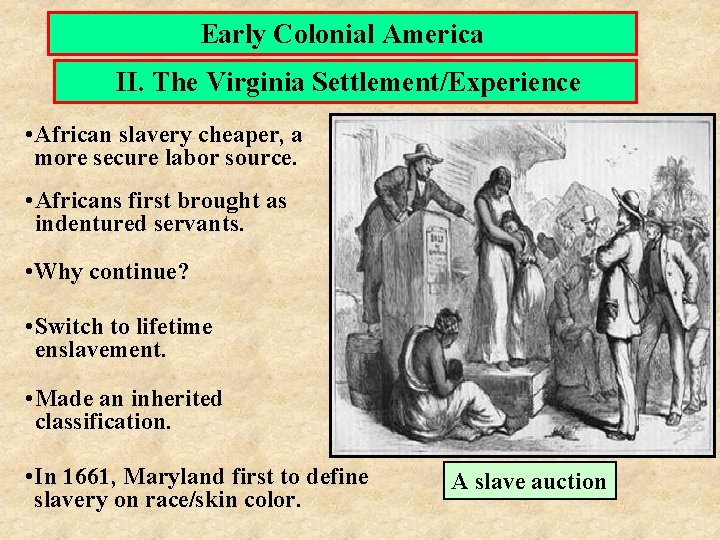
Early Colonial America II. The Virginia Settlement/Experience • African slavery cheaper, a more secure labor source. • Africans first brought as indentured servants. • Why continue? • Switch to lifetime enslavement. • Made an inherited classification. • In 1661, Maryland first to define slavery on race/skin color. A slave auction
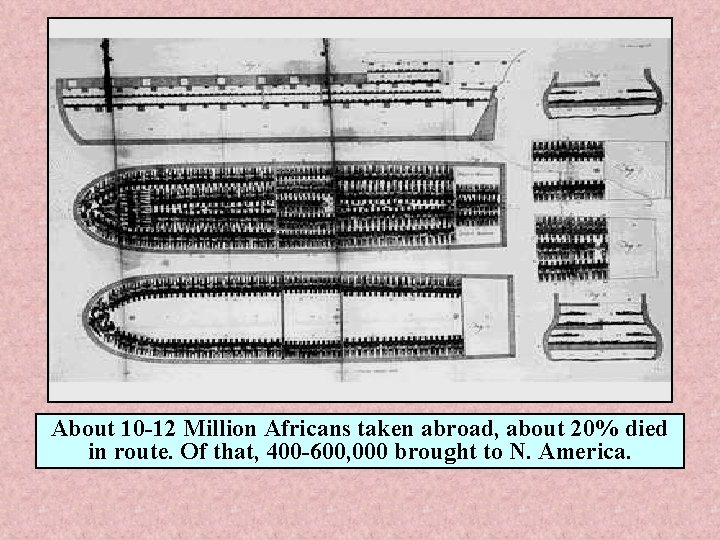
About 10 -12 Million Africans taken abroad, about 20% died in route. Of that, 400 -600, 000 brought to N. America.
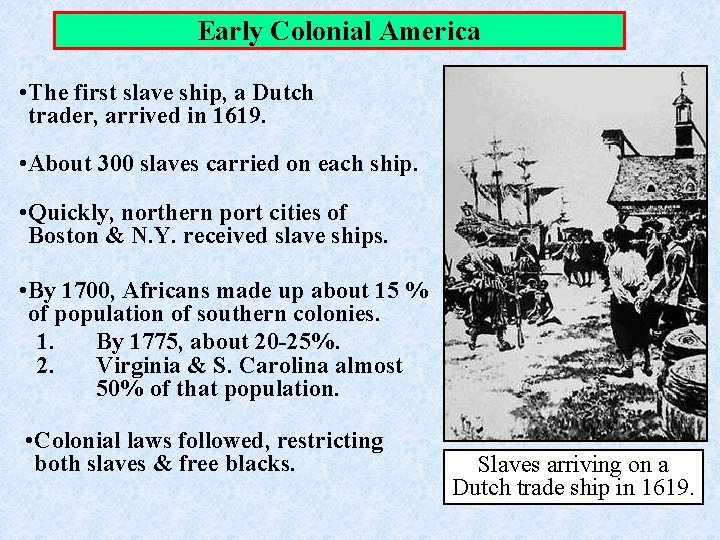
Early Colonial America • The first slave ship, a Dutch trader, arrived in 1619. • About 300 slaves carried on each ship. • Quickly, northern port cities of Boston & N. Y. received slave ships. • By 1700, Africans made up about 15 % of population of southern colonies. 1. By 1775, about 20 -25%. 2. Virginia & S. Carolina almost 50% of that population. • Colonial laws followed, restricting both slaves & free blacks. Slaves arriving on a Dutch trade ship in 1619.
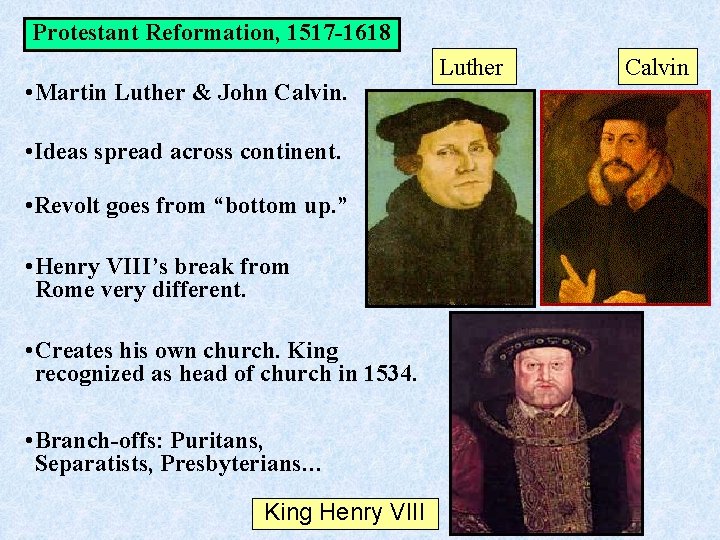
Protestant Reformation, 1517 -1618 • Martin Luther & John Calvin. • Ideas spread across continent. • Revolt goes from “bottom up. ” • Henry VIII’s break from Rome very different. • Creates his own church. King recognized as head of church in 1534. • Branch-offs: Puritans, Separatists, Presbyterians… King Henry VIII Luther Calvin
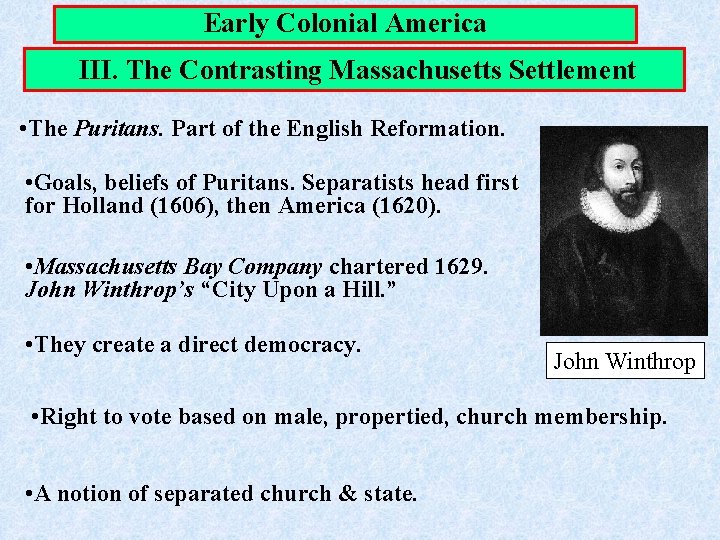
Early Colonial America III. The Contrasting Massachusetts Settlement • The Puritans. Part of the English Reformation. • Goals, beliefs of Puritans. Separatists head first for Holland (1606), then America (1620). • Massachusetts Bay Company chartered 1629. John Winthrop’s “City Upon a Hill. ” • They create a direct democracy. John Winthrop • Right to vote based on male, propertied, church membership. • A notion of separated church & state.
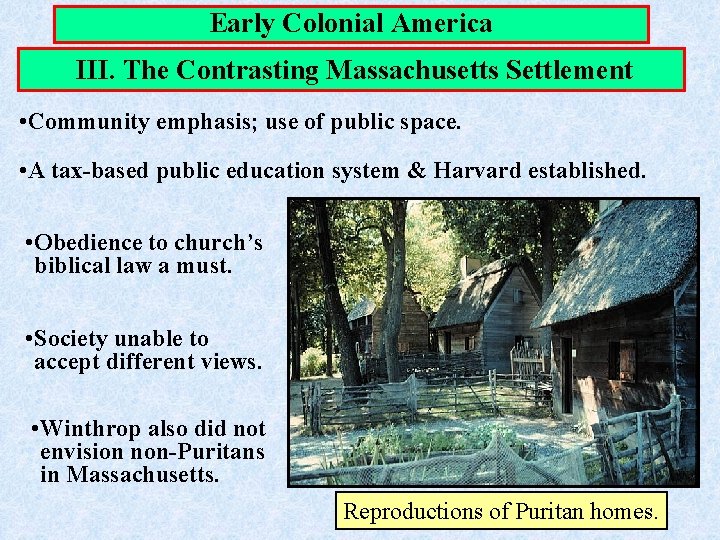
Early Colonial America III. The Contrasting Massachusetts Settlement • Community emphasis; use of public space. • A tax-based public education system & Harvard established. • Obedience to church’s biblical law a must. • Society unable to accept different views. • Winthrop also did not envision non-Puritans in Massachusetts. Reproductions of Puritan homes.
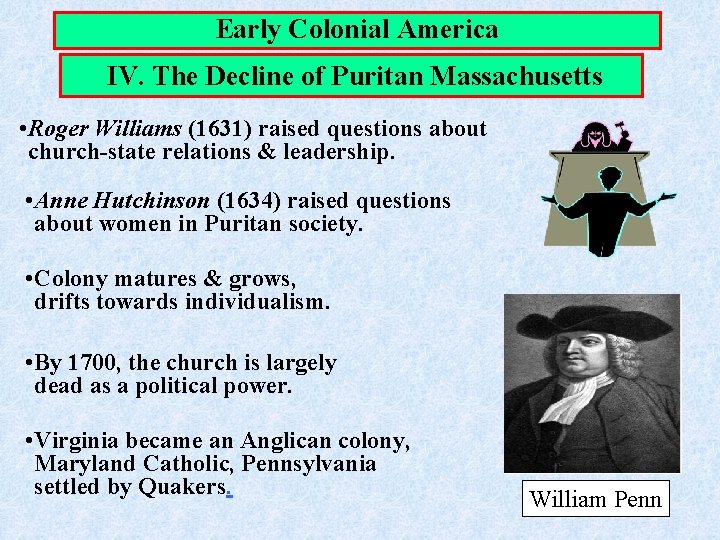
Early Colonial America IV. The Decline of Puritan Massachusetts • Roger Williams (1631) raised questions about church-state relations & leadership. • Anne Hutchinson (1634) raised questions about women in Puritan society. • Colony matures & grows, drifts towards individualism. • By 1700, the church is largely dead as a political power. • Virginia became an Anglican colony, Maryland Catholic, Pennsylvania settled by Quakers. William Penn
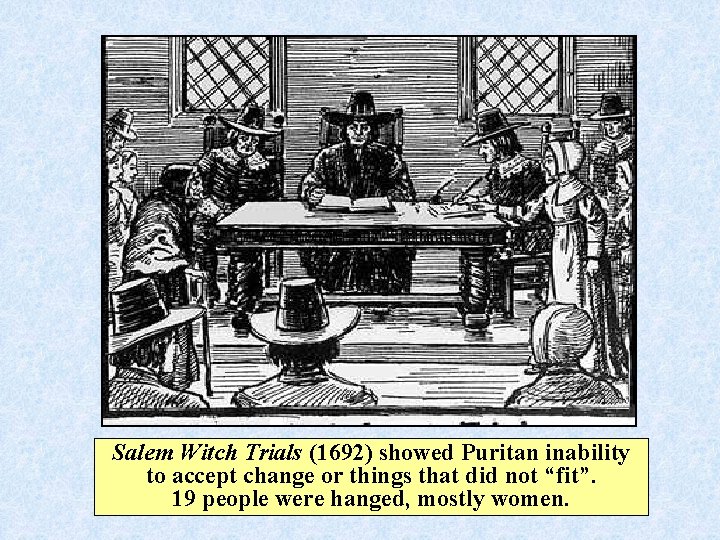
Salem Witch Trials (1692) showed Puritan inability to accept change or things that did not “fit”. 19 people were hanged, mostly women.
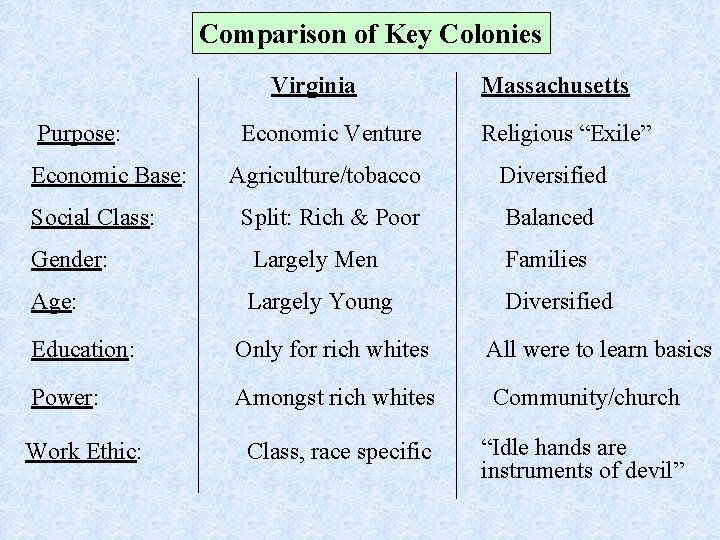
Comparison of Key Colonies Virginia Purpose: Economic Base: Social Class: Economic Venture Massachusetts Religious “Exile” Agriculture/tobacco Diversified Split: Rich & Poor Balanced Gender: Largely Men Families Age: Largely Young Diversified Education: Only for rich whites All were to learn basics Power: Amongst rich whites Community/church Class, race specific “Idle hands are instruments of devil” Work Ethic:
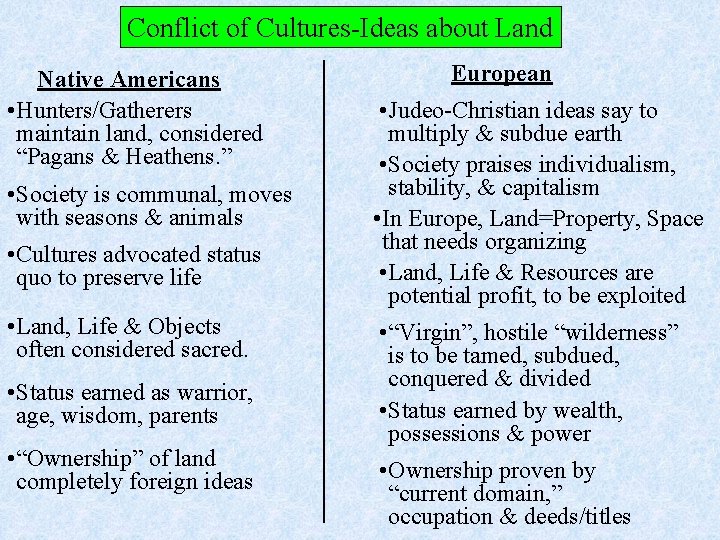
Conflict of Cultures-Ideas about Land Native Americans • Hunters/Gatherers maintain land, considered “Pagans & Heathens. ” • Society is communal, moves with seasons & animals • Cultures advocated status quo to preserve life • Land, Life & Objects often considered sacred. • Status earned as warrior, age, wisdom, parents • “Ownership” of land completely foreign ideas European • Judeo-Christian ideas say to multiply & subdue earth • Society praises individualism, stability, & capitalism • In Europe, Land=Property, Space that needs organizing • Land, Life & Resources are potential profit, to be exploited • “Virgin”, hostile “wilderness” is to be tamed, subdued, conquered & divided • Status earned by wealth, possessions & power • Ownership proven by “current domain, ” occupation & deeds/titles