
European Centre for Modern Languages and European Commission
- Slides: 6
European Centre for Modern Languages and European Commission cooperation on Innovative Methodologies and Assessment In Language Learning Two topics for training workshops: Relating language examinations to the common European reference levels of language proficiency: promoting quality assurance in education and facilitating mobility http: //relang. ecml. at Use of ICT in support of language teaching and learning http: //ict-rev. ecml. at
Constructing valid language tests and examinations based on the CEFR National Centre for Education Riga, 29 -31 October 2014
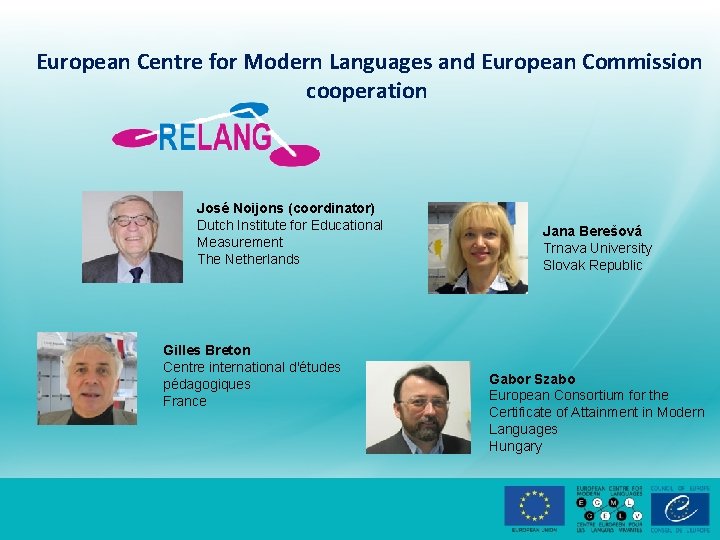
European Centre for Modern Languages and European Commission cooperation José Noijons (coordinator) Dutch Institute for Educational Measurement The Netherlands Gilles Breton Centre international d'études pédagogiques France Jana Berešová Trnava University Slovak Republic Gabor Szabo European Consortium for the Certificate of Attainment in Modern Languages Hungary
Aims • to evaluate the existing foreign language examinations for Grade 9; • to analyse how the examinations reflect the required CEFR levels (A 2 / B 1); • to understand how the use of the CEFR model of language use can lead to more valid and reliable language testing.
The CEFR approach: • actions performed by persons - individuals and social agents; • a range of competences, both general and in particular communicative language competences; • various contexts under various conditions and constraints to engage in language activities; • language processes to produce and/or receive texts in relation to themes in specific domains.
Benchmarking • productive skills; • performance samples to be used for benchmarking purposes; • set standards for individual levels.