
European Benchmarks and Indicators in Education and Training

European Benchmarks and Indicators in Education and Training Jean-Raymond Masson Turin, 30 November 2004

The Lisbon Conclusions (March 2000) « The EU to become the most competitive and dynamic knowledge-based economy in the world, capable of sustainable economic growth with more and better jobs and greater social cohesion » Central role of education and training in responding to the challenges: three strategic objectives (Stockholm Council March 2001) 1. Improving the quality and effectiveness of education and training systems 2. Facilitating access of all to education and training systems 3. Opening up education and training systems to the wider world 2
The Barcelona Council (March 2002) 1. Detailed « Work Programme for 2010 for education and training systems » adopted by the Barcelona Council (March 2002). 13 objectives 2. Objectives to be achieved through the Open Method of Coordination 3. Communication on « Making a European Area for Lifelong Learning a Reality » 4. New goal « to make Europe’s education and training systems a world quality reference by 2010 » 3
The open method of coordination Ø Amsterdam Treaty; Articles 149 and 150 « means of spreading best practice and achieving greater convergence towards the main EU goals » Ø From Lisbon Conclusions: used « as a fully decentralised approach using variable forms of partnerships and designed to help Member States to develop their own policies progressively » Ø Indicators and benchmarks Ø Exchange of experiences Ø Peer reviews Ø Dissemination of good practice Ø Commission reports to the Spring summits 4
Monitoring Progress regarding Education and Training For each indicator: Ø Present levels: EU Average/ Average of the 3 best performing EU countries / USA and Japan Ø Progress: Up till 2004 / Up till 2010 Ø Benchmarks: for 2004 / For 2010 Ø To be disaggregated by gender where relevant Ø The Standing Group on Indicators to revise the list, develop new indicators and ask the EUMS to collect them 5
Thirteen concrete objectives and 29 indicators 1. 1 Improving education and training for teachers and trainers: (1) Age of teachers, (2) Number of young people, (3) Ratio of pupils to teaching staff, 1. 2 Developing skills for the knowledge society: (4) Completion of upper secondary education, (5) Low-performing students in reading literacy, (6 to 8) Performance in reading, mathematical and scientific literacy, (9) Participation in education or training of initially low qualified people 1. 3 Ensuring access to ICT for everyone 6
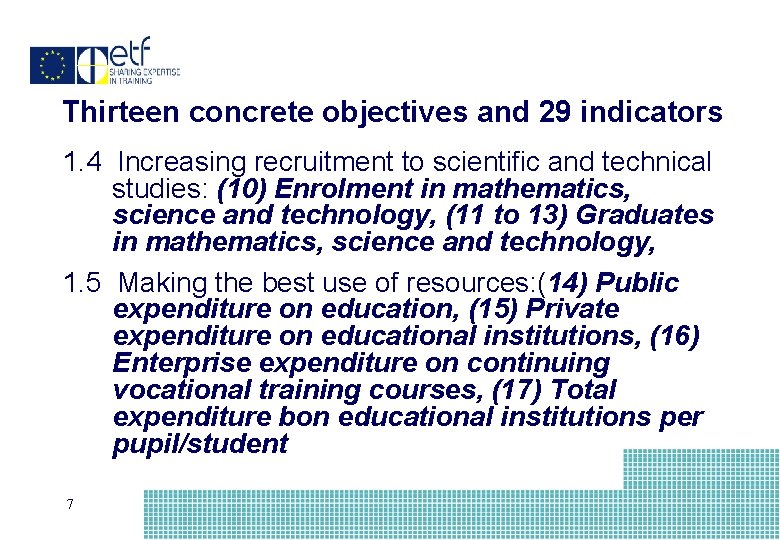
Thirteen concrete objectives and 29 indicators 1. 4 Increasing recruitment to scientific and technical studies: (10) Enrolment in mathematics, science and technology, (11 to 13) Graduates in mathematics, science and technology, 1. 5 Making the best use of resources: (14) Public expenditure on education, (15) Private expenditure on educational institutions, (16) Enterprise expenditure on continuing vocational training courses, (17) Total expenditure bon educational institutions per pupil/student 7
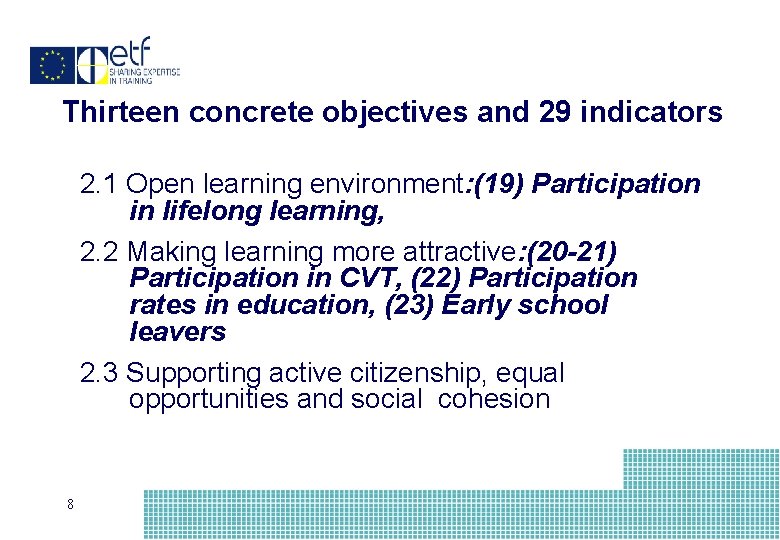
Thirteen concrete objectives and 29 indicators 2. 1 Open learning environment: (19) Participation in lifelong learning, 2. 2 Making learning more attractive: (20 -21) Participation in CVT, (22) Participation rates in education, (23) Early school leavers 2. 3 Supporting active citizenship, equal opportunities and social cohesion 8
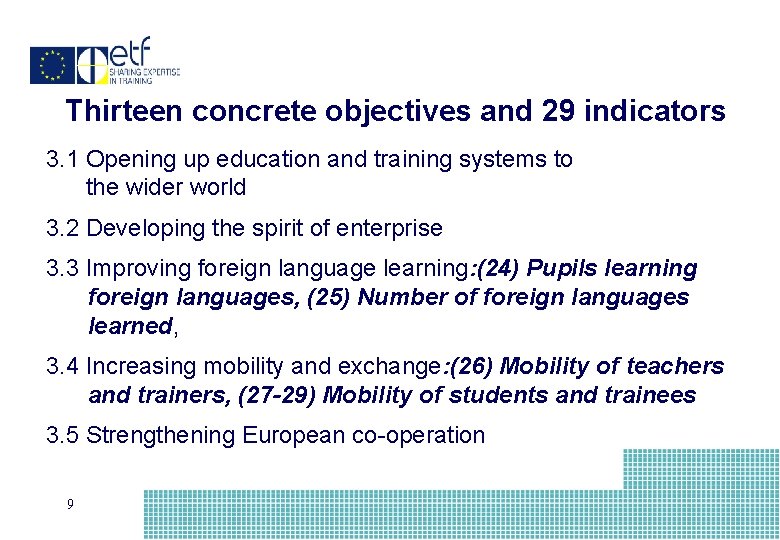
Thirteen concrete objectives and 29 indicators 3. 1 Opening up education and training systems to the wider world 3. 2 Developing the spirit of enterprise 3. 3 Improving foreign language learning: (24) Pupils learning foreign languages, (25) Number of foreign languages learned, 3. 4 Increasing mobility and exchange: (26) Mobility of teachers and trainers, (27 -29) Mobility of students and trainees 3. 5 Strengthening European co-operation 9
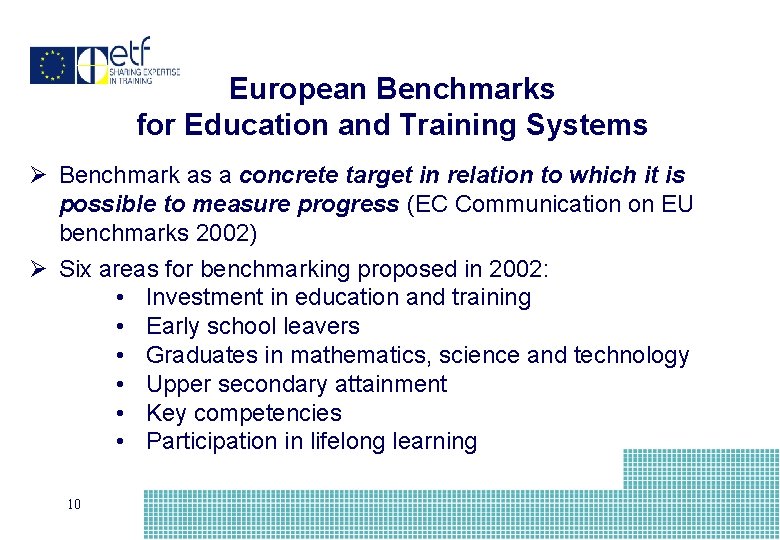
European Benchmarks for Education and Training Systems Ø Benchmark as a concrete target in relation to which it is possible to measure progress (EC Communication on EU benchmarks 2002) Ø Six areas for benchmarking proposed in 2002: • Investment in education and training • Early school leavers • Graduates in mathematics, science and technology • Upper secondary attainment • Key competencies • Participation in lifelong learning 10
European Benchmarks for Education and Training Systems Ø Five adopted by the Council (2 to 6) May 2003 Ø Not concrete targets for individual country but « reference levels of European average performance » Ø Stress on the relevance of “benchmarks to identify best practice and to ensure efficient and effective investment in human resources” 11
The five European benchmarks for education and training (1) Ø By 2010, an EU average rate of no more than 10% early school leavers should be achieved Ø The total number of graduates in mathematics, science and technology in the EU should increase by at least 15 % by 2010 while at the same time the level of gender imbalance should decrease 12
The five European benchmarks for education and training (2) Ø By 2010, at least 85 % of 22 years old in the EU should have completed upper secondary education Ø By 2010, the percentage of low-achieving 15 year olds in reading literacy in the EU should have decreased by at least 20% compared to the year 2000 Ø BY 2010, the EU average level of participation in Lifelong learning should be at least 12. 5% of the adult working age population (25 -64 age group) 13
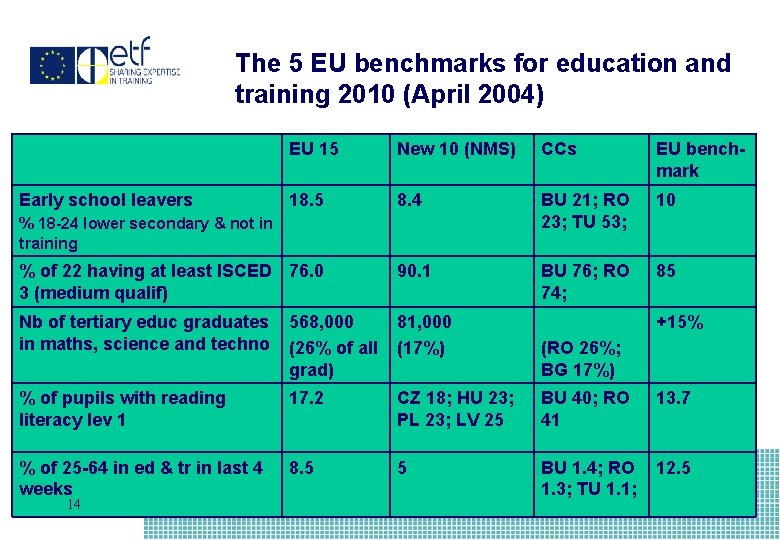
The 5 EU benchmarks for education and training 2010 (April 2004) Early school leavers EU 15 New 10 (NMS) CCs EU benchmark 18. 5 8. 4 BU 21; RO 23; TU 53; 10 90. 1 BU 76; RO 74; 85 % 18 -24 lower secondary & not in training % of 22 having at least ISCED 76. 0 3 (medium qualif) Nb of tertiary educ graduates 568, 000 81, 000 in maths, science and techno (26% of all (17%) grad) (RO 26%; BG 17%) % of pupils with reading literacy lev 1 17. 2 CZ 18; HU 23; PL 23; LV 25 BU 40; RO 41 % of 25 -64 in ed & tr in last 4 weeks 8. 5 5 BU 1. 4; RO 12. 5 1. 3; TU 1. 1; 14 +15% 13. 7
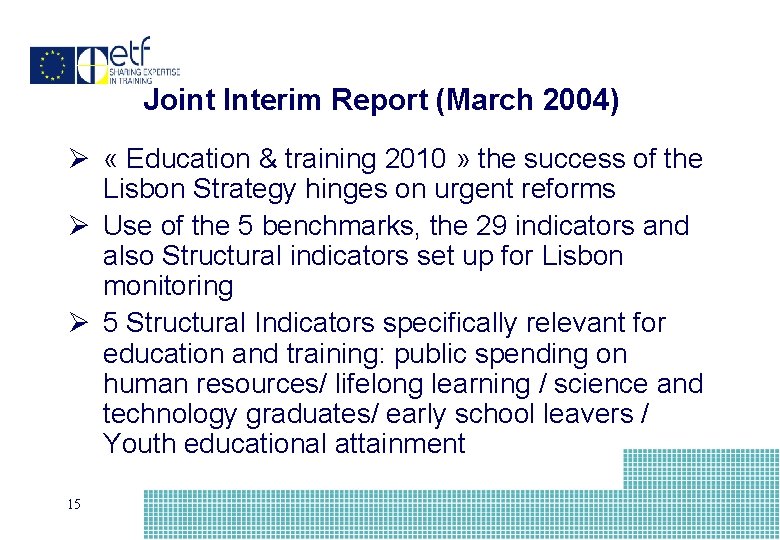
Joint Interim Report (March 2004) Ø « Education & training 2010 » the success of the Lisbon Strategy hinges on urgent reforms Ø Use of the 5 benchmarks, the 29 indicators and also Structural indicators set up for Lisbon monitoring Ø 5 Structural Indicators specifically relevant for education and training: public spending on human resources/ lifelong learning / science and technology graduates/ early school leavers / Youth educational attainment 15

- Slides: 19