
Europe Physical Geography of Europe Mountains and Plains
- Slides: 40
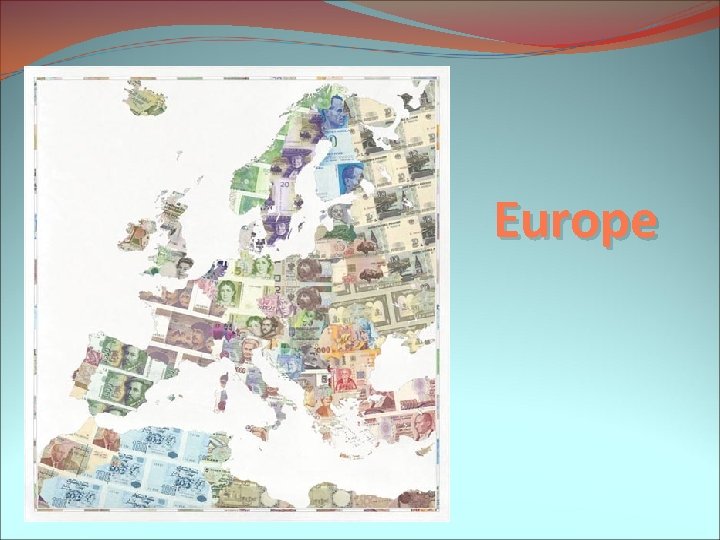
Europe
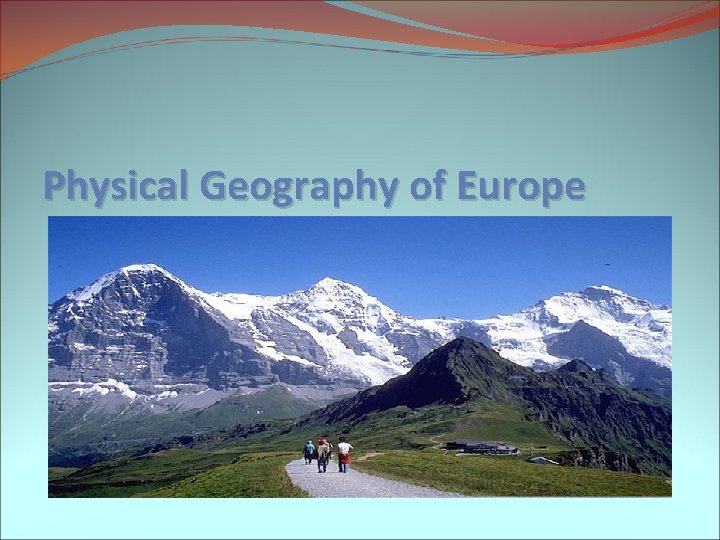
Physical Geography of Europe
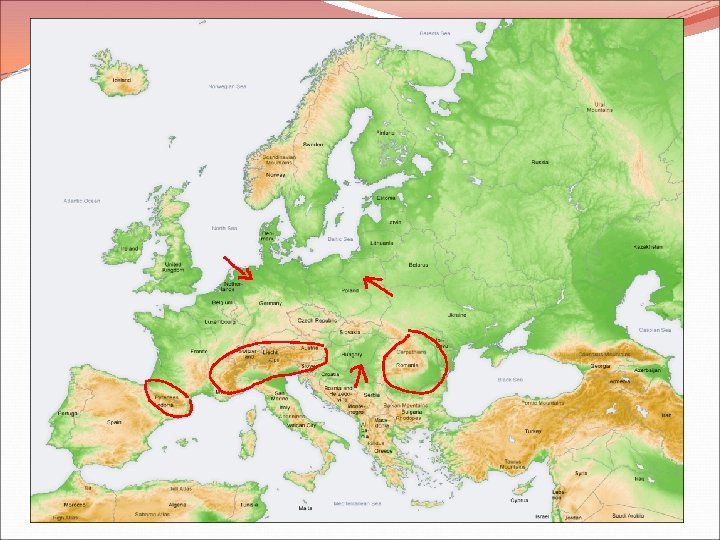
Mountains and Plains Landforms shaped lives of Europeans Geologically older mountains across northern Europe Younger, higher mountains in the south (Alps, Pyrenees) created by recent tectonic activity Alps separate warm, dry climate of Mediterranean from cooler northern Europe Carpathian Mountains in Eastern Europe Northern European Plain- across northern Europe Fertile soil, good for agriculture Location of largest cities in Europe Hungarian Plain- eastern Europe, good agricultural area Long rivers in heartland of Europe- Rhine, Danube, Rhone, Seine, Po Europeans have altered waterways (canals, dikes) to connect industrial centers Danube most important river in eastern Europe, Rhine important to western Europe
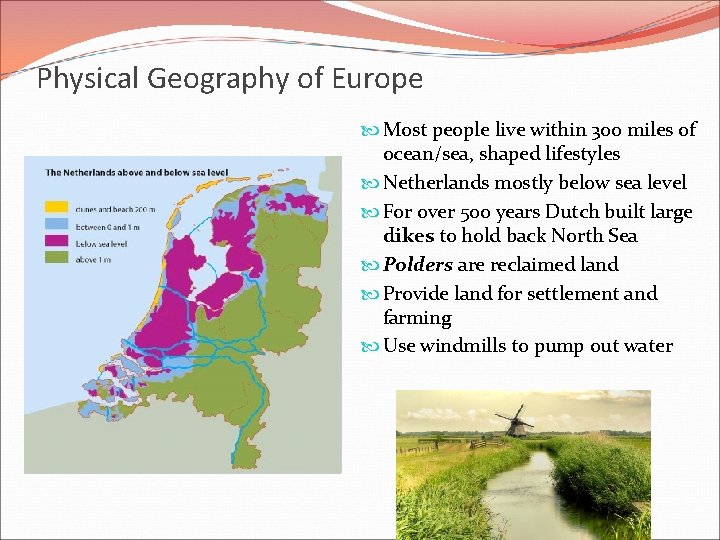
Physical Geography of Europe Most people live within 300 miles of ocean/sea, shaped lifestyles Netherlands mostly below sea level For over 500 years Dutch built large dikes to hold back North Sea Polders are reclaimed land Provide land for settlement and farming Use windmills to pump out water
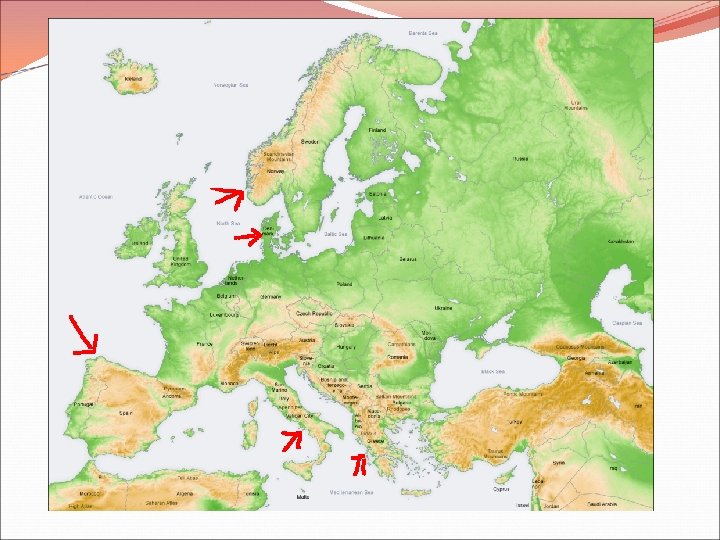
Land of Peninsulas Europe is a large peninsula Scandinavian Peninsula- Norway, Sweden, Finland Norway’s coast has many small inlets called fjordsevidence of glaciations Jutland-Denmark Iberian Peninsula- Spain and Portugal, most of it is a semiarid plateau, cut off from the rest of Europe by Pyrenees Mts. , mts kept region isolated Apennine Peninsula- Italy, along spine of peninsula Apennines Mts. , earthquakes, volcanoes common in region Balkan Peninsula- southeast Europe, tangle of mountains and valleys, historically kept people isolated
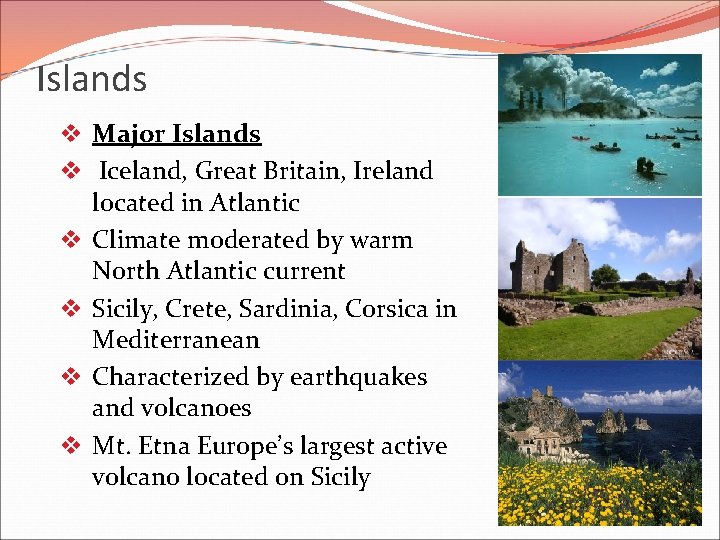
Islands v Major Islands v Iceland, Great Britain, Ireland located in Atlantic v Climate moderated by warm North Atlantic current v Sicily, Crete, Sardinia, Corsica in Mediterranean v Characterized by earthquakes and volcanoes v Mt. Etna Europe’s largest active volcano located on Sicily
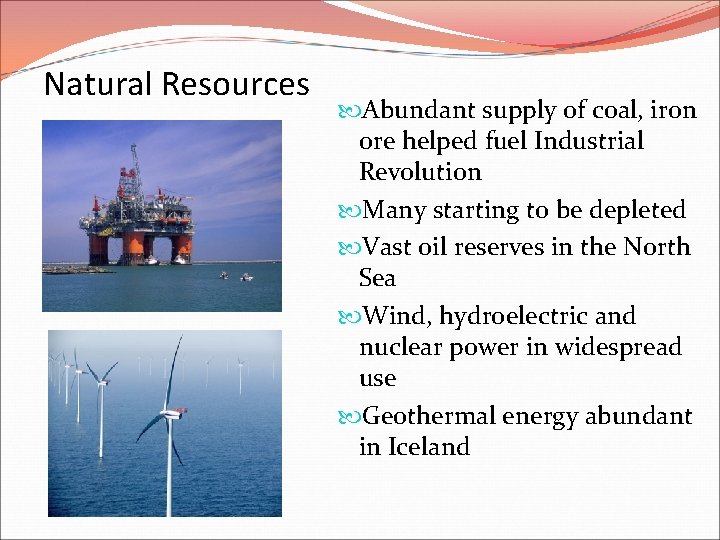
Natural Resources Abundant supply of coal, iron ore helped fuel Industrial Revolution Many starting to be depleted Vast oil reserves in the North Sea Wind, hydroelectric and nuclear power in widespread use Geothermal energy abundant in Iceland
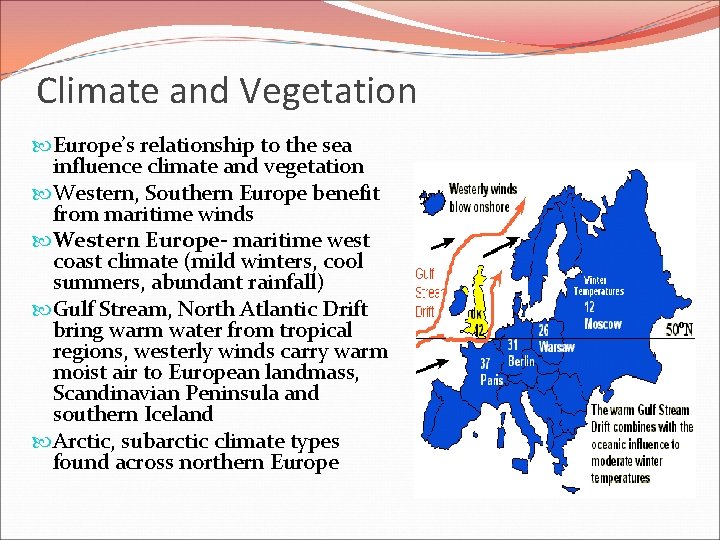
Climate and Vegetation Europe’s relationship to the sea influence climate and vegetation Western, Southern Europe benefit from maritime winds Western Europe- maritime west coast climate (mild winters, cool summers, abundant rainfall) Gulf Stream, North Atlantic Drift bring warm water from tropical regions, westerly winds carry warm moist air to European landmass, Scandinavian Peninsula and southern Iceland Arctic, subarctic climate types found across northern Europe
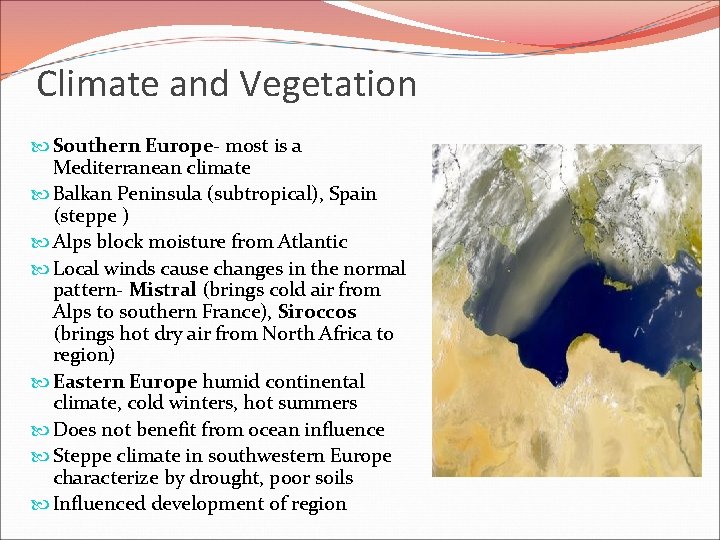
Climate and Vegetation Southern Europe- most is a Mediterranean climate Balkan Peninsula (subtropical), Spain (steppe ) Alps block moisture from Atlantic Local winds cause changes in the normal pattern- Mistral (brings cold air from Alps to southern France), Siroccos (brings hot dry air from North Africa to region) Eastern Europe humid continental climate, cold winters, hot summers Does not benefit from ocean influence Steppe climate in southwestern Europe characterize by drought, poor soils Influenced development of region
Cultural Geography of Europe
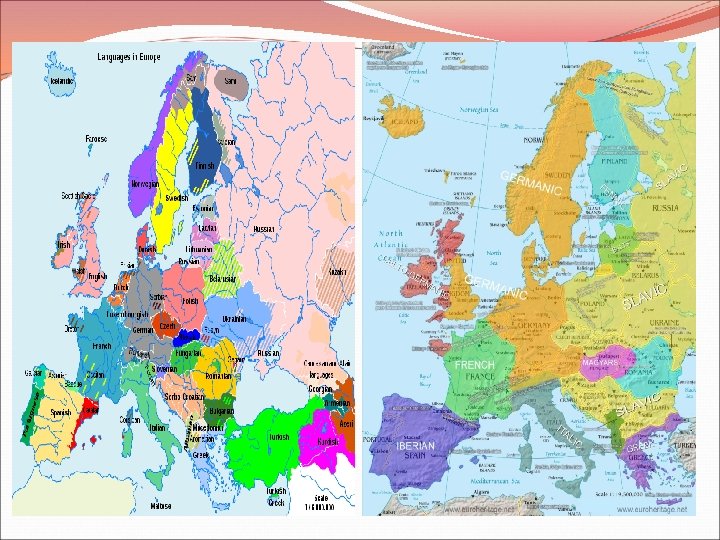
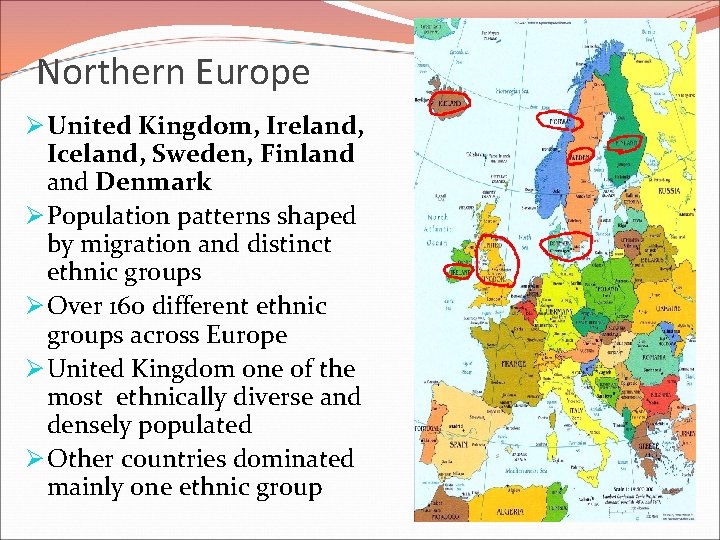
Northern Europe Ø United Kingdom, Ireland, Iceland, Sweden, Finland Denmark Ø Population patterns shaped by migration and distinct ethnic groups Ø Over 160 different ethnic groups across Europe Ø United Kingdom one of the most ethnically diverse and densely populated Ø Other countries dominated mainly one ethnic group
Northern Europe UK has been conquered by different groups for thousands of years Recently welcomed immigrants from across former British Empire Scandinavian countries have less diversity Ireland, UK have temperate climates and fertile soil that have supported a large population Internal and external migration has affected the region Internal migration has brought people to urban areas for opportunity Major cities and economic centers and capitals - London, England; Stockholm, Sweden; Copenhagen, Denmark
Northern Europe Mid 1700’s Industrial Revolution A. Began in England, transformed manufacturing in Europe and across the world B. Transportation, communication developed C. Rise of Industrial capitalism (profits used to expand companies) D. Rise of middle class, rise of material comforts Factory workers- poor, lived in crowded slums Social problems led to ideas of communism Idea based on economic equality, workers control factories and industrial production By end of 1800’s many gov’ts began to pass laws to improve workers lives
Northern Europe Since the end of World War II northern European countries have built stable democracies and strong economies All northern European countries are members of the European Union Languages all have Indo-European language Most countries are Protestant and allow religious freedom School is mandatory for at least 10 years and literacy rates are around 100% Countries offer complete social welfare to citizens Welfare States- tax supported programs for higher education, health care, social security Large portions of national budget spent to provide services Because of recent economic pressures governments have had to limit services
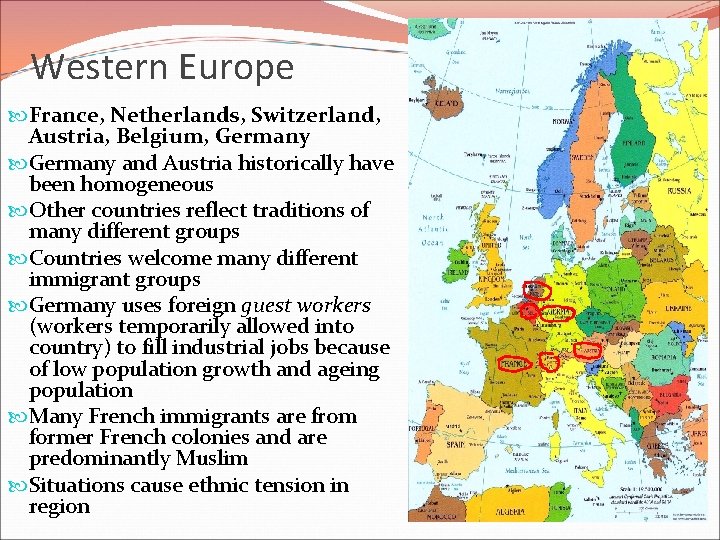
Western Europe France, Netherlands, Switzerland, Austria, Belgium, Germany and Austria historically have been homogeneous Other countries reflect traditions of many different groups Countries welcome many different immigrant groups Germany uses foreign guest workers (workers temporarily allowed into country) to fill industrial jobs because of low population growth and ageing population Many French immigrants are from former French colonies and are predominantly Muslim Situations cause ethnic tension in region
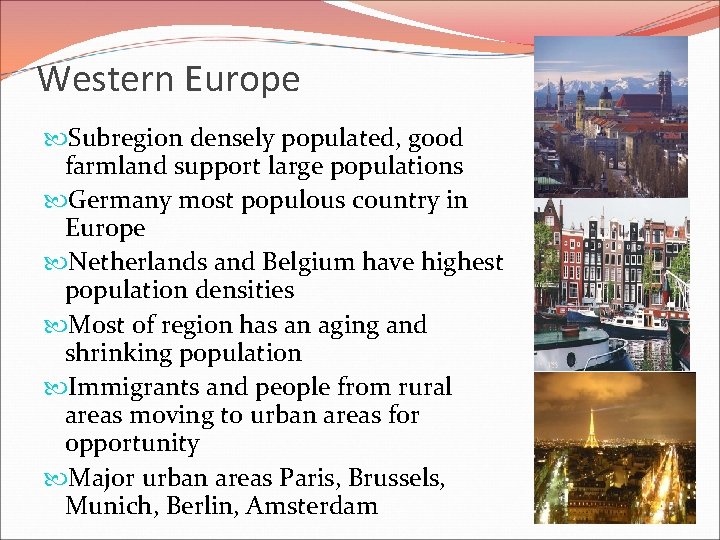
Western Europe Subregion densely populated, good farmland support large populations Germany most populous country in Europe Netherlands and Belgium have highest population densities Most of region has an aging and shrinking population Immigrants and people from rural areas moving to urban areas for opportunity Major urban areas Paris, Brussels, Munich, Berlin, Amsterdam
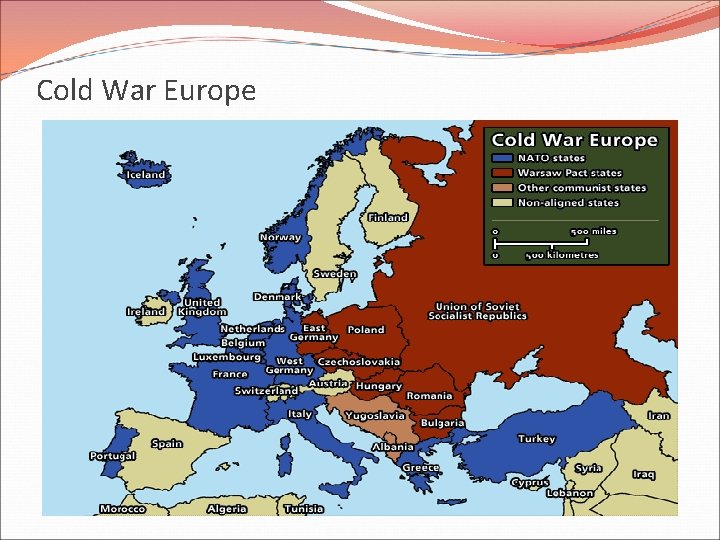
Western Europe Subregion part of Roman, Empire, Holy Roman Empire and place where Protestant Reformation began France, Prussia (modern Germany and Poland) were once major European powers Countries suffered heavily during two World Wars End of WW II left Europe divided, ruined Eastern Europe came under Communist control (USSR) Most of Western Europe helped by aid from the US Struggle between non- communist world and communist world –Cold War Germany at center of tensions After WWII Germany divided for almost 50 years West Germany was democratic, East Germany was communist (reunited 1991) West Germany prospered at this time by becoming a member of the EU and a player in the world economy Economic development lags behind in the former East Germany
Cold War Europe
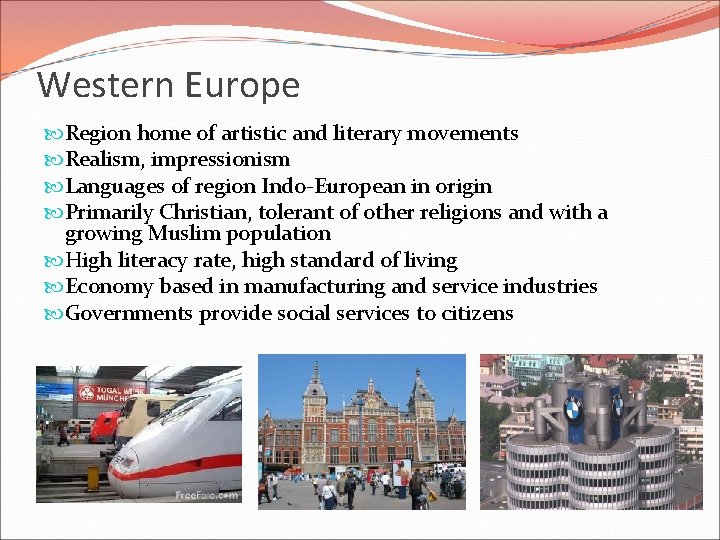
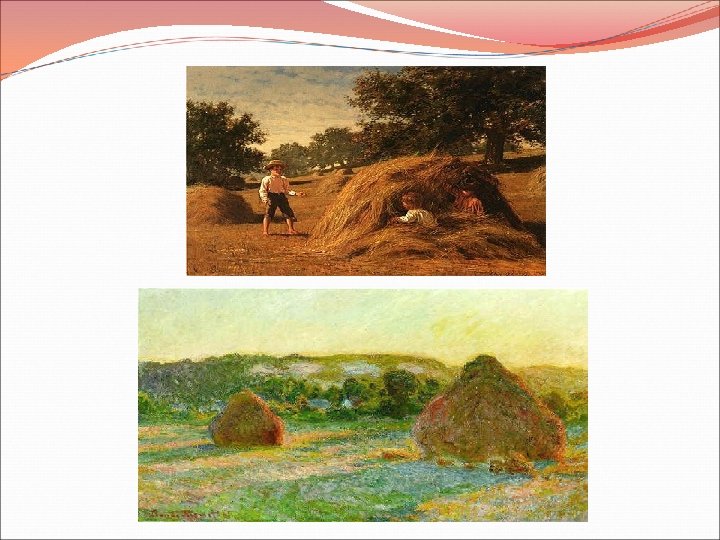
Western Europe Region home of artistic and literary movements Realism, impressionism Languages of region Indo-European in origin Primarily Christian, tolerant of other religions and with a growing Muslim population High literacy rate, high standard of living Economy based in manufacturing and service industries Governments provide social services to citizens
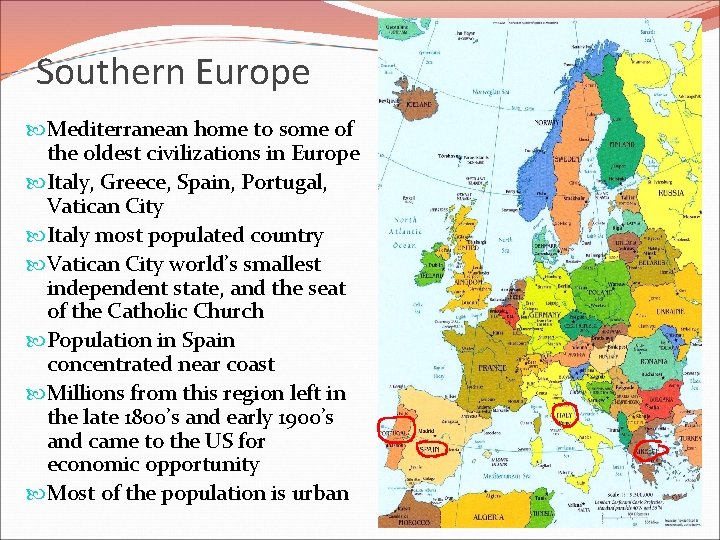
Southern Europe Mediterranean home to some of the oldest civilizations in Europe Italy, Greece, Spain, Portugal, Vatican City Italy most populated country Vatican City world’s smallest independent state, and the seat of the Catholic Church Population in Spain concentrated near coast Millions from this region left in the late 1800’s and early 1900’s and came to the US for economic opportunity Most of the population is urban
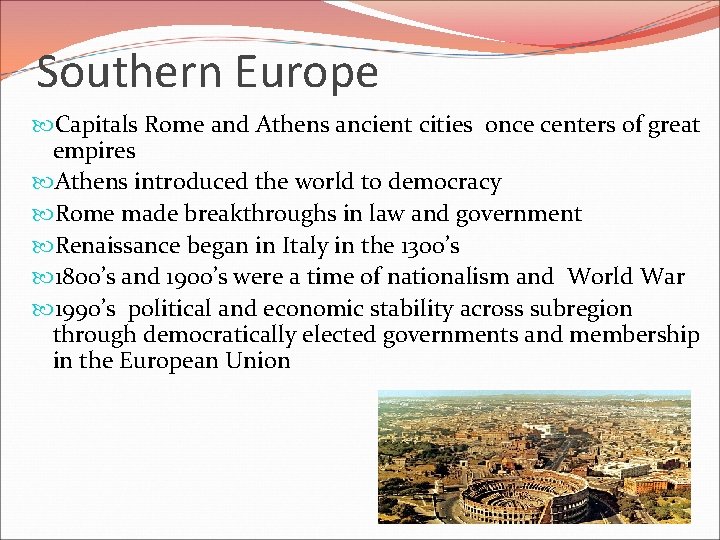
Southern Europe Capitals Rome and Athens ancient cities once centers of great empires Athens introduced the world to democracy Rome made breakthroughs in law and government Renaissance began in Italy in the 1300’s 1800’s and 1900’s were a time of nationalism and World War 1990’s political and economic stability across subregion through democratically elected governments and membership in the European Union
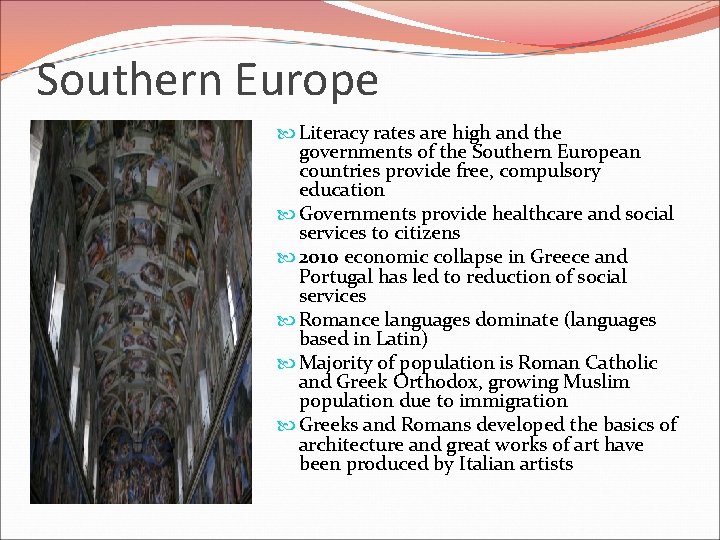
Southern Europe Literacy rates are high and the governments of the Southern European countries provide free, compulsory education Governments provide healthcare and social services to citizens 2010 economic collapse in Greece and Portugal has led to reduction of social services Romance languages dominate (languages based in Latin) Majority of population is Roman Catholic and Greek Orthodox, growing Muslim population due to immigration Greeks and Romans developed the basics of architecture and great works of art have been produced by Italian artists
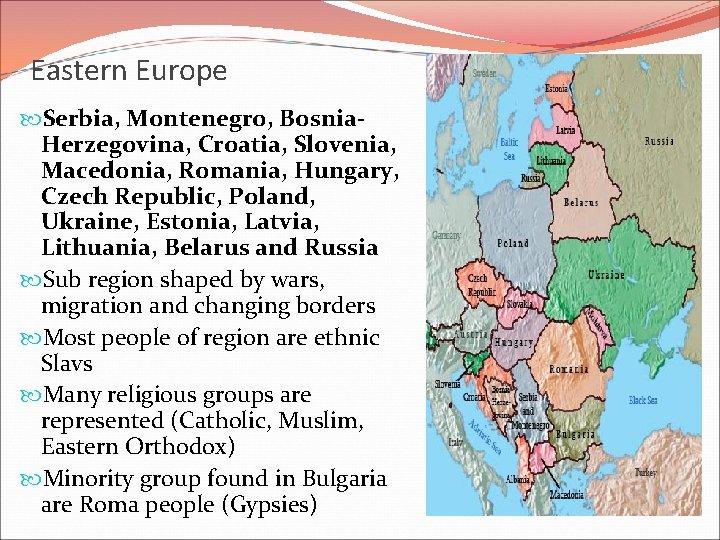
Eastern Europe Serbia, Montenegro, Bosnia. Herzegovina, Croatia, Slovenia, Macedonia, Romania, Hungary, Czech Republic, Poland, Ukraine, Estonia, Latvia, Lithuania, Belarus and Russia Sub region shaped by wars, migration and changing borders Most people of region are ethnic Slavs Many religious groups are represented (Catholic, Muslim, Eastern Orthodox) Minority group found in Bulgaria are Roma people (Gypsies)
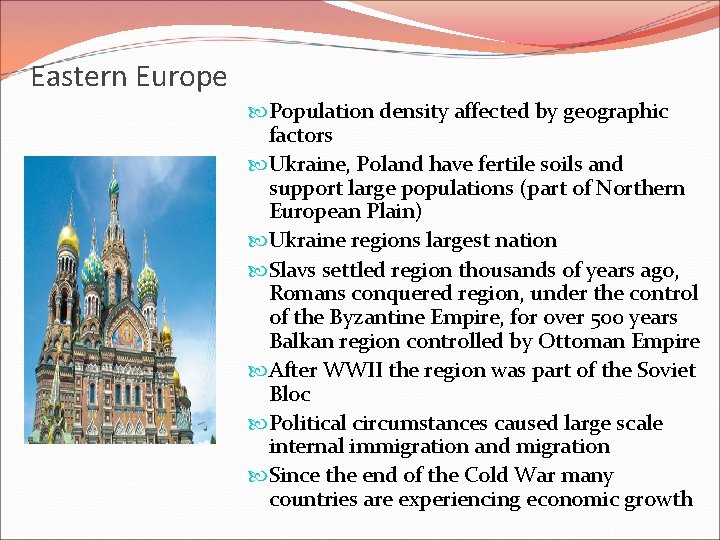
Eastern Europe Population density affected by geographic factors Ukraine, Poland have fertile soils and support large populations (part of Northern European Plain) Ukraine regions largest nation Slavs settled region thousands of years ago, Romans conquered region, under the control of the Byzantine Empire, for over 500 years Balkan region controlled by Ottoman Empire After WWII the region was part of the Soviet Bloc Political circumstances caused large scale internal immigration and migration Since the end of the Cold War many countries are experiencing economic growth
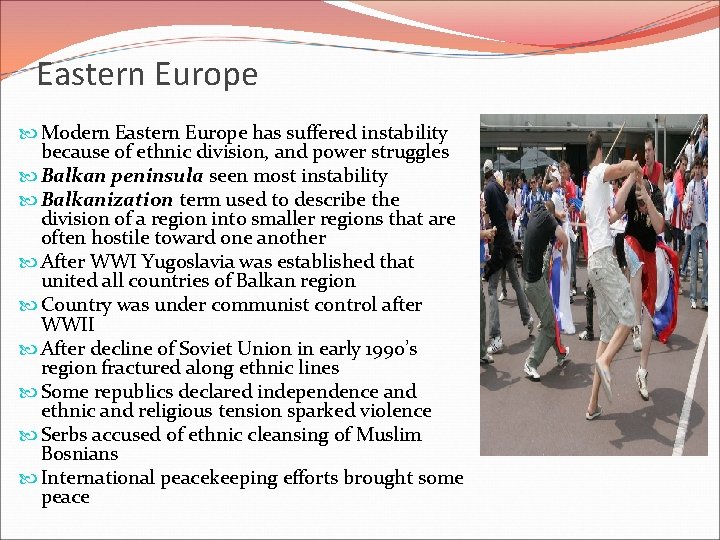
Eastern Europe Modern Eastern Europe has suffered instability because of ethnic division, and power struggles Balkan peninsula seen most instability Balkanization term used to describe the division of a region into smaller regions that are often hostile toward one another After WWI Yugoslavia was established that united all countries of Balkan region Country was under communist control after WWII After decline of Soviet Union in early 1990’s region fractured along ethnic lines Some republics declared independence and ethnic and religious tension sparked violence Serbs accused of ethnic cleansing of Muslim Bosnians International peacekeeping efforts brought some peace
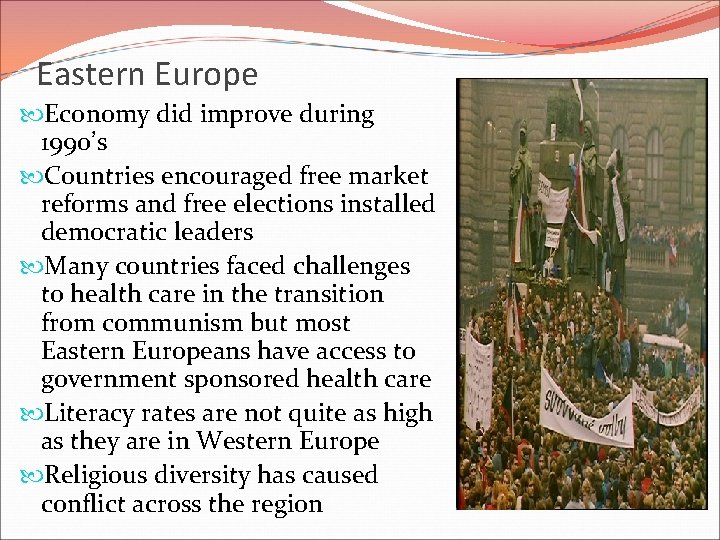
Eastern Europe Economy did improve during 1990’s Countries encouraged free market reforms and free elections installed democratic leaders Many countries faced challenges to health care in the transition from communism but most Eastern Europeans have access to government sponsored health care Literacy rates are not quite as high as they are in Western Europe Religious diversity has caused conflict across the region
Europe The Region Today
The Economy Industrial Revolution made Europe birthplace of modern industry Availability of raw materials helped develop industry in parts of Europe Major industrial centers of Ruhr district in Germany, Po Basin in Italy and the Upper Silesia district in the Czech Republic and Poland Service industry provides a large percentage of the GDP (Gross domestic product, the value of goods and services produced by a country in a year) across Europe 60% of workers in service industry Banking and finance, high tech industries and tourism, leading service sector industries
The Economy Europe has fertile farmland Numbers involved in farming is dropping Crops vary across Europe Farmers use advanced techniques to make best use of limited space Mixed farming common- several crops and livestock on one farm Farm cooperatives- farmers share growing and selling products, reduces costs, increases profits Under communism collective farms, government owned farms, workers received wages and a share of products Out dated equipment, lack of incentive resulted in low yields Debate over new farming methods from genetically modified foods to organic practices Government subsidies for agriculture an issue Many think it causes overproduction and artificial price protection
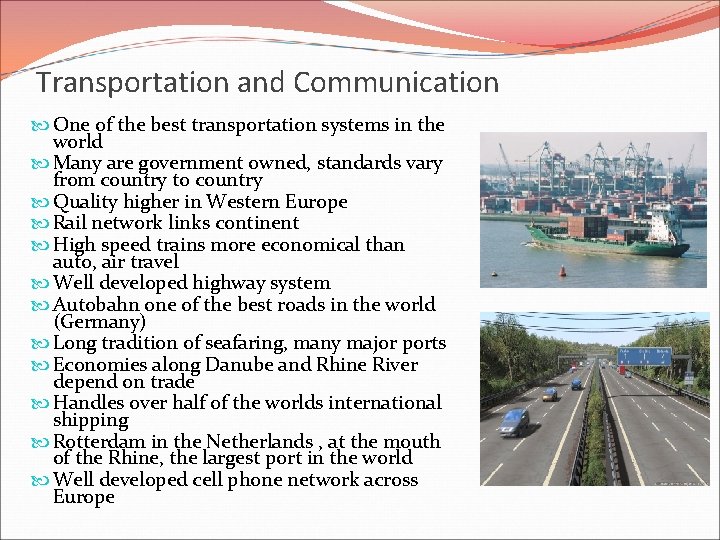
Transportation and Communication One of the best transportation systems in the world Many are government owned, standards vary from country to country Quality higher in Western Europe Rail network links continent High speed trains more economical than auto, air travel Well developed highway system Autobahn one of the best roads in the world (Germany) Long tradition of seafaring, many major ports Economies along Danube and Rhine River depend on trade Handles over half of the worlds international shipping Rotterdam in the Netherlands , at the mouth of the Rhine, the largest port in the world Well developed cell phone network across Europe
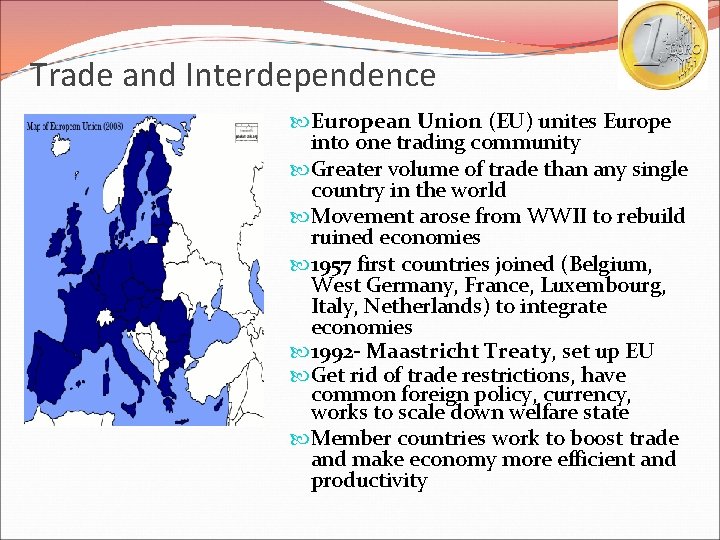
Trade and Interdependence European Union (EU) unites Europe into one trading community Greater volume of trade than any single country in the world Movement arose from WWII to rebuild ruined economies 1957 first countries joined (Belgium, West Germany, France, Luxembourg, Italy, Netherlands) to integrate economies 1992 - Maastricht Treaty, set up EU Get rid of trade restrictions, have common foreign policy, currency, works to scale down welfare state Member countries work to boost trade and make economy more efficient and productivity
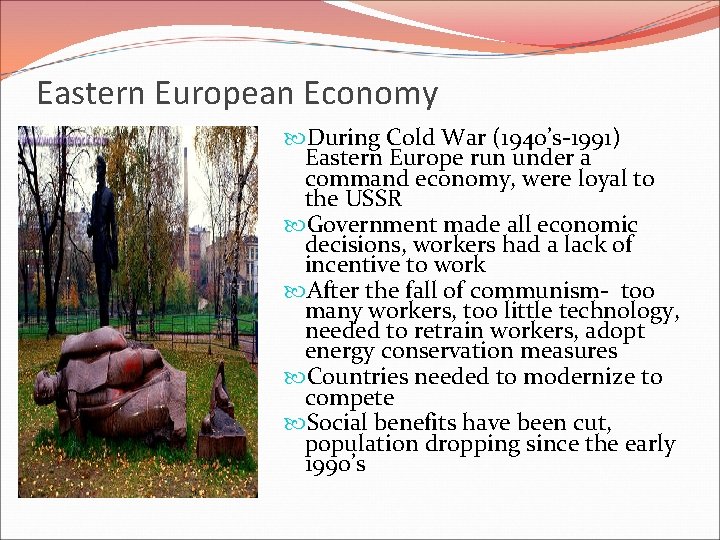
Eastern European Economy During Cold War (1940’s-1991) Eastern Europe run under a command economy, were loyal to the USSR Government made all economic decisions, workers had a lack of incentive to work After the fall of communism- too many workers, too little technology, needed to retrain workers, adopt energy conservation measures Countries needed to modernize to compete Social benefits have been cut, population dropping since the early 1990’s
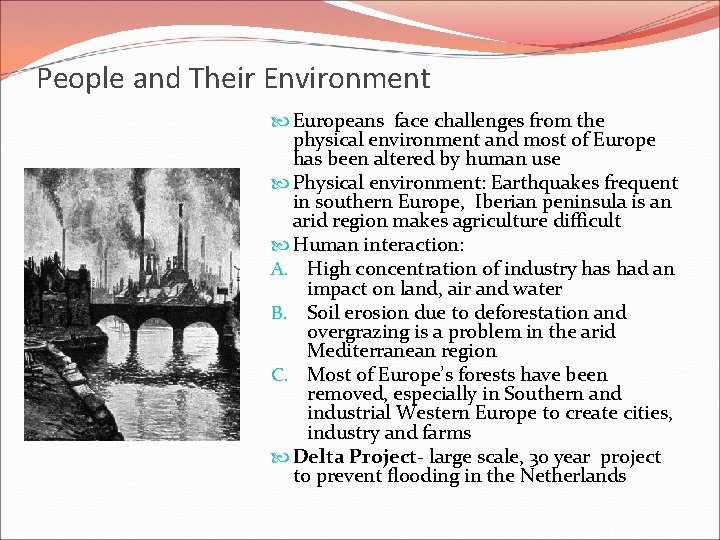
People and Their Environment Europeans face challenges from the physical environment and most of Europe has been altered by human use Physical environment: Earthquakes frequent in southern Europe, Iberian peninsula is an arid region makes agriculture difficult Human interaction: A. High concentration of industry has had an impact on land, air and water B. Soil erosion due to deforestation and overgrazing is a problem in the arid Mediterranean region C. Most of Europe’s forests have been removed, especially in Southern and industrial Western Europe to create cities, industry and farms Delta Project- large scale, 30 year project to prevent flooding in the Netherlands
Water Pollution Agricultural , industrial runoff problems across Europe Industrial pollution, raw sewage and agricultural runoff have harmed river systems Destroyed fish species, contaminated ecosystems Biggest concern along Mediterranean Recent times many have moved near the sea, tourism popular, has caused an increase in environmental problems Used for transportation, recreation also a dumping ground for waste, sewage, industrial waste Small tides, weak currents do not disperse pollution
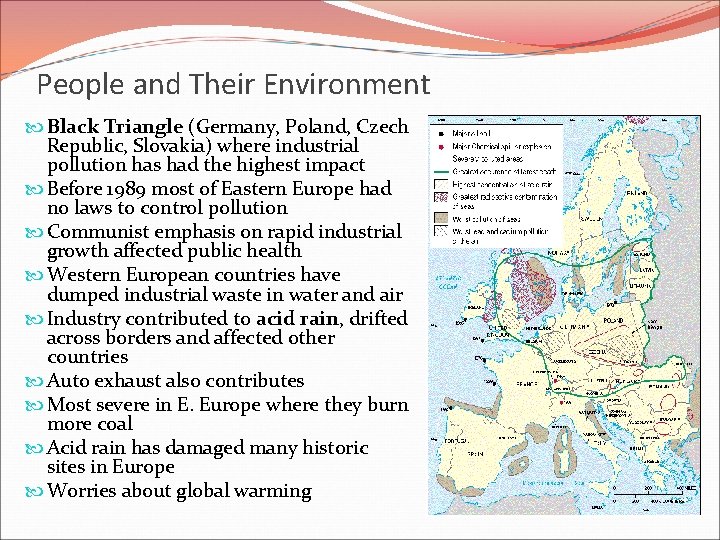
People and Their Environment Black Triangle (Germany, Poland, Czech Republic, Slovakia) where industrial pollution has had the highest impact Before 1989 most of Eastern Europe had no laws to control pollution Communist emphasis on rapid industrial growth affected public health Western European countries have dumped industrial waste in water and air Industry contributed to acid rain, drifted across borders and affected other countries Auto exhaust also contributes Most severe in E. Europe where they burn more coal Acid rain has damaged many historic sites in Europe Worries about global warming
People and their Environment Many European governments have made an effort to clean up the environment EU requires environmental protection and cleanup from its members EU members face legal actions for not following environmental protection laws Countries wishing to join the EU are required to meet environmental standards Many Western European countries and the US are providing technology and investment to clean up the environment Financing and cleanup is expensive and difficult because of the number of countries involved Many European countries are using alternative energy resources