
Europe in the International Economy 1500 1800 Interpretation
- Slides: 18
Europe in the International Economy 1500 - 1800 Interpretation of European Success Europe in World Economy 2015
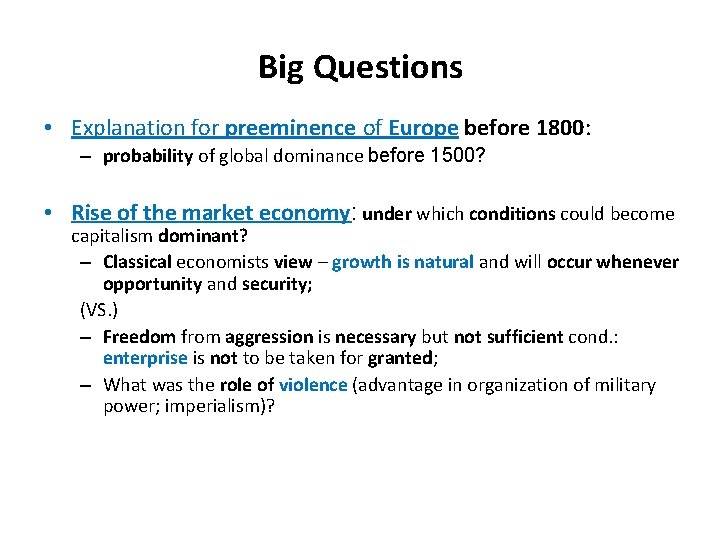
Big Questions • Explanation for preeminence of Europe before 1800: – probability of global dominance before 1500? • Rise of the market economy: under which conditions could become capitalism dominant? – Classical economists view – growth is natural and will occur whenever opportunity and security; (VS. ) – Freedom from aggression is necessary but not sufficient cond. : enterprise is not to be taken for granted; – What was the role of violence (advantage in organization of military power; imperialism)?
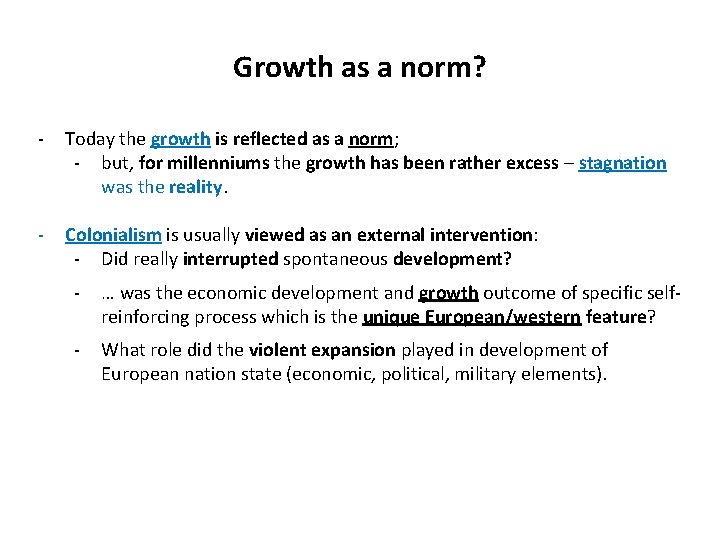
Growth as a norm? - Today the growth is reflected as a norm; - but, for millenniums the growth has been rather excess – stagnation was the reality. - Colonialism is usually viewed as an external intervention: - Did really interrupted spontaneous development? - … was the economic development and growth outcome of specific selfreinforcing process which is the unique European/western feature? - What role did the violent expansion played in development of European nation state (economic, political, military elements).
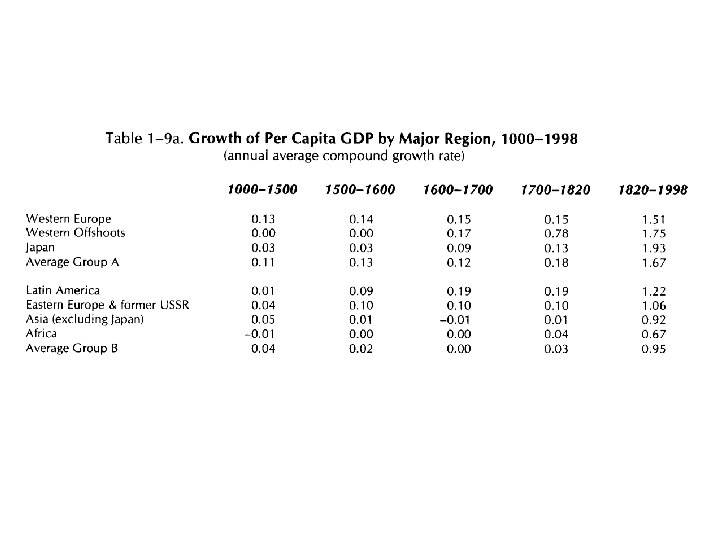
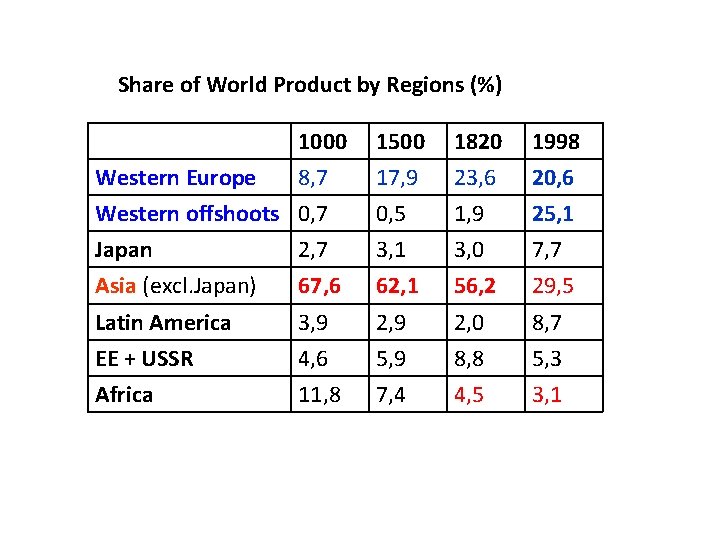
Share of World Product by Regions (%) 1000 1500 1820 1998 8, 7 17, 9 23, 6 20, 6 Western offshoots 0, 7 0, 5 1, 9 25, 1 Japan 2, 7 3, 1 3, 0 7, 7 Asia (excl. Japan) 67, 6 62, 1 56, 2 29, 5 Latin America 3, 9 2, 0 8, 7 EE + USSR 4, 6 5, 9 8, 8 5, 3 Africa 11, 8 7, 4 4, 5 3, 1 Western Europe
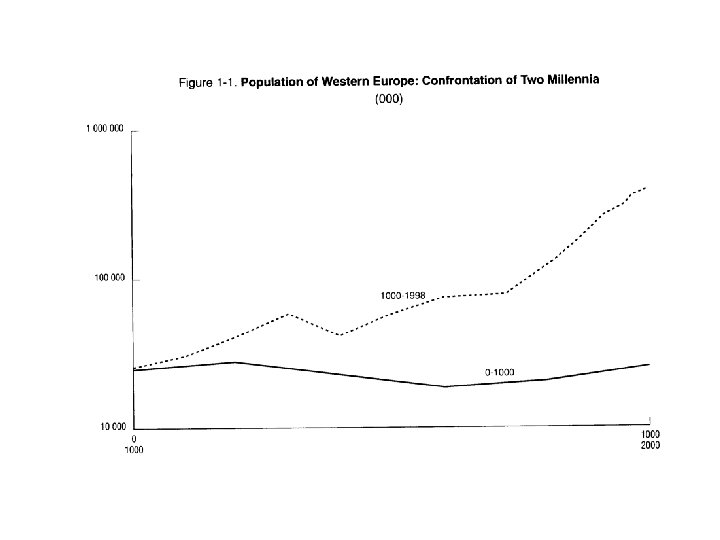
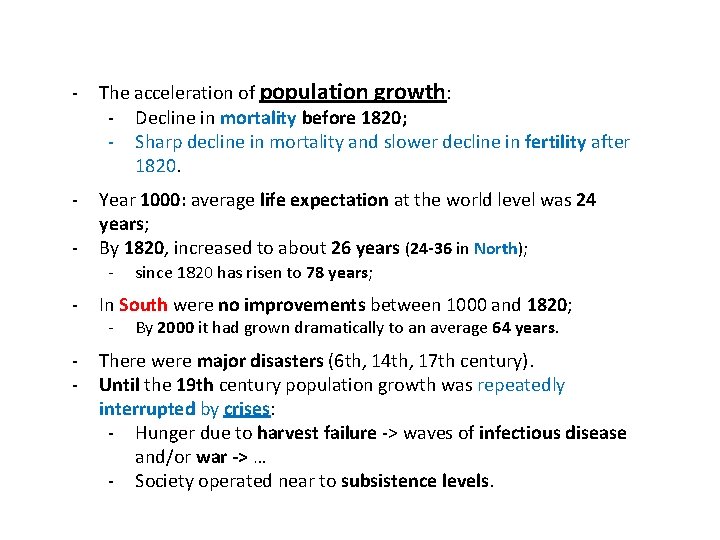
- The acceleration of population growth: - Decline in mortality before 1820; - Sharp decline in mortality and slower decline in fertility after 1820. - Year 1000: average life expectation at the world level was 24 years; By 1820, increased to about 26 years (24 -36 in North); - - since 1820 has risen to 78 years; - In South were no improvements between 1000 and 1820; - There were major disasters (6 th, 14 th, 17 th century). Until the 19 th century population growth was repeatedly interrupted by crises: - Hunger due to harvest failure -> waves of infectious disease and/or war -> … - Society operated near to subsistence levels. - By 2000 it had grown dramatically to an average 64 years.
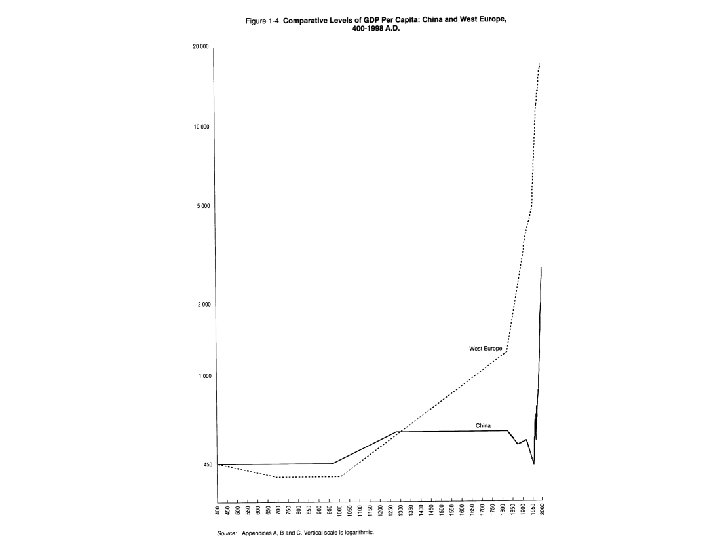
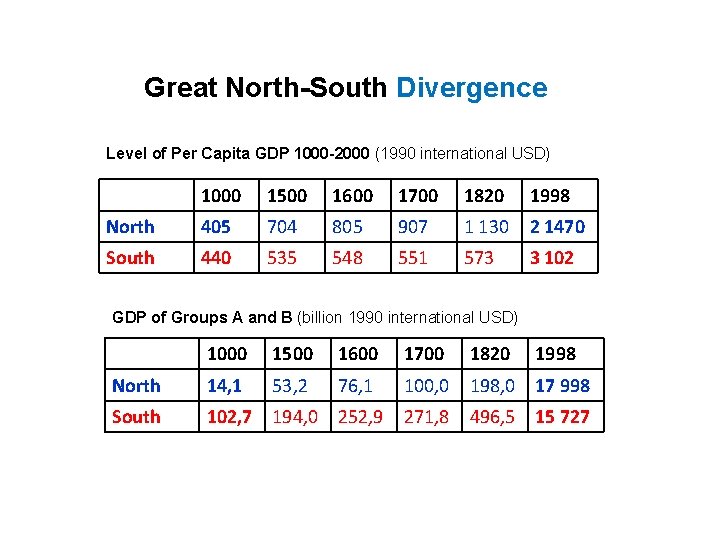
Great North-South Divergence Level of Per Capita GDP 1000 -2000 (1990 international USD) 1000 1500 1600 1700 1820 1998 North 405 704 805 907 1 130 2 1470 South 440 535 548 551 573 3 102 GDP of Groups A and B (billion 1990 international USD) 1000 1500 1600 1700 1820 1998 North 14, 1 53, 2 76, 1 100, 0 198, 0 17 998 South 102, 7 194, 0 252, 9 271, 8 496, 5 15 727
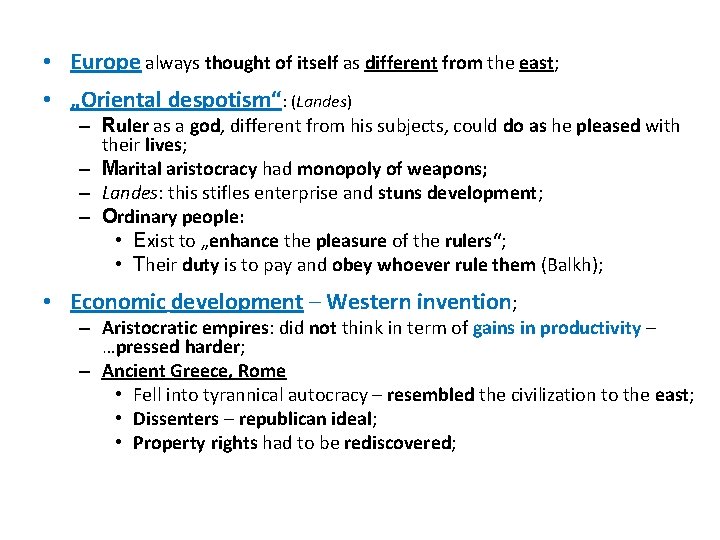
• Europe always thought of itself as different from the east; • „Oriental despotism“: (Landes) – Ruler as a god, different from his subjects, could do as he pleased with their lives; – Marital aristocracy had monopoly of weapons; – Landes: this stifles enterprise and stuns development; – Ordinary people: • Exist to „enhance the pleasure of the rulers“; • Their duty is to pay and obey whoever rule them (Balkh); • Economic development – Western invention; – Aristocratic empires: did not think in term of gains in productivity – …pressed harder; – Ancient Greece, Rome • Fell into tyrannical autocracy – resembled the civilization to the east; • Dissenters – republican ideal; • Property rights had to be rediscovered;
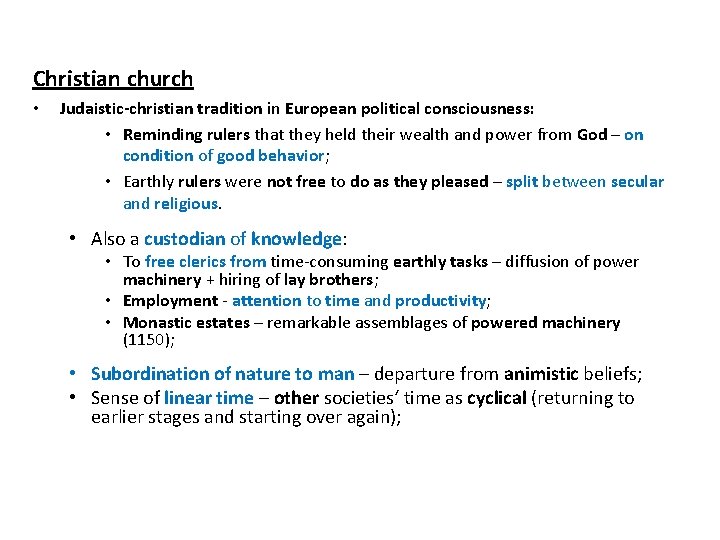
Christian church • Judaistic-christian tradition in European political consciousness: • Reminding rulers that they held their wealth and power from God – on condition of good behavior; • Earthly rulers were not free to do as they pleased – split between secular and religious. • Also a custodian of knowledge: • To free clerics from time-consuming earthly tasks – diffusion of power machinery + hiring of lay brothers; • Employment - attention to time and productivity; • Monastic estates – remarkable assemblages of powered machinery (1150); • Subordination of nature to man – departure from animistic beliefs; • Sense of linear time – other societies‘ time as cyclical (returning to earlier stages and starting over again);
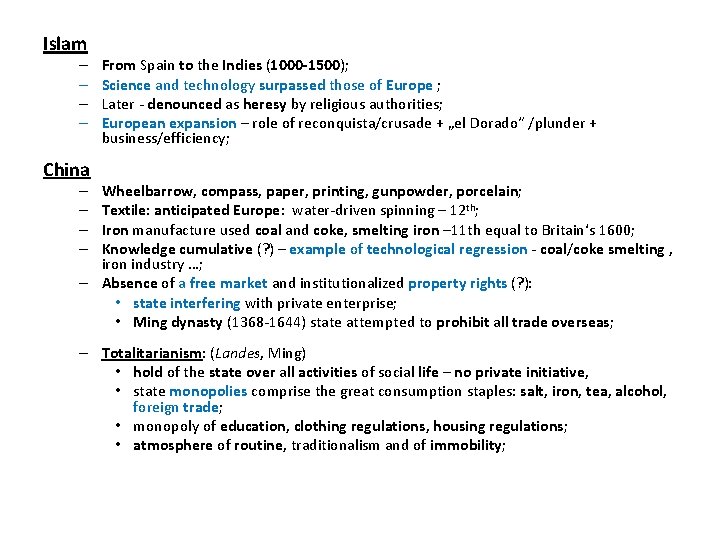
Islam – – From Spain to the Indies (1000 -1500); Science and technology surpassed those of Europe ; Later - denounced as heresy by religious authorities; European expansion – role of reconquista/crusade + „el Dorado“ /plunder + business/efficiency; China Wheelbarrow, compass, paper, printing, gunpowder, porcelain; Textile: anticipated Europe: water-driven spinning – 12 th; Iron manufacture used coal and coke, smelting iron – 11 th equal to Britain‘s 1600; Knowledge cumulative (? ) – example of technological regression - coal/coke smelting , iron industry …; – Absence of a free market and institutionalized property rights (? ): • state interfering with private enterprise; • Ming dynasty (1368 -1644) state attempted to prohibit all trade overseas; – – – Totalitarianism: (Landes, Ming) • hold of the state over all activities of social life – no private initiative, • state monopolies comprise the great consumption staples: salt, iron, tea, alcohol, foreign trade; • monopoly of education, clothing regulations, housing regulations; • atmosphere of routine, traditionalism and of immobility;
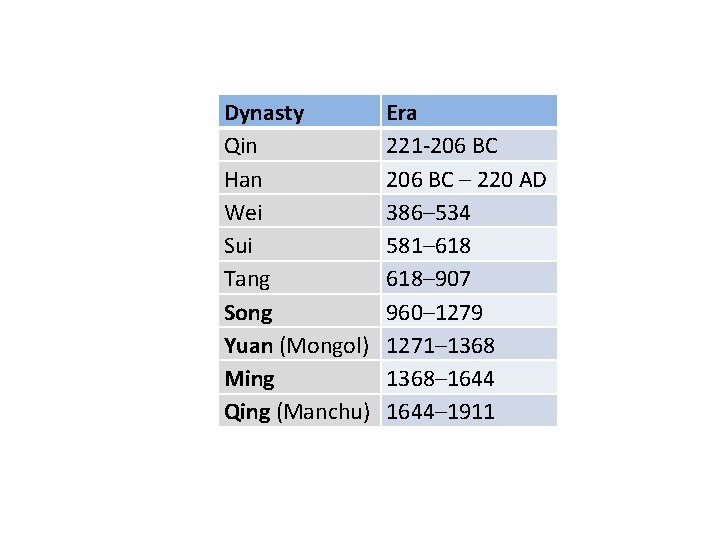
Dynasty Qin Han Wei Sui Tang Song Yuan (Mongol) Ming Qing (Manchu) Era 221 -206 BC – 220 AD 386– 534 581– 618– 907 960– 1279 1271– 1368– 1644– 1911
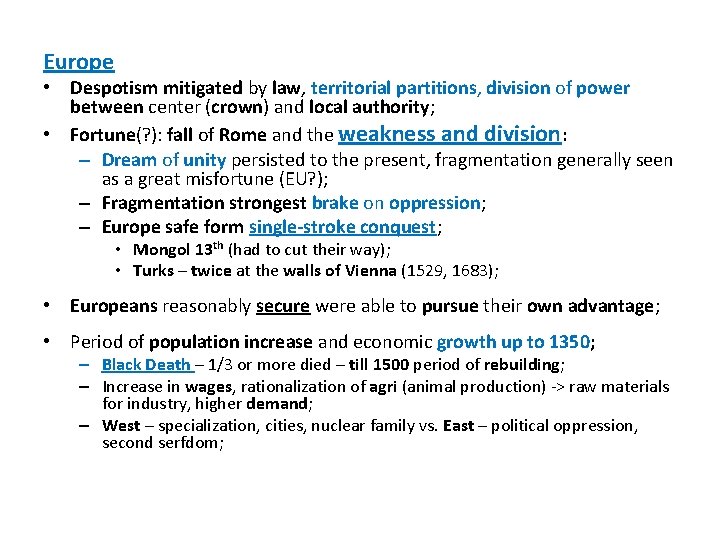
Europe • Despotism mitigated by law, territorial partitions, division of power between center (crown) and local authority; • Fortune(? ): fall of Rome and the weakness and division: – Dream of unity persisted to the present, fragmentation generally seen as a great misfortune (EU? ); – Fragmentation strongest brake on oppression; – Europe safe form single-stroke conquest; • Mongol 13 th (had to cut their way); • Turks – twice at the walls of Vienna (1529, 1683); • Europeans reasonably secure were able to pursue their own advantage; • Period of population increase and economic growth up to 1350; – Black Death – 1/3 or more died – till 1500 period of rebuilding; – Increase in wages, rationalization of agri (animal production) -> raw materials for industry, higher demand; – West – specialization, cities, nuclear family vs. East – political oppression, second serfdom;
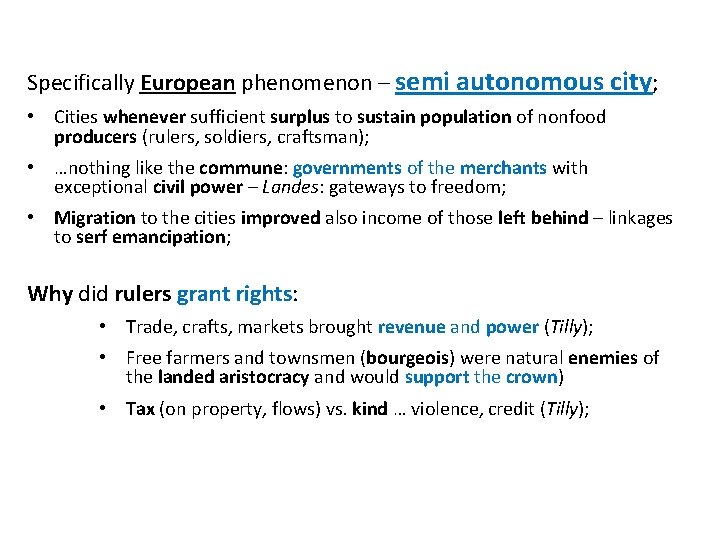
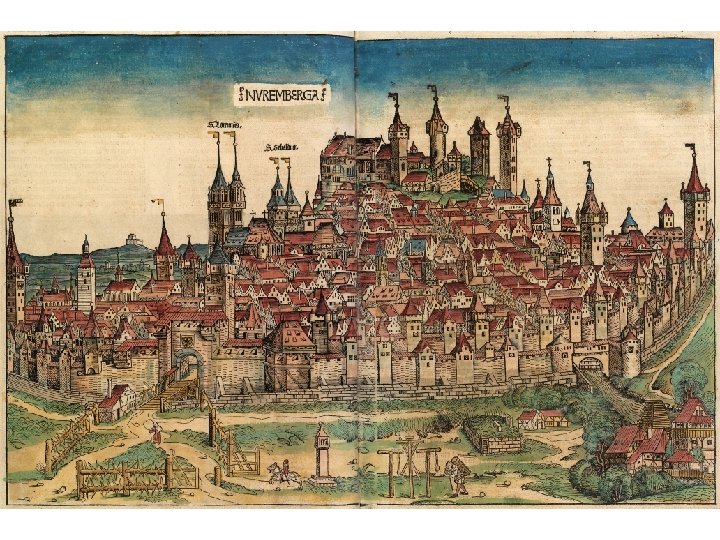
Specifically European phenomenon – semi autonomous city; • Cities whenever sufficient surplus to sustain population of nonfood producers (rulers, soldiers, craftsman); • …nothing like the commune: governments of the merchants with exceptional civil power – Landes: gateways to freedom; • Migration to the cities improved also income of those left behind – linkages to serf emancipation; Why did rulers grant rights: • Trade, crafts, markets brought revenue and power (Tilly); • Free farmers and townsmen (bourgeois) were natural enemies of the landed aristocracy and would support the crown) • Tax (on property, flows) vs. kind … violence, credit (Tilly);
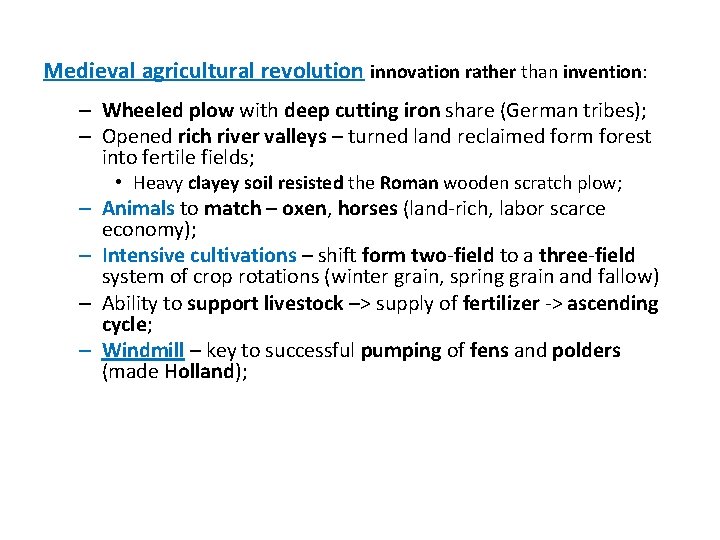
Medieval agricultural revolution innovation rather than invention: – Wheeled plow with deep cutting iron share (German tribes); – Opened rich river valleys – turned land reclaimed form forest into fertile fields; • Heavy clayey soil resisted the Roman wooden scratch plow; – Animals to match – oxen, horses (land-rich, labor scarce economy); – Intensive cultivations – shift form two-field to a three-field system of crop rotations (winter grain, spring grain and fallow) – Ability to support livestock –> supply of fertilizer -> ascending cycle; – Windmill – key to successful pumping of fens and polders (made Holland);